
Can your vessel’s operational budget survive a 72-hour customs delay for a single critical engine component? When you’re managing a transit through the Panama Canal, the margin for error is nonexistent. You understand that sourcing engine spare parts in Panama involves much more than just a purchase order. It requires precise coordination of logistics, 7% ITBM tax compliance, and immediate technical availability at Balboa or Cristobal. We recognize the pressure of a ticking clock and the high cost of a missed slot.
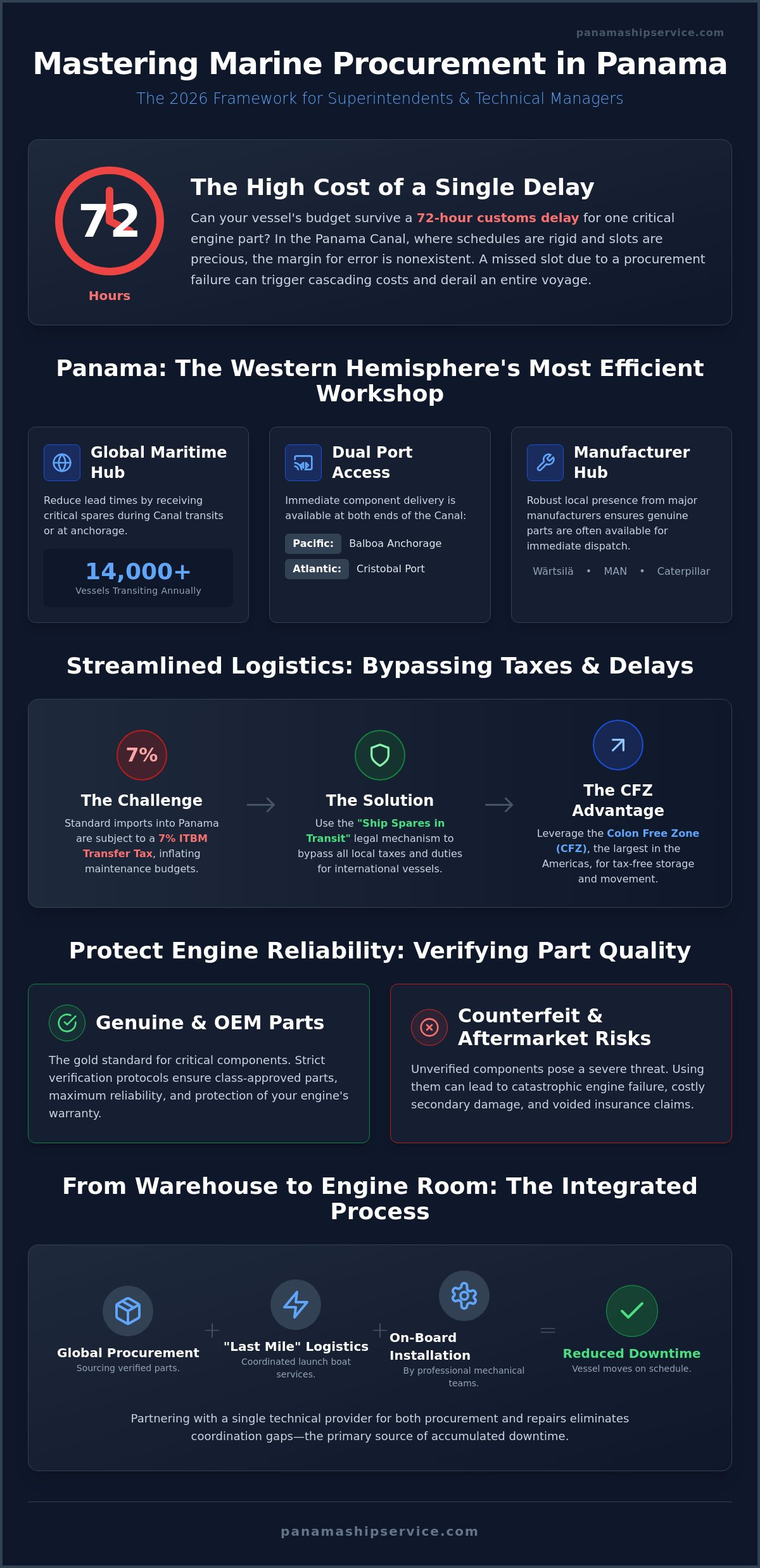
This guide provides the definitive 2026 framework for superintendents to master marine procurement and delivery. You’ll learn how to leverage the Colon Free Zone to eliminate unnecessary overhead and ensure your vessel receives class-approved parts without the typical bureaucratic friction. We preview the essential steps for integrating parts sourcing with professional mechanical installation. This approach allows you to bypass local technical uncertainty and keep your fleet moving on schedule.
Key Takeaways
- Leverage Panama’s status as a global maritime hub to reduce lead times by receiving critical spares during Canal transits or at anchorage.
- Navigate the Colon Free Zone (CFZ) to facilitate tax-free movement and storage, streamlining the process of sourcing engine spare parts in Panama.
- Protect engine reliability by implementing strict verification protocols for Genuine and OEM components to eliminate the risks of counterfeit parts.
- Optimize “last mile” logistics by coordinating launch boat services with mechanical teams to ensure immediate on-board installation upon delivery.
- Reduce vessel downtime by partnering with a single technical provider capable of managing both global procurement and complex mechanical repairs.
The Strategic Advantage of Sourcing Engine Spares in Panama
Panama is more than a geographical shortcut; it’s the most efficient workshop in the Western Hemisphere. With over 14,000 vessels transiting the Canal annually, the maritime infrastructure has evolved to meet extreme technical demands. Sourcing engine spare parts in Panama provides a decisive edge for superintendents who can’t afford the logistical lag of shipping from European or Asian hubs. By utilizing local inventory, technical managers drastically reduce lead times for critical components, ensuring that a minor mechanical failure doesn’t escalate into a missed schedule.
The proximity of the ports is a primary advantage. Whether your vessel is positioned at the Balboa anchorage on the Pacific side or Cristobal on the Atlantic side, the delivery window remains open. This strategic placement allows for the transfer of heavy components like cylinder liners or fuel pumps during the transit process itself or while the vessel waits for its slot. Major manufacturers, including Wärtsilä, MAN Energy Solutions, and Caterpillar, have established a robust presence here. This ensures that genuine parts are often available for immediate dispatch rather than being subject to transcontinental freight delays.
Procurement is only effective when paired with execution. Integrating your supply chain with professional mechanical ship repairs ensures that once the components arrive on board, they’re fitted by technicians who understand the specific pressures of Canal operations. This one-stop approach eliminates the coordination gap between the supplier and the repair crew, which is often where vessel downtime accumulates.
Minimizing Transit Delays
The Panama Canal Authority (ACP) operates on a rigid scheduling system. A delay in receiving a critical engine store can result in the loss of a transit slot, leading to cascading costs and missed arrival windows at the next port. Sourcing engine spare parts in Panama locally acts as a safeguard. Local agents and technical providers operate with a sense of urgency, providing 24/7 coordination to ensure parts reach the vessel before the pilot boards. This rapid response is vital during emergency mechanical failures where every hour of idleness impacts the bottom line.
Regional Logistics Hub Capabilities
Panama’s role as a transshipment center is supported by a sophisticated network of ports and railways. Panama’s transportation infrastructure facilitates the movement of goods across the entire Latin American region, making it a natural warehouse for high-rotation engine stores. The logistics sector is expanding rapidly; the Colon Free Zone alone saw a 13.3% growth in economic activity during the first quarter of 2025, reflecting the increasing volume of maritime trade passing through the region. Urgent imports that aren’t available in local stock can be funneled through Tocumen International Airport, which offers high-frequency airfreight connections. This multi-modal capability ensures that even the most specialized components reach the engine room with minimal friction.
Navigating Panama Logistics: Free Zones and Customs
Taxes and duties can inflate a vessel’s maintenance budget by nearly 10% if not managed correctly. Panama’s Free Zones provide a vital legal framework that allows for the tax-free storage and movement of ship spares intended for international vessels. While most imports into Panama are subject to a 7% transfer tax (ITBM), engine components destined for a ship in transit can bypass these costs entirely through the “Ship Spares in Transit” mechanism. This status ensures that parts are treated as being in a state of continuous movement, never officially entering the local economy.
The Panama Maritime Authority (AMP) regulates the standards for these services, ensuring that the logistics chain remains secure and compliant with international maritime law. To successfully utilize these tax exemptions, technical managers must work with a licensed Panama ship supplies provider. A licensed partner manages the customs clearance process through the Integrated Customs Management System (SIGA), preventing the administrative bottlenecks that often lead to vessel delays at the Canal. If you require urgent clearance, our team can manage the entire logistics chain from the airport to the engine room.
The Colon Free Zone (CFZ) Advantage
The Colon Free Zone is the largest free trade zone in the Western Hemisphere and serves as the primary hub for marine equipment distribution. When sourcing engine spare parts in Panama, the CFZ offers a logistical advantage that competitors in other regional hubs cannot match. The zone experienced a 13.3% growth in economic activity during the first quarter of 2025, driven by its ability to house massive inventories for major engine manufacturers. This high-density warehousing means parts can move from a shelf in Colon to a vessel in Cristobal or Balboa in hours. Procurement within the CFZ is inherently cost-efficient because it eliminates import duties on high-value components like turbochargers and crankshafts.
Handling Owner’s Spares
Superintendents often need to ship specialized components from global headquarters directly to the vessel. This process requires precise documentation to maintain “In-Transit” status. All shipments must be clearly labeled as “Ship Spares in Transit” and must include the vessel’s name and IMO number on all waybills. Common pitfalls include incorrect CIF value declarations or failing to manifest the spares for the specific port of delivery. Whether your parts arrive via Tocumen International Airport or a transshipment port, they must be met by a local agent who can provide immediate transport to the anchorage. Proper manifesting ensures that the spares are ready for pickup at Balboa or Cristobal the moment the vessel arrives.
Evaluating Quality: Genuine vs. OEM vs. Aftermarket
Engine reliability isn’t a variable you can compromise on when a vessel is committed to a Canal transit. Sourcing engine spare parts in Panama requires more than just finding a match for a part number; it demands a rigorous assessment of the component’s origin and its impact on the ship’s overall performance. While the pressure to reduce maintenance costs is constant, the financial fallout of a mechanical failure within the Canal locks far outweighs the initial savings of a sub-standard part. Technical managers must prioritize components that meet or exceed original manufacturer specifications to maintain operational integrity.
The global supply chain remains vulnerable to counterfeit parts, and Panama’s high-volume transshipment environment is no exception. Verifying local vendors is a critical step in the procurement process. Engaging marine surveys in Panama provides an essential layer of independent verification. A surveyor can inspect the physical condition of high-value spares before they leave the warehouse, ensuring they’re free from defects and fully compliant with international standards. This step is particularly vital for ensuring that all sourced spares come with the necessary Class certificates from bodies such as ABS, DNV, or Lloyd’s Register. Without these certificates, you risk insurance complications and potential detention by port state control.
The Genuine vs. OEM Debate
Superintendents must decide where to allocate their budget based on the criticality of the engine system. Genuine parts, sourced directly from the engine maker, are non-negotiable for systems under warranty or for critical components like fuel injection pumps and main bearings. These parts guarantee 100% compatibility and protection for the vessel’s primary assets. Conversely, OEM parts, produced by the same manufacturers that supply the engine makers, offer a cost-effective alternative for non-critical auxiliaries. For older engine models where the original maker no longer provides support, reputable aftermarket suppliers can bridge the gap, provided the parts are vetted for safety and environmental compliance as per local regulations.
Verification and Certification
A systematic approach to verification prevents costly installation errors. At the warehouse level, visual inspection protocols must include checking for factory seals and protective coatings. Every part number and serial number should be cross-referenced with the vessel’s specific engine manuals to ensure total compatibility. Traceability is the final pillar of quality control. We maintain a clear record of the component’s journey from the manufacturer through the Free Zone logistics chain and finally to the engine room. This documentation isn’t just for your records; it’s a requirement for maintaining the vessel’s class status and ensuring long-term mechanical reliability.
The Last Mile: Delivery and On-Board Installation
Procurement is a desk-based success; delivery is a field-based victory. Once you have successfully navigated the process of sourcing engine spare parts in Panama, the focus shifts to the “last mile.” This is the most volatile phase of the supply chain. Getting a 500kg cylinder liner from a warehouse in the Colon Free Zone to a vessel at the Pacific anchorage requires more than just a truck. It demands a synchronized operation involving launch boats, crane barges, and specialized technical teams who understand the unique geography of the Canal’s entry points.
Most suppliers stop their service at the pier. We bridge that gap by integrating parts procurement with mechanical ship repairs panama. This ensures that the technicians responsible for the installation are the ones receiving the components at the gangway. This integration eliminates the risk of “part mismatch” discoveries that often occur too late, while the vessel is already at anchorage. When handling heavy lifts, we coordinate specialized cranes to manage large engine components like pistons or liners, ensuring a safe and efficient transfer from the supply boat to the engine room hatch.
Coordinating with Canal Operations
The Panama Canal Authority (ACP) operates on a precision timeline that leaves no room for logistical errors. A delivery boat that arrives thirty minutes late can disrupt a vessel’s transit slot, leading to massive financial penalties and cascading schedule delays. We establish direct communication protocols between the ship’s master, the local agent, and the supply boat captain. This coordination is especially critical during emergency scenarios, such as night transits or periods of inclement weather, where visibility and sea states complicate the transfer of heavy stores at Balboa or Cristobal.
Technical Installation Teams
Local mechanical expertise is the final piece of the puzzle. Replacing complex engine components at anchorage requires teams that hold the necessary permits to work within Panama’s territorial waters. Our technical teams don’t just deliver the parts; they execute the replacement and conduct rigorous post-installation testing. This includes monitoring pressure levels and performing sea trials to confirm that the engine is ready for the rigors of the Canal transit. To secure your next delivery and expert installation, contact our mechanical repair department today to review your vessel’s requirements.
Panama Ship Service: Your Integrated Technical Partner
Managing a vessel’s technical needs during a Canal transit shouldn’t involve juggling multiple vendors and logistics providers. Panama Ship Service offers a one-stop-shop approach that integrates procurement with mechanical execution. By delegating the complexity of sourcing engine spare parts in Panama to our team, you ensure that every logistical detail is handled with precision. We don’t just find the part; we manage its journey from the manufacturer through the Free Zone to the engine room, providing a seamless transition that protects your operational schedule.
Our extensive network of global and local suppliers ensures competitive pricing for engine stores while maintaining the highest quality standards. We handle the entire logistical chain, including customs clearance and technical delivery. Every service we provide is aligned with MARPOL compliance and international environmental standards, ensuring your vessel remains in full regulatory standing. This comprehensive oversight reduces the administrative burden on superintendents and technical managers, allowing them to focus on broader fleet operations.
Our Mechanical Expertise
We deploy highly skilled teams capable of handling major engine overhauls and emergency repairs under the most demanding timelines. This mechanical proficiency is reinforced by our integration with underwater hull services, enabling total vessel maintenance during a single anchorage stop. Our technical staff understands the specific pressures of the Panama Canal environment. We have a consistent track record of minimizing downtime for transiting vessels, transforming potential delays into efficient technical interventions.
Streamlined Procurement Process
Efficiency in sourcing engine spare parts in Panama begins with a clear and responsive communication channel. To request a quote, technical managers only need to specify their requirements and part numbers for a rapid technical assessment. We prioritize transparency in every transaction, providing detailed documentation and manufacturer certification for every component sourced. This ensures 100% traceability and compliance with Class requirements. For emergency engine spare parts or immediate mechanical support, our coordination team is available to provide the technical resources necessary to keep your fleet moving.
Securing Operational Continuity at the Panama Canal
Mastering the logistics of the Panama Canal requires a shift from transactional procurement to integrated technical management. Successful superintendents recognize that sourcing engine spare parts in Panama is only effective when paired with local Free Zone expertise and professional on-board installation. By leveraging the Colon Free Zone and the strategic proximity of Balboa and Cristobal, you can eliminate the customs delays and high freight costs that threaten vessel schedules. Reliability depends on the synergy between quality components and expert mechanical execution, a standard also upheld by Compass Marine in their engine repair services.
Panama Ship Service provides the authoritative presence needed to manage these high-stakes requirements. We offer strategic Free Zone logistics access and 24/7 emergency response to ensure your vessel never misses a transit slot. Our Class-approved technical teams handle the entire process from warehouse clearance to final sea trials. Delegate your technical complexity to a partner that understands the urgency of Canal operations. Contact Panama Ship Service for 24/7 Engine Spare Parts Sourcing and Installation to keep your fleet moving with precision and confidence.
Frequently Asked Questions
How long does it take to clear engine spares through customs in Panama?
Customs clearance for engine spares typically takes between 24 and 48 hours when managed by a licensed agent. This timeline is achievable through the Integrated Customs Management System (SIGA), which allows for pre-declaration of “Ship Spares in Transit.” For urgent components arriving via airfreight at Tocumen International Airport, expedited handling can often result in same-day release to the transport team.
Can I ship my own “Owner’s Spares” to Panama for my vessel?
You can ship Owner’s Spares to Panama provided they’re correctly manifested for a vessel in transit. These shipments must be clearly labeled as “Ship Spares in Transit” on all waybills and commercial invoices. It’s essential to include the vessel’s name and IMO number on all documentation to ensure the parts bypass local import duties and the 7% ITBM tax.
Are there genuine spare parts available for major engine brands in Panama?
Genuine components for major manufacturers including Wärtsilä, MAN Energy Solutions, and Caterpillar are consistently available through local inventory. Sourcing engine spare parts in Panama from these authorized suppliers ensures that your vessel maintains its warranty and remains compliant with Class requirements. Local warehouses frequently stock high-rotation items like fuel injectors, filters, and cylinder head components for immediate dispatch.
Which ports in Panama are best for receiving engine spare parts?
Balboa on the Pacific side and Cristobal on the Atlantic side are the most efficient ports for receiving spares. Their strategic location at the Canal entrances allows for seamless delivery via launch boat while your vessel is at anchorage. These ports feature the specialized infrastructure necessary for handling heavy technical stores and coordinating with mechanical repair teams.
Is it possible to have engine parts installed while transiting the Panama Canal?
Technical installations are generally not permitted while the vessel is in motion through the Canal locks or channels due to safety regulations. Repairs and component replacements are instead performed at the Pacific or Atlantic anchorages. Our teams coordinate these installations to coincide with your vessel’s waiting period, ensuring the engine is fully operational before the transit begins.
What documentation is required for “Ship Spares in Transit” in Panama?
The primary documentation required includes the Air Waybill or Bill of Lading, a commercial invoice, and a detailed packing list. All documents must explicitly state the “Ship Spares in Transit” status and reference the receiving vessel’s IMO number. Working with a specialized provider ensures these documents are filed correctly with the Panama Maritime Authority to avoid administrative holds.
Do you provide 24/7 emergency sourcing for engine failures?
We provide 24/7 emergency response for vessels experiencing critical mechanical failures. Our coordination team remains on standby to initiate the process of sourcing engine spare parts in Panama at any hour. This includes immediate retrieval from Free Zone warehouses or managing high-priority airfreight logistics to meet a vessel’s arrival at the anchorage.
How do Free Zones in Panama help reduce the cost of marine spare parts?
Free Zones like the Colon Free Zone (CFZ) allow for the duty-free storage and transshipment of marine components. By keeping parts within these zones until they’re delivered to a vessel, ship owners avoid the standard 7% ITBM transfer tax and other import duties. This logistical framework significantly reduces the total landed cost of high-value engine spares compared to other regional hubs.