
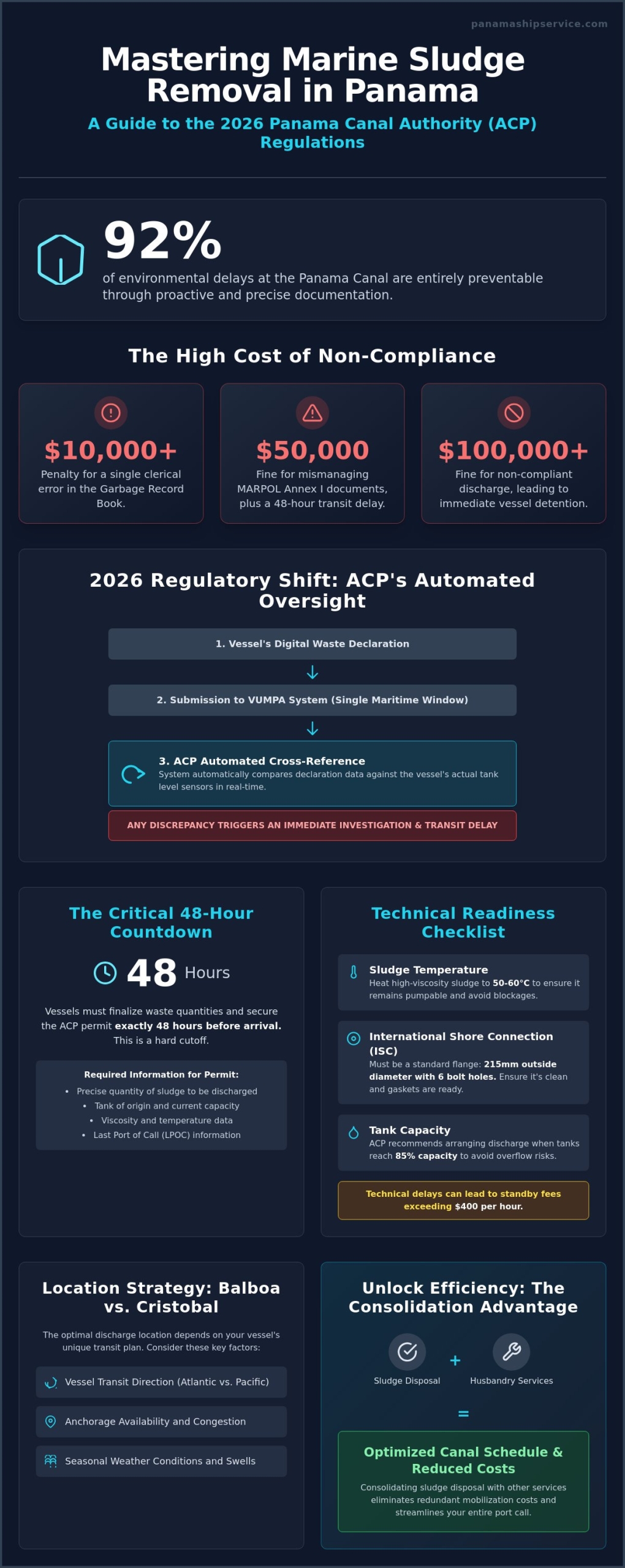
Did you know that 92% of environmental delays at the Panama Canal are entirely preventable through proactive documentation? In 2026, marine sludge removal in Panama is no longer just a routine waste service; it’s a data-driven compliance maneuver where the margin for error has disappeared. With the Panama Canal Authority now using automated systems to cross-reference reported waste with actual tank levels, a single discrepancy in your Garbage Record Book can lead to immediate fines exceeding $10,000.
You likely already feel the pressure of managing tight transit windows while fearing $100,000 penalties for record-book errors or hidden surcharges from unvetted barge operators. This guide helps you master the logistics of sludge disposal to ensure 100% MARPOL compliance and zero transit delays. We’ll provide a clear roadmap for navigating the critical 48-hour notification rule, choosing between Balboa and Cristobal anchorages, and securing transparent pricing that protects your bottom line. By the end of this guide, you’ll have the expertise to coordinate discharge operations that satisfy every regulatory requirement without impacting your arrival at the next port of call.
Key Takeaways
- Understand the 2026 ACP environmental oversight protocols to ensure your marine sludge removal panama operations meet strict MARPOL Annex I standards and avoid costly vessel detention.
- Identify the optimal discharge location between Balboa and Cristobal based on your transit direction, anchorage availability, and seasonal weather conditions.
- Learn the specific technical requirements for International Shore Connections and pump pressure limits to ensure a seamless transfer between the vessel and the disposal barge.
- Master the mandatory 48-hour notification window and the precise data points required to secure an accurate disposal permit and avoid standby fees.
- Explore the operational advantages of consolidating sludge disposal with other husbandry services to eliminate redundant mobilization costs and optimize your canal schedule.
The Regulatory Landscape for Sludge Removal in Panama (2026)
The Panama Canal Authority (ACP) has fundamentally transformed environmental oversight as of January 2026. Regulatory oversight for marine sludge removal panama has reached a new level of technical scrutiny, making it a high-stakes compliance operation governed by the MARPOL 73/78 Convention. Sludge, defined under Annex I as the oily residue from fuel oil purification and lubricating oil filtration, must be managed with absolute precision. The ACP now utilizes automated systems to cross-reference your digital waste declarations with actual tank level sensors. If these numbers don’t align, the system triggers an immediate investigation before your vessel even reaches the locks.
Mismanaging a single MARPOL Annex I document can result in a $50,000 fine and a 48-hour transit delay. If a vessel is found discharging non-compliant waste in Panamanian waters, fines can exceed $100,000 and lead to immediate vessel detention. In extreme cases, the ACP may blacklist the operator from future canal transits. The digital synchronization with the Single Window for Maritime Commerce (VUMPA) means that every liter of oily waste must be accounted for and verified by an authorized agent.
MARPOL Annex I Compliance
Ships must ensure they have sufficient storage capacity to reach the next port or arrange a discharge at the canal anchorages. The International Oil Pollution Prevention (IOPP) certificate remains your primary validation of equipment and tank capacity. However, the ACP’s 2026 standards require more than just a valid certificate. Every entry in your Oil Record Book and Garbage Record Book must be flawless. As of January 1, 2026, even vessels between 100 and 400 gross tonnage must maintain a detailed Garbage Record Book. A single clerical error now carries a penalty of $10,000, as inspectors no longer accept manual corrections without official verification.
Panama-Specific Environmental Mandates
Local regulations at Balboa and Cristobal anchorages are strictly enforced through the VUMPA system. You can’t wait until you’re at the locks to report your discharge requirements. Vessels must finalize waste quantities and secure the mandatory ACP permit exactly 48 hours before arrival. This deadline is a hard cutoff; missing it will push your vessel to the back of the service queue and likely disrupt your transit slot. Successful marine sludge removal panama depends on this early synchronization. Coordination is especially critical if your arrival requires complex mechanical ship repairs alongside your waste discharge, as these services must be scheduled to avoid conflicting with barge mobilization.
Technical Requirements for Efficient Sludge Discharge
Operational efficiency during marine sludge removal panama depends entirely on the vessel’s technical readiness before the barge arrives. Compliance isn’t just about paperwork; it requires specific hardware configurations and pump performance that meet the standards set by the International Maritime Organization (IMO). If your vessel isn’t prepared for the hook-up, you risk incurring standby fees that can exceed $400 per hour. Technical delays often stem from a lack of standardized equipment or poor temperature management of high-viscosity waste.
Pumping capacity is a critical factor. Most disposal barges in the canal zone expect a minimum discharge rate to maintain the transit schedule. If your sludge tanks are at the 85% capacity threshold recommended by the ACP, the transfer volume will be significant. High-viscosity sludge must be heated to approximately 50-60°C to ensure it remains pumpable. Failure to maintain these temperatures can lead to pump cavitation or line blockages, which immediately halts the operation and complicates your compliance timeline. To learn more about how similar complex pumping and utility systems are engineered for efficiency in civil construction, consider the standards used in advanced infrastructure projects.
Manifold and Connection Standards
Standardizing the manifold is the first step toward a successful transfer. Vessels must be equipped with an International Shore Connection (ISC) that features a standard flange with a 215mm outside diameter and six holes for bolts. Ensuring these flanges are clear of debris and that proper gaskets are available is the crew’s responsibility. Safety protocols require a dedicated crew member to monitor the connection point at all times. This prevents minor leaks from escalating into reportable spills, which would trigger the heavy fines discussed in the previous section.
Segregation and Pre-Treatment
Effective waste management requires strict segregation of bilge water from heavy sludge. Mixing these streams increases the overall volume of “sludge” and significantly inflates your disposal costs. Your Oily Water Separator (OWS) should be fully operational and used to minimize the water content in your sludge tanks before arrival. Professional MARPOL disposal panama services prioritize vessels that present well-segregated waste, as this allows for faster processing and more accurate volume reporting. If you’re unsure about your vessel’s manifold compatibility or pump performance, consulting with a seasoned canal transit agency can help you identify technical gaps before you reach the anchorage.
Crew members must also be prepared to provide a representative sample of the waste. Viscosity and flash point data are often required to confirm the waste profile matches the initial declaration. By maintaining technical standards and ensuring the manifold is ready for immediate hook-up, you protect your vessel from preventable delays and unnecessary surcharges.
Logistical Comparison: Sludge Removal at Balboa vs. Cristobal
Choosing between the Pacific and Atlantic entrances is a strategic decision that affects your vessel’s bottom line. While Balboa and Cristobal both support marine sludge removal panama, the logistical friction varies based on your transit direction and seasonal weather patterns. Aligning your discharge with the correct port minimizes mobilization costs and prevents your vessel from being pushed to the back of the queue. For operators accustomed to international standards, following U.S. Coast Guard MARPOL guidance provides a solid foundation for the technical expectations at both Panamanian hubs. Most standard barges in these hubs handle between 400 and 600 CBM, but mobilization costs are fixed per trip.
Balboa Anchorage Operations
Balboa is the primary choice for northbound transits. The Pacific side offers extensive anchorage areas, but operations are highly sensitive to tidal swings. Pacific tides in the Bay of Panama can reach up to 6 meters. This massive vertical movement creates strong currents that can complicate the positioning of smaller disposal barges alongside larger tankers or container ships. Crew members must maintain constant tension on mooring lines during the transfer to prevent flange stress. Despite these challenges, Balboa remains the most logical choice for vessels arriving from the west or south who need to clear their tanks before a northbound transit. You can efficiently coordinate your waste discharge with underwater hull services or mechanical inspections while waiting for your transit slot. Because Balboa is a high-traffic hub, barge availability is generally consistent, though response times in the outer anchorage can stretch if not booked 48 hours in advance.
Cristobal and Colon Logistics
For southbound vessels, Cristobal serves as the final opportunity for discharge before entering the canal. The Atlantic side operates differently, with Caribbean weather often dictating the schedule. The sudden onset of Caribbean “Northers”, which are strong seasonal winds, can shut down barge operations with little warning. High swells often lead to the suspension of barge operations in the outer anchorage, making the inner anchorage a more stable but crowded alternative. Logistically, Cristobal is excellent for integrating waste removal with the delivery of ship supplies panama canal. Turnaround times here are efficient, provided you’ve secured your ACP permit early. If you miss your window in Cristobal, the next compliant disposal point may be days away, making Atlantic-side coordination a critical priority for fleet managers.
Selecting the wrong port for marine sludge removal panama results in more than just a minor delay. It can lead to redundant mobilization fees if your volume exceeds the barge’s capacity and you’re forced to arrange a second pickup at the opposite end of the canal. By choosing the port that aligns with your transit direction, you ensure the barge is ready when you are, keeping your schedule on track and your record book compliant. This proactive selection process is the most effective way to manage the 33 daily transits that congest these anchorages.
Coordination Best Practices: The 48-Hour Rule
The 48-hour notification rule is the most critical milestone in the logistics of marine sludge removal panama. It represents the hard deadline for securing the mandatory Panama Canal Authority (ACP) permit and finalizing waste quantities via the Single Window for Maritime Commerce (VUMPA). Failing to meet this window doesn’t just result in logistical headaches; it effectively pushes your vessel to the back of the service queue. In a waterway handling approximately 33 transits daily, a delay of this nature can cascade into missed transit slots and significant financial losses for the ship operator.
To secure an accurate disposal quote and avoid barge standby fees that can exceed $400 per hour, you must provide a comprehensive “Declaration of Waste” to your local agent. This document requires specific technical data to ensure the disposal barge is properly equipped for your specific waste stream. Inspectors and barge operators require the following data points before mobilization:
- Total volume of waste expressed in Cubic Meters (CBM).
- Estimated water content percentage to determine processing requirements.
- Viscosity of the sludge (cSt at 50°C) to ensure pump compatibility.
- Flash point of the mixture, which must typically be above 60°C for standard disposal.
The Pre-Arrival Notification Sequence
Effective coordination begins at least 72 hours before arrival with an initial slot reservation. This allows your agent to check barge availability at either the Balboa or Cristobal anchorages. Exactly 48 hours before the vessel reaches the pilot station, you must provide the final confirmation with exact quantities. At this stage, the agent drafts the “Notice of Readiness” for waste discharge and submits the final permit request to the ACP. Any change in volume after this 48-hour cutoff can trigger a requirement for a second mobilization fee, which typically costs around $3,500 if the volume exceeds the initially booked barge capacity.
Safety and Spill Prevention
Safety protocols are paramount during the transfer to prevent environmental incidents that trigger $100,000+ fines. The vessel’s Shipboard Oil Pollution Emergency Plan (SOPEP) must be fully operational, and the crew must be briefed on the specific risks of the transfer. For vessels carrying 400 metric tons or more of persistent oil, a Panama Canal Shipboard Oil Pollution Emergency Plan (PCSOPEP) authorized person must be designated and available. Communication between the Chief Engineer and the barge master is the first line of defense; they must establish clear emergency stop signals and agree on the pumping sequence before the first liter of sludge moves.
Barge-side safety equipment, including containment booms and absorbent materials, must be deployed according to ACP environmental mandates. By delegating these complex logistical requirements to a professional canal transit agency, you ensure that every safety check and regulatory deadline is met without distraction. This proactive approach turns a high-risk operation into a routine maintenance task, protecting your vessel’s record and your fleet’s reputation.
Consolidated Marine Solutions with Panama Ship Service
Managing a vessel transit in 2026 requires more than just technical proficiency; it demands a partner who understands the friction points of the Panama Canal’s regulatory environment. Panama Ship Service has established itself as a seasoned veteran in this strategic hub, providing a calm and expert presence during high-pressure transit windows. We recognize that marine sludge removal panama is often just one of several critical tasks on a Chief Engineer’s checklist. By consolidating your waste disposal with other essential husbandry requirements, you eliminate the logistical fragmentation that leads to schedule slippage and hidden surcharges.
The primary advantage of our service model is the ability to overlap operations. While your vessel is at the anchorage for sludge discharge, our technical teams can simultaneously perform mechanical ship repairs or underwater inspections. This integrated approach ensures that your vessel remains productive during every hour it spends in Panamanian waters. We provide 24/7 technical support to handle emergency waste issues, ensuring that even last-minute discrepancies in tank levels don’t jeopardize your transit slot. Our billing process reflects this efficiency; you receive a single, transparent invoice from one agent, removing the complexity of managing multiple unvetted vendors.
The One-Stop-Shop Efficiency Model
Reducing downtime is our priority. Consider the case of a bulk carrier arriving at the Balboa anchorage with a critical engine room component failure and tanks at the 85% sludge capacity threshold. Under a fragmented service model, this vessel would face two separate mobilization fees and potentially two different wait times. By using our consolidated model, the operator synchronized the repair team and the disposal barge to arrive within the same window. This proactive coordination saved the operator approximately 18 hours of anchorage time, allowing them to maintain their original transit slot despite the mechanical setback. Our deep familiarity with the 2026 ACP regulatory shifts allows us to navigate the VUMPA system on your behalf, ensuring all digital declarations are synchronized before the 48-hour cutoff.
Requesting a Comprehensive Service Quote
Maximizing cost-efficiency at the canal requires a strategic view of your vessel’s needs. We encourage fleet managers to bundle MARPOL disposal with marine surveys, crew changes, or ship supplies to reduce mobilization overhead. Our team provides immediate assistance and clear, declarative answers to your technical questions, helping you delegate the complexity of the canal to a reliable partner. You can reach our operations desk directly to secure a fixed-price quote that includes all barge fees, permits, and environmental handling charges. Don’t let documentation errors or logistical delays impact your bottom line. Contact Panama Ship Service for 2026 MARPOL Compliance Support and ensure your next marine sludge removal panama is handled with professional precision.
Streamlining Your 2026 Transit Compliance
Success in the 2026 maritime environment requires shifting from reactive waste management to proactive compliance maneuvers. You’ve seen that mastering the 48-hour notification window and ensuring technical manifold readiness are the only ways to avoid the ACP’s automated penalties. By selecting the correct anchorage based on your transit direction and consolidating disposal with other husbandry needs, you protect your bottom line from redundant mobilization fees and Caribbean weather disruptions.
Navigating marine sludge removal panama doesn’t have to be a source of operational anxiety. Our team provides MARPOL-compliant disposal certificates for every operation and maintains 24/7 emergency response capabilities for all vessel types. With our deep expertise in the latest 2026 ACP regulatory updates, you can delegate these complex logistics to a partner that prioritizes your schedule and compliance record.
Secure Your 2026 MARPOL Compliance and Sludge Removal with Panama Ship Service
We’re ready to ensure your next Panama Canal passage is efficient, compliant, and completely seamless.
Frequently Asked Questions
What is the maximum capacity for sludge barge removal in Panama?
Standard disposal barges operating in the Panama Canal hub typically offer capacities ranging from 400 to 600 CBM. If your vessel’s waste volume exceeds the capacity of a single barge, you must arrange for a second mobilization. It’s critical to declare accurate volumes 48 hours in advance to avoid the $3,500 fee often associated with an unplanned second trip.
How much lead time is required to schedule sludge removal before a canal transit?
The Panama Canal Authority mandates a strict 48-hour notification rule for all waste disposal services. You must provide your final “Declaration of Waste” and secure the ACP permit within this window to maintain your service slot. We recommend initiating the reservation process at least 72 hours before arrival to ensure barge availability during high-traffic periods.
Are MARPOL certificates issued immediately after sludge discharge in Panama?
Yes, an official MARPOL disposal certificate is issued to the vessel immediately upon completion of the pumping operation. This document serves as your primary evidence of compliance for the Oil Record Book. You must keep this certificate on board for inspection by port state control or ACP authorities to verify that the waste was handled by an authorized facility.
Can I discharge sludge and take on bunkers simultaneously at Balboa?
Simultaneous operations, or SIMOPS, are generally permitted at the Balboa anchorage but require precise coordination between the bunker barge and the sludge barge masters. Safety zones must be strictly maintained to prevent interference between the two transfers. Your local agent must approve the safety plan for simultaneous marine sludge removal panama and bunkering before the barges are mobilized.
What happens if there is a discrepancy in my Garbage Record Book during an ACP inspection?
As of January 2026, the ACP uses automated systems to cross-reference reported waste with actual tank levels, leaving no room for clerical errors. A single discrepancy in your Garbage Record Book or Oil Record Book can result in an immediate fine of $10,000. Significant mismatches may trigger a full environmental audit, vessel detention, and fines that can exceed $100,000.
Do sludge removal services in Panama include the disposal of oily rags and filters?
Most marine sludge removal panama providers can include the disposal of Annex V oily waste, such as rags and used filters, if requested in advance. These items must be bagged and declared separately from the liquid sludge in your initial notification. This ensures the barge arrives with the correct containment equipment for both liquid and solid hazardous waste.
What are the current ACP fines for illegal discharge in Panamanian waters in 2026?
The ACP has intensified environmental enforcement in 2026, with fines for illegal discharge often exceeding $100,000. Beyond the financial penalty, non-compliant vessels face immediate detention and potential blacklisting from future canal transits. The authority uses satellite monitoring and automated reporting to identify any unauthorized discharge within the Canal Zone’s jurisdictional waters.
Is there a difference in cost between discharging sludge at the pier versus at anchorage?
Discharging at the pier is significantly more expensive due to additional port authority tariffs, line handling fees, and wharfage charges. Anchorage discharge is the standard and most cost-effective method for transiting vessels. Pier-side service is typically only utilized if the vessel is already alongside for extensive mechanical repairs or cargo operations that prevent it from staying at the anchorage.