
For a Neo-Panamax vessel in 2026, a single administrative oversight regarding health documentation can trigger a 72-hour delay, costing your operation upwards of $65,000 per day. VUMPA filing errors now stand as the primary cause of transit slot forfeiture, surpassing weather and mechanical issues combined. You know that maintaining a strict transit sequence is non-negotiable for your bottom line, yet the 2026 transition to digital WHO certificates and MINSA synchronization adds a layer of complexity that threatens even the most seasoned fleet managers. Coordinating medical care without deviating from your route requires more than just a basic agent; it demands a strategic husbandry partner.
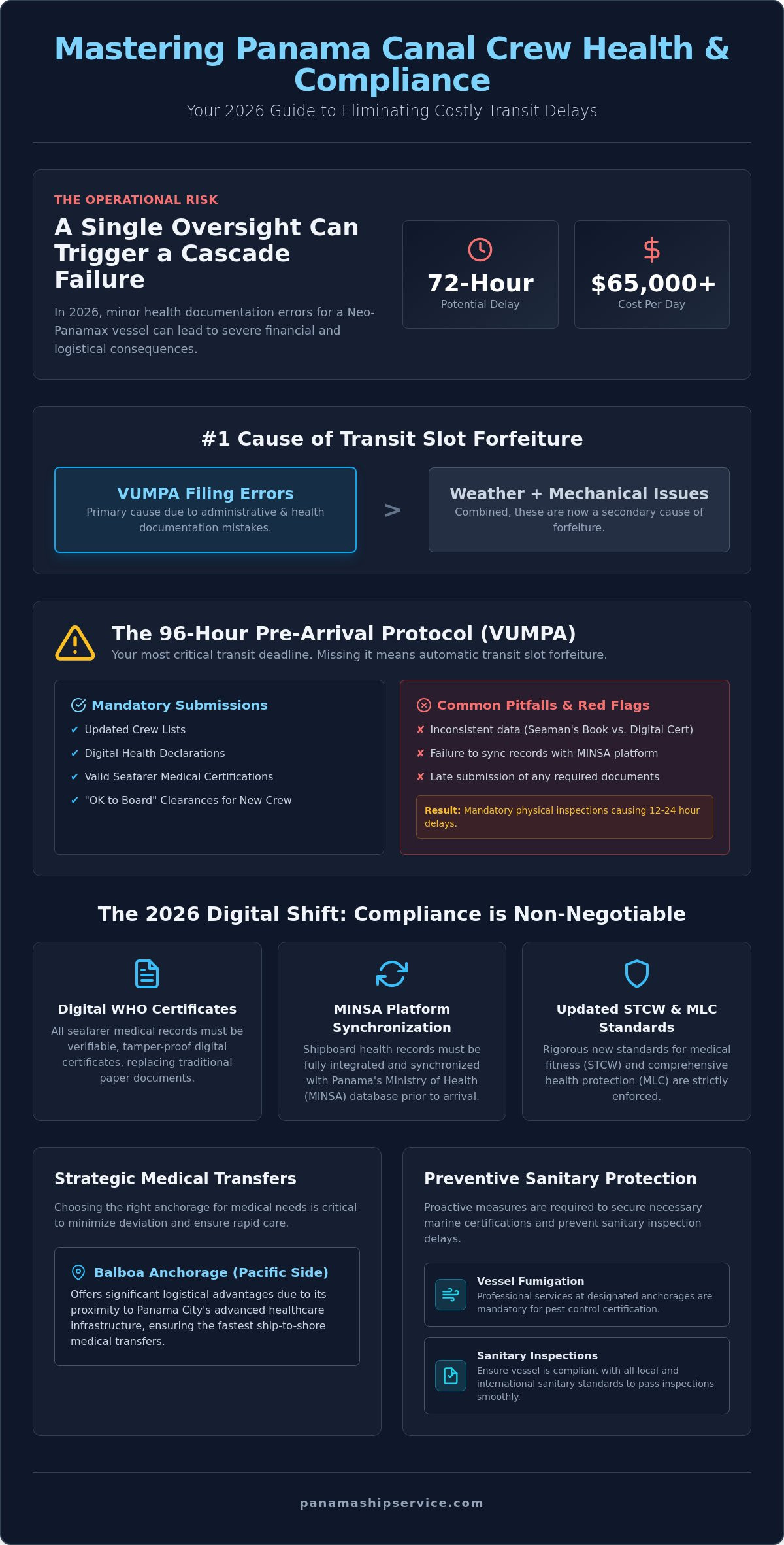
This guide provides the technical framework you need to master panama canal crew change requirements and ensure your vessel remains in full compliance with evolving 2026 STCW and MLC standards. We’ll detail the mandatory digital health protocols, the logistics of seamless ship-to-shore medical transfers at designated anchorages, and the specific documentation needed to prevent sanitary inspections from stalling your journey. By integrating medical welfare with rigorous regulatory readiness, you can eliminate the risk of costly idle time and protect your crew health with precision and efficiency.
Key Takeaways
- Identify the critical medical reporting timelines to the Panama Canal Authority (ACP) to mitigate the risk of $65,000+ daily operational losses.
- Navigate the 2026 panama canal crew change requirements by transitioning to digital WHO certificates and synchronized MINSA health platforms.
- Evaluate the logistical advantages of Balboa versus Cristobal for medical transfers to ensure rapid access to Panama City’s healthcare infrastructure.
- Secure necessary marine certifications by completing professional vessel fumigation and sanitary inspections at designated anchorages.
- Consolidate health management into a unified husbandry strategy to eliminate transit delays and ensure full compliance with updated STCW and MLC standards.
The Operational Risk of Crew Health Issues at the Panama Canal
Modern vessel husbandry requires a shift in perspective. Crew health management is no longer a secondary welfare concern; it’s a critical technical variable that dictates your transit success. The Panama Canal Authority (ACP) views sanitary compliance with the same rigour as mechanical readiness. Given the long history of health measures in the Canal Zone, local authorities maintain a zero-tolerance policy for undisclosed medical issues. Managing panama canal crew change requirements effectively means recognizing that the human element is a core component of your ship’s operational profile.
The “Golden Window” for medical reporting is your most vital timeline. You must disclose any crew illness or injury to the ACP through the Maritime Service Portal well before your vessel reaches the sea buoy. If a health issue is discovered during a pilot boarding or a boarding officer’s inspection rather than through prior declaration, the consequences are immediate. Your vessel will likely be removed from the transit sequence, forcing a costly return to the anchorage for a full sanitary evaluation.
The True Cost of a Health-Related Transit Forfeiture
A missed transit slot in 2026 is a financial catastrophe. For Neo-Panamax vessels, the daily loss in charter hire and operational overhead can exceed $65,000. These health-related delays create a cascade of secondary costs:
- Increased fuel consumption while idling at the Pacific or Atlantic anchorages.
- Additional launch boat fees for medical personnel and supplies.
- Contractual penalties for late cargo delivery at the next port of call.
- Potential labor overhead for crew members whose contracts expire during the delay.
Proactive communication with the ACP isn’t optional. It’s the only way to protect your schedule. When you identify a health risk early, you allow your agent to coordinate a resolution that fits within the transit window rather than disrupting it.
Navigating the 96-Hour Pre-Arrival Protocol
The Vessel Universal Measurement and Pre-Arrival (VUMPA) package is the most important document in your transit strategy. You must submit this complete package at least 96 hours before your scheduled arrival at the Canal anchorage. Missing this deadline results in the automatic forfeiture of your transit slot. The health portion of the VUMPA requires precise documentation, including updated crew lists and digital health declarations.
The Master plays a decisive role here. They must verify that every seafarer’s medical certification is valid and that any required boosters are recorded in the digital portal. Common pitfalls that trigger red flags include:
- Inconsistent data between the Seaman’s Book and the digital health certificate.
- Failure to synchronize vaccination records with the Panama Ministry of Health (MINSA) platform.
- Late submission of “OK to Board” clearances for incoming crew members.
Digital errors often lead to mandatory physical inspections. These inspections don’t just take time; they can push your vessel back by 12 to 24 hours in the transit sequence, effectively ending your chances of a delay-free transit.
2026 Compliance: STCW Amendments and Digital Health Standards
Compliance in 2026 revolves around the aggressive digitization of seafarer credentials. The latest amendments to the STCW Convention have introduced rigorous standards for medical fitness that directly influence panama canal crew change requirements. These updates ensure every crew member possesses a verifiable, tamper-proof medical history before they step foot on a vessel. Alongside these global standards, the Maritime Labor Convention (MLC) 2006 mandates that shipowners provide comprehensive health protection. In Panama, this translates to a mandatory integration of shipboard records with national health databases. You can’t afford to treat these as mere suggestions; they’re the gatekeepers of your transit schedule.
Implementing Digital Health Certificates
Verification starts long before the vessel enters Panamanian waters. As of 2026, the Panama Maritime Authority (AMP) requires all digital health certificates, passports with six months’ validity, and signed employment contracts to be uploaded to their digital portal at least 48 hours before a crew member’s arrival. For seafarers from restricted nationalities, this process is even more demanding, requiring visa applications to be submitted 15 business days in advance. Standard visa fees typically range from $200 to $450 depending on the processing speed and port of entry.
- Step 1: Confirm all WHO-approved medical certificates are in the required digital format and include the latest seasonal respiratory boosters.
- Step 2: Cross-check Seaman’s Book validity; Panama does not permit entry or exit if the document expires within six months of the arrival date.
- Step 3: Use an experienced canal transit agency to pre-verify these digital uploads and ensure the MINSA “OK to Board” is issued.
Compatibility issues often arise between shipboard management software and the AMP’s updated API. A local agent acts as a technical buffer, manually verifying that digital records are synchronized with the Panama Ministry of Health (MINSA) platform. This proactive verification prevents the “red flags” that trigger mandatory, time-consuming physical inspections by boarding officers.
ACP Health Regulations and Quarantine Standards
ACP sanitary standards are now synchronized with real-time disease tracking platforms. Vessels must prove that all joining and departing crew members are compliant with the latest health directives. If a crew member displays symptoms of a communicable disease, you must immediately notify the ACP through the VUMPA portal. Failure to report these symptoms before the pilot boards is a violation of local health laws. Such an oversight results in immediate quarantine at the anchorage and the loss of your transit slot. Local Panamanian health laws take precedence once you’re in the jurisdictional waters, and the ACP won’t hesitate to prioritize the safety of the Canal over your vessel’s schedule.
Logistics of Ship-to-Shore Medical Transfers in Panama
Executing a medical transfer without disrupting your transit sequence requires precise coordination between sea and shore. While panama canal crew change requirements focus heavily on documentation, the physical movement of personnel is where operational delays often occur. Ship operators must choose between the Balboa (Pacific) and Cristobal (Atlantic) entrances based on the level of care required. Balboa is the preferred hub for specialized medical attention due to its proximity to Panama City’s private hospitals and Tocumen International Airport (PTY). Cristobal serves as a functional alternative for vessels on the Atlantic side, though it requires more complex ground logistics to reach specialized facilities.
A successful husbandry strategy integrates medical transfers with other technical services. Launch boat trips for crew transfers start at approximately $450 per trip, but scheduling errors can quickly lead to logistics penalties exceeding $5,000. Coordinating these launches with private medical providers ensures that a seafarer moves directly from the anchorage to a clinic without idling at the pier. This level of synchronization is essential for routine specialist visits, such as dental or optical care, which must be completed within the vessel’s limited stay at the anchorage. Efficiently managing these windows prevents the need for costly deviations to other regional ports.
Anchorage vs. In-Transit Medical Coordination
Timing is the most critical factor in medical logistics. You must remember that crew transfers of any kind are strictly prohibited while a vessel is transiting the Panama Canal locks. All personnel movements must take place at designated anchorages before or after the transit. For non-emergency care, scheduling the transfer during a technical service window maximizes efficiency. In the event of an emergency medevac during the transit phase, the ACP takes control of the vessel’s movement. This inevitably leads to the forfeiture of your transit slot and significant rescheduling fees. Proactive planning at the anchorage is the only way to maintain your position in the transit sequence.
Managing Immigration and Port Authorities
Immigration protocols for medical shore leave are as rigid as those for standard crew rotations. Even for temporary medical treatment, seafarers must have a valid passport with at least six months of remaining validity and a current Seaman’s Book. If the crew member belongs to a “Restricted Nationality,” their visa application must be processed 15 business days in advance. Standard seafarer visas cost between $200 and $450 depending on the urgency. A protective ship agency manages this bureaucracy, ensuring all “OK to Board” clearances are active so the crew member can re-board the vessel immediately after treatment. This prevents departure delays at the sea buoy and ensures the vessel stays on schedule.
Preventive Protection: Sanitary Inspections and Pest Control
Sanitary excellence is a prerequisite for operational continuity at the Panama Canal. While much of the focus on panama canal crew change requirements involves visas and digital health certificates, the physical condition of the vessel is equally scrutinized. Sanitary inspections are a mandatory hurdle for many marine surveys and international certifications. A vessel that fails a health inspection at the sea buoy faces immediate transit forfeiture. This doesn’t just delay your schedule; it invalidates the technical readiness you’ve worked to maintain. Sanitary failure is an operational choice that carries a heavy price tag.
Professional pest control is not merely a matter of comfort. It’s a regulatory necessity. Infestations are a primary vector for communicable diseases that can trigger a quarantine. Beyond the physical risks, pests are a significant stressor for seafarers. Poor living conditions lead to fatigue and decreased morale, which are dangerous variables during the high-pressure environment of a Canal transit. To help crew members recharge after such demanding assignments, many companies recommend active outdoor pursuits; for instance, you might discover Przystań Pontonowa and its scenic river rafting tours for high-quality team-building. Addressing these issues at the anchorage ensures your crew remains focused on the complex navigation required for a successful crossing.
Fumigation and Deratting Certificate Issuance
The technical process of MARPOL-compliant fumigation at the Panama anchorage is designed for speed and safety. Specialized teams board the vessel to apply treatments that target pests without contaminating food supplies or living spaces. Many ship operators use the waiting period before a transit to renew their Ship Sanitation Control Exemption Certificate (SSCEC). This renewal prevents the vessel from being flagged during future inspections in international ports. A standard Ship Sanitation Control Exemption Certificate issued in Panama remains valid for a period of six months.
- Inspect all galley and dry store areas for signs of vector activity before arrival.
- Coordinate fumigation services at least 48 hours in advance to align with your transit window.
- Ensure the Master has the previous certificate ready for the boarding health officer.
Preventing Outbreaks Through Sanitary Excellence
Outbreaks on board can halt a transit instantly. Galley and living quarter sanitation are your first line of defense against transit-stopping illnesses. There’s a direct link between professional tank cleaning and overall vessel hygiene. Contaminated water systems are frequent sources of infection. Utilizing your port stay for deep-cleaning and disinfection prevents the buildup of bacteria that leads to widespread illness. By integrating these preventive measures into your husbandry strategy, you eliminate the risk of a sanitary red flag during the ACP inspection process.
Integrating Health Services into Your Panama Transit Strategy
Health management is a technical pillar of a successful transit, not an isolated administrative task. Successful ship operators in 2026 recognize that medical readiness is as vital as mechanical integrity. By positioning health compliance within a one-stop-shop service model, you eliminate the friction of managing multiple vendors at the anchorage. This integrated approach ensures that panama canal crew change requirements are met with the same precision as your technical repairs, protecting your vessel from the $65,000 daily losses associated with transit delays.
Panama Ship Service handles health compliance alongside technical repairs to maximize your operational efficiency. Consolidating these services under a single agency reduces administrative overhead and ensures that your vessel’s sanitary status is pre-verified before the ACP boarding officer arrives. This level of coordination is the only way to navigate the 2026 transition to digital health standards without risking your transit slot.
The One-Stop-Shop Advantage for Ship Operators
Combining marine surveys in Panama with health checks saves significant time at the anchorage. Instead of scheduling separate windows for technicians and medical personnel, you can synchronize these tasks. For instance, we can coordinate a seamless medical transfer during underwater hull services or while our teams perform mechanical ship repairs. This holistic strategy keeps your vessel moving and ensures every husbandry need is resolved within a single technical stop.
Preparing for Your 2026 Transit with Panama Ship Service
Total readiness requires a proactive checklist. Before your vessel reaches the sea buoy, ensure you’ve completed these critical steps to satisfy panama canal crew change requirements:
- Submit the complete VUMPA package at least 96 hours before arrival.
- Upload all digital WHO health certificates and employment contracts 48 hours in advance.
- Synchronize all crew vaccination records with the MINSA digital platform.
- Verify that Seaman’s Books and passports have at least six months of validity.
- Confirm that any restricted nationality visas were processed at least 15 business days prior.
Don’t let administrative health hurdles jeopardize your transit sequence. Panama Ship Service provides the localized expertise needed to manage complex logistics and technical compliance simultaneously. It’s time to delegate the complexity of Canal transits to a partner that prioritizes your schedule and your bottom line. Optimize your next transit with our comprehensive ship services.
Secure Your 2026 Transit with Strategic Health Compliance
Navigating the complexities of the Panama Canal requires more than just mechanical readiness; it demands a proactive approach to medical husbandry and sanitary standards. As digital WHO certificates and synchronized MINSA platforms become mandatory, the margin for error in meeting panama canal crew change requirements has disappeared. You must integrate these health protocols into your broader technical strategy to avoid the devastating financial impact of transit slot forfeiture. By prioritizing preventive sanitation and precise medical coordination at the anchorages, you ensure your vessel remains a compliant and efficient link in the global supply chain.
Panama Ship Service stands as your authoritative partner in this high-stakes environment. We offer a comprehensive one-stop-shop for technical and husbandry services, combining deep expertise in MARPOL and ACP compliance with 24/7 availability for emergency repairs and medical logistics. Our team manages the administrative burden so you can focus on safe navigation. Contact Panama Ship Service for Expert Crew Health and Sanitary Support to protect your operation from unnecessary delays. We’re ready to ensure your next transit is seamless and successful.
Frequently Asked Questions
What are the 2026 digital health requirements for Panama Canal transit?
All seafarers must present digital WHO-approved medical certificates synchronized with the Panama Ministry of Health (MINSA) digital platform. This requirement ensures that vaccination records, including seasonal respiratory boosters, are verified before an “OK to Board” is issued. Ship operators must upload these documents to the digital portal at least 48 hours before arrival. Failure to comply with these 2026 standards will trigger a mandatory physical inspection and potential transit delays.
How much does a missed Panama Canal transit slot cost due to medical issues?
A missed transit slot for a Neo-Panamax vessel results in daily losses exceeding $65,000. These costs stem from a combination of charter hire penalties, fuel consumption while idling, and logistical overhead. Since a missed slot often leads to a 72-hour wait for reassignment, the total financial impact can quickly surpass $195,000. Proactive management of panama canal crew change requirements is the most effective way to mitigate this significant fiscal risk.
Can I perform crew changes and medical transfers simultaneously in Panama?
You can perform these activities simultaneously, provided the vessel is at the designated anchorages of Balboa or Cristobal. Crew changes and medical transfers are strictly prohibited once the vessel begins its transit through the locks. Coordinating these services through a single husbandry agent allows you to consolidate launch boat fees, which start at approximately $450 per trip, and ensures all personnel movements are completed within your technical service window.
What is the VUMPA deadline for reporting crew health status to the ACP?
The VUMPA (Vessel Universal Measurement and Pre-Arrival) submission deadline is exactly 96 hours before your scheduled arrival at the Canal anchorage. This package must include a complete health declaration for all crew members. Filing errors or late submissions are the primary cause of transit slot forfeiture. You must file the package through the ACP Maritime Service Portal to maintain your position in the transit sequence.
How do I obtain or renew a Deratting Certificate while in Panama?
You can renew your Ship Sanitation Control Exemption Certificate (SSCEC) by scheduling a professional sanitary inspection while your vessel is at the anchorage. These certificates are valid for six months in Panama and are essential for international regulatory compliance. It’s best to coordinate the inspection at least 48 hours in advance. This allows the sanitary team to board and complete the process without disrupting your scheduled transit time.
What happens if a crew member tests positive for a communicable disease during transit?
If a crew member displays symptoms or tests positive, you must immediately notify the ACP through the Maritime Service Portal. The vessel will be removed from the transit sequence and directed to an anchorage for quarantine and evaluation by MINSA officials. Non-disclosure of health issues before a pilot boards is a serious violation. It leads to mandatory fines and the automatic loss of your transit slot, which causes extensive scheduling delays.
Are private hospitals in Panama City equipped for specialized maritime medical care?
Panama City offers several world-class private hospitals that are fully equipped for specialized maritime medical care. These facilities are located near the Balboa port, making the Pacific side the preferred choice for ship-to-shore transfers. These hospitals provide everything from routine specialist visits to emergency trauma care. Using a local agent ensures that transport from the pier to the hospital is synchronized with the crew member’s arrival to minimize time ashore.
How can I coordinate fumigation services without delaying my ship transit?
You can coordinate fumigation by scheduling the service to occur during your vessel’s mandatory waiting period at the anchorage. Professional teams can complete MARPOL-compliant treatments while other husbandry tasks, such as ship supplies delivery or hull cleaning, are underway. This integrated approach ensures that panama canal crew change requirements regarding sanitary status are met. By aligning pest control with your technical window, you avoid any additional idle time before your transit.