
Would you pay $4 million just to skip a line? In May 2026, some shipping companies did exactly that to secure an unreserved Panama Canal transit slot. When the stakes are this high, your vessel cannot afford a single hour of unplanned downtime due to poor coordination. Effective ship repair project management in the Panama Canal zone isn’t just about fixing mechanical issues. It’s a high-stakes race against a rigid logistics clock where every minute matters.
You already know that a single uncoordinated subcontractor or a delay in class-approved documentation can turn a routine repair into a logistical nightmare. This often results in missed windows and astronomical auction fees that gut your operational margins. It’s a high-pressure environment that demands absolute precision and transparency from every partner involved.
This guide helps you master the complexities of marine engineering and logistics to ensure your repairs stay within narrow transit windows. You’ll learn how to synchronize technical labor with canal schedules to achieve zero-delay transits and fixed-budget execution. We’ll also cover how to manage regulatory compliance and documentation to minimize downtime and keep your vessel on schedule.
Key Takeaways
- Understand how professional ship repair project management integrates engineering, logistics, and strict regulatory oversight to ensure your vessel meets its transit window.
- Learn to optimize the initiation and planning phases by utilizing marine surveys and damage assessments to define a precise project scope.
- Discover how to synchronize technical repairs with the Panama Canal schedule by selecting the most efficient port, whether in Balboa or Cristobal.
- Mitigate operational risks through rigorous HSE protocols and ensure technical integrity with Class-approved documentation for every repair.
- Identify why an integrated “one-stop-shop” model is the most effective way to manage emergency repairs and minimize vessel downtime in high-stakes environments.
What is Ship Repair Project Management in the Maritime Industry?
Ship repair project management is the specialized application of engineering principles, logistics coordination, and regulatory oversight to vessel maintenance and emergency fixes. While traditional project management often deals with stationary infrastructure, marine PM focuses on mobile, high-value assets. These vessels operate under unpredictable environmental variables and strict international laws. The core objective is to return a vessel to operational status on time, within a fixed budget, and in full compliance with global maritime standards.
Technical expertise is the foundation of this discipline. A project manager can’t simply rely on scheduling software; they must understand the mechanical and structural realities of the work being performed. Whether the vessel is at anchor or in a shipyard, the manager must verify that every weld, engine overhaul, or hull coating meets required specifications. Without this technical depth, it’s impossible to identify scope creep or assess the true progress of complex repairs. It’s about maintaining technical integrity while the clock is ticking.
The Role of the Marine Project Manager
Why Effective PM is Critical at the Panama Canal
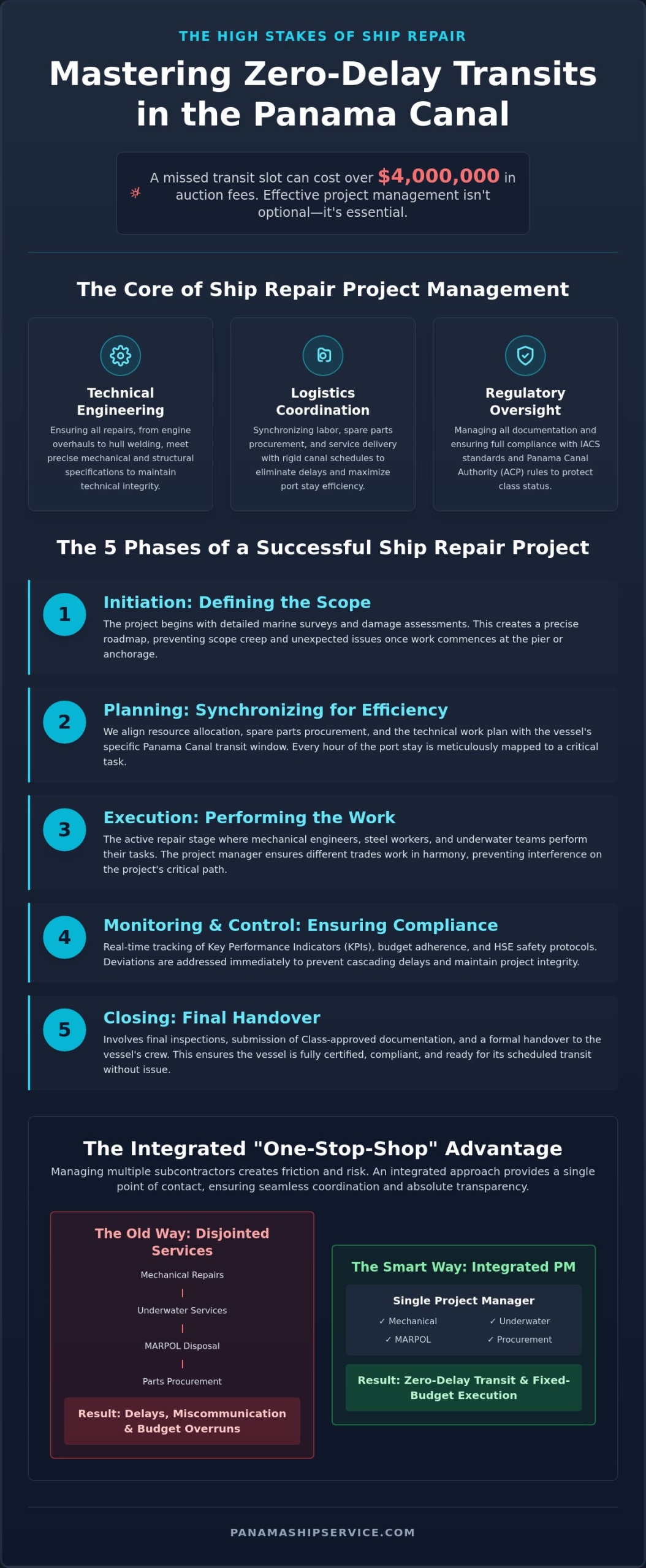
In the Panama Canal zone, the clock is the most unforgiving factor. The high cost of missed transit slots can reach hundreds of thousands of dollars, especially if a vessel is forced into the auction system to secure a new window. Effective ship repair project management ensures that every repair is synchronized with the vessel’s scheduled arrival at the locks. This requires navigating the unique and rigid regulatory environment of the Panama Canal Authority (ACP).
Managing repairs in this region often involves consolidating multiple specialized services under one management umbrella. A project manager might simultaneously coordinate mechanical repairs, underwater hull services, and MARPOL disposal. This integrated approach eliminates the friction of dealing with multiple uncoordinated subcontractors. Much like how Taller Baja 1000 provides comprehensive diagnostic and repair solutions for specialized vehicles, marine PM requires a unified strategy to ensure quality. It provides the transparency needed to ensure the vessel is ready for transit the moment the pilot boards. When you delegate this complexity to a single expert partner, you simplify your own operations and protect your bottom line.
The 5 Phases of a Successful Ship Repair Project
Executing vessel repairs in a high-traffic hub requires more than just technical skill. It demands a systematic approach. Professional ship repair project management breaks the complex lifecycle of a repair into five distinct, manageable phases. This structure ensures that no detail is overlooked and that the vessel remains compliant with international standards throughout the process.
- Initiation: This phase focuses on defining the project scope. We rely on detailed marine surveys and damage assessments to create a clear roadmap. This prevents the “unknown” from derailing the project once the vessel is at the pier or anchorage.
- Planning: Efficiency is built here. We manage resource allocation and spare parts procurement while aligning the repair schedule with the vessel’s specific Panama Canal transit window. Every hour of the port stay is mapped to a specific technical task.
- Execution: This is the active repair stage. Mechanical engineers, steel workers, and underwater teams perform the physical work. The project manager ensures that different trades don’t interfere with each other’s progress on the critical path.
- Monitoring & Control: We track key performance indicators (KPIs) and safety compliance in real-time. This phase is about staying on schedule and addressing deviations immediately before they cascade into costly delays.
- Closing: The final phase involves rigorous inspections and obtaining Class certification. We ensure all Class-approved documentation is finalized and the vessel is fully cleared for departure.
Planning for the Unexpected: Contingency Management
Marine environments are inherently unpredictable. Hidden defects often emerge only after work begins. To counter this, we conduct aggressive pre-repair inspections to identify potential issues before they become critical delays. A successful schedule always includes a 15% time contingency buffer. This allows for weather interruptions or technical challenges without jeopardizing the transit slot. Efficiently coordinating the delivery of parts through Panama ship supplies is a cornerstone of this phase. It ensures that the right components are staged and ready for immediate installation when the ship arrives.
Execution and Real-Time Reporting
Owners and managers need total visibility during the execution phase. We provide daily progress reports (DPRs) that detail exactly what was accomplished and what remains to be done. Managing specialized labor like certified welders and commercial divers requires active, on-site supervision to maintain technical integrity. Quality assurance isn’t a final step; it’s an ongoing process that happens at every stage of the repair. If you’re looking for a reliable partner to oversee these high-stakes operations, our team offers integrated ship repair project management to ensure your vessel stays on schedule and within budget.
Managing Complexity: The Panama Canal Factor
Managing a repair project in Panama is a logistical chess game played across two oceans. Unlike a standard port call, a Panama Canal stop is governed by a rigid transit queue where any delay carries exponential costs. Successful ship repair project management in this region requires a deep understanding of the geographic and administrative divide between the Pacific and Atlantic entrances. You don’t just manage the repair; you manage the vessel’s position in one of the world’s most crowded maritime corridors.
Choosing the right port for your repair scope is the first strategic decision. Balboa, located at the Pacific entrance, is the traditional hub for heavy mechanical work and extensive structural repairs. Cristobal, on the Atlantic side, often serves as a tactical staging point for vessels needing rapid intervention before they enter the locks. Selecting the wrong side of the Isthmus can add 8 to 12 hours of unnecessary transit time just to reach a specific berth. Local expertise is essential to navigate these choices and bypass the administrative bottlenecks that often trap international operators.
The Logistics of Balboa and Cristobal Ports
The operational differences between the Pacific and Atlantic entrances are significant. Balboa offers closer proximity to major dry dock facilities and specialized heavy equipment. Conversely, Cristobal provides unique anchorage opportunities for “repair-while-waiting” scenarios. Local mechanical ship repairs providers optimize these port stays by staging teams and equipment in advance. This proactive staging ensures that work begins the moment the vessel is cleared by authorities. When spare parts arrive from overseas, your management team must handle customs clearance with extreme urgency to move components across the Isthmus in hours, not days.
Regulatory Compliance and ACP Coordination
The Panama Canal Authority (ACP) enforces some of the world’s strictest safety and environmental standards. Any repair work conducted at anchorage or pier-side must be coordinated with canal pilots and port agents to ensure it doesn’t interfere with the scheduled transit. Non-compliance with ACP “Notices to Shipping” can lead to immediate fines or the loss of a hard-won transit slot. This includes managing MARPOL disposal in Panama during the repair window. A dedicated project manager ensures that all waste removal and technical fixes are documented and approved by the ACP before the vessel is cleared to enter the locks. This level of coordination turns a potential regulatory bottleneck into a streamlined part of your vessel’s journey.
Risk Mitigation and Quality Control in Marine PM
Risk management in the maritime sector is often misunderstood as merely having insurance. In reality, it’s the proactive identification of technical, financial, and regulatory threats before they manifest as a missed transit window. When evaluating a team for ship repair project management, owners should use a specific checklist of risk-mitigation capabilities. A competent manager doesn’t just react to problems; they neutralize them through rigorous quality control and strict adherence to international safety standards.
- Safety First: Professional ship repair project management mandates rigorous HSE (Health, Safety, and Environment) protocols. This includes mandatory PPE, hot-work permits, and confined-space entry certifications to prevent accidents that can halt a project indefinitely.
- Technical Integrity: Repairs are technically worthless if they don’t pass Class approval. Managers must oversee every weld and mechanical adjustment to ensure they meet the specific requirements of the vessel’s classification society.
- Cost Control: Preventing scope creep is a primary management function. This is achieved through strict change-order management, where every deviation from the original plan is documented, costed, and approved by the owner in writing.
- Environmental Risk: Handling hazardous materials like fuel oil, lubricants, and chemical cleaners requires specialized containment. Effective management ensures these materials are handled without risking spills that could lead to massive ACP fines.
Ensuring Class Approval and Documentation
A repair project isn’t finished until the paperwork is signed. We work directly alongside Class surveyors from organizations like ABS, Lloyd’s, and DNV to verify that every technical fix is certified for sea-going service. The role of marine surveys in Panama is critical in this process. These surveys provide the objective evidence needed to verify work quality and technical compliance. At the end of the project, the manager provides a comprehensive “as-built” documentation trail. This ensures the owner has a permanent record of all materials used and tests performed for future reference.
Mitigating Downtime and Financial Loss
Financial loss in Panama is directly tied to the clock. One of the most effective ways to mitigate this risk is by using underwater hull services to perform repairs while the vessel is afloat. This avoids the high cost and scheduling difficulty of dry docking, allowing the ship to remain in the transit queue while work progresses. Identifying critical path items early allows the team to focus resources where they matter most for the departure date. The ROI of expert management is found in the avoidance of auction fees and port stay extensions. If you need to protect your operational margins during a repair, contact our project management team to discuss your specific technical requirements.
Panama Ship Service: Your Integrated PM Partner
Managing multiple vendors while your vessel is in the transit queue is an unnecessary operational risk. Fragmented coordination between subcontractors often leads to the scope creep and documentation gaps discussed earlier. At Panama Ship Service, we provide a “one-stop-shop” model for ship repair project management. This integrated approach ensures that every technical requirement is handled under a single management umbrella. We eliminate the friction of uncoordinated labor to keep your vessel moving toward the locks without delay.
Our project managers are seasoned veterans with deep roots in Panama’s maritime sector. We don’t just oversee repairs; we consolidate mechanical work, underwater hull services, and MARPOL disposal into a single, streamlined schedule. This consolidation significantly reduces administrative overhead and ensures that technical teams aren’t competing for deck space or pier time. Whether you’re facing an emergency engine failure or a scheduled maintenance window, our 24/7 responsiveness ensures that labor and equipment are mobilized the moment they’re needed.
The PSS Advantage: Expertise and Reliability
We’ve built a proven track record across mechanical repairs, complex steel fabrication, and specialized underwater work. Reliability in the Panama Canal zone depends on more than just technical skill; it requires direct, constant coordination with the Panama Canal Authority (ACP). We manage these regulatory interfaces on your behalf to ensure seamless transits. Transparency is a cornerstone of our service. Fleet managers receive detailed daily progress reports that track every KPI and technical milestone. This proactive communication provides the confidence you need to manage your fleet from anywhere in the world.
Streamlining Your Vessel’s Stay in Panama
The complexity of a Panama Canal stop shouldn’t rest on your shoulders. We handle the logistical heavy lifting so you can focus on your next voyage. Our extensive local network allows for rapid procurement of international spare parts and the immediate mobilization of certified technical teams. We understand that in this hub, time isn’t just money; it’s the difference between a successful transit and a costly auction fee. We delegate complexity to our specialists to simplify your operations and protect your bottom line. Contact Panama Ship Service today to discuss your technical specifications and secure your next repair window with confidence.
Secure Your Vessel’s Operational Integrity in the Panama Canal
Success in the Panama Canal corridor requires moving beyond fragmented coordination. We’ve detailed how mastering the five project phases and leveraging localized expertise in Balboa and Cristobal are the only ways to ensure repairs don’t collide with your transit schedule. Professional ship repair project management serves as your primary defense against the escalating costs of missed slots and uncoordinated labor. Centralizing technical repairs, surveys, and disposal under one umbrella eliminates the friction that often derails tight port stays.
Panama Ship Service brings over 20 years of experience at the Panama Canal to every project. Our Class-approved technical teams and 24/7 emergency response capability ensure your vessel remains compliant and operational, regardless of repair complexity. We handle the logistical heavy lifting so your fleet maintains its momentum through the locks and onto the next destination.
Don’t leave your vessel’s schedule to chance. Request a Project Management Consultation for Your Vessel today and experience the efficiency of an integrated marine partner. We’re ready to help you navigate your next repair window with absolute confidence.
Frequently Asked Questions
What are the main challenges of ship repair in the Panama Canal?
The primary challenges involve the unforgiving transit schedule and the high financial risks of missing a slot. Auction premiums for unreserved slots can reach hundreds of thousands of dollars, making any repair delay extremely costly. Managing technical labor within these narrow windows requires precise coordination to prevent cascading delays that could jeopardize the vessel’s position in the canal queue.
How do you ensure ship repairs meet Class approval standards in Panama?
We ensure repairs meet Class standards by coordinating directly with surveyors from IACS members like ABS, Lloyd’s, or DNV. Our project managers oversee every technical milestone to verify that materials and workmanship comply with the vessel’s specific classification requirements. This proactive oversight guarantees that all repairs are fully certified and documented before the vessel is cleared for departure.
Can repairs be conducted while a vessel is waiting for its Panama Canal transit?
Yes, many repairs can be conducted at anchorage while the vessel is in the transit queue. This “repair-while-waiting” strategy is a core component of effective ship repair project management. It allows technical teams to perform mechanical or underwater work without the vessel losing its position in the scheduling system, effectively turning waiting time into productive maintenance time.
What documentation is required for a ship repair project in Panama?
Essential documentation includes the VUMPA submission, hot-work permits, and Class-approved technical drawings. For repairs in the canal zone, you must also provide detailed work scopes to the Panama Canal Authority (ACP) to ensure compliance with local safety regulations. A comprehensive “as-built” report is finalized at the project’s conclusion to provide the shipowner with a permanent record of the work.
How does project management help in reducing ship repair costs?
Project management reduces costs by eliminating uncoordinated downtime and preventing scope creep through strict change-order control. By synchronizing technical labor with the canal’s logistics, we help owners avoid the massive auction fees associated with missed transit windows. Efficient resource allocation ensures that you only pay for the labor and parts strictly necessary for the defined project scope.
What is the difference between afloat repairs and dry dock repairs in Panama?
Afloat repairs are performed while the vessel is in the water, often at anchorage, which minimizes downtime and avoids expensive dry dock fees. Dry dock repairs require the vessel to be removed from the water for extensive hull or propulsion work. In the Panama hub, afloat repairs are the preferred method for maintaining a transit schedule whenever the technical scope allows it.
How do you coordinate multiple subcontractors during a major repair?
We coordinate multiple subcontractors by acting as the single point of contact and central hub for all technical communication. This “one-stop-shop” approach ensures that mechanical, steel, and underwater teams work in parallel without interfering with each other’s progress. We manage the interdependencies between different trades to maintain the project’s critical path and ensure a timely departure.
What safety protocols are followed during ship repair projects in Panama?
Safety protocols follow rigorous HSE standards, including mandatory PPE, gas-free certifications for confined spaces, and strict hot-work permitting. All ship repair project management activities must also comply with the Panama Canal Authority’s specific environmental and safety “Notices to Shipping.” These measures protect the crew and technical teams while preventing accidents that could halt the repair project and cause delays.