
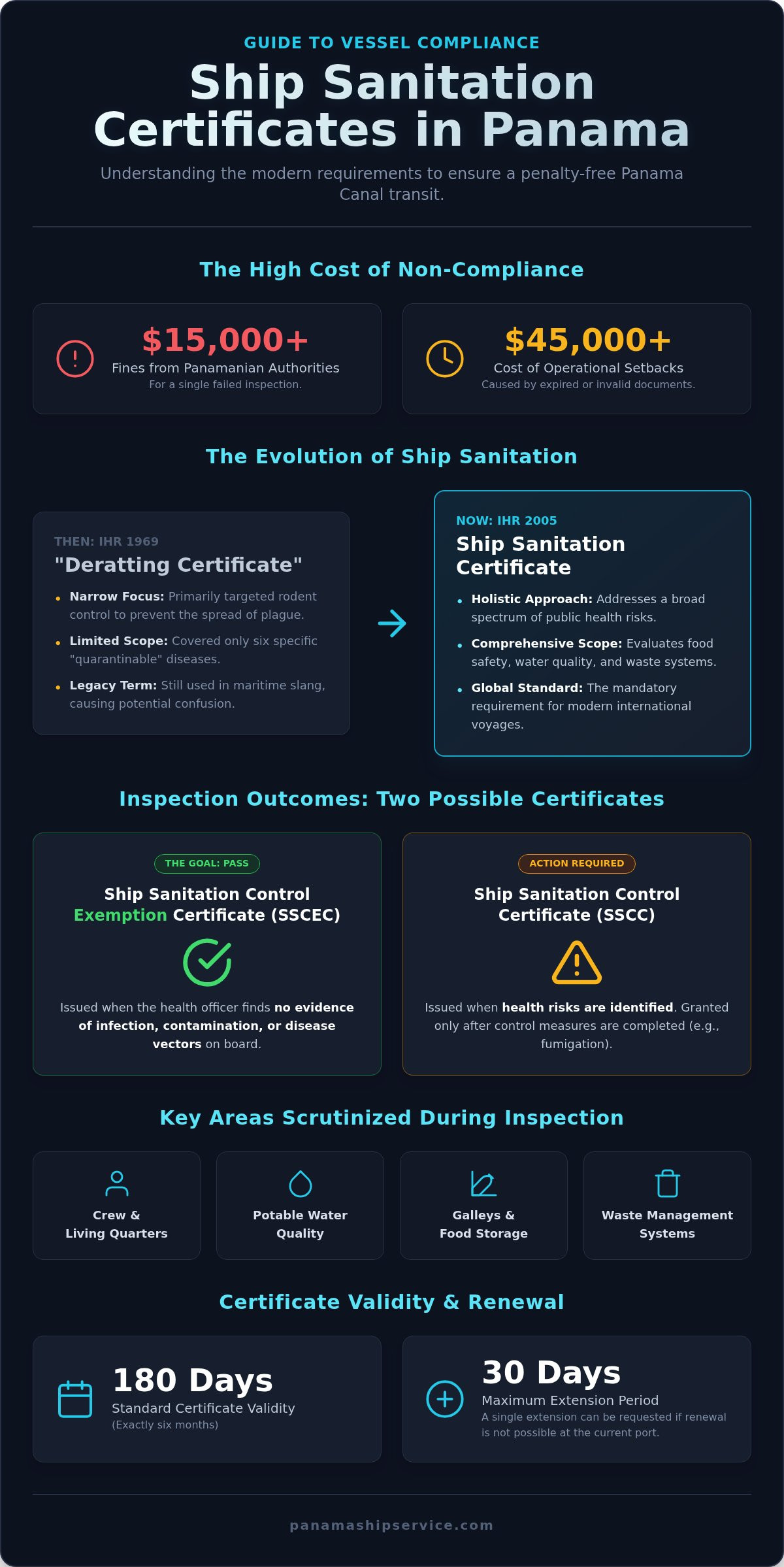
A single expired document can trigger operational setbacks costing over $45,000, while a failed inspection might result in fines exceeding $15,000 from Panamanian authorities. You likely understand that securing a valid ship sanitation certificate panama is a non-negotiable requirement for a smooth transit, yet keeping your vessel compliant is a constant administrative battle. This is particularly true when industry terminology shifts from the traditional “Deratting Certificate” to modern international standards. Confusion over these terms often leads to avoidable delays at critical maritime hubs.
This guide clarifies the transition to the Ship Sanitation Control Certificate (SSCC) and explains how to secure compliance without disrupting your operational schedule. You’ll learn exactly what inspectors look for in 2026, how to manage the mandatory e-certificate platform, and why the distinction between exemption and control certificates matters for your bottom line. We provide a clear roadmap for preparing your vessel for a sanitary inspection, ensuring your Panama Canal transit remains efficient and penalty-free. By delegating these technical complexities to a seasoned partner, you can focus on the voyage while we handle the regulatory pressure.
Key Takeaways
- Understand the evolution from the legacy “Deratting Certificate” to the modern Ship Sanitation Control Certificate (SSCC) required by the World Health Organization.
- Identify the specific high-risk areas health officers inspect, including galleys and food storage, to avoid failed inspections and heavy fines.
- Learn the exact steps to obtain or renew a ship sanitation certificate panama while transiting the Canal to maintain operational momentum.
- Master the timeline for renewals, including the standard 180-day validity and the process for requesting a 30-day extension when in transit.
- Discover how integrating sanitary compliance with other essential maritime services at the Panama hub minimizes vessel idle time and administrative overhead.
Understanding the Deratting Certificate and Its Modern Evolution
Historically, a Deratting Certificate was a specific document certifying a vessel was free of rodents. It focused on preventing the spread of plague. Today, while the name persists in maritime slang, the legal standard has evolved into a more comprehensive health declaration. Securing a Ship Sanitation Certificate is now the mandatory requirement for international trade. Even in 2026, Port State Control officers and charterers often use “Deratting” as shorthand. However, relying on outdated terminology during a canal transit leads to confusion. Understanding the current legal framework is essential for maintaining your schedule and avoiding the $15,000 fines often associated with documentation errors.
The Shift from IHR 1969 to IHR 2005
The transition from the International Health Regulations (IHR) of 1969 to the 2005 revision marked a significant change in maritime health standards. The 1969 rules were narrow. They primarily targeted six “quarantinable” diseases and focused almost exclusively on rodent control. The World Health Organization (WHO) updated these standards to address a broader spectrum of public health risks. Modern inspections don’t just look for rats. They evaluate food safety protocols, potable water quality, and waste management systems. This holistic approach ensures that a vessel doesn’t become a vector for any infectious disease, not just those carried by pests. Securing a valid ship sanitation certificate panama ensures your vessel meets these modern biosecurity demands before entering the Canal.
SSCC vs. SSCEC: Which One Does Your Vessel Need?
Your vessel will receive one of two specific documents depending on the inspection results. The Ship Sanitation Control Exemption Certificate (SSCEC) is the goal for every master. It’s issued when the inspector finds no evidence of infection or vectors on board. If the inspection reveals issues, such as pest infestations or hygiene failures, the authority issues a Ship Sanitation Control Certificate (SSCC). This document is only granted after the vessel completes specific control measures, like professional fumigation or deep cleaning. A ship sanitation certificate panama remains valid for exactly six months, though you can request a single 30-day extension if the inspection cannot be performed at your current port. Understanding this distinction helps you prepare your crew and avoid the operational delays caused by unexpected control requirements.
The Regulatory Framework: IHR 2005 and International Health Standards
Article 39 of the International Health Regulations (2005) provides the legal foundation for modern maritime health compliance. This regulation mandates that every vessel engaged in international voyages must carry a valid certificate. Port State Control (PSC) officers treat these documents as a primary indicator of a vessel’s hygiene management. An expired or invalid ship sanitation certificate panama does more than just trigger a warning. It signals a systemic failure in vessel maintenance, often leading to intensive inspections that delay transit schedules. In Panama, the Ministry of Health (MINSA) and the Panama Maritime Authority (AMP) enforce these standards with zero tolerance. Documentation non-compliance often results in fines starting at $15,000, while the resulting operational delays can cost ship owners upwards of $45,000 in lost time.
Global Port Authority Requirements
Authorities across the globe rely on standardized WHO forms to maintain a consistent defense against disease transmission. For a certificate to be legally recognized in every port, it must be issued by a “Competent Authority” designated by the World Health Organization. This standardization is why the WHO handbook for ship inspections is the essential reference for both surveyors and ship masters. Ensuring your vessel meets these global benchmarks is a technical process. Aligning your health documentation with professional marine surveys in Panama provides a comprehensive safety net, ensuring every sanitary and technical detail is verified before you reach the Canal anchorage. If your paperwork is nearing its expiration, it’s efficient to coordinate a renewal inspection alongside your scheduled transit to avoid redundant stops.
Public Health Emergencies of International Concern (PHEIC)
The Ship Sanitation Certificate serves as a frontline defense against Public Health Emergencies of International Concern (PHEIC). Its role is critical in preventing the spread of infectious diseases across borders. Inspectors focus heavily on vector-borne diseases like Yellow Fever, Malaria, and Plague. This is especially relevant in tropical hubs. For instance, Panama reported over 10,000 cases of Dengue fever in 2023, which has led to increased scrutiny of vessel vector control measures. Regular inspections don’t just satisfy a legal requirement; they protect the lives of your crew and ensure operational continuity. A single outbreak on board can lead to a total vessel quarantine, with daily detention costs for bulk carriers often exceeding $25,000. Maintaining a valid ship sanitation certificate panama is your most effective tool for managing these high-stakes health risks.
The Inspection Process: How to Obtain a Ship Sanitation Certificate
Securing a ship sanitation certificate panama requires more than just updated paperwork. It demands a rigorous physical audit of the vessel’s living and operational spaces. Preparation is the only way to ensure a seamless transition from the anchorage to the Canal. When the health officer boards, they expect the crew to have all high-risk areas accessible and documentation organized for immediate review. This isn’t a casual walkthrough; it’s a technical evaluation of the vessel’s ability to prevent disease transmission. A lack of preparation often leads to the discovery of biological evidence, which immediately complicates your transit schedule and increases overhead.
Step-by-Step Vessel Audit
The inspection follows a systematic protocol designed to identify health risks quickly. The process typically unfolds in four distinct stages:
- Step 1: Documentation Review. The inspector begins by examining the Maritime Declaration of Health, medical logs, and the garbage record book. They’ll also verify the status of your previous SSCC or SSCEC.
- Step 2: High-Risk Area Walkthrough. The focus shifts to the galley, dry stores, and refrigerated lockers. Inspectors look for standing water, food debris, and improper storage temperatures that could encourage vector breeding.
- Step 3: Vector Evidence Check. This is a detailed search for signs of rodents or insects. The surveyor looks for droppings, gnaw marks, or larvae in dark corners, cable runs, and behind galley equipment.
- Step 4: Technical Systems Inspection. The audit concludes with an assessment of the potable water system and sewage treatment units. The inspector may check chlorination levels or maintenance logs for these critical systems.
What Happens if Infestation is Found?
If the inspector finds evidence of pests or infectious risks, the vessel will not receive an exemption. Instead, the authority issues a Ship Sanitation Control Certificate (SSCC). This document lists the specific findings and mandates ‘control measures’ that the ship must undergo. In most cases, this involves professional fumigation, localized pest control, or the disinfection of water tanks. You can’t simply ignore these findings. The vessel must complete the remediation before a new 6-month certificate is issued. Because we operate as a consolidated service provider, we can coordinate these remediation steps immediately. This prevents the vessel from being idle while waiting for third-party contractors, ensuring you maintain your scheduled transit window despite the inspection findings.
Validity, Renewals, and the Risks of Non-Compliance
A Ship Sanitation Certificate carries a standard validity of 180 days. This six-month window ensures that vessels maintain high hygiene standards through regular, professional oversight. You can’t renew these certificates remotely. A physical inspection is a mandatory requirement under international law. If your vessel is in transit and the certificate is about to expire, you may apply for a single 30-day extension. This extension is typically granted only if the port of call lacks the authorized personnel to conduct a full audit. Relying on extensions is a risky strategy. It leaves zero margin for error during critical transits where scheduling is tight. Securing a ship sanitation certificate panama early is the most efficient way to protect your transit window.
Non-compliance creates a ripple effect across your entire maintenance schedule. For example, if a vessel is detained for health violations, you lose the window for scheduled mechanical ship repairs in Panama. Port authorities often restrict technical work while a ship is under quarantine or sanitation review. This creates a bottleneck that increases your total vessel downtime and inflates operational costs. Managing these requirements proactively prevents a minor administrative oversight from becoming a major financial burden.
Managing the 6-Month Renewal Cycle
Proactive fleet management is the only way to avoid expiration. Technical managers should schedule inspections at least 30 days before the deadline. Maintaining a detailed “Sanitation Log” on board significantly simplifies the process. When an inspector sees a well-documented history of pest control and water testing, it builds confidence in the ship’s management. This often leads to a faster, more efficient audit. Tracking these dates across a fleet requires a centralized digital system. The Panama Maritime Authority’s shift to e-certificates in late 2025 has made this tracking easier, but the responsibility for timely renewal remains with the operator.
The Cost of Delays: Port State Control Detentions
The financial consequences of an expired “Deratting Certificate” are severe. A mid-sized bulk carrier can lose between $25,000 and $55,000 per day while idle in quarantine. Missing a reserved Panama Canal slot due to documentation errors is even more costly. A failed inspection can cost a vessel over $50,000 in lost time and fines. Beyond the immediate financial hit, uncertified outbreaks carry significant legal liabilities for ship owners. If a crew member falls ill due to a vector-borne disease and the vessel lacks a valid ship sanitation certificate panama, the owner faces massive litigation risks. You can avoid these liabilities by ensuring your paperwork is always current. To secure your vessel’s compliance before your next transit, contact our authorized surveyors today.
Streamlining Sanitation Inspections at the Panama Canal Hub
Timing is everything in the maritime industry. We coordinate directly with vessel agents to ensure health officers board at the optimal moment, whether the vessel is at the Balboa or Colon anchorage. This precision prevents the inspection from clashing with other critical operations like bunkering or crew changes. If the surveyor identifies a need for remediation, our team provides rapid response fumigation services immediately. We don’t just identify the problem; we resolve it while the ship is still in transit. Integrating these health audits with mechanical ship repairs allows technical managers to optimize vessel downtime. You can complete your engine maintenance and secure your sanitation exemption simultaneously. This ensures the vessel is fully compliant and technically sound before entering the locks, preventing any risk of being turned back by the Panama Canal Authority (ACP).
Choosing Panama Ship Service for Compliance
Our team brings deep expertise in both local ACP regulations and international WHO standards. We understand the dual-layer verification systems implemented in 2026, which require comparing digital data with original hard copies. This technical knowledge ensures your documentation withstands the highest levels of scrutiny from Port State Control. We are committed to providing MARPOL and IHR-compliant maritime solutions that protect your fleet’s global reputation. Delegating these complexities to an authorized local partner reduces the administrative load on your crew and shore-based staff. Much like the meticulous planning and coordination required in custom residential architecture and neighborhood planning by TanneyDesign, our presence in this strategic hub allows us to act as a single point of contact for all compliance needs, from cargo handling to technical surveys. Contact us today for a comprehensive quote on sanitary inspections and certification to ensure your next transit is efficient and penalty-free.
Secure Your Transit with Expert Health Compliance
Maintaining maritime health compliance is no longer just about rodent control; it’s a comprehensive biosecurity requirement that protects your crew and your commercial schedule. By understanding the shift from legacy deratting terminology to modern SSCC standards, you can avoid the $15,000 fines and multi-day detentions that plague unprepared operators. Utilizing the strategic anchorage time at the Canal ensures your ship sanitation certificate panama remains valid without adding unnecessary port calls or deviations to your voyage.
As an authorized IHR inspection provider, we offer 24/7 service at both Balboa and Cristobal ports to keep your fleet moving. Our consolidated maritime solutions allow you to handle sanitary audits, technical repairs, and supplies in a single, efficient stop. Don’t let an administrative oversight disrupt your next transit. Ensure your vessel compliance—request a Ship Sanitation Inspection from Panama Ship Service today. We’re here to help you navigate these regulatory complexities with confidence and precision.
Frequently Asked Questions
What is the difference between a Deratting Certificate and a Ship Sanitation Certificate?
The legacy Deratting Certificate focused exclusively on rodent control to prevent the spread of plague. In contrast, the modern Ship Sanitation Certificate covers a broader spectrum of public health risks under the IHR 2005 framework. This includes food safety, potable water quality, and vector control for diseases like Dengue or Malaria. While mariners still use the old term, Port State Control requires the updated SSCC or SSCEC documentation to permit transit.
How long is a Ship Sanitation Control Exemption Certificate (SSCEC) valid?
A Ship Sanitation Control Exemption Certificate (SSCEC) is valid for exactly six months, or 180 days, from the date of issuance. This period is standardized globally by the World Health Organization to ensure regular hygiene monitoring across international fleets. To maintain compliance, you must schedule a new inspection before this window closes. Failing to renew your ship sanitation certificate panama on time results in immediate vessel detention and significant administrative penalties.
Can a private company issue a Deratting Certificate in Panama?
In Panama, only authorized competent authorities like the Ministry of Health (MINSA) or the Panama Maritime Authority (AMP) can officially issue these documents. However, private consolidated service providers like Panama Ship Service are authorized to conduct the required sanitary inspections and facilitate the issuance process. We act as the technical bridge between your vessel and the regulatory bodies, ensuring that all physical audits meet the specific requirements for a valid certificate.
What happens if my ship sanitation certificate expires while at sea?
If your certificate expires while the vessel is at sea, you must notify your port agent and the maritime authority at your next destination immediately. You may be eligible for a single 30-day extension if the upcoming port lacks the facilities for a full inspection. Without this extension, your vessel faces mandatory quarantine and fines starting at $15,000. Proactive communication is the only way to mitigate these operational and financial risks.
Do I need a new certificate for every port I visit?
No, you don’t need a new certificate for every port of call. A valid Ship Sanitation Certificate is recognized internationally by all signatories of the IHR 2005 for its full six-month lifespan. As long as the document is current and issued by a recognized competent authority, it serves as proof of health compliance in every global port. You only need a re-inspection if the certificate expires or if an inspector finds evidence of a health risk.
Is fumigation mandatory to receive a Ship Sanitation Certificate?
Fumigation isn’t a mandatory requirement for every vessel. It’s only required if the inspector finds active evidence of pests, such as rodents or insects, during the physical audit. If your ship is clean, you’ll receive an Exemption Certificate (SSCEC). If remediation is necessary, you’ll be issued a Control Certificate (SSCC) after the fumigation is completed. Maintaining a clean galley and dry stores is the most effective way to avoid these extra costs.
What areas of the ship are checked during a sanitation inspection?
Inspectors conduct a thorough walkthrough of several high-risk zones. Key areas include the galley, food storage lockers, and refrigerated units to check for hygiene and temperature control. They also examine potable water systems, sewage treatment plants, and medical lockers. In the engine room, they focus on ballast points and standing water. Every area capable of harboring vectors is subject to scrutiny during a ship sanitation certificate panama inspection.
Can I get a 30-day extension on my expired deratting certificate?
You can request a single 30-day extension on a certificate that’s nearing expiration. This is typically granted when a vessel is in transit to a port where a full inspection can be performed. You must apply for this extension before the original 180-day period ends. Authorities won’t grant an extension if the certificate has already expired. It’s a temporary measure designed to prevent vessel detention while you reach an authorized inspection hub like Panama.