
Did you know that 40% of avoidable Panama Canal delays stem from technical non-compliance and mechanical neglect that could be rectified while your vessel is at anchorage? In a year where Neopanamax slot auction premiums have spiked to $425,000, understanding the common causes of panama canal transit delays isn’t just about operational logistics; it’s about protecting your bottom line. You’re likely already dealing with the stress of unpredictable waiting times and the 81% probability of a severe El Niño event further restricting Gatun Lake water levels. It’s a high-stakes environment where a single oversight leads to massive financial penalties.
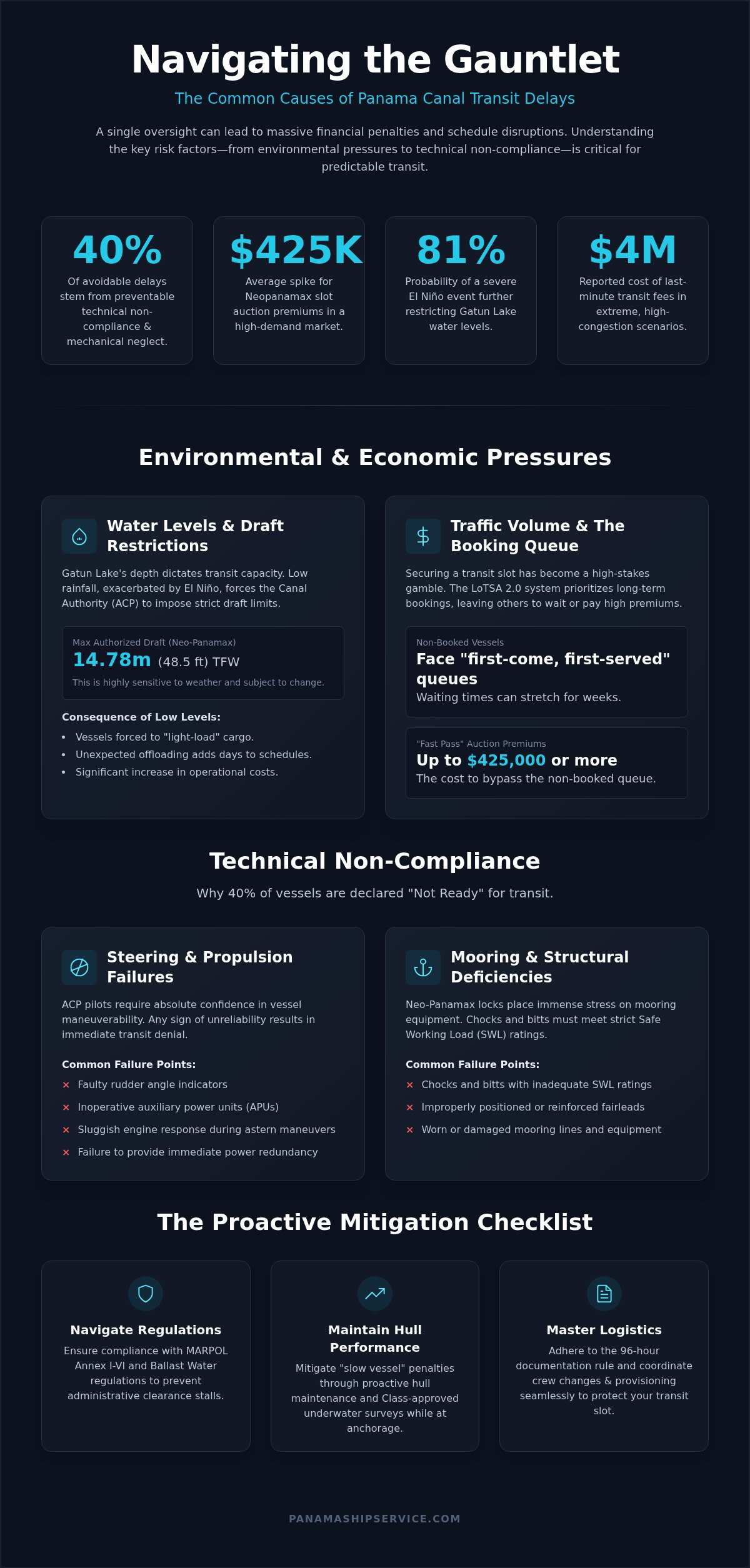
We understand that the pressure to maintain a schedule is immense, especially with last-minute auction fees reaching as high as $4 million in extreme cases. This guide will help you identify and mitigate the most frequent technical, environmental, and regulatory hurdles that cause costly vessel stalls. We’ll preview the latest 2026 requirements, from the 14.78-meter draft limit to the LoTSA 2.0 reservation system, to ensure your fleet achieves predictable transit schedules and zero fines for non-compliance.
Key Takeaways
- Understand how Gatun Lake water levels and seasonal weather patterns dictate daily transit capacity and draft limits throughout 2026.
- Identify the common causes of panama canal transit delays, specifically focusing on propulsion, steering, and mooring equipment standards required for Neo-Panamax locks.
- Navigate MARPOL Annex I-VI and ballast water regulations to prevent administrative clearances from stalling your vessel’s schedule.
- Learn how to mitigate “slow vessel” penalties through Class-approved underwater surveys and proactive hull maintenance while at anchorage.
- Master the 96-hour documentation rule and logistics coordination to ensure seamless crew changes and provisioning without disrupting your transit sequence.
Environmental and Macro Factors Driving Canal Congestion in 2026
Operational certainty at the Panama Canal is currently dictated by environmental volatility. While technical readiness is vital, the macro landscape of 2026 presents hurdles that even the most prepared fleet managers find daunting. These external pressures are among the most significant common causes of panama canal transit delays this year. Global shipping shocks, such as redirected traffic from other major waterways, have surged volume at both the Pacific and Atlantic entrances. This creates a bottleneck that requires precise strategic planning to navigate effectively.
Water Level Management and Draft Restrictions
Gatun Lake serves as the canal’s primary reservoir. Its depth is the lifeblood of transit capacity. As of August 15, 2026, the maximum authorized draft for the Neo-Panamax locks is set at 14.78 meters (48.5 feet) Tropical Fresh Water (TFW). This limit is highly sensitive to rainfall in the Chagres River basin. With an 81% probability of a severe El Niño event in the latter half of 2026, fleet managers must prepare for even stricter fluctuations. When water levels drop, the Panama Canal Authority (ACP) implements tiered draft restrictions. This forces vessels to “light-load” or offload cargo at local terminals. Such maneuvers add days to the schedule and thousands to operational costs. Proactive monitoring of lake levels isn’t optional; it’s a core requirement for avoiding unexpected delays.
Traffic Volume and the Booking Queue
Securing a transit slot has become a high-stakes financial gamble. The ACP’s LoTSA 2.0 system now prioritizes long-term slot allocation, leaving non-booked vessels to face the “first-come, first-served” realities of the anchorage queue. For those without a reservation, waiting times can stretch into weeks. This has led to an increased reliance on the “Fast Pass” auction system. In May 2026, auction premiums for Neo-Panamax slots reached $425,000. Extreme cases have seen last-minute fees hit $4 million. Fleet managers must weigh the $100,000 standard Neopanamax booking fee against the potential of a $10,000 fixed Freshwater Surcharge and the risk of indefinite anchorage. Understanding these common causes of panama canal transit delays is the only way to maintain a competitive schedule in this congested environment. Predictive scheduling requires analyzing current vessel backlog statistics daily to determine the most cost-effective entry strategy.
In addition to navigating transit logistics, ensuring the quality of goods at the point of origin is vital; for businesses sourcing from Asia, The Inspection Company provides the quality control and factory audits necessary to prevent supply chain disruptions before cargo even reaches the canal.
Technical Non-Compliance: Why Vessels are Declared ‘Not Ready’
While many operators focus on environmental factors and canal congestion, mechanical failure remains a leading reason for costly stalls. The Panama Canal Authority (ACP) maintains zero tolerance for equipment deficiencies. If your vessel isn’t technically compliant during the boarding inspection, it’s declared “Not Ready.” Technical oversights are among the most frustrating common causes of panama canal transit delays because they are entirely preventable through proactive maintenance. A vessel declared “not ready” loses its assigned transit slot and is reassigned to the end of the non-booked queue, which can add days of expensive waiting time.
Steering and Propulsion Redundancy
Steering gear and main engine reliability are paramount for safe navigation through the locks. ACP pilots must have absolute confidence in the vessel’s maneuverability within the narrow lock chambers. Common failures that trigger immediate transit denial include faulty rudder angle indicators, inoperative auxiliary power units, or sluggish engine response during astern maneuvers. The ACP requires main engines to be capable of multiple starts and auxiliary power systems to provide immediate redundancy. Pre-arrival steering gear tests and engine room drills are not just recommendations; they are survival tactics for your schedule. Identifying a sluggish governor or a leaking hydraulic line while at anchorage allows for correction before the official inspection begins.
Mooring Gear and Structural Requirements
Mooring gear requirements are significantly stricter for vessels using the Neo-Panamax locks. Chocks and bitts must meet specific Safe Working Load (SWL) ratings to handle the immense stress of the canal’s tugs and locomotives. Many older vessels or those recently converted for canal transit fail because their fairleads are not properly positioned or their bitts lack the required reinforcement. All technical specifications must be accurately logged in the VUMPA (Single Window) system well before arrival. Discrepancies between your digital filings and the physical hardware on deck will lead to a failed clearance. Ensuring your mooring equipment is up to Neo-Panamax standards is a critical step in avoiding common causes of panama canal transit delays.
Bridge visibility and internal communication systems are equally vital for safe passage. Pilots require an unobstructed view of the canal banks and lock walls from the bridge wings. Any temporary cargo, new equipment installations, or structural obstructions that violate these sightline requirements will result in a failed inspection. Furthermore, communication links between the bridge and mooring stations must be crystal clear. If a pilot cannot communicate with the crew at the bow or stern instantly, the transit is aborted for safety reasons. Addressing these mechanical risks early is vital. You can secure Mechanical Ship Repairs while at anchorage to ensure your vessel passes the ACP boarding inspection on the first attempt.
Environmental Regulations and MARPOL Violations
Regulatory non-compliance is just as disruptive as mechanical failure. Environmental standards are among the primary common causes of panama canal transit delays in 2026. The Panama Canal Authority (ACP) enforces strict adherence to international MARPOL standards, and any discrepancy during the boarding inspection can halt your transit immediately. For instance, every vessel over 400 gross tons must maintain an approved Panama Canal Shipboard Oil Pollution Emergency Plan (PCSOPEP). Failure to produce these documents or demonstrate compliance with fuel sulfur limits (0.50% m/m) leads to immediate detention. You must ensure your vessel readiness and compliance documentation is updated and available before the pilot boards.
Invasive species management has also become a critical gateway for canal clearance. Vessels are required to conduct a full ballast water exchange in the open ocean or utilize an approved onboard Ballast Water Treatment System (BWTS). Biofouling on the hull is scrutinized with equal intensity. If inspectors detect significant growth, they may deem the vessel an ecological risk. This leads to transit denial until the hull is cleaned, which is a costly and time-consuming process while in the queue.
MARPOL Waste and Sludge Management
Landing sludge and bilge water in Panama is a complex logistical task that requires precision. You can’t simply offload waste without following specific local protocols and securing authorized receipts. If your oil record book entries don’t match your physical tank levels, expect a delay. Many fleet managers struggle with the coordination of MARPOL disposal panama services while at anchorage. This often results in port state control delays that cause you to miss your assigned transit window. Accurate documentation for garbage disposal and oil record book entries is non-negotiable for a smooth passage.
Sanitary and Health Compliance
The Ministry of Health (MINSA) plays a critical role in vessel boarding and clearance. They inspect for sanitary conditions and verify the validity of Deratting or Sanitation certificates. Common errors in crew health declarations or missing vaccination records often stall transit approval. If your vessel carries specific cargo types, pre-arrival fumigation requirements might apply. Don’t let a clerical error in a health declaration become one of the common causes of panama canal transit delays for your fleet. Maintaining a proactive stance on crew health and sanitary documentation ensures that MINSA clearance remains a routine step rather than a bottleneck.
The Hidden Cost of Hull Fouling and Mechanical Neglect
Extended periods at anchorage are more than just a scheduling inconvenience; they’re a period of active mechanical and biological degradation for your vessel. Biofouling accumulates rapidly in the warm, nutrient-rich waters of the Pacific and Atlantic entrances. This silent accumulation is one of the most overlooked common causes of panama canal transit delays. When a vessel’s hull is heavily fouled, its hydrodynamic efficiency drops, making it difficult to maintain the minimum transit speed required by the Panama Canal Authority (ACP). If a vessel cannot keep pace with the convoy, it faces “slow vessel” penalties or, in extreme cases, removal from the transit sequence. This results in the immediate loss of a multi-million dollar slot and reassignment to the end of a weeks-long queue.
Underwater Integrity and Performance
Maintaining a clean hull is a strategic necessity for 2026 operations. Proactive fleet managers utilize their time at anchorage to conduct Class-approved underwater inspections (UWILD). These surveys identify structural damage or fouling before the official ACP boarding. Utilizing professional underwater hull services while waiting at Balboa or Cristobal ensures your vessel meets performance standards. Propeller polishing is particularly effective; it’s a low-cost strategy that significantly improves thrust and fuel efficiency during the actual transit. Identifying a niche structural issue or excessive barnacle growth through an in-water inspection allows you to rectify the problem before it triggers a transit denial.
Routine Maintenance vs. Emergency Repairs
The Panamanian climate is unforgiving on vessel machinery. High humidity and tropical water temperatures place immense strain on engine room cooling systems, pumps, and valves. It’s common for critical components to fail after days of idling in the heat. A malfunctioning A/C system or a seized cooling pump can lead to engine room overheating, which renders the vessel “not ready” for the pilot. By coordinating mechanical ship repairs panama while your vessel is in the queue, you turn idle time into a technical advantage. Fixing a leaking valve or a temperamental governor at anchorage is far more cost-effective than losing your transit slot due to a last-minute mechanical failure. Proactive maintenance is the only safeguard against the high-stakes financial risk of an aborted transit. For immediate technical support and to ensure your vessel remains compliant, contact Panama Ship Service to schedule your pre-transit inspection.
Strategies to Minimize Delays: The Logistics Checklist
Precision in logistical planning is the only way to counteract the volatility of the 2026 transit environment. While weather patterns and water levels remain outside your control, the management of your vessel’s administrative and physical readiness is entirely within your remit. One of the most avoidable common causes of panama canal transit delays is the failure to adhere to the ACP’s strict 96-hour rule. This mandate requires an accurate Estimated Time of Arrival (ETA) notice and the submission of all required documentation, including ballast water declarations and PCSOPEP details, well before the vessel reaches the canal’s waters. Late or inaccurate filings result in immediate slot forfeiture and steep administrative penalties.
Effective fleet management requires a clear distinction between the roles of your shipping agent and your technical service provider. While the agent manages the paperwork and pilotage bookings, your technical partner ensures the vessel remains compliant under the heat and humidity of the Panamanian anchorage. Turning “waiting time” into “working time” is a strategic advantage. Instead of allowing your crew to idle, use the delay to coordinate crew changes, conduct surveys, and replenish resources. This proactive approach ensures that when the pilot finally boards, the vessel is in peak operational condition.
Provisioning and Spare Parts Logistics
Long waiting periods at anchorage can quickly deplete onboard stores, leading to potential sanitary or health compliance issues. It’s essential to source ship supplies panama canal from providers who understand the urgency of the transit sequence. Logistics in Balboa and Cristobal must be handled with speed to ensure that fresh water, provisions, and technical spare parts reach the vessel without disrupting its position in the queue. If a critical component, such as a fuel pump or a steering gear seal, fails during the wait, emergency sourcing through local technical partners is the only way to avoid a “not ready” declaration. Reliable supply chains are your primary defense against the cascading costs of a missed transit window.
The Final Transit Checklist
The 24-hour window before your scheduled transit is the most critical period for operational success. Your bridge team must undergo a comprehensive pre-boarding briefing on current ACP pilotage protocols to ensure seamless communication with the incoming pilot. A final, rigorous verification of all steering gear, propulsion systems, and mooring equipment is mandatory. Any technical doubt at this stage should be addressed immediately. Coordinating with mechanical ship repairs specialists for a final technical sign-off provides the necessary assurance that the vessel will pass the boarding inspection. This final checklist is your last opportunity to mitigate the common causes of panama canal transit delays and secure a predictable, efficient passage through the locks.
Secure Your Fleet’s Transit Schedule in 2026
Navigating the Panama Canal in 2026 requires more than just a booking slot; it demands technical and regulatory precision. We’ve explored how mechanical failures and non-compliance with MARPOL standards are among the most persistent common causes of panama canal transit delays. By addressing hull biofouling and propulsion issues while your vessel is at anchorage, you transform idle time into an operational advantage. This proactive approach is the only way to avoid the extreme costs associated with failed boarding inspections and lost transit windows.
You don’t have to manage these complexities alone. Ensure a seamless transit with Panama Ship Service’s technical expertise and repair solutions. Our team provides Class-approved underwater and mechanical surveys along with 24/7 emergency support in Balboa and Cristobal ports. From full-service MARPOL disposal to reliable provisioning, we handle the technical details so you can focus on your voyage. Let’s work together to make your next transit predictable and efficient.
Frequently Asked Questions
What are the most common mechanical reasons for Panama Canal transit denial?
Deficiencies in steering gear, main engine reliability, and mooring equipment are the leading technical reasons for denial. Specifically, inoperative rudder angle indicators or mooring bitts that don’t meet Neo-Panamax Safe Working Load (SWL) standards will cause an immediate failed inspection. Pilots must have absolute confidence in a vessel’s maneuverability before entering the narrow lock chambers.
How long is the current average delay for non-booked vessels in 2026?
Waiting times for non-booked vessels currently stretch into weeks depending on the seasonal backlog and water level restrictions. Because the ACP prioritizes vessels with pre-paid bookings, those in the “first-come, first-served” queue face significant uncertainty. Monitoring daily backlog statistics is essential for predicting your actual transit window.
Is a hull cleaning mandatory before transiting the Panama Canal?
Hull cleaning isn’t strictly mandatory for all vessels, but it’s highly recommended if biofouling is present. The ACP monitors transit speeds closely. If excessive growth prevents your vessel from maintaining the minimum required speed, you’ll face “slow vessel” penalties or transit denial. Severe fouling is also scrutinized for invasive species risks.
Can I perform engine repairs while my vessel is at the Panama Canal anchorage?
Yes, you can and should perform necessary repairs at the Balboa or Cristobal anchorages. Addressing mechanical issues while in the queue is a proactive way to avoid common causes of panama canal transit delays. This ensures your vessel is in peak condition before the official ACP boarding officer arrives for inspection.
What happens if my vessel fails the ACP boarding officer’s inspection?
If a vessel fails inspection, it’s declared “Not Ready” for transit. This status results in the immediate loss of your assigned slot and any associated booking fees. The vessel is then reassigned to the end of the non-booked queue, which can lead to weeks of additional waiting time and significant financial loss.
Are there specific MARPOL requirements unique to the Panama Canal?
Every vessel over 400 gross tons must have an approved Panama Canal Shipboard Oil Pollution Emergency Plan (PCSOPEP). Additionally, the ACP strictly enforces a 0.50% m/m fuel sulfur limit within canal waters. You must also demonstrate compliance with ballast water exchange or treatment regulations to prevent the introduction of invasive species.
How do Gatun Lake water levels affect Neo-Panamax vessel requirements?
Low water levels in Gatun Lake trigger tiered draft restrictions to conserve resources. As of August 15, 2026, the maximum authorized draft for Neo-Panamax locks is 14.78 meters (48.5 feet) TFW. When levels drop further, vessels are forced to light-load or offload cargo, which directly impacts the profitability of the transit.
What documentation is required for crew changes during a canal delay?
Crew changes require updated health declarations, valid vaccination records, and clearance from the Ministry of Health (MINSA). Documentation must be submitted through the VUMPA (Single Window) system. Any clerical errors or missing health certificates can stall the clearance process and contribute to common causes of panama canal transit delays for your fleet.