
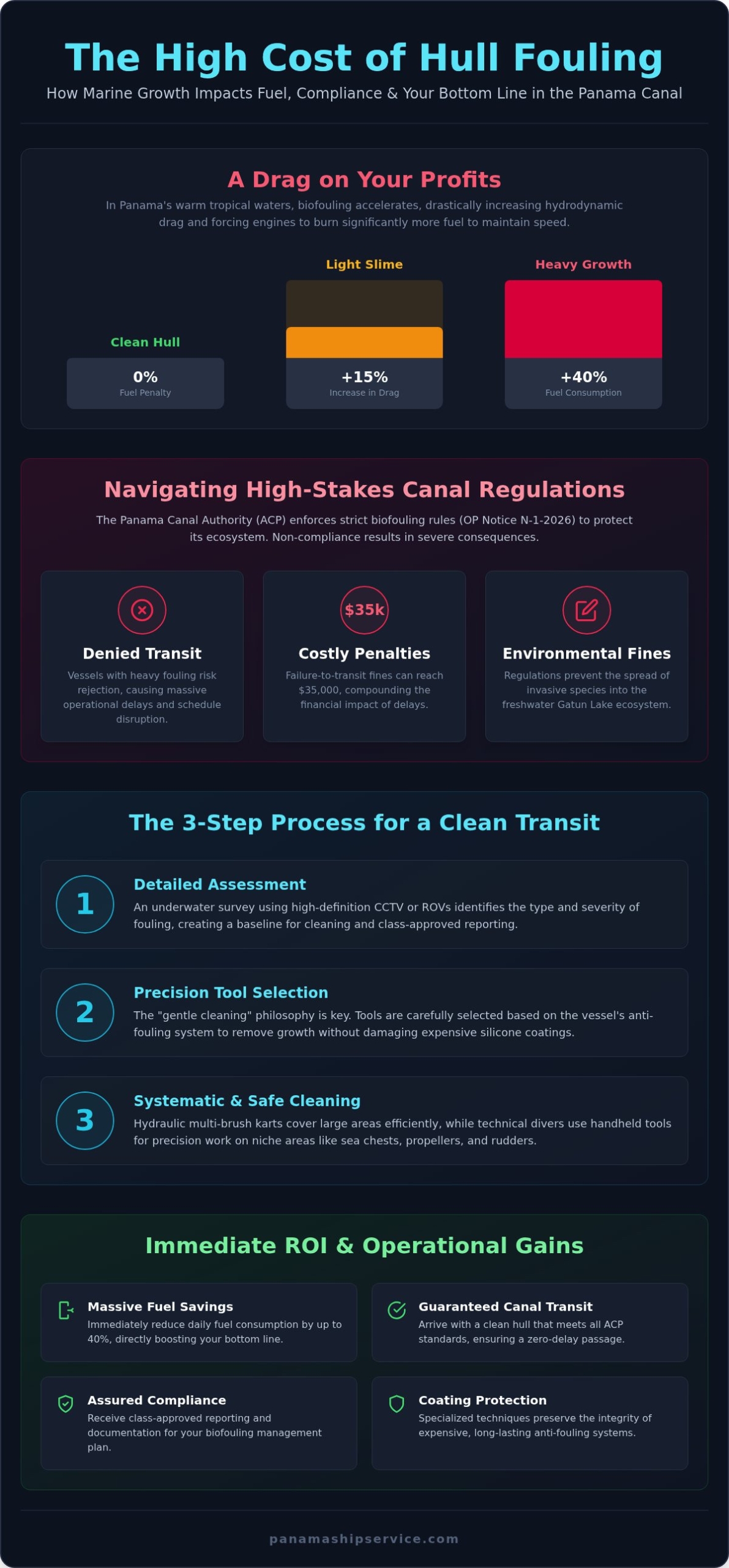
Did you know that even a light layer of slime can increase your vessel’s drag by 15%, while heavy marine growth can spike fuel consumption by a staggering 40%? For ship owners and operators, these escalating fuel costs are a constant drain on the bottom line, especially when combined with the strict 2026 ACP environmental regulations that make every Panama Canal transit a high-stakes event. It’s a high-pressure environment where poor maintenance doesn’t just waste fuel; it risks expensive fines and denied entry.
Professional marine biofouling removal in Panama is no longer just routine maintenance. It’s a strategic necessity to ensure your vessel passes inspection and maintains peak efficiency. This guide explains how to achieve an immediate reduction in daily fuel burn and remain in full compliance with your biofouling management plan without risking damage to expensive silicone hull coatings. We’ll examine the latest “clean and capture” requirements, the impact of the OP Notice to Shipping No. N-1-2026, and how to maximize your anchorage window at Balboa or Cristobal to ensure a zero-delay transit.
Key Takeaways
- Understand why Panama’s tropical waters accelerate hull fouling and how professional cleaning can slash fuel consumption by up to 40%.
- Discover the technical nuances of marine biofouling removal panama, including CCTV inspections and the use of specialized tools that protect delicate silicone coatings.
- Learn to navigate strict 2026 ACP environmental regulations to ensure your vessel passes inspection and avoids costly transit delays.
- Optimize your operational schedule by coordinating hull services at Balboa or Cristobal anchorages to align perfectly with your Canal transit window.
- Evaluate the immediate ROI of underwater maintenance and why partnering with an experienced local provider is critical for class-approved reporting.
Understanding Marine Biofouling in the Panama Canal Zone
Marine biofouling is the persistent accumulation of microorganisms, plants, algae, and small animals on submerged surfaces. For vessels operating in or transiting through the Panama Canal, this biological buildup is an aggressive reality. Panama’s warm tropical waters act as a biofouling hotspot. These conditions accelerate growth rates far beyond what operators experience in temperate zones. This rapid colonization creates a direct relationship between hull roughness, hydrodynamic drag, and engine load. Effective marine biofouling removal panama is a critical preventive maintenance task that restores the vessel to its original design efficiency and protects the hull’s long-term integrity.
A comprehensive approach to Understanding Marine Biofouling reveals that the process begins within minutes of a hull entering the water. Biofilm formation quickly leads to macro-fouling, which significantly alters the vessel’s hydrodynamics. When a hull’s surface is compromised by growth, the engine must work harder to maintain speed, leading to increased wear and tear on mechanical systems. This is why technical managers prioritize cleaning schedules during the anchorage window at Balboa or Cristobal to ensure the ship’s performance isn’t compromised before a transit.
The Economic Impact of Unmanaged Growth
The financial consequences of hull drag are immediate and measurable. Data indicates that even a thin layer of slime can increase fuel consumption by up to 10%. If left untreated, this develops into hard fouling. Barnacles and tubeworms create severe turbulence along the hull, leading to fuel penalties that often exceed 40%. Beyond the daily burn rate, unmanaged growth increases a vessel’s carbon footprint. This leads to higher emissions and potential environmental fines in strict jurisdictions that monitor vessel efficiency and discharge. Professional marine biofouling removal panama turns these potential losses back into operational savings.
Regulatory Compliance and the ACP
The Panama Canal Authority (ACP) maintains stringent requirements for hull cleanliness to protect the local ecosystem. Biofouling management is a primary defense against the spread of invasive aquatic species into the freshwater environment of Gatun Lake. Vessels with heavy growth risk being denied transit or facing significant fines. Technical managers must provide clear documentation of their biofouling management plans and recent cleaning activities. Maintaining a clean hull isn’t just about fuel ROI; it’s about ensuring your vessel remains compliant with the OP Notice to Shipping No. N-1-2026 and avoids the $35,000 failure-to-transit penalties.
The Technical Process of Underwater Biofouling Removal
Professional marine biofouling removal panama starts with a detailed assessment. We don’t just dive in. Technicians use CCTV systems or ROVs to capture high-definition footage of the hull’s condition. This initial inspection identifies the fouling type, whether it’s light slime or hard barnacles, and maps out the niche areas like sea chests and rudders that require specialized attention. Establishing this baseline is essential for choosing the right cleaning intensity and reporting the results to class surveyors.
Choosing the right tool is the most critical technical decision. Using aggressive brushes on a delicate silicone coating can destroy the paint’s integrity, leading to even faster growth in the future. We select brush materials based on the specific anti-fouling system applied to your vessel. This precision ensures we eliminate the growth’s impact on fuel efficiency without compromising the hull’s protective layers. A systematic approach covers the flat bottom first, followed by the vertical sides, before focusing on the complex geometries of the propulsion system.
Advanced Cleaning Equipment: Karts and ROVs
For large, flat surfaces, hydraulic multi-brush karts provide the necessary speed and consistency. These units use adjustable pressure settings to maintain a uniform clean across the hull. While ROVs are excellent for deep-water inspections or areas with high currents, they can’t always reach the intricate geometries of sea chests or gratings. Our technical diving teams use handheld pneumatic tools for this precision work. This combination of automation and manual expertise ensures that even the hardest-to-reach areas are free of invasive species before your Canal transit.
Preserving Hull Coatings and Anti-Fouling
We follow a “gentle cleaning” philosophy. The goal is to remove the biofouling while leaving the anti-fouling paint intact. For modern silicone-based coatings, we employ soft-brush technology. These specialized brushes lift away microorganisms without stripping the expensive, low-friction surface. This proactive grooming extends the interval between dry-docks and keeps the anti-fouling system active for longer. If you’re concerned about maintaining your coating’s warranty, you can consult with our technical team for a customized maintenance plan that prioritizes paint preservation.
The process concludes with a final post-cleaning CCTV inspection. This footage serves as a verifiable record for vessel managers and technical directors. We provide a comprehensive report that documents the “before and after” states, confirming that the vessel is restored to its optimal hydrodynamic profile. This documentation is essential for demonstrating compliance with local ACP regulations and ensuring a smooth transit through the locks.
Economic Benefits: ROI, Fuel Savings, and Performance Gains
Calculating the return on investment for hull maintenance is a straightforward exercise in fiscal responsibility. When you consider that heavy biofouling can increase fuel consumption by 40%, the cost of marine biofouling removal panama becomes an essential investment rather than a mere expense. A single professional cleaning session in Panama can pay for itself within the first two weeks of a transoceanic voyage. Beyond fuel, a clean hull reduces the load on the main engine and propulsion systems, directly lowering long-term mechanical wear and maintenance overhead.
Safety during Canal transits is another critical performance gain. The complex maneuvers required within the locks demand precise control. Biofouling on the rudder or bow thrusters can degrade maneuverability, increasing the risk of incidents or the need for expensive tugboat assistance. By restoring the vessel’s hydrodynamic profile, you ensure the ship responds accurately to the pilot’s commands during every stage of the transit. This operational reliability is vital when a single day of delay at the Canal can cost a Neopanamax vessel over $52,000 in lost charter hire and rescheduling fees.
Reducing engine load isn’t just about fuel; it’s about the lifespan of your hardware. When a vessel is fouled, the engine must run at higher RPMs to overcome drag, which leads to increased exhaust temperatures and accelerated carbon buildup. Professional cleaning helps you avoid these secondary costs. It protects your capital investment while ensuring you don’t face unexpected downtime for engine repairs. In the high-stakes environment of the Panama Canal, this level of technical proficiency is a competitive advantage.
The Synergy of Hull Cleaning and Propeller Polishing
A fouled propeller can negate many of the gains achieved by a clean hull. Even minor calcareous growth on the blades disrupts water flow and reduces torque efficiency. We provide propeller polishing to achieve a “super-smooth” finish, targeting Rupert Scale Grade A. This level of precision maximizes power output and minimizes vibration. Combining these tasks into a single package of underwater hull services ensures the entire propulsion train operates at peak performance.
Performance Gains by Vessel Type
The economic impact varies depending on the vessel’s operational profile. Containerships rely on maintaining high service speeds to meet strict arrival windows. Any drag-induced speed loss results in missed slots and heavy fines. Bulk carriers, which often operate at lower speeds with high displacement, see significant drag reduction that translates into massive volume-based fuel savings over long hauls. For tankers, optimizing the hull condition is vital for both laden and ballast conditions, ensuring efficiency regardless of the cargo volume or draft depth.
Operational Logistics at Panama’s Major Anchorages
Operational efficiency in the Panama Canal depends on precision timing. Coordinating marine biofouling removal panama requires a deep understanding of the anchorage logistics at both the Pacific and Atlantic entrances. We maintain a constant presence at the Balboa and Cristobal anchorages. This allows us to align cleaning schedules perfectly with your vessel’s ETA and transit window. 24/7 availability isn’t a luxury; it’s a requirement for time-sensitive maritime operations where every hour of delay carries a significant financial penalty.
Navigating the local environment is a technical challenge that requires experienced diving teams. The Pacific side at Balboa often presents different swell and current conditions compared to the Atlantic side at Cristobal. Our teams monitor these variables in real-time to ensure safe and effective diving operations. We prioritize safety protocols to protect both our divers and your hull’s integrity. By managing these environmental factors, we ensure that the cleaning process is completed within the allotted time frame without compromising quality.
Balboa vs. Cristobal: Site-Specific Considerations
Choosing the right anchorage usually depends on your transit direction and the prevailing weather patterns. Northbound vessels typically utilize Balboa, while Southbound transits favor Cristobal. However, availability of specialized support craft can vary between sites. We provide a seamless transition between these locations to accommodate your logistics plan. If your vessel needs more than underwater maintenance, you can coordinate mechanical ship repairs panama to resolve technical issues while the hull is being serviced. This multi-service approach minimizes the need for additional stops.
Maximizing the Anchorage Window
The anchorage window is your best opportunity to handle multiple technical requirements through a single point of contact. We specialize in concurrent services. Our teams can perform class-approved underwater inspections (UWILD) while the cleaning karts are active on the hull. This consolidation is the most efficient way to manage your vessel’s technical needs. You can also streamline your port call by arranging marpol disposal panama and the replenishment of ship supplies during the same window. This reduces administrative complexity and ensures your crew can focus on the upcoming Canal transit.
Effective logistics management turns mandatory downtime into a productive maintenance event. By delegating these complexities to a localized partner, you simplify your operations and ensure full compliance with ACP standards. To secure your schedule for an upcoming transit, contact our operations department for a detailed logistics plan.
Why Partner with Panama Ship Service for Biofouling Control?
Choosing a service provider at the Panama Canal requires more than just looking at a price list. It demands a partner with decades of experience in this unique operational environment. We’ve spent years refining our marine biofouling removal panama protocols to meet the specific needs of global ship owners. Our teams use class-approved cleaning equipment designed to prioritize coating preservation, ensuring your vessel maintains its hydrodynamic efficiency without compromising the paint system. This technical expertise is why major fleets trust us to handle their underwater maintenance during the critical anchorage window.
Rapid mobilization is a core component of our service model. We understand that transit schedules are rigid and delays are unacceptable. Our diving teams are stationed at both ends of the Canal, ready to deploy the moment your vessel arrives. We don’t just clean the hull; we provide detailed technical reporting that satisfies the stringent requirements of both owners and class societies. This documentation includes high-definition CCTV footage and a comprehensive analysis of the hull’s condition, providing you with verifiable proof of performance and compliance before you enter the locks.
Reliability and Local Expertise
Operating within the Panama Canal Zone involves navigating complex ACP regulations and local maritime laws. We have a deep understanding of the OP Notice to Shipping No. N-1-2026 and other environmental discharge standards. Our commitment to transparency means you’ll receive professional communication throughout the entire operation, from the initial inspection to the final report. We position ourselves as your premier partner for all technical needs, including mechanical ship repairs. This consolidated approach allows you to delegate complex logistics to a single, reliable entity, simplifying your port call and reducing administrative overhead.
Requesting Your Technical Quote
To provide an accurate and customized service proposal, our operations team requires specific vessel data. When requesting a quote, please include the vessel type, dimensions, the date of your last dry-dock, and your estimated time of arrival (ETA). This information allows us to tailor our equipment selection and diving schedule to your fleet’s specific needs. We focus on business outcomes like fuel efficiency and time savings, ensuring your vessel is restored to peak performance. Contact Panama Ship Service to optimize your vessel’s performance today and secure your slot for professional hull maintenance.
Secure Your Vessel’s Performance and Transit Schedule
Managing hull drag is a financial imperative in an era of escalating fuel costs and strict environmental standards. By prioritizing marine biofouling removal panama, you transform a mandatory anchorage window into a high-value maintenance event. We’ve explored how professional cleaning restores hydrodynamic profiles, reduces fuel burn by up to 40%, and ensures your vessel meets the ACP’s rigorous 2026 biosecurity requirements. These proactive measures don’t just save money; they protect your capital investment and ensure your vessel remains a reliable asset in your fleet.
Panama Ship Service provides the localized expertise needed to navigate the complexities of the Canal zone. We maintain a constant operational presence at both Balboa and Cristobal anchorages, specializing in minimizing Panama Canal transit delays through rapid mobilization. Our class-approved underwater survey and cleaning capabilities ensure that every operation meets the highest technical standards. Don’t let unmanaged growth compromise your schedule or your bottom line. Request a quote for marine biofouling removal in Panama and experience the difference that professional, results-driven underwater services can make for your operations.
Frequently Asked Questions
How often should a vessel undergo biofouling removal in Panama?
Frequency depends on your vessel’s idle time and the age of its coating. In Panama’s high-fouling tropical environment, proactive grooming every six to twelve months is standard to prevent the transition from light slime to hard calcareous growth. Regular maintenance ensures you don’t face transit denials due to biosecurity risks or the need for more aggressive, paint-stripping cleaning methods later.
Will underwater hull cleaning damage my anti-fouling paint?
No, professional cleaning utilizes specialized equipment designed to preserve the hull coating. We select brush materials based on whether you have traditional anti-fouling or a delicate silicone-based system. This “gentle cleaning” approach removes the biological layer without stripping the paint or reducing its active lifespan. Using the correct technical parameters is essential for maintaining your coating’s warranty and effectiveness.
Is biofouling removal permitted at both Balboa and Cristobal anchorages?
Yes, professional marine biofouling removal panama is permitted and standard practice at both the Balboa (Pacific) and Cristobal (Atlantic) anchorages. We manage all logistics and ensure full compliance with the latest ACP environmental discharge regulations. This allows you to maximize your anchorage window effectively regardless of whether your vessel is entering the Canal from the Pacific or the Atlantic side.
How long does a typical hull cleaning take for a Panamax vessel?
A full hull cleaning for a Panamax-sized vessel generally takes between eight and twelve hours. The exact timeframe depends on the fouling severity and the complexity of the niche areas like sea chests and rudders. We deploy multiple diving teams and hydraulic karts to ensure the operation is completed efficiently without delaying your scheduled Panama Canal transit window.
Can hull cleaning be performed during the actual Panama Canal transit?
No, all underwater maintenance must be performed at the designated anchorages before or after the transit. The Panama Canal Authority prohibits any in-water cleaning or mechanical repairs while the vessel is in the locks or transiting the Canal channels. Coordination before arrival is essential to ensure your vessel is clean and compliant before the transit begins.
What is the expected fuel saving after a professional biofouling removal?
Fuel savings depend on the initial condition of the hull but can reach up to 40% for vessels with hard fouling like barnacles. Removing even a light biofilm or slime layer can yield a 10% to 15% reduction in fuel consumption. This immediate ROI makes professional cleaning one of the most cost-effective maintenance tasks for reducing daily operational overhead.
Do you provide photographic before-and-after reports for class approval?
Yes, we provide detailed technical reports that include before-and-after CCTV footage and high-resolution photography. These reports are meticulously structured to meet the standards required for class approval and internal technical audits. This documentation serves as a verifiable record of your vessel’s restored hydrodynamic profile and is essential for maintaining accurate vessel performance logs.
Can propeller polishing be combined with biofouling removal services?
Yes, we highly recommend combining propeller polishing with your marine biofouling removal panama schedule. A fouled propeller significantly reduces propulsion efficiency and can cause excessive vibration and mechanical wear. Achieving a Rupert Scale Grade A finish on the blades maximizes torque and ensures you gain the full economic benefit of a clean and smooth hull.