
A single steering failure during a Panama Canal transit can trigger a $250,000 high-impact disruption charge, instantly turning a profitable voyage into a financial liability. You’re likely aware that the Panama Canal Authority (ACP) has intensified its oversight, yet roughly 12% of vessels still face immediate delays due to technical discrepancies found during pre-transit inspections. When your steering gear or rudder assembly shows signs of wear, securing an expert ship rudder repair panama partner is the only way to safeguard your transit slot and avoid these punitive costs.
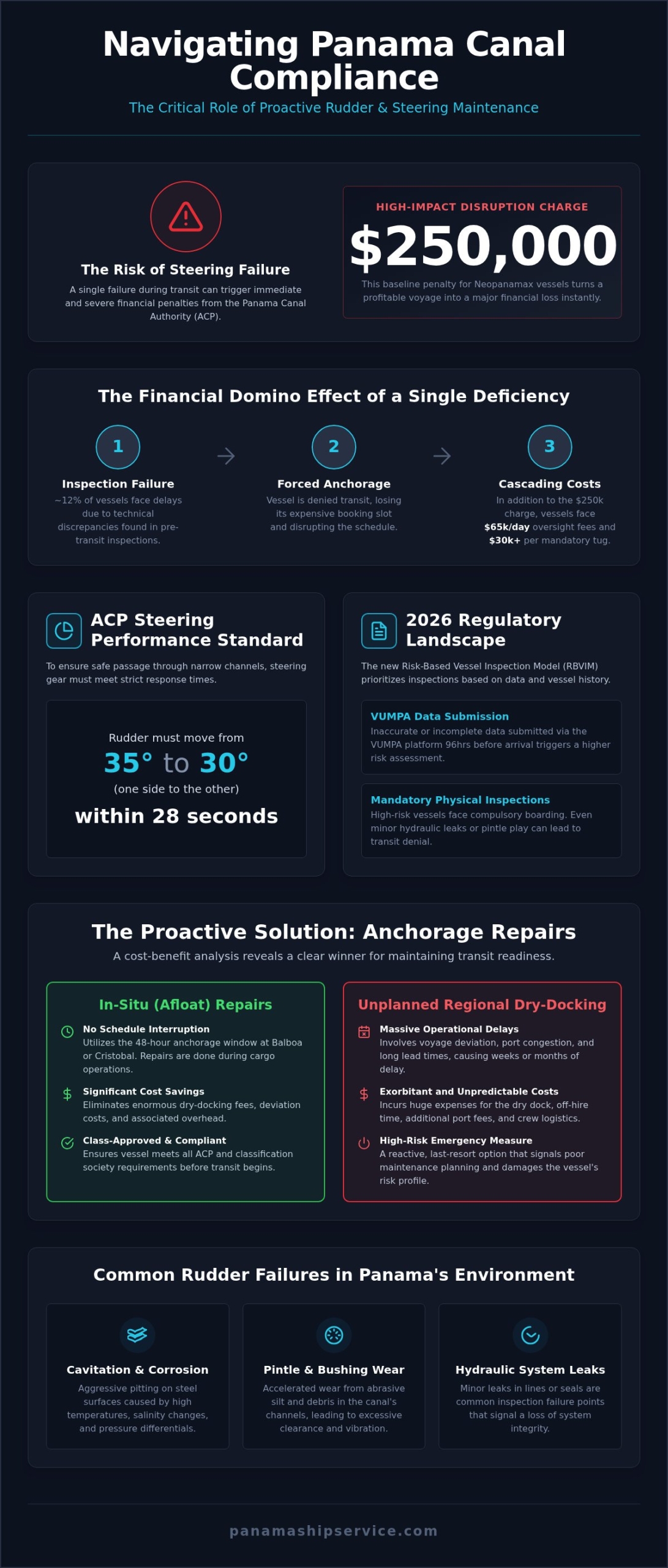
This article provides the technical roadmap you need to master 2026 compliance standards, including the new Risk-Based Vessel Inspection Model (RBVIM) that now dictates physical inspection priorities. You’ll learn how to execute class-approved, in-situ repairs at Balboa or Cristobal anchorages to eliminate the need for costly dry-docking while ensuring your vessel meets mandatory steering performance requirements. We’ll cover everything from navigating the Vessel Unified Maritime Platform (VUMPA) to coordinating specialized underwater inspections that keep your schedule intact and your maintenance overhead low.
Key Takeaways
- Understand the 2026 ACP fee structure and how to mitigate the $250,000 high-impact disruption charge through proactive steering system maintenance.
- Learn the technical advantages of performing a ship rudder repair panama at anchorage to address cavitation and mechanical wear without interrupting your transit schedule.
- Analyze the cost-benefit of in-situ afloat repairs versus the significant overhead and operational delays associated with unplanned regional dry-docking.
- Discover how to strategically utilize the 48-hour anchorage windows at Balboa or Cristobal to complete class-approved technical work during cargo operations.
- Identify how consolidating mechanical and underwater services with a single expert partner simplifies ACP compliance and reduces administrative complexity.
The Criticality of Rudder Integrity for Panama Canal Transits
Vessel control in the Panama Canal’s narrow reaches, specifically the Culebra Cut and the lock approaches, leaves zero margin for mechanical error. Rudder integrity is the primary safeguard against a vessel becoming “not-under-command” in a waterway where lateral clearance is often measured in inches. If a vessel loses steerage and obstructs the channel, the financial consequences are immediate. The Panama Canal Authority (ACP) levies a high-impact disruption charge of $250,000 for Neopanamax vessels. This is a baseline penalty that doesn’t account for the loss of expensive transit slots or the daily $65,000 administrative oversight surcharges. Addressing wear and tear through a professional ship rudder repair panama service is no longer optional; it’s a requirement for fiscal survival.
Steerage Requirements for Safe Lock Passage
The ACP enforces strict performance benchmarks for steering systems to maintain operational flow. According to current standards, the steering gear must be capable of moving the rudder from 35° on one side to 30° on the opposite side within 28 seconds at the vessel’s maximum ahead service speed. Technical adherence to Rudder principles and design ensures the pilot can maintain the ship’s center line under heavy hydraulic pressure. If your system fails to meet these response times, the ACP will mandate tug assistance at a cost of $30,000 or more per tug. These tugs are mandatory for vessels over 100 feet in beam, and any mechanical deficiency that forces an unscheduled tug request will be flagged in the vessel’s permanent record, affecting its future risk assessment profile.
ACP Safety Inspections and Technical Compliance
The 2026 regulatory environment is defined by the OP Notice to Shipping N-1-2026. Under the new Risk-Based Vessel Inspection Model (RBVIM), the ACP uses data from the Vessel Unified Maritime Platform (VUMPA) to categorize ships by risk level. Incomplete or inaccurate data submitted through VUMPA at least 96 hours before arrival can trigger a higher risk assessment, making physical boarding by ACP inspectors inevitable. High-risk vessels, or those with a history of steering deficiencies, face mandatory physical inspections before they’re cleared to enter the canal. Even minor leaks in hydraulic lines or slight play in the rudder pintles can lead to a transit denial. Coordinating proactive mechanical ship repairs for your ship rudder repair panama before your scheduled arrival is the only way to ensure these inspections don’t result in a forced anchorage and a missed booking.
Technical Analysis: Common Rudder Failures & Diagnostic Standards
Panama’s tropical marine environment presents unique challenges for rudder assemblies. High water temperatures and fluctuating salinity levels between Gatun Lake and the ocean entrances create a perfect storm for electrochemical corrosion. Cavitation damage is particularly aggressive on the leading edges and bottom plates. This occurs when pressure drops create vapor bubbles that implode against the steel, causing localized pitting that can compromise structural thickness. Accurate diagnostics are the first step in any successful ship rudder repair panama project, as they determine whether a vessel can safely proceed or requires immediate intervention.
Pintle and Bushing Wear Analysis
The dense silt and organic debris found within the Canal’s restricted channels act as an abrasive, significantly accelerating the wear of pintle bushings. Measuring these clearances during a pre-transit survey is essential for maintaining compliance with the Panama Canal Authority (ACP) Maritime Regulations. Technicians use specialized in-situ measurement tools, such as telescopic gauges and ultrasonic thickness meters, to assess tolerances while the vessel is at anchorage. If the pintle clearance exceeds the maximum allowable limit set by the classification society, the vessel risks vibration issues or mechanical binding. Operators shouldn’t ignore slight increases in vibration, as these often signal that the bushing’s sacrificial material has reached its limit. Professional inspections provide the data needed to justify afloat repairs before a minor wear issue escalates into a transit-blocking failure.
Underwater Welding and Steel Fabrication Standards
Structural repairs to the rudder trunk or blade require adherence to rigorous standards to withstand the immense hydraulic forces experienced during lock maneuvers. We follow AWS D3.6M:2017 Class A specifications for all underwater wet welding. This standard ensures the weld quality is comparable to those performed in dry conditions. When addressing cracks in the rudder trunk, technicians use specialized gouging techniques to remove the defect before re-welding with high-tensile electrodes. This process must also account for lamellar tearing, a common structural failure in thick steel plates subjected to high welding stresses. By utilizing class-approved procedures, a ship rudder repair panama can be completed afloat, restoring the vessel’s integrity without the logistical nightmare of an emergency dry-docking. If your diagnostic reports indicate thinning or structural stress, consulting with a qualified technical partner ensures your repairs meet both class and ACP requirements.
In-Situ vs. Dry Dock Rudder Repairs: A Cost-Benefit Analysis
Unplanned dry-docking in the Panama region is a logistical and financial burden that most operators cannot afford. Beyond the immediate docking fees, the hidden costs of deviating from a set route and the resulting off-hire time can exceed the repair costs themselves. Choosing a ship rudder repair panama service that operates in-situ allows your vessel to maintain its schedule while technicians address mechanical issues at anchorage. This approach is particularly effective during cargo operations or while waiting for a transit slot, turning idle time into productive maintenance. It’s about maintaining momentum in a high-stakes environment where every hour of downtime counts.
Consolidating your rudder work with underwater hull services creates a streamlined operational window. By handling hull cleaning, propeller polishing, and rudder repair simultaneously, you reduce the need for multiple service deployments and administrative overhead. However, risk assessment is critical. In-situ repair isn’t a universal solution. If the rudder pintle is completely seized or if there’s catastrophic internal damage to the steering gear housing that requires heavy lifting beyond the capacity of a support barge, dry-docking becomes the only safe path. Identifying these limits early prevents wasted resources and ensures the vessel’s safety remains the priority.
The ROI of In-Water Rudder Maintenance
The return on investment for afloat repairs is measured in days saved. By avoiding the 7-14 day window typically required for an emergency dry-docking, operators preserve their revenue stream. There’s also a direct impact on fuel efficiency. Cavitation pitting on the rudder surface creates turbulence, increasing drag. Smoothing these surfaces through underwater grinding and filler application restores hydrodynamic efficiency. These small gains in fuel economy, coupled with the extension of intervals between scheduled dockings, significantly lower the total cost of ownership for the vessel’s steering system.
Class Approval for Underwater Repairs
Securing approval from major societies like DNV, ABS, or Lloyd’s is a non-negotiable step for any permanent afloat repair. The process begins with a detailed Work Method Statement (WMS) and a Welding Procedure Specification (WPS) tailored to the specific defect. During a ship rudder repair panama, the Class Surveyor monitors the progress via live CCTV feeds from the divers’ helmet-mounted cameras. They verify that the repair adheres to the pre-approved plan before issuing a certificate of fitness. This documentation is vital for ACP compliance and insurance purposes, proving that the vessel’s maneuverability meets international safety standards without requiring a trip to the shipyard.
Logistical Planning: Coordinating Repairs During Canal Anchorage
Success in the Panama Canal depends on precision timing. Vessel operators often have a limited 48-hour window at anchorage before their scheduled transit time. Utilizing this period for a ship rudder repair panama requires a synchronized logistical plan that aligns with the Panama Canal Authority’s strict scheduling. Any delay in the repair process risks the loss of a hard-earned transit slot, which can lead to weeks of waiting and massive port fees. Strategic planning is the only way to ensure technical compliance without disrupting the voyage’s momentum. Following specific steps for minimizing vessel downtime is essential when dealing with critical steering components.
Balboa and Cristobal Service Hubs
The choice between Balboa on the Pacific side and Cristobal on the Atlantic side depends on your vessel’s route and the specific nature of the repair. Balboa is often the preferred hub for southbound vessels needing extensive mechanical support due to its proximity to established workshops and a wider range of heavy-duty work floats. Cristobal serves as a critical gateway for northbound traffic, offering robust mobile workshop capabilities that can be deployed rapidly to the breakwater anchorage. Both hubs provide access to transit-specific spare parts, though sourcing should begin as soon as a deficiency is identified. Having a partner with established local supply chains ensures that specialized bushings or hydraulic seals are ready for installation the moment the vessel arrives.
The Coordination Process with Panama Ship Service
The repair process starts with an immediate technical assessment. Once you provide the initial damage report or wear measurements, our team mobilizes 24/7 emergency response units to meet the vessel at the designated anchorage. We manage the complex interface between the vessel’s crew, the attending Class Surveyor, and our technical teams to ensure everyone is aligned with the Work Method Statement. This proactive management prevents the typical communication breakdowns that cause delays in foreign ports. Our goal is to complete the ship rudder repair panama within the existing anchorage window, allowing you to proceed to the locks with full technical clearance. For immediate assistance with your transit logistics, contact our technical department to initiate a pre-arrival assessment.
Panama Ship Service: Your Partner for Rudder & Mechanical Excellence
Panama Ship Service functions as a critical technical anchor for vessels transiting the Canal. We provide comprehensive mechanical ship repairs that extend far beyond steering systems to include main engines and auxiliary machinery. Our redundant safety protocols are designed specifically for the high-pressure environment of the Canal, where a single mechanical oversight can lead to the $250,000 disruption charge mentioned in previous sections. By choosing a dedicated partner for your ship rudder repair panama, you delegate technical complexity to a team with decades of local experience. We maintain a constant 24/7 readiness state to address emergency steerage issues at both Balboa and Cristobal anchorages. Our goal is to ensure your vessel meets every ACP requirement before the pilot boards.
The One-Stop-Shop Advantage
Managing multiple vendors in a foreign port increases the risk of scheduling conflicts and administrative errors. Our consolidated service model eliminates this friction by acting as a single point of contact for all operational needs. While our technical teams execute a ship rudder repair panama, we simultaneously coordinate MARPOL disposal and the delivery of essential ship supplies. This synchronization ensures that your vessel is fully provisioned and compliant by the time the repair is certified. It reduces administrative overhead and ensures that no secondary service delays your transit slot. We handle the logistics so your crew can focus on safe navigation.
Quality Assurance and 24/7 Response
Our team holds a proven track record in achieving ACP technical compliance for both Panamax and Neo-Panamax vessels. We understand the specific nuances of the 2026 Risk-Based Vessel Inspection Model and ensure every repair meets or exceeds these rigorous standards. Through integrated marine surveys, we provide the documentation required by classification societies and the Canal Authority to prove vessel fitness. Before your vessel enters the locks, we conduct a final technical verification to ensure all systems are operational. Use this final checklist to ensure a disruption-free transit:
- Verify rudder response time is under the mandatory 28-second threshold.
- Confirm all hydraulic lines and seals are leak-free and under proper pressure.
- Validate that all class-approved repair documentation is uploaded to VUMPA at least 96 hours before arrival.
- Ensure all MARPOL and supply receipts are organized for inspector review.
- Test emergency steering gear protocols with the bridge team.
Our proactive approach and 24/7 emergency response teams provide the reliability needed to navigate the Canal’s strict regulatory landscape. Whether you require a routine inspection or an emergency structural repair, we deliver the technical proficiency required to keep your fleet moving without penalty.
Safeguarding Your Transit Schedule through Technical Excellence
The 2026 operational landscape at the Panama Canal demands absolute mechanical reliability. The financial risk of a steering failure extends far beyond simple repair costs; it encompasses $250,000 disruption charges and the potential loss of critical transit windows. Successful operators prioritize proactive diagnostics and utilize the efficiency of in-situ maintenance to remain compliant with the latest ACP safety standards. By addressing cavitation, bushing wear, and structural integrity while at anchorage, you eliminate the need for costly dry-docking and ensure your vessel passes the Risk-Based Vessel Inspection Model without delay.
Panama Ship Service provides the specialized expertise required to navigate these high-stakes requirements. We offer 24/7 Emergency Response and utilize Class-Approved Technical Procedures to handle every aspect of your ship rudder repair panama. Our team is Specialized in ACP Compliance, providing a consolidated service model that simplifies your logistics and protects your bottom line. Don’t leave your transit to chance. Secure your Panama Canal transit with expert rudder repair services and maintain your operational momentum with a partner that understands the urgency of the waterway.
Frequently Asked Questions
What are the most common causes of rudder failure at the Panama Canal?
The most common causes include cavitation pitting on bottom plates and abrasive wear from suspended silt in the Canal’s restricted channels. These issues are often exacerbated by the high-torque maneuvers required during lock entries. Regular maintenance through a ship rudder repair panama specialist identifies these defects early. Tropical water conditions also accelerate electrochemical corrosion on the rudder’s leading edges, which can compromise steerage if left unaddressed.
Can ship rudder repairs in Panama be performed without dry-docking?
Most mechanical and structural rudder repairs can be performed afloat at anchorage without the need for dry-docking. Technicians use in-situ grinding, underwater welding, and specialized tooling to address wear and cavitation damage. This approach allows the vessel to maintain its transit schedule while avoiding the significant overhead costs of regional shipyards. Afloat repairs are a standard industry practice for maintaining ACP compliance during a voyage.
How long does a typical in-situ rudder bushing replacement take?
A typical in-situ rudder bushing replacement generally takes between 24 and 48 hours to complete. The exact duration depends on the extent of the wear and the specific configuration of the rudder assembly. By coordinating the repair during the vessel’s scheduled stay at the Balboa or Cristobal anchorage, you can ensure the work is finished before your assigned transit time. This efficiency is critical for preventing the loss of expensive booking slots.
Does the Panama Canal Authority require specific certifications for repair companies?
The Panama Canal Authority (ACP) requires that all technical work be performed by authorized service providers that meet specific safety and operational standards. While the ACP doesn’t certify every individual technician, the company must be an authorized entity with a proven track record of compliance with the Regulation for Navigation in Canal Waters. Using an established ship rudder repair panama partner ensures that all work meets the legal requirements for a safe transit.
What is the cost of a disruption charge if my rudder fails during transit?
If a vessel suffers a high-impact disruption such as a loss of steerage that obstructs the waterway, the ACP can levy a charge of $250,000. Neopanamax vessels are particularly vulnerable to these penalties. Additionally, a daily surcharge of $65,000 can be applied for administrative oversight or technical non-compliance. These costs don’t include the $30,000 tugboat charges often mandated for vessels with compromised mechanical systems.
Is it possible to coordinate rudder repairs while the vessel is at the Balboa anchorage?
Coordinating rudder repairs at the Balboa anchorage is a standard logistical procedure for vessels arriving from the Pacific. Balboa serves as a primary service hub with 24/7 access to mobile workshops and specialized work floats. This location is ideal for performing technical assessments and executing repairs while the vessel waits for its transit window. Our teams can mobilize quickly to ensure all steering gear issues are resolved before lock entry.
How do I ensure my underwater rudder repairs receive class approval?
You ensure class approval by selecting a technical partner that uses class-approved procedures and maintains direct communication with societies like ABS, DNV, or Lloyd’s. The process requires a detailed Work Method Statement and a Welding Procedure Specification tailored to the specific repair. During the project, a Class Surveyor typically monitors the progress via live CCTV feeds from diver cameras to verify that the repair restores the vessel’s structural integrity.
What technical documents are needed before Panama Ship Service can begin repairs?
Before repairs begin, we require the vessel’s general arrangement drawings, rudder assembly plans, and any recent wear measurement reports or survey findings. Providing these documents at least 96 hours before arrival allows our technical team to prepare a specific repair plan and source any necessary spare parts. Accurate documentation is also essential for updating the Vessel Unified Maritime Platform (VUMPA) to ensure a smooth pre-transit inspection by the ACP.