
A sudden mechanical failure at the Atlantic entrance to the Panama Canal is more than a technical glitch; it’s a financial crisis that can trigger an immediate ACP disruption charge of up to $250,000. You understand that every hour your vessel sits idle at the Cristobal anchorage, you’re losing upwards of $52,000 in charter hire while risking the loss of a hard-earned transit slot. It’s a high-pressure environment where regulatory scrutiny from the Panama Canal Authority is relentless. Finding a reliable partner for emergency ship repair colon shouldn’t add to that stress.
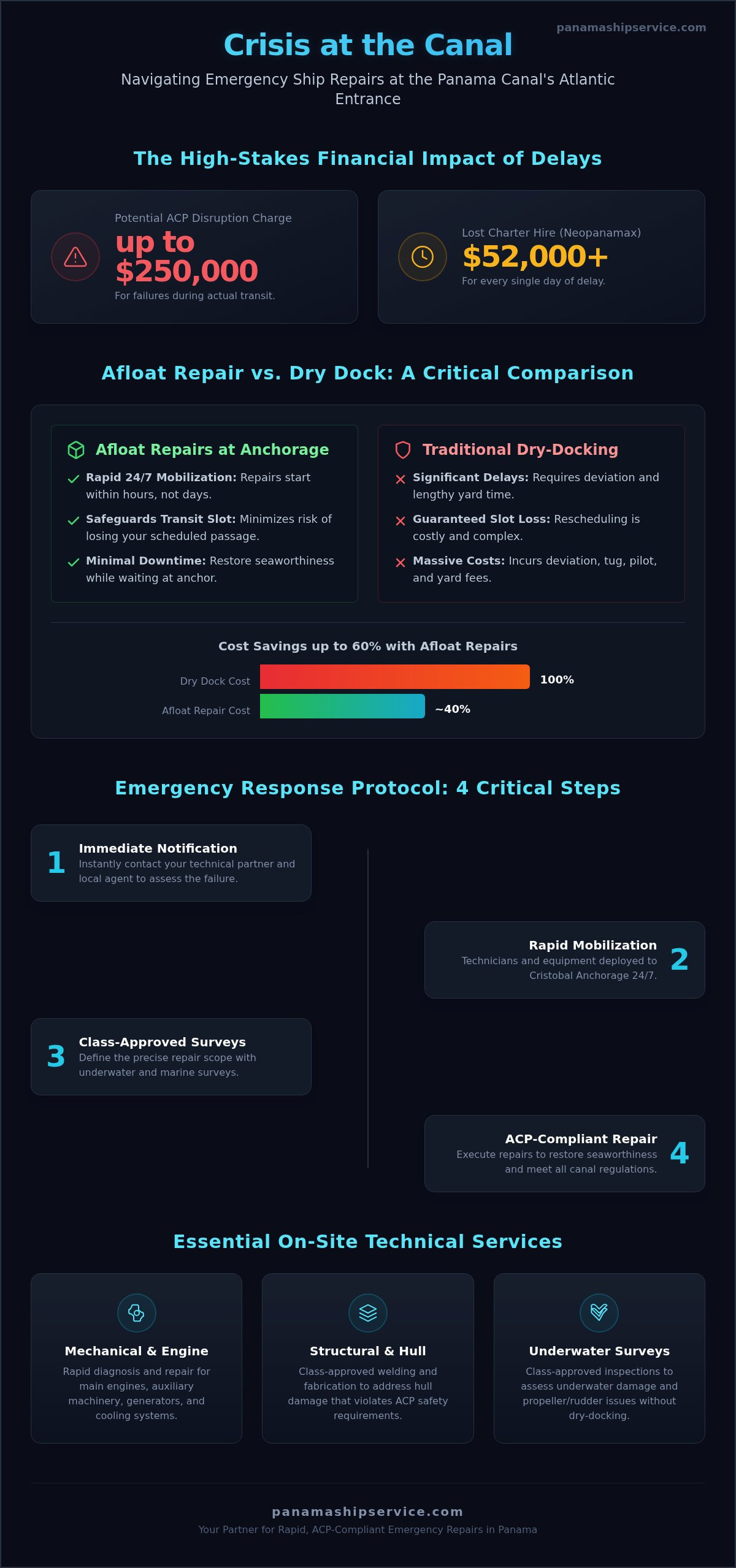
We agree that maintaining your schedule is the absolute priority when technical failures occur. This article explains how to resolve critical vessel failures with rapid, ACP-compliant emergency repairs that safeguard your canal transit. You’ll discover how consolidated technical services, including mechanical work and class-approved underwater surveys, can restore seaworthiness at anchor. We’ll also examine how afloat repairs can reduce your maintenance costs by up to 60% compared to traditional dry-docking, ensuring you move through the locks on time and under budget.
Key Takeaways
- Understand the financial implications of transit delays and how to avoid ACP disruption charges through rapid Atlantic-side mobilization.
- Learn the advantages of afloat repairs at the Cristobal anchorage to restore vessel seaworthiness without the costs and delays of dry-docking.
- Discover the critical steps for coordinating 24/7 emergency ship repair colon to ensure full compliance with Panama Canal Authority (ACP) regulations.
- Master the emergency response protocol, including immediate notification procedures and the role of class-approved marine surveys in defining repair scopes.
- Identify how a consolidated service model reduces operational overhead by synchronizing technical repairs with MARPOL disposal and essential ship supplies.
Critical Logistics of Emergency Ship Repair in Colon
Colon and the Port of Cristobal serve as the final staging area for vessels entering the canal from the Atlantic. This geographic bottleneck creates a high-pressure environment where any technical failure immediately threatens a vessel’s scheduled lockage. Because Panama Canal transits are booked weeks in advance, a sudden mechanical or structural issue at the Atlantic anchorage requires an immediate, localized response. The ability to perform repairs while at anchor is the difference between a successful passage and a costly operational standstill.
The Atlantic Entrance: A High-Stakes Repair Hub
The Cristobal anchorage is often crowded, with vessels performing final checks before their pilot boards. When a critical system fails here, the logistical challenge involves mobilizing specialized labor and heavy equipment to a vessel that is effectively “on the clock.” Common issues include steering gear malfunctions, auxiliary engine failures, or hull damage that violates the Panama Canal Authority (ACP) safety requirements. These problems often emerge during the transition from open sea to the controlled environment of the canal approach.
In this zone, 24/7 technical availability isn’t a luxury; it’s an operational necessity. Effective emergency ship repair colon requires a partner who can mobilize launch services and technicians to the anchorage within hours. This rapid response prevents minor defects from escalating into major transit denials. Technicians must be prepared to work in the dynamic conditions of the Atlantic side, where weather and traffic density complicate the delivery of spare parts and specialized tools.
Synchronizing Repairs with Transit Schedules
Timing is the most critical factor in Atlantic-side repairs. If a vessel fails to meet its transit slot due to a technical breakdown, the financial consequences are severe. A single day of delay for a Neopanamax vessel can cost over $52,000 in lost charter hire and rescheduling fees. Even worse, an engine or steering failure during the actual transit can result in an immediate ACP disruption charge of up to $250,000. These penalties make the speed of repair mobilization the most important metric for any superintendent.
Success depends on the tight coordination between technical teams and the local agent. The agent must provide real-time updates to the ACP to keep the transit slot open while the repair crew works to restore seaworthiness. Utilizing professional mechanical ship repairs in Panama can save thousands in delay penalties by ensuring that work is completed within the narrow window before the pilot’s arrival. By managing these variables simultaneously, operators can resolve failures and maintain their position in the transit queue without needing to deviate to a distant dry dock.
Essential Technical Services for Emergency Marine Repairs
Restoring a vessel’s seaworthiness under the pressure of a strict transit schedule requires a diverse range of technical capabilities. In Colon, technical support must go beyond simple fixes to address complex system failures that could otherwise lead to a transit denial. Every intervention is performed with strict adherence to Panama Canal Authority regulations to ensure the vessel meets all safety and environmental standards before entering the locks. This high level of compliance simplifies the process of emergency ship repair colon by providing immediate technical relief at the Cristobal anchorage.
Mechanical and Engine Room Emergencies
Mechanical failures often involve the main engine or auxiliary machinery, such as generators and cooling systems. Rapid diagnosis is essential. Our teams specialize in diesel engine troubleshooting and can quickly identify issues with fuel injection, turbochargers, or lubrication systems. Because Colon is a major logistics hub, we can source critical marine spare parts locally, reducing the lead time for installations. For instance, restoring auxiliary power is often the primary requirement for vessels that have lost redundancy in their electrical systems. Without reliable backup power, the ACP won’t authorize a transit, making immediate mechanical intervention a priority. For a full breakdown of technical capabilities, you can view our guide to mechanical ship repairs at the Panama Canal.
Structural Integrity and Steel Fabrication
Emergency steel fabrication is frequently required for hull plating, structural welding, and pipework repairs. Damage sustained during heavy weather or minor collisions must be addressed before the vessel is permitted to proceed. We provide certified welders capable of performing high-quality repairs at the anchorage. This includes structural reinforcements and the replacement of damaged sections to maintain hull integrity. During these repairs, maintaining MARPOL compliance is vital, especially when working on fuel tanks or ballast systems. Our consolidated service model ensures that any waste generated during the repair process is handled through authorized MARPOL disposal channels, preventing environmental violations and additional fines. If you’re facing a critical failure, our team can provide a comprehensive marine survey and repair plan to get your vessel back on schedule.
Propulsion and maneuverability are non-negotiable for canal passage. This includes rudder and propeller interventions, such as polishing or temporary plugging, which can often be performed afloat. Electrical and automation system recovery is also a key service, ensuring that navigation lights, steering controls, and safety alarms are fully functional. Providing these specialized services as a single-source provider simplifies the coordination process for ship owners, allowing them to focus on the logistics of the voyage while we handle the technical complexities of emergency ship repair colon.
Afloat vs. Dry Dock: Choosing the Faster Path in Colon
When a vessel faces a technical failure at the Atlantic entrance, the choice between afloat repairs and dry docking is a strategic decision that impacts the entire voyage. For vessels in transit, afloat repairs at the Cristobal anchorage are almost always the superior option. This approach eliminates the need for off-loading cargo, which is a significant logistical hurdle and a major cost driver. By addressing issues while the ship remains in the water, operators can maintain their position in the queue and avoid the massive overhead associated with shipyard deviation.
Underwater Interventions and Surveys
Many critical failures occur below the waterline and require immediate specialized attention. Utilizing professional underwater hull services allows for rapid resolution without the need for a dry dock. Our divers perform class-approved underwater welding and specialized hull cleaning to restore operational efficiency. If a vessel has suffered a minor grounding or collision, an Underwater Inspection in Lieu of Dry-docking (UWILD) is necessary to satisfy class requirements. Propeller polishing is another effective afloat intervention that restores propulsion efficiency, often resolving vibration issues that would otherwise lead to a transit denial. These services ensure the vessel remains compliant with international maritime safety standards while keeping the schedule intact.
Cost-Benefit Analysis of Afloat Repairs
The financial benefits of choosing afloat emergency ship repair colon are substantial. Research indicates that utilizing afloat repairs at Cristobal can reduce maintenance bills by 40% to 60% compared to traditional dry-docking. This saving is driven by the elimination of docking fees and the reduction of vessel downtime. Mobilizing a mobile repair team to the anchorage is a proactive move that prioritizes the bottom line. It allows for simultaneous operations; while technicians work on the engine or hull, the vessel can continue bunkering or handling crew changes.
Safety and stability remain the top priorities during these interventions. All afloat mechanical work is conducted with strict adherence to safety protocols to protect both the crew and the environment. While afloat repairs can resolve the majority of common maintenance issues, some catastrophic failures may eventually require a shipyard. If structural damage is too extensive or a major component like a crankshaft needs replacement, we assist in evaluating local shipyard options. However, our primary goal is always to provide a permanent or temporary afloat fix that keeps the vessel moving toward its transit slot. This efficiency is what makes Colon a vital hub for modern maritime logistics.
Emergency Response Protocol: Steps to Take in Colon
When a technical failure occurs at the Atlantic entrance, the clock starts immediately. The first priority is clear communication. You must contact your local agent and the Panama Canal Authority (ACP) without delay. This step is vital to secure your position in the transit queue and avoid the heavy disruption charges that can reach $250,000 for mid-transit failures. Following notification, the next phase of emergency ship repair colon involves rapid technical mobilization. Our specialized teams are dispatched directly to the vessel at the Colon anchorage, bringing the necessary tools and expertise to your specific location.
Speed doesn’t mean a lack of documentation. Once our team is on board, we begin the process of reporting for the vessel’s flag state and insurers. This ensures that every repair is traceable and meets the high standards required for continued operation. By managing the technical and administrative requirements simultaneously, we help you navigate the pressure of a looming transit slot while maintaining full regulatory transparency.
Defining the Scope via Marine Surveys
Accurate diagnosis is the foundation of any successful intervention. This is why marine surveys in Panama are the first step in our emergency protocol. A professional surveyor provides a detailed damage assessment that serves multiple purposes. It defines the technical scope of work and provides the necessary documentation for insurance claims and liability protection. During this phase, we also conduct bunker and draft surveys to ensure vessel stability remains within safe limits while repairs are underway. This comprehensive assessment prevents scope creep and ensures that the repair team focuses on the critical path to seaworthiness.
Regulatory and Environmental Compliance
Repairs at anchorage are subject to strict oversight. All waste generated during technical interventions must be managed according to MARPOL regulations in Panama. We handle the entire disposal process, from collection to certification, ensuring your vessel remains compliant with international environmental laws. Additionally, we coordinate all necessary ACP authorizations, including hot work permits for welding or fabrication. This proactive approach ensures that every repair meets international maritime safety standards, allowing for seamless reporting to your flag state and insurers. If your vessel requires immediate technical assistance at the Cristobal anchorage, contact Panama Ship Service for 24/7 support and mobilization.
Panama Ship Service: Your One-Stop Emergency Partner
Panama Ship Service operates as the primary strategic technical partner for owners and managers facing critical failures at the Atlantic entrance. We provide 24/7 availability across all Panama Canal ports, including Balboa, Cristobal, and Colon. Our team has a proven track record of maintaining transit schedules for a wide range of vessel types, from bulk carriers and tankers to the largest Neopanamax container ships. By offering a comprehensive service model, we handle everything from complex mechanical repairs to essential ship supplies and MARPOL disposal, ensuring your vessel is fully prepared for its lockage appointment.
Reducing Expenses through Service Consolidation
Ready for Any Maritime Challenge
Choosing a veteran provider ensures that your vessel remains compliant with all local and international regulations without unnecessary complications. We don’t just fix machinery; we manage the entire technical environment to safeguard your Panama Canal transit. Our goal is to restore your vessel’s operational status so you can proceed through the locks with confidence. For reliable emergency ship repair colon, our team provides the technical depth and logistical reach required to keep your fleet moving. If you’re facing an unexpected failure at the Cristobal anchorage, contact Panama Ship Service for immediate technical assistance and rapid mobilization in Colon.
Secure Your Transit Schedule with Rapid Technical Support
Technical failures at the Cristobal anchorage don’t have to result in catastrophic delays or massive ACP penalties. By choosing afloat repairs, you bypass the logistical nightmare of off-loading cargo and the high costs of shipyard deviation. We’ve explored how a consolidated approach to emergency ship repair colon, combining mechanical repairs with class-approved marine and underwater surveys, restores seaworthiness while your vessel remains in the water.
Efficiency in the Colon maritime zone depends on local expertise and immediate mobilization. Panama Ship Service provides the specialized labor and 24/7 emergency technical support required to navigate high-pressure transit windows. Our strategic hub at the Panama Canal Atlantic entrance ensures your vessel meets all safety requirements without missing its slot. Request an Urgent Ship Repair Quote from Panama Ship Service to protect your voyage and minimize operational downtime. Your schedule is our priority; let us handle the technical complexities so you can focus on the crossing.
Frequently Asked Questions
How quickly can a repair team mobilize to the Colon anchorage?
Technical teams are available 24/7 for immediate mobilization to the Colon anchorage. We typically dispatch technicians and specialized equipment within 2 to 4 hours of receiving a confirmed request. This rapid response is essential for vessels facing tight transit windows. By maintaining a constant presence at the Atlantic entrance, we ensure that critical mechanical or structural issues are addressed before your pilot boards, minimizing the risk of schedule disruptions.
Are your emergency ship repairs approved by major classification societies?
All technical interventions are performed to meet the standards of major classification societies, including ABS, Lloyd’s Register, and DNV. We coordinate directly with class surveyors to ensure that every repair, from structural welding to mechanical overhauls, receives the necessary certifications. This alignment is vital for maintaining vessel insurance coverage and satisfying the safety requirements of the Panama Canal Authority before a vessel enters the locks.
Can you perform underwater repairs while the vessel is waiting for canal transit?
We specialize in performing underwater repairs at the Cristobal anchorage while vessels wait for their transit slots. Our divers provide class-approved services such as propeller polishing, temporary hull plugging, and underwater welding. These afloat interventions allow you to resolve below-the-waterline issues without the need for dry-docking or off-loading cargo. This proactive approach ensures your vessel remains compliant with international maritime safety standards while keeping your schedule intact.
What documents are required by the Panama Canal Authority (ACP) for emergency repairs?
The ACP requires immediate notification of any technical failure that affects a vessel’s maneuverability or safety. Essential documentation includes a detailed marine survey report defining the scope of work and a formal repair plan. If the intervention involves welding, you must also secure hot work permits. We manage these administrative requirements on your behalf, ensuring all paperwork aligns with the latest Notice to Shipping regulations to avoid transit delays.
Do you provide emergency spare parts sourcing and delivery in Colon?
We provide comprehensive spare parts sourcing and delivery services through our strategic hub in Colon. Leveraging our proximity to the Colon Free Zone, we can quickly locate and transport critical engine components, valves, and electrical parts to your vessel at anchor. Our logistics team handles the entire process, including customs clearance and launch delivery, ensuring that your emergency ship repair colon is not delayed by supply chain bottlenecks.
How do you ensure MARPOL compliance during emergency tank or hull repairs?
All emergency repairs are conducted under strict environmental protocols to ensure full MARPOL compliance. We provide authorized MARPOL disposal services for any sludge, oily water, or solid waste generated during technical work on tanks or hulls. Our team handles the collection and provides the necessary certification for your vessel’s records. This integrated service model prevents environmental violations and protects ship owners from the significant fines associated with non-compliance in canal waters.
Can emergency repairs be carried out simultaneously with cargo operations in Cristobal?
Most emergency repairs can be carried out simultaneously with cargo operations at the Port of Cristobal, provided safety protocols are met. We coordinate with port authorities and the vessel’s crew to ensure that technical work does not interfere with loading or discharging. This allows for maximum operational efficiency, as mechanical troubleshooting or structural fabrication can proceed without requiring the vessel to leave the terminal, further reducing the total time spent in port.
What is the typical lead time for an emergency marine survey in Colon?
The lead time for an emergency marine survey in Colon is typically between 2 and 6 hours from the initial call. Our surveyors are stationed locally to provide rapid damage assessments, bunker surveys, or draft inspections. This quick turnaround is critical for defining the scope of an emergency ship repair colon and providing the documentation required by insurers and the Panama Canal Authority to authorize a transit.