
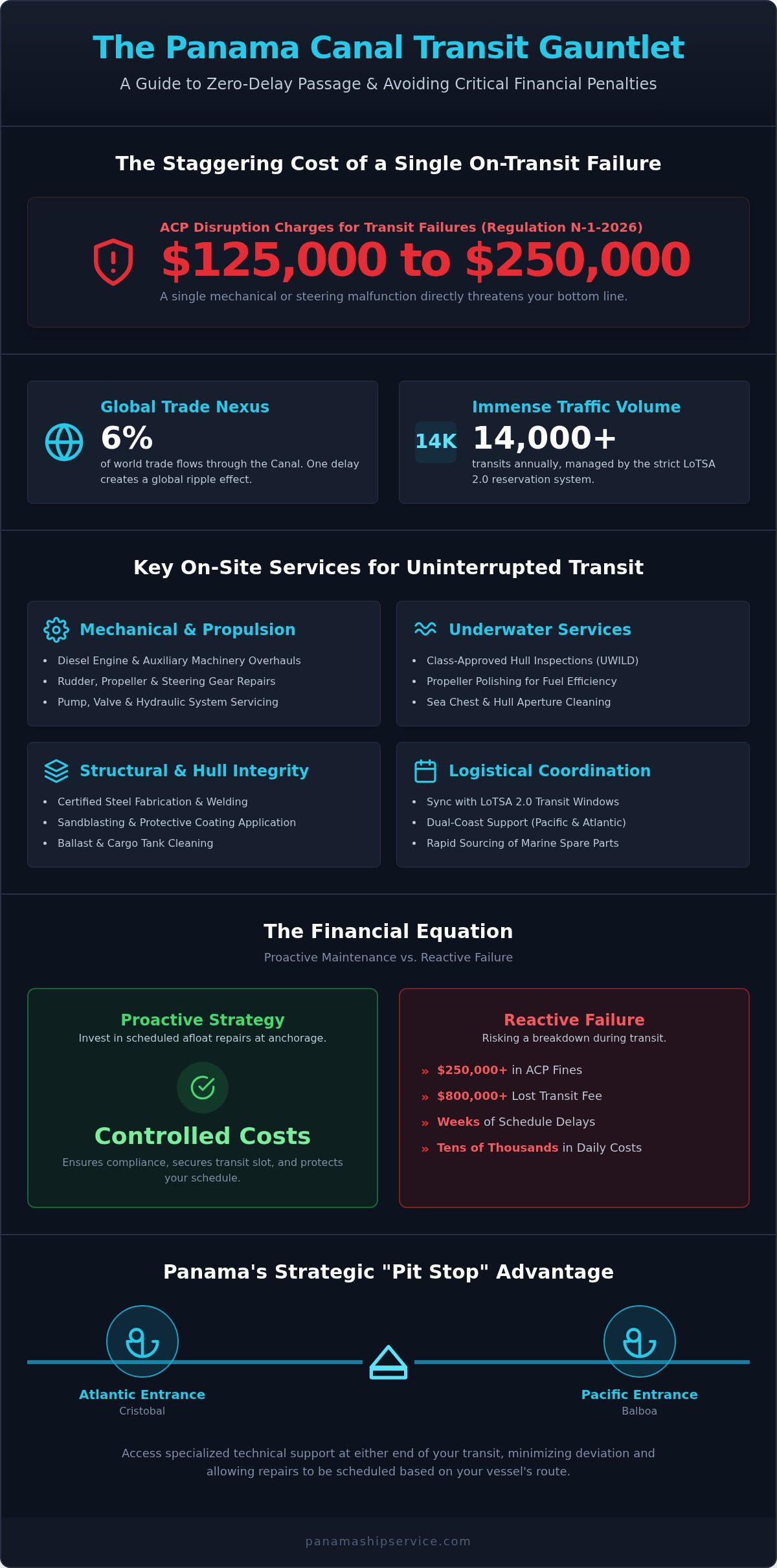
In 2026, the Panama Canal Authority can levy disruption charges ranging from $125,000 to $250,000 for vessel failures during transit. A single mechanical or steering malfunction doesn’t just stall your schedule; it directly threatens your bottom line with massive penalties. Securing reliable ship repair services Panama Canal is no longer just about maintenance; it’s a critical component of your risk management strategy.
You know that at this strategic hub, time is the most expensive commodity. Coordinating technical work while managing strict transit windows and the new LoTSA 2.0 reservation system is an immense logistical challenge that leaves no room for error. You need technical solutions that align perfectly with the Canal’s rigorous operational pace.
This guide provides the technical and regulatory roadmap you need to master these complexities. You’ll learn how to ensure your vessel remains compliant, efficient, and on schedule despite the Canal’s high-pressure environment.
We’ll examine the latest ACP regulations, explore essential mechanical and underwater maintenance strategies, and detail how to secure class-approved documentation for zero-delay transits.
Key Takeaways
- Identify why the Panama Canal serves as a strategic “pit stop” for maintaining global trade efficiency and vessel safety.
- Explore the technical scope of mechanical repairs, including specialized rudder, propeller, and steel fabrication services.
- Learn how to leverage class-approved ship repair services Panama Canal for underwater hull inspections and UWILD to avoid unnecessary dry docking.
- Gain a step-by-step understanding of how to coordinate technical maintenance with transit windows and the LoTSA 2.0 reservation system.
- Discover how a consolidated service model for repairs, surveys, and supplies can reduce overhead and simplify your maritime operations.
The Strategic Role of Ship Repair Services at the Panama Canal
In the maritime industry, the Panama Canal acts as a high-stakes conveyor belt for global trade. When a vessel experiences a mechanical failure or requires urgent maintenance, it doesn’t just affect that ship; it threatens the flow of 6% of world trade. This environment transforms ship repair services Panama Canal into a critical “pit stop” where efficiency is the only metric that matters. Every minute at anchor translates into mounting operational costs and potential regulatory penalties.
The Panama Canal Authority (ACP) enforces strict readiness standards through mandates like “Notice to Shipping N-1-2026.” These regulations ensure that every vessel entering the locks is mechanically sound. If a ship suffers a propulsion or steering failure during transit, the ACP can levy disruption charges ranging from $125,000 to $250,000. Reliable technical support is your primary defense against these financial risks. Most of this work is performed as “afloat repairs,” allowing technicians to resolve issues at anchorage without the need for time-consuming dry docking, keeping your transit schedule intact.
Why Panama is the Preferred Hub for Maritime Maintenance
Panama’s geographic position provides a unique operational advantage. Vessels can access specialized technical support at both the Pacific entrance in Balboa and the Atlantic entrance in Cristobal. This dual-coast availability means repairs can be scheduled based on your transit direction, minimizing deviation. To understand the scale of this logistical feat, one only needs to look at the Panama Canal’s history and operations, which involve managing over 14,000 transits annually. Professionals in the region offer deep expertise in everything from engine overhauls to specialized MARPOL disposal in Panama, creating a comprehensive service ecosystem that simplifies complex port calls.
The Financial Impact of Vessel Downtime at the Canal
Downtime at the Canal is exceptionally punitive. Beyond daily running costs, which can exceed tens of thousands of dollars, a missed transit slot can lead to weeks of delays. With the implementation of the LoTSA 2.0 reservation system, slot availability is tighter than ever. If a vessel is detained by port state control due to maintenance deficiencies, the owner faces not only repair costs but also the potential loss of a high-value booking. Proactive ship repair services Panama Canal ensure that your ship meets all class requirements before it reaches the locks. This prevents emergency detentions and protects your investment in transit fees, which can exceed $800,000 for Neopanamax vessels. Efficient technical intervention isn’t an expense; it’s an essential safeguard for your voyage’s profitability.
Comprehensive Mechanical and Structural Repair Solutions
Maintaining a vessel’s technical integrity in the high-humidity, high-salinity environment of the Isthmus requires more than standard maintenance. The tropical climate accelerates corrosion and biofouling, making specialized ship repair services Panama Canal a necessity for long-term hull preservation. Beyond immediate fixes, operators must prioritize sandblasting and painting to protect steel surfaces from rapid oxidation. Similarly, regular tank cleaning ensures that fuel systems and ballast tanks remain free of contaminants that could lead to engine failure or environmental compliance issues during transit. To further safeguard these systems, many owners utilize advanced fuel and oil purification technology from MarShip UK as part of their proactive maintenance strategy.
Effective mechanical ship repairs at the Panama Canal cover a wide technical spectrum. From overhauling complex A/C systems to repairing rudders and propellers, the focus remains on restoring full operational capacity with minimal disruption. These interventions are often performed while the vessel is at anchorage, allowing for significant work to be completed without the logistical burden of dry docking.
Precision Mechanical Repairs: Engines, Pumps, and Valves
Transit wait times at the Pacific or Atlantic anchorages provide a strategic window for addressing diesel engine issues and auxiliary machinery malfunctions. Technicians specialize in repairing pumps, valves, and hydraulic systems that are under constant stress during the lockage process. Sourcing marine spare parts locally is a critical factor in these repairs. It avoids the delays of international shipping and ensures that components meet the official Panama Canal Authority regulations for safety and performance. Quick turnaround on these mechanical assets prevents minor leaks or pressure drops from escalating into costly transit denials.
Marine Steel Fabrication and Welding Standards
Structural repairs demand a high level of precision and adherence to international maritime standards. Whether you’re dealing with hull damage, worn decks, or internal bulkhead fatigue, all welding must be performed by certified professionals using class-approved procedures. Local on-site fabrication capabilities allow for the custom creation of steel components, which significantly reduces the need for external sourcing. This agility is vital when structural issues are identified during pre-transit inspections. If your vessel requires immediate technical attention to meet safety standards, partnering with a seasoned technical provider in Panama can help you secure the necessary approvals without losing your scheduled transit slot.
By consolidating mechanical repairs and structural fabrication with a single provider, ship owners reduce the administrative burden of coordinating multiple vendors. This integrated approach ensures that every repair, from a simple valve replacement to complex steel work, is documented and ready for class surveyor approval.
Underwater Services: Enhancing Efficiency and Compliance
Vessels navigating the Isthmus face unique biological challenges that demand specialized underwater hull services in Panama. The warm, nutrient-rich tropical waters accelerate the growth of marine organisms, leading to significant biofouling in a matter of days. This buildup increases hydrodynamic drag, which directly impacts engine load and fuel consumption. Because of the Canal’s strategic importance for global maritime transportation, maintaining hull cleanliness is essential to ensure vessels meet the strict transit speed and maneuverability requirements set by the authorities.
Underwater Inspection in Lieu of Dry Docking (UWILD) is a critical service for operators looking to extend their vessel’s time between scheduled dry dockings. By utilizing class-approved divers and technology, ship owners can satisfy the requirements of major classification societies without the massive expense and downtime of a shipyard visit. This process is particularly effective for ship repair services Panama Canal because it allows for comprehensive inspections while the ship is at the Atlantic or Pacific anchorages. It’s a proactive approach that ensures operational readiness without breaking the transit schedule.
Underwater Inspections and Class-Approved Surveys
Modern underwater assessments utilize high-definition CCTV and digital photography to provide real-time damage assessment to superintendents onshore. These tools are indispensable for pre-purchase condition surveys, allowing potential buyers to verify the structural integrity of a hull before finalizing a transaction in Panama. Additionally, technical teams conduct bunker surveys and quantity verifications during the transit window to prevent fuel discrepancies. These surveys provide an objective record of the vessel’s condition, ensuring that all ship repair services Panama Canal are based on accurate, visual data rather than guesswork.
In-Water Cleaning and Propeller Polishing
The choice between hydraulic brush systems and manual cleaning is a matter of efficiency and surface preservation. Hydraulic systems allow for rapid removal of heavy fouling across large surface areas, whereas manual cleaning is reserved for delicate niche areas like sea chests and transducers. Panama maintains strict environmental regulations regarding hull cleaning to prevent the release of invasive species or heavy metals into the local ecosystem; therefore, only authorized providers using approved debris-collection methods can operate. Propeller polishing is a highly effective method to achieve up to 5% fuel savings by reducing surface roughness and improving propulsion efficiency. This immediate ROI makes underwater maintenance one of the most cost-effective technical interventions available during a Canal port call.
Navigating the Logistics: Timing and Coordination
Successfully managing ship repair services Panama Canal requires a granular understanding of the Canal’s operational rhythm. You don’t just fix a ship; you manage a rigid transit window. To ensure accurate quoting and immediate resource allocation, you must provide a detailed Scope of Work (SOW) at the earliest opportunity. This document should include technical drawings, high-resolution photographs of the damage, and specific class requirements. A precise SOW allows your technical partner to mobilize the right personnel and equipment to the Pacific or Atlantic anchorage before your vessel even arrives.
Pre-Transit Planning and Communication
Adhering to the 72-hour rule is a non-negotiable standard for efficient operations. You should initiate contact with your repair partner at least three days before arrival. This lead time is necessary to process essential documentation, such as crew lists, technical permits, and security clearances required for boarding vessels at Balboa or Cristobal. Coordinating with the Port Authority ensures that your repair berth or anchorage position is optimized for both technical work and the subsequent transit. This planning is even more critical under the LoTSA 2.0 reservation system, where missing a transit slot can result in significant financial penalties or weeks of delay.
Minimizing Delays During Emergency Repairs
When critical equipment fails, 24/7 response protocols are your only protection against missing a transit slot. The ACP prioritizes safety above all else, so you must justify any emergency intervention through objective data. Professional marine surveys in Panama provide the necessary technical evidence to prove a vessel’s seaworthiness or to explain the scope of required repairs to Canal inspectors. Balancing the urgency of a repair with ACP safety regulations is a delicate process that requires local expertise. If you face a sudden mechanical failure, contact a trusted technical partner in Panama immediately to coordinate a rapid recovery plan that satisfies both class and Canal requirements. Reliable ship repair services Panama Canal ensure that emergency fixes don’t become permanent transit obstacles.
Panama Ship Service: Your Expert Technical Partner
Panama Ship Service brings 20 years of experience to the Isthmus, positioning itself as a veteran provider of ship repair services Panama Canal. We’ve built our reputation on a “one-stop-shop” model that simplifies the complex logistics of a Canal transit. By consolidating mechanical repairs, underwater surveys, and MARPOL-compliant disposal under a single technical umbrella, we eliminate the coordination errors that lead to costly delays. Our team operates on both the Atlantic and Pacific sides; this ensures that your vessel has access to expert technical support regardless of its transit direction or anchorage location.
Our approach is grounded in the belief that technical proficiency must be matched by fiscal responsibility. We focus on delivering cost-effective solutions that protect your bottom line while maintaining the highest safety standards. Ship owners and managers often face a fragmented service landscape in Panama, but our integrated model provides a clear, documented path to operational readiness. You can delegate the technical complexity of your port call to us, allowing your crew to focus on the critical task of Canal transit.
Why Global Operators Trust Our Local Expertise
Efficiency at the Canal is measured in hours, not days. For example, our technical teams recently managed a complex rudder repair at the Balboa anchorage, restoring a vessel’s steering integrity within its scheduled 48-hour wait window. This level of responsiveness is only possible when you have a single point of contact managing the entire technical scope. We understand the specific pressures of the LoTSA 2.0 system and the ACP’s rigorous inspection protocols. Our commitment to MARPOL compliance and environmental responsibility ensures that all waste disposal and technical interventions meet international standards, protecting your fleet from regulatory risks in Panamanian waters. This localized expertise transforms a high-pressure environment into a manageable, routine operation.
Get a Technical Assessment and Quote
Planning your next transit requires accurate financial and technical data. You can request a Pro Forma Disbursement Account (PDA) or a specific repair quote to ensure your budget reflects the actual technical needs of your vessel. We provide transparent pricing and detailed technical reports for every intervention, from minor mechanical fixes to class-approved underwater surveys. For immediate assistance, our 24/7 response teams are ready to handle emergency equipment failures that threaten your transit slot. We also invite you to explore our full range of ship supplies at the Panama Canal to consolidate your provisions with your technical repairs. Nominate Panama Ship Service for your upcoming transit to experience a seamless integration of technical expertise and logistical efficiency.
Secure Your Transit with Expert Technical Support
Managing vessel maintenance at the Isthmus is a high-stakes logistical challenge where technical precision meets strict regulatory enforcement. By leveraging afloat repairs and class-approved underwater inspections, you protect your schedule from the severe financial penalties of transit delays and disruption charges. Expert ship repair services Panama Canal are your primary defense against the complexities of the LoTSA 2.0 system and evolving ACP mandates. You don’t just need a mechanic; you need a strategic partner who understands the urgency of a transit window.
With over 20 years of specialized experience at the Canal, our class-approved technical teams provide comprehensive 24/7 emergency support to keep your fleet moving. We handle the technical and regulatory complexity so you can focus on your voyage’s profitability. Request a ship repair quote and minimize your vessel downtime today. We’re ready to ensure your vessel remains efficient, compliant, and on schedule for a successful crossing.
Frequently Asked Questions
Can ship repairs be performed while my vessel is waiting for transit?
Yes, most ship repair services Panama Canal are performed at the Pacific or Atlantic anchorages while vessels wait for their transit slots. This afloat repair method allows technical teams to address mechanical, electrical, or structural issues without interrupting your schedule. We mobilize our personnel and equipment to your vessel’s specific location, ensuring that all work is completed before your pilot boards for the Canal transit.
Are underwater hull cleaning services permitted in all Panama Canal anchorages?
No, hull cleaning is only permitted in specific designated areas and must be performed by authorized providers using approved debris-collection systems. The Panama Canal Authority enforces strict environmental regulations to prevent the release of invasive species or heavy metals into local waters. We ensure all underwater hull services comply with these mandates, utilizing specialized equipment that captures residues to maintain local environmental standards while improving your vessel’s fuel efficiency.
What certifications should I look for in a Panamanian ship repair company?
You should prioritize companies that hold valid Class approvals from major societies such as ABS, Lloyds Register, or DNV. These certifications are essential for structural welding, underwater inspections (UWILD), and specialized mechanical work. Working with a certified provider ensures that all repair documentation is accepted by your vessel’s classification society and the Port Authority, preventing regulatory delays or the need for re-inspections during your port call.
How long does a typical underwater survey (UWILD) take in Panama?
A standard Underwater Inspection in Lieu of Dry Docking (UWILD) typically takes between 4 and 8 hours to complete. The exact duration depends on the vessel’s size, the clarity of the water, and the specific hull condition. Our divers use high-definition CCTV and photography to provide real-time data to surveyors. This efficiency allows you to satisfy Class requirements within a single anchorage window without impacting your scheduled transit time.
Can you provide MARPOL-compliant waste disposal during a repair call?
Yes, we provide comprehensive waste disposal services that fully comply with MARPOL Annex I, IV, and V regulations. This includes the removal of sludge, bilge water, and solid garbage while your vessel undergoes technical repairs. We provide the necessary certificates of disposal required for your vessel’s record books. Consolidating waste management with your repair call reduces administrative overhead and ensures your vessel remains compliant with international environmental laws.
Do you offer emergency mechanical repairs 24/7 at both Balboa and Cristobal?
Yes, we provide 24/7 emergency support for critical mechanical failures at both the Balboa and Cristobal anchorages. Our technical teams are ready to mobilize immediately to address propulsion, steering, or auxiliary machinery issues that could jeopardize your transit slot. We understand the high costs of disruption charges and prioritize rapid intervention to restore your vessel’s operational readiness at any hour of the day or night.
Is it possible to source specialized marine spare parts in Panama on short notice?
Yes, Panama’s position as a global logistics hub allows for the rapid sourcing of specialized marine spare parts. We maintain a local inventory of common mechanical components and have established networks to expedite the delivery of specialized items from international manufacturers. This capability is vital for ship repair services Panama Canal, as it prevents minor equipment failures from escalating into prolonged downtime while waiting for critical components to arrive.
How do you coordinate with the Panama Canal Authority (ACP) during repairs?
Coordination is managed through your local agent, who acts as the primary liaison with the Panama Canal Authority. The agent secures the necessary technical permits and ensures that the repair schedule aligns with your assigned transit window. We provide detailed Scopes of Work and technical reports that the agent uses to satisfy Canal inspectors, ensuring that all maintenance activities are transparent and fully approved before transit begins.