
What if a single missed 96-hour VUMPA window cost your fleet over $65,000 in a single day? Forfeiting a Panama Canal transit slot in 2026 isn’t just an operational hiccup; it’s a massive financial blow that most operators can’t afford. You know that the Panama Canal Authority (ACP) doesn’t leave room for error, especially regarding hull integrity and Board of Inspectors’ requirements. Securing a class-approved underwater damage survey panama is the only way to satisfy these strict regulations and keep your vessel moving. Waiting until you reach the locks to discover a compliance issue is a risk that compromises your budget and your schedule.
We understand that handling these complex submission windows requires a strategic partner who recognizes the high stakes of maritime logistics. This article will show you how to secure a successful ACP inspection and achieve zero transit downtime through expert damage assessments. We’ll break down the technical requirements for 2026 and explain how to streamline your reporting process to protect your slot. You’ll learn how to manage technical complexity so your team can focus on the voyage ahead without the anxiety of unexpected delays.
Key Takeaways
- Quantify the financial risks of Neo-Panamax slot forfeiture and understand why immediate hull assessments are critical for 2026 operations.
- Identify the technical requirements for a class-approved underwater damage survey panama, including high-definition CCTV and NDT documentation.
- Master the 96-hour VUMPA submission window and RBVIM compliance to avoid administrative delays with the Panama Canal Authority.
- Streamline logistics at Balboa and Cristobal anchorages by coordinating vessel preparation with expert diver deployment teams.
- Reduce transit downtime by integrating damage identification with immediate repair planning through a consolidated technical service provider.
The Financial Stakes of Underwater Damage in Panama
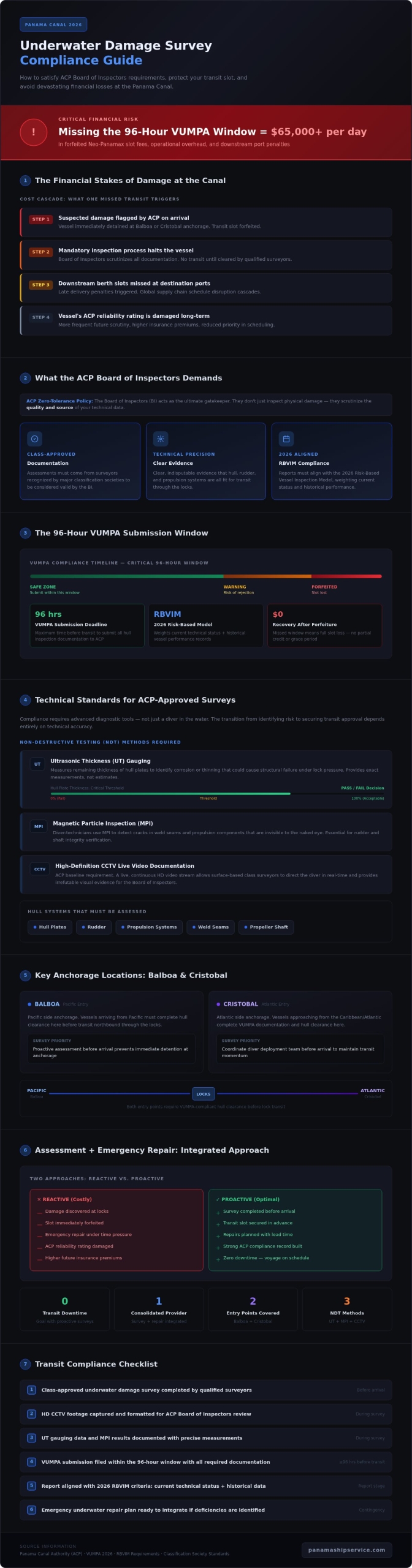
Arriving at the Panama Canal with suspected hull damage is a high-stakes gamble that most operators can’t afford. The Panama Canal Authority (ACP) maintains a strict zero-tolerance policy for any deficiency that might compromise the safety of the locks or the flow of traffic. If your vessel shows signs of structural compromise, it won’t transit until it’s cleared by a professional team. This makes an underwater damage survey panama a critical transit requirement rather than a routine maintenance task. You must clear any suspicion of damage before reaching the Balboa or Cristobal anchorages to prevent immediate detention and the subsequent loss of your scheduled window.
The Risk of Transit Slot Forfeiture
The Role of the Board of Inspectors
The ACP Board of Inspectors (BI) acts as the ultimate gatekeeper for canal transits. They don’t just look for physical cracks or dents; they scrutinize the quality and source of your technical data. A professional damage report must meet specific criteria to satisfy their rigorous requirements. The BI looks for several key markers in a report:
- Class-Approved Documentation: Assessments must come from surveyors recognized by major classification societies to be considered valid.
- Technical Precision: The BI requires clear, indisputable evidence that the vessel’s hull, rudder, and propulsion systems are fit for the transit.
- Regulatory Alignment: Reports must align with the 2026 Risk-Based Vessel Inspection Model, which places higher weight on current technical status and historical performance.
A failed inspection does more than delay your current voyage. It can negatively affect your vessel’s future reliability rating with the ACP, leading to more frequent scrutiny and potentially higher insurance premiums. By utilizing a class-approved underwater damage survey panama, you provide the BI with the authoritative data they need to grant immediate transit approval. This proactive approach moves your vessel from a state of technical uncertainty to a position of full compliance. It protects your bottom line and ensures your reputation with the Canal Authority remains intact.
Technical Standards for Professional Marine Damage Surveys
Compliance in the Panama Canal requires more than just a diver in the water. To satisfy the Board of Inspectors, an underwater damage survey panama must utilize advanced diagnostic tools that provide indisputable data. The transition from identifying a potential risk to securing a transit approval depends entirely on the technical accuracy of the assessment. Operators must ensure their chosen partner uses standardized protocols that align with both Classification Society rules and specific ACP mandates. This technical precision is what separates a routine check from a report that actually clears a vessel for transit.
Advanced NDT Inspection Techniques
Non-Destructive Testing (NDT) in 2026 maritime standards refers to a suite of diagnostic methods used to evaluate the structural integrity of a vessel without damaging the hull or its components. These techniques are essential when visual inspections alone cannot confirm the extent of internal damage or metal fatigue.
- Ultrasonic Thickness (UT) Gauging: This tool measures the remaining thickness of hull plates to identify corrosion or thinning that could lead to structural failure under the pressure of the locks.
- Magnetic Particle Inspection (MPI): Diver-technicians use MPI to detect cracks in weld seams and propulsion components that are invisible to the naked eye.
Visual Documentation and CCTV Standards
High-definition CCTV feeds have become the baseline requirement for ACP-approved inspections. The Board of Inspectors requires a live, continuous video stream that allows surface-based class surveyors to direct the diver in real-time. This ensures that every area of concern is documented from multiple angles with professional-grade clarity. Without this real-time communication, a survey may be rejected for failing to provide the necessary oversight required by class societies.
- Resolution and Lighting: Video must be captured in high definition with adequate subsea lighting to eliminate shadows that might hide defects.
- Diver Narration: Real-time audio commentary from the diver is mandatory to provide context for the visual findings and to answer questions from the surface team.
- Digital Archiving: All survey data must be archived digitally to provide a permanent record for future RBVIM assessments and insurance claims.
Standardizing these technical elements into a comprehensive report is what allows for immediate ACP and Class society approval. When your data is clear and your methods are class-approved, you eliminate the back-and-forth that often leads to transit delays. Utilizing professional underwater hull services ensures that your technical documentation is ready for submission the moment the diver surfaces. This level of technical precision is the only way to move from a “suspected damage” status to a confirmed “fit for transit” designation without risking your schedule.
Navigating VUMPA 2026 and RBVIM Compliance
The Panama Canal Authority has transitioned to a sophisticated Risk-Based Vessel Inspection Model (RBVIM) for 2026. This system isn’t just an administrative formality; it’s a dynamic scoring mechanism that dictates which vessels face the most scrutiny on arrival. By providing a class-approved underwater damage survey panama, you’re not just checking a box. You’re actively lowering your vessel’s risk profile. The ACP uses this data to prioritize transit slots and identify potential safety hazards before they reach the lock chambers. If your documentation is outdated or missing technical specifics, your ship is flagged for a manual, time-consuming inspection that can derail your entire schedule.
The RBVIM Regulatory Framework
RBVIM compliance relies on technical transparency. The model calculates risk based on vessel age, historical performance, and current technical status. Proactive hull assessments are the most effective way to influence these scores. When you provide a professional underwater damage survey panama, you demonstrate a commitment to safety that the ACP rewards with faster processing. During high-traffic seasons, these scores become even more critical. A vessel with a “Low Risk” designation is far less likely to be pulled aside for a board of inspectors’ review, ensuring you maintain your position in the transit queue even when the Canal is operating at peak capacity.
VUMPA Submission Deadlines
Timing is everything in the VUMPA 2026 environment. You must submit all technical data, including survey results and repair reports, within a strict 96-hour window prior to arrival. This timeline is non-negotiable. Late or incomplete submissions trigger automatic delays and can lead to the immediate forfeiture of your transit slot. To manage this window effectively, you need a streamlined reporting process that delivers class-approved data the moment the inspection concludes. For a deeper look at how these requirements fit into your broader operational strategy, consult our guide on marine surveys panama.
- T-96 Hours: Final deadline for VUMPA technical data upload to the ACP portal.
- T-72 Hours: ACP preliminary risk assessment completed based on submitted hull data.
- T-48 Hours: Slot confirmation or additional inspection request issued by the Board of Inspectors.
Adhering to these milestones is the only way to protect your schedule. For Neo-Panamax vessels, the margin for error is non-existent. Regulatory updates for 2026 now require more granular digital documentation than in previous years, specifically regarding hull coating condition and structural integrity at the waterline. By integrating these technical requirements into your pre-arrival checklist, you eliminate the risk of last-minute administrative bottlenecks at the Canal entrance.
Strategic Preparation for Surveys at Balboa and Cristobal
Success in a Canal transit starts long before the first diver enters the water. Efficiently managing an underwater damage survey panama requires precise coordination between the vessel’s master, the local agent, and the technical team. You must secure anchorage assignments that provide the best environmental conditions for a stable assessment. Waiting until the last minute to organize these logistics often results in missed 96-hour VUMPA windows. By preparing the vessel and the bridge team in advance, you ensure the survey proceeds without technical interruptions or safety delays.
Logistics at Balboa vs. Cristobal
Choosing between Balboa and Cristobal depends on your vessel’s arrival direction and current weather patterns. Balboa often experiences stronger tidal currents that can impact diver stability and underwater visibility. Cristobal, while generally calmer, is more susceptible to Atlantic swell during the northern winter months. Clear communication between the bridge and the dive team is vital. The bridge must confirm that propulsion systems, thrusters, and sea suctions are locked out and tagged out before deployment. For comprehensive support in managing these variables, operators should utilize professional underwater hull services.
Vessel Crew Preparation Checklist
Practical preparation on deck is the most effective way to accelerate the inspection process. If the crew is ready when the dive boat arrives, the survey starts immediately, reducing the total time on site. Use this checklist to streamline your preparation:
- Access and Clearance: Ensure all relevant hull areas are accessible and unobstructed by external gear or discharge.
- Data Readiness: Have historical maintenance records, previous survey reports, and hull drawings ready for the lead surveyor.
- Safety Briefing: Conduct a formal safety briefing with the survey team to establish emergency protocols and communication signals.
- Vessel Stability: Confirm that the vessel’s position is stable and monitor for anchor drag throughout the operation.
Safety protocols must be non-negotiable. The Board of Inspectors expects a controlled environment where risks are mitigated before the inspection begins. This preparation doesn’t just protect the divers; it protects the integrity of your data. When the crew is proactive, the technical team can focus entirely on identifying damage and documenting compliance. If you’re approaching the locks and need an immediate, class-approved underwater damage survey panama, coordinate your assessment today to protect your transit slot.
Integrating Assessment with Emergency Underwater Repairs
Identifying a structural defect is only the first step in protecting your transit schedule. Once an underwater damage survey panama confirms a deficiency, the focus must immediately shift to resolution. The transition from diagnostic assessment to physical repair is a critical period where every hour of delay increases the risk of slot forfeiture. In the high-pressure environment of the 2026 Panama Canal transit, you don’t have the luxury of waiting for a separate repair crew to mobilize. You need a seamless pivot where the data gathered during the inspection directly informs the engineering solution.
Transitioning to Emergency Repairs
The high-definition CCTV feeds and NDT thickness measurements obtained during the survey serve as the blueprint for the repair plan. When damage is localized to the hull plating or propulsion system, this technical data allows engineers to calculate steel fabrication requirements and welding procedures before the repair team even enters the water. Securing class approval for these repairs depends on the accuracy of this initial data. Depending on the severity of the findings, class societies may grant approval for temporary repairs to facilitate the Canal transit, or they may require permanent underwater welding to satisfy safety standards. For complex issues involving the engine room or internal systems, integrating these findings with mechanical ship repairs ensures that both internal and external deficiencies are addressed simultaneously.
Consolidating Services for Efficiency
A “one-stop-shop” approach is the most effective way to minimize downtime at the Isthmus. By using a single technical partner for both the survey and the subsequent repair, you eliminate the communication gaps that often lead to administrative errors in the VUMPA file. This consolidation allows for a more aggressive timeline, as the same team that identified the crack or dent is already equipped to fix it. Efficiency is further maximized when you manage multiple operational needs during the same anchorage window. While the dive team performs the underwater damage survey panama, you can simultaneously coordinate other essential services:
- Hull Cleaning and Propeller Polishing: Removing biofouling alongside the damage assessment to improve fuel efficiency for the next leg of the voyage.
- Bunker Surveys: Conducting fuel quantity verifications while the vessel is stationary for technical inspections.
- Finalizing the Technical File: Consolidating all repair logs and survey videos into a single, ACP-ready package for immediate Board of Inspectors approval.
The goal is to reach the locks with a clean bill of health and a completed technical file. When you integrate assessment with immediate repair, you move your vessel from a state of non-compliance to a confirmed “ready to transit” status in the shortest possible timeframe. Don’t let a technical discovery turn into a multi-day delay. Contact Panama Ship Service for an urgent underwater damage survey and ensure your vessel is prepared for a successful 2026 transit.
Secure Your 2026 Panama Canal Transit Today
Navigating the Panama Canal in 2026 requires more than operational skill; it demands technical precision and strict regulatory compliance. You’ve seen how the 96-hour VUMPA window and the Risk-Based Vessel Inspection Model leave no room for administrative or technical errors. A single delay can trigger substantial financial losses, but proactive planning eliminates this risk. By securing a class-approved underwater damage survey panama, you provide the Board of Inspectors with the authoritative data needed for immediate clearance. It’s the most effective way to transform a potential detention into a successful transit.
Our team provides 24/7 emergency response at both Balboa and Cristobal anchorages, ensuring your vessel meets every ACP requirement without the stress of downtime. We specialize in transitioning from complex assessments to immediate repairs, consolidating your technical needs into a single, efficient operation. We handle the technical complexity so you can focus on your fleet’s global schedule. Don’t leave your slot to chance when expert support is available at both Canal entrances. Secure Your Transit Slot with an Expert Damage Survey and keep your cargo moving with total confidence.
Frequently Asked Questions
How long does a standard underwater hull damage assessment take in Panama?
A standard assessment typically takes between four and eight hours to complete. The exact duration depends on the extent of the suspected damage and the prevailing underwater visibility at the anchorage. For complex cases involving propulsion systems or multiple hull sections, the process may extend to a full day. Efficiency is prioritized to ensure all data is ready for the 96-hour VUMPA submission deadline.
Can an underwater damage survey be performed while the vessel is at anchor?
Yes, almost all damage surveys occur while the vessel is at the Balboa or Cristobal anchorages. This allows the dive team to operate in a controlled environment without disrupting the vessel’s position in the transit queue. The bridge team must coordinate closely with the divers to ensure all thrusters and sea suctions are locked out and tagged out before the operation begins.
What certifications should I look for in a Panama underwater survey company?
You must prioritize companies that hold class-approval from major societies such as ABS, Lloyd’s Register, or DNV. Additionally, the service provider should have a proven track record of meeting Panama Canal Authority (ACP) standards. Reports from uncertified divers are frequently rejected by the Board of Inspectors, leading to immediate transit denials and costly administrative delays for the operator.
How much does a forfeited Panama Canal transit slot cost in 2026?
Forfeiting a Neo-Panamax transit slot in 2026 can cost an operator upwards of $65,000 per day. This figure represents the immediate loss in reservation fees and vessel overhead. It doesn’t account for the secondary costs of missed berthing windows at the next port or the potential for late delivery penalties. Proactive inspections are the only way to safeguard against these massive financial risks.
What is the VUMPA 2026 requirement for underwater inspections?
The VUMPA 2026 mandate requires that all technical documentation, including a professional underwater damage survey panama, is uploaded to the ACP portal at least 96 hours before arrival. This data is fed into the Risk-Based Vessel Inspection Model (RBVIM). Failure to provide accurate technical data within this window can result in your vessel being flagged for a high-risk manual inspection upon arrival.
Can I use survey results to get class approval for emergency repairs?
Yes, high-definition survey results are the primary evidence used to secure class approval for emergency repairs. Class surveyors rely on the NDT measurements and visual documentation provided by the dive team to authorize temporary or permanent fixes. This allows you to address structural deficiencies immediately, often while the vessel is still at anchor, ensuring you meet all safety requirements for the locks.
Is CCTV documentation mandatory for all damage surveys in Panama?
High-definition CCTV documentation is a mandatory requirement for any survey intended for ACP or class society review. A live video feed allows surface-based surveyors to direct the diver in real-time and verify findings as they are discovered. This level of transparency is essential for the Board of Inspectors to confirm that the vessel’s hull integrity meets the strict safety standards of the Canal.
What happens if the Board of Inspectors rejects a damage report?
If the Board of Inspectors rejects a report, the vessel is detained at the anchorage until a new, compliant underwater damage survey panama is performed. This rejection typically causes the vessel to miss its assigned transit window, resulting in the immediate forfeiture of the slot. The operator must then re-apply for a new window, which can lead to several days of unplanned and expensive downtime.