
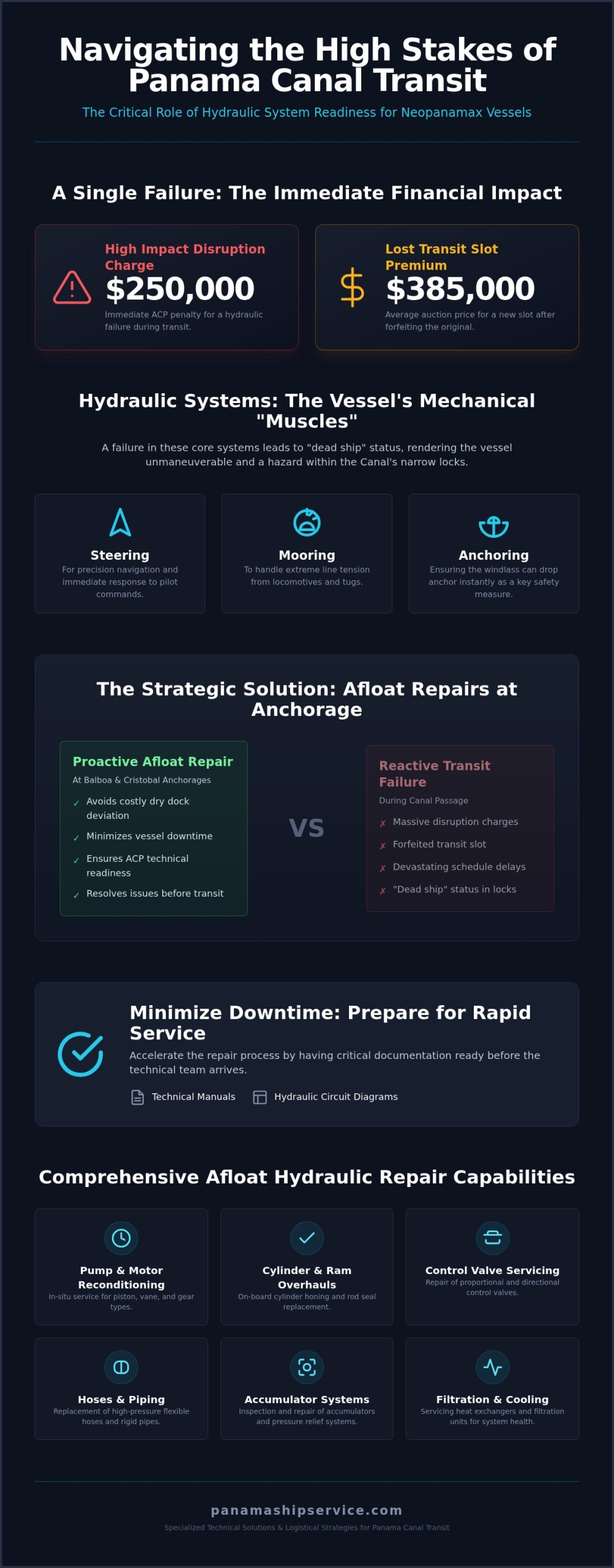
A single hydraulic failure during a Neopanamax transit in 2026 can trigger an immediate $250,000 disruption charge from the Panama Canal Authority. For ship owners and operators, the pressure to maintain technical readiness is at an all-time high. You know that even a minor malfunction in a winch or steering system can lead to forfeited transit slots and massive financial losses. Finding reliable ship hydraulic repair panama services at short notice is often the only way to protect your bottom line and maintain your schedule.
We understand the high stakes of Canal transit and the urgency of maintaining operational capacity. This article demonstrates how expert afloat repair services at Balboa and Cristobal anchorages resolve critical mechanical issues without the need for a costly dry dock deviation. You’ll learn how to ensure compliance with the latest ACP safety standards while restoring full capacity to your cranes and winches. We provide a clear overview of specialized technical solutions and logistical strategies designed to get your vessel through the locks safely and efficiently.
Key Takeaways
- Understand why hydraulic failures act as critical vessel “muscles” that can lead to immediate “dead ship” status and forfeited transit slots.
- Explore specialized ship hydraulic repair panama services available at Balboa and Cristobal anchorages to avoid costly dry dock deviations.
- Learn a systemic diagnostic approach to troubleshooting complex pressure loss and identifying root causes in high-pressure marine systems.
- Discover how to accelerate the repair process by preparing technical manuals and circuit diagrams before the technical team arrives.
- Minimize vessel overhead by utilizing a one-stop-shop model that consolidates mechanical repairs with required marine surveys and supplies.
Critical Hydraulic Systems and Panama Canal Risks
Hydraulic systems serve as the critical mechanical “muscles” of any vessel, providing the high-torque power necessary for steering, anchoring, and mooring. In the high-stakes environment of the Panama Canal, these systems must operate at peak performance. A failure here is more than a simple maintenance inconvenience. It often results in “dead ship” status, where the vessel is deemed unmaneuverable and a hazard to navigation within the narrow confines of the locks.
Under the ACP Notice to Shipping N-1-2026, technical readiness is strictly enforced. If your vessel experiences a hydraulic failure during transit, you face an immediate High Impact Disruption Charge of $250,000. Beyond this fine, the loss of a transit slot can be devastating to your schedule. With auction premiums for new slots averaging $385,000 in early 2026, the financial incentive for professional ship hydraulic repair panama is clear. Addressing leaks or pressure drops at the Balboa or Cristobal anchorages is a strategic necessity to avoid these extreme overhead costs.
Steering Gear and Rudder Hydraulics
Precision is the priority when navigating the locks. Steering gear must respond instantly to pilot commands to avoid contact with lock walls or other vessels. Common failures include hydraulic seal leaks, actuator malfunctions, or solenoid issues in the control valves. The ACP requires redundant systems to be fully operational. If one pump fails, the backup must be ready to take the load immediately. Seeking ship hydraulic repair panama experts to verify solenoid performance and actuator integrity is a standard pre-transit precaution for experienced operators. Any hesitation in rudder response can lead to an immediate transit suspension.
Mooring Winches and Windlass Reliability
Mooring winches are essential for connecting to the “mules” (locomotives) and tugboats that guide vessels through the locks. These systems endure extreme tension during the lifting and lowering of water levels. A hydraulic motor stall during high-tension operations can snap lines or cause the vessel to drift dangerously. Before entering the Canal, crews must perform preventative checks on all mooring hydraulics. This includes testing pressure relief valves and inspecting hoses for signs of wear or bulging. High-pressure systems are sensitive to particulates that can seize a motor at the worst possible moment. Ensuring your windlass can drop anchor instantly is a non-negotiable safety requirement for every vessel in the queue.
Comprehensive Hydraulic Repair Services at Panama Anchorages
Vessels waiting at the Balboa or Cristobal anchorages don’t have to wait for a dry dock to address critical system failures. Our technical teams deploy specialized mobile workshops equipped for complex on-site disassembly and repair. This ship hydraulic repair panama capability is vital for meeting the Panama Canal Authority’s maritime regulations, which require all vessels to demonstrate full technical readiness before a transit begins. We utilize high-quality replacement seals and high-viscosity index fluids to ensure your systems withstand the extreme pressure demands of the lock operations.
Effective ship hydraulic repair panama is most efficient when integrated with broader mechanical ship repairs. By consolidating these technical requirements, you minimize the logistical costs of multiple launch trips and simplify your vessel’s schedule. Our technicians service a wide range of components afloat, including:
- Proportional and directional control valves
- High-pressure hydraulic hoses and rigid piping
- Accumulators and pressure relief systems
- Heat exchangers and filtration units
Hydraulic Pump and Motor Reconditioning
Piston pumps, vane pumps, and gear motors are the heart of your vessel’s hydraulic power. We handle in-situ reconditioning to address common marine wear patterns such as internal leakage, scoring, or cavitation damage. Every reconditioned unit undergoes rigorous on-board testing to verify that flow rates and pressure settings align exactly with OEM specifications. This ensures that your steering and cargo systems deliver the reliability needed for a safe Canal passage.
Cylinder and Ram Overhauls
Managing large-scale hydraulic rams for hatch covers, ramps, or cranes requires specialized technical expertise. We provide cylinder honing and rod seal replacement directly at the anchorage, avoiding the time-consuming process of shore-side transport. Environmental safety is a priority during these operations. We implement strict containment protocols for fluid drainage and replacement, ensuring your vessel stays compliant with local environmental laws. If you need to consolidate technical tasks, you can coordinate your next repair through our centralized agency service to optimize your stay in Panama.
Diagnostic Techniques for Marine Hydraulic Failures
Troubleshooting intermittent hydraulic issues at sea requires more than a visual inspection. When a winch or steering gear behaves erratically during low-speed maneuvers, the root cause is often hidden within the complex interaction of pumps, valves, and actuators. A systemic approach is essential to resolve these malfunctions. This method moves beyond symptom-based fixes to isolate the exact component responsible for pressure loss. In the high-pressure environment of ship hydraulic repair panama, technical teams at the Balboa anchorage utilize advanced diagnostic tools like thermal imaging. This technology identifies internal valve leakage by detecting heat signatures caused by high-pressure fluid bypassing internal seals; this allows for a precise diagnosis without premature disassembly.
Oil contamination analysis remains a cornerstone of marine diagnostics. Because hydraulic systems on deck are constantly exposed to the elements, salt water ingress and particulate buildup are persistent threats. Identifying these contaminants early prevents the abrasive wear that leads to total pump failure. Our diagnostic protocols prioritize finding the source of ingress, whether it’s a perished ram seal or a corroded heat exchanger, ensuring the repair addresses the cause rather than just the effect.
Pressure and Flow Monitoring
Accurate data is the foundation of every successful repair. Digital flow meters are employed to identify bypass in hydraulic circuits that traditional gauges might miss. These tools allow technicians to verify if a pump is delivering its rated output or if fluid is slipping through worn internal components. Setting relief valves to correct parameters is equally critical, especially for heavy-lift operations where system over-pressurization can lead to catastrophic hose failure. Pressure profiling is a non-invasive diagnostic tool used to map system behavior across various load cycles. By analyzing these profiles, we can predict component wear before it results in a total system shutdown during a Canal transit.
Oil Analysis and Contamination Control
Marine environments present unique challenges, specifically the risk of metal particulate accumulation and moisture. Oil contamination is the primary driver of hydraulic failure, often causing sudden seizures in sensitive proportional valves. A professional ship hydraulic repair panama service includes on-site oil analysis to detect these issues immediately. High-efficiency filtration systems are then deployed to remove particulates, extending the operational life of the entire system. We evaluate the contamination level to determine the best course of action:
- Full System Flush: Mandatory if metal shavings are present to protect new components.
- Kidney-Loop Filtration: Effective for removing moisture and fine particulates without a total fluid change.
- Partial Oil Replacement: Utilized when additives have depleted but the base oil remains stable.
These targeted diagnostic steps ensure that your vessel’s hydraulic systems are restored to full operational capacity with minimal guesswork.
Minimizing Downtime: Preparing for Emergency Hydraulic Service
Operational efficiency at the Panama Canal depends on rapid technical response. When a vessel is at anchorage, every hour lost to preparation is an hour closer to a missed transit window. Ship managers can significantly accelerate the ship hydraulic repair panama process by organizing critical technical data before the boarding team arrives. This proactive approach allows technicians to begin diagnostics immediately, rather than spending valuable time searching for technical specifications or clearing access to the machinery space. In a region where a single day of delay for a Neopanamax vessel can cost over $52,000, preparation is a financial necessity.
Combining technical services is another effective strategy for reducing overhead. For example, underwater hull services can be performed simultaneously with hydraulic work while the vessel is at the Balboa anchorage. Coordinating these tasks through a single agency minimizes launch hire costs, which can range from $450 to $900 per trip in 2026. Additionally, a ship chandler in Panama can facilitate the delivery of specific hydraulic fluids or spare parts directly to the repair team, ensuring that work doesn’t stall due to missing inventory.
Essential Documentation for Technicians
Safety and access are the responsibility of the vessel’s crew. Before the technicians arrive, the crew should isolate the affected hydraulic circuit and ensure the area is clean and well-lit. If the repair requires welding or structural fabrication, preparing hot-work permits in advance is essential to avoid administrative delays. The crew should also inventory on-board spares and make them easily accessible. If you need to expedite your technical response, you can contact our specialized mechanical department to coordinate your emergency response and minimize your vessel’s downtime.
Reliable Hydraulic Engineering with Panama Ship Service
Panama Ship Service provides specialized technical expertise in high-pressure hydraulic systems, ensuring your vessel remains technically ready for the rigors of a 2026 Canal transit. We operate as a comprehensive service provider, allowing ship owners to delegate complex technical coordination to a single, reliable partner. Our “one-stop-shop” model integrates hydraulic work with other essential requirements like marine surveys and ship supplies. This consolidated approach is a proven strategy for minimizing vessel downtime in Panama. We maintain 24/7 emergency support across all major anchorages, providing an experienced technical presence that protects your schedule and your bottom line.
Our mechanical department is specifically structured to handle the urgent nature of the maritime industry. We don’t just provide labor; we deliver engineered solutions that address the root cause of equipment failure. By choosing a partner with a deep understanding of ship hydraulic repair panama, you ensure that your steering gear, winches, and cranes are restored to full operational capacity before you reach the first set of locks. This proactive technical management is the most effective way to avoid the extreme disruption charges associated with mechanical failure during transit.
Strategic Locations: Balboa and Cristobal
We maintain full operational coverage at both the Pacific and Atlantic entrances of the Panama Canal. This dual-coast presence allows for the rapid mobilization of technicians to vessels at anchor in Balboa or Cristobal. We also extend our reach to outer holding areas, providing technical support to vessels before they are cleared for entry. Our teams coordinate with the Panama Canal Authority to ensure our service delivery aligns perfectly with your assigned transit window. By positioning our ship hydraulic repair panama experts at these strategic geographical hubs, we eliminate unnecessary travel delays and maximize the time available for technical interventions.
Quality Assurance and Class Compliance
Reliability is built on adherence to international maritime engineering standards. We reject temporary “quick fixes” that might compromise vessel safety during high-tension lock operations. Instead, our technicians follow strict OEM specifications and technical best practices to ensure long-term system integrity. Every repair project concludes with a detailed service report that documents diagnostic findings, parts replaced, and final pressure testing results. These reports provide the transparency required by class surveyors, ship owners, and insurance underwriters. Our focus on quality assurance ensures that your vessel meets all ACP safety requirements and continues to operate at peak efficiency long after the transit is complete.
Secure Your Transit with Expert Hydraulic Readiness
The financial risks of hydraulic failure during a Panama Canal transit are too significant to ignore. By addressing mechanical issues while at anchor, you eliminate the threat of “dead ship” status and the extreme disruption fines that follow. Professional ship hydraulic repair panama ensures that critical systems like steering gear and mooring winches operate at full capacity when you need them most. Utilizing advanced diagnostics and high-quality seal replacements at the Balboa and Cristobal anchorages provides the long-term reliability required for high-tension lock operations.
Consolidating your technical needs through a single agency further optimizes your schedule. Our 24/7 afloat mechanical support and strategic locations at both entrances allow for rapid mobilization and reduced launch hire expenses. By coordinating marine surveys and repairs through our one-stop-shop model, you simplify your vessel’s logistics and minimize overhead. Don’t let a minor leak become a major delay. Request an Emergency Hydraulic Repair Quote in Panama today to ensure your vessel remains compliant and operational. We are ready to support your fleet with expert engineering and reliable service.
Frequently Asked Questions
Can hydraulic repairs be performed while the vessel is at anchor in Panama?
Yes, we specialize in performing comprehensive repairs while your vessel is at anchor in Balboa or Cristobal. This approach avoids the high costs and scheduling delays of traditional dry-docking. Our mobile technical teams are equipped to handle complex disassembly and technical troubleshooting directly at the anchorage. By resolving mechanical issues afloat, you maintain your position in the Canal queue and avoid the risk of missing your assigned transit window.
What types of hydraulic components can you repair on-site?
Our technicians service a broad range of high-pressure components, including piston pumps, gear motors, and proportional control valves. We also perform on-site overhauls for steering gear actuators and large-scale hydraulic rams used for hatch covers or ramps. We carry specialized tools for cylinder honing and seal replacement, ensuring that every ship hydraulic repair panama project meets the technical specifications required for safe and efficient Canal lock operations.
How long does a typical hydraulic pump overhaul take afloat?
The duration of an overhaul depends on the extent of internal wear and the availability of seal kits. A standard pump reconditioning typically takes between 12 and 24 hours once the team is on board. To minimize this timeframe, we recommend providing technical manuals and fault codes in advance. Our priority is to restore full operational capacity as quickly as possible to prevent your vessel from being declared “dead ship” by the authorities.
Do you provide 24/7 emergency hydraulic repair services for the Panama Canal?
Yes, we provide 24/7 emergency support for all vessels transiting the Panama Canal. Mechanical failures don’t follow a schedule, so our technical department remains on standby to respond to urgent requests at any hour. This constant availability is essential for vessels facing immediate technical readiness issues before entering the locks. We mobilize our boarding teams rapidly to both the Pacific and Atlantic entrances to ensure minimal disruption to your transit schedule.
Can you help source specialized hydraulic spare parts in Panama?
We utilize our integrated ship supply network to source specialized components such as Rexroth, Hagglunds, or Danfoss parts. Our team coordinates directly with local and international suppliers to expedite the delivery of seal kits, high-pressure hoses, and filtration units. By managing the logistics of spare parts alongside the technical repair, we eliminate the delays often caused by missing inventory and ensure the technical team has exactly what it needs for the job. For those who need to source high-quality components for industrial machinery, you can learn more about GSM Internacional, a leader in high-performance spare parts distribution.
To provide an accurate quote, we require the specific make and model of the failing equipment, along with hydraulic schematics and maintenance logs. Descriptions of the malfunction, such as pressure drops or erratic movement, are also vital. Providing photographs of nameplates and the affected area helps our engineers identify the necessary tools and spare parts. This detailed information allows us to provide a transparent cost estimate and a realistic timeline for the intervention.
Are your hydraulic technicians certified for class-approved repairs?
Our technicians are highly experienced in marine engineering and perform all work according to international standards. We provide comprehensive service reports that detail the diagnostics, parts replaced, and final pressure testing results. These documents are designed to meet the requirements of class surveyors and insurance underwriters. While you should always verify specific class approval for your vessel’s requirements, our commitment to quality ensures that every ship hydraulic repair panama meets the rigorous safety standards of the industry.
How do you ensure environmental safety during hydraulic oil changes?
We implement strict containment protocols to prevent any fluid discharge into the Canal’s ecosystem. Our teams use specialized pumping equipment and secondary containment trays during all oil changes and component disassemblies. Any waste oil or contaminated materials are handled and removed following MARPOL protocols. As a provider of MARPOL disposal services, we ensure that all hazardous waste is managed legally and responsibly, protecting both your vessel’s compliance and the local environment.