
A single mechanical failure in the Panama Canal’s narrow reaches can trigger a $250,000 High-Impact Disruption Charge before your vessel even clears the locks. For Neopanamax operators, the risk of losing maneuverability isn’t just a safety concern; it’s a massive financial liability that can derail an entire 2026 schedule. We understand that the pressure to maintain strict transit slots while managing technical deficiencies is at an all-time high. Securing reliable ship rudder repair in Panama is the only way to avoid these penalties and ensure your vessel remains compliant with the latest ACP N-01-2026 requirements.
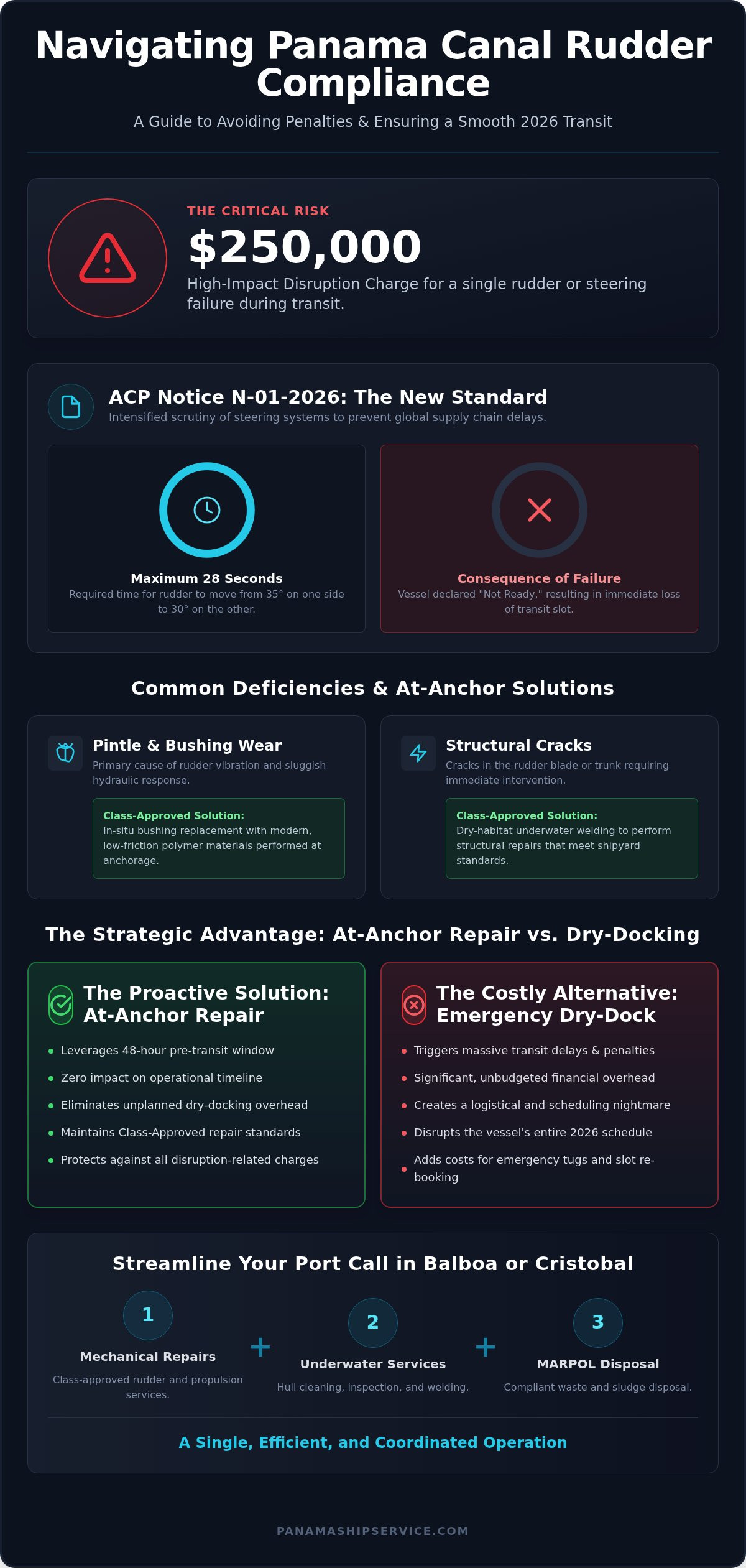
You need a solution that prioritizes efficiency and technical precision without the expense of an unplanned dry-docking. This article provides a comprehensive look at how to handle rudder issues while at anchor. You’ll learn how class-approved underwater services and in-situ mechanical repairs can restore full functionality while you wait for your VUMPA clearance. We’ll also examine the impact of the new risk-based inspection models and how proactive maintenance keeps your transit costs within budget. By the end of this guide, you’ll have a clear roadmap for navigating repairs in Balboa or Cristobal with zero impact on your operational timeline.
Key Takeaways
- Identify the specific technical requirements of ACP Notice N-01-2026 to protect your vessel from $250,000 High-Impact Disruption Charges.
- Understand how to address common deficiencies like pintle wear and bushing vibration using class-approved repair standards while at anchor.
- Discover the fiscal benefits of performing ship rudder repair panama at Balboa or Cristobal to eliminate the overhead of unplanned dry-docking.
- Learn how to leverage the 48-hour pre-transit anchorage window to complete mechanical interventions without affecting your 2026 schedule.
- Streamline your port call by consolidating mechanical repairs, underwater hull services, and MARPOL disposal into a single, efficient operation.
The Strategic Importance of Rudder Integrity for Panama Canal Transits
The Panama Canal remains one of the most demanding maritime passages in the world. In narrow sections like the Culebra Cut, there is zero margin for error. A vessel’s Rudder must respond instantly to pilot commands to avoid contact with canal banks or lock walls. As of 2026, the Panama Canal Authority (ACP) has intensified its scrutiny of steering systems under OP Notice to Shipping N-01-2026. This regulation mandates that all transiting vessels maintain peak mechanical integrity to prevent transit delays that affect the entire global supply chain. Preventative inspections aren’t just a recommendation; they’re a prerequisite for a successful passage.
ACP Technical Compliance and Maneuverability Standards
The transition through Neopanamax locks requires precision that only a fully functional steering system can provide. During pre-transit inspections, ACP officials look for specific deficiencies such as excessive pintle clearance, sluggish hydraulic response, or visible cracks in the rudder blade. For 2026, the ACP requires that steering gear must be capable of moving the rudder from 35 degrees on one side to 30 degrees on the other in no more than 28 seconds at the vessel’s maximum ahead service speed. If your vessel fails to meet these benchmarks, it will be declared “not ready” for transit. This status results in the immediate loss of your scheduled slot and a mandatory referral for ship rudder repair panama before any further movement is permitted.
Risk Mitigation: Avoiding the $250,000 Disruption Charge
Mechanical failure during a transit is a worst-case scenario. When a ship loses steerage in the canal, the ACP initiates emergency disruption protocols to clear the channel. This triggers a High-Impact Disruption Charge, which for Neopanamax vessels in 2026 stands at $250,000. This fine doesn’t include the additional costs of emergency tug assistance, which are billed at premium rates. Beyond the immediate financial penalty, the vessel loses its transit booking, which can cost between $12,500 and $50,000 to re-secure. Expert ship rudder repair panama serves as a critical strategic investment. By addressing technical deficiencies at the Balboa or Cristobal anchorages before entering the locks, operators protect themselves against these cascading operational losses. Proactive maintenance ensures your vessel remains a reliable partner in the 2026 transit schedule.
Common Rudder Technical Deficiencies and Class-Approved Repair Standards
Rudder deficiencies often remain hidden until a vessel slows for canal approach. The increased torque required for low-speed maneuvering in the locks exposes mechanical weaknesses that might go unnoticed in open water. Addressing these issues requires strict adherence to Class-Approved Repair Standards to ensure the vessel remains seaworthy and compliant. When technical faults are identified, specialized ship rudder repair panama services focus on restoring structural integrity while the vessel is afloat, avoiding the logistical nightmare of an emergency dry-docking.
Pintle and Bushing Wear Analysis
Excessive pintle and bushing clearance is the primary catalyst for rudder vibration and sluggish response. Over time, the constant movement and exposure to seawater degrade the bearing surfaces. Technical teams measure these clearances using precision underwater gauges to determine if they exceed the maximum limits set by the manufacturer or class society. If wear is excessive, we perform in-situ bushing replacements. By using modern synthetic materials like reinforced polymers, we provide a solution that offers superior longevity and lower friction compared to traditional bronze bearings. This process is completed at the anchorage, ensuring your steerage is restored without interrupting your transit window.
Underwater Welding and Steel Fabrication
Structural cracks in the rudder trunk or blade require immediate intervention. We utilize both wet welding for non-structural attachments, such as zinc anode replacement, and dry-habitat welding for critical structural repairs. Dry-habitat welding involves creating a localized pressurized environment around the repair site, allowing for high-quality welds that meet the same standards as those performed in a shipyard. This is particularly effective for repairing cavitation damage on the leading edge of the rudder blade, which can severely impact hydrodynamic efficiency. It’s critical to use certified underwater welders to maintain structural rudder integrity and satisfy rigorous class requirements during the 2026 inspection cycle. Our mechanical ship repair specialists coordinate these technical interventions with class surveyors to provide a seamless approval process. By integrating underwater hull services with mechanical expertise, we deliver a comprehensive solution for ship rudder repair panama that keeps your vessel moving safely through the canal.
In-Situ vs. Dry Docking: Optimizing Rudder Repairs for Minimum Downtime
For vessel operators, the choice between in-situ repair and dry-docking is a calculation of total operational impact. While dry-docking provides a controlled environment, the associated overhead often exceeds the cost of the repair itself. Choosing ship rudder repair panama at the Balboa or Cristobal anchorages allows a vessel to remain operational while technicians address critical steering deficiencies. This strategic decision prevents the massive disruption of pulling a ship out of service during peak transit periods.
The ROI of In-Water Technical Support
The financial advantages of afloat repairs are clear when analyzing the hidden costs of a shipyard visit. Dry-docking requires the vessel to deviate from its route, often involving high daily yard rates and the expense of emergency tug hire. Additionally, most shipyards require fuel discharge and gas-freeing before a vessel can enter the dock, adding days of non-productive time. These logistical hurdles don’t just cost money; they destroy the commercial schedule.
In contrast, mobile repair teams mobilize directly to the vessel’s location. This approach eliminates the need for expensive deviations. By consolidating rudder work with underwater hull services, operators can maximize their time at anchor. This consolidation reduces mobilization fees and ensures that all hull-related deficiencies are cleared before the ACP inspection. Successful 2026 transits depend on this level of logistical efficiency and fiscal responsibility.
Logistical Feasibility of Afloat Repairs
Executing complex mechanical work at sea requires deep local knowledge of Panama’s unique environmental conditions. At the Pacific entrance in Balboa, tidal ranges can reach up to 20 feet, creating significant current speeds. Conversely, the Atlantic side at Cristobal often faces unpredictable swell patterns. We utilize specialized work floats and portable welding equipment designed for these dynamic environments. This equipment allows us to perform high-precision tasks without the infrastructure of a permanent berth.
Coordination with the Panama Port Authority is essential for securing the necessary permits for anchorage repairs. Our team handles these administrative requirements, ensuring that technical interventions comply with local safety regulations. While certain catastrophic failures, such as a sheared rudder stock or severe internal structural collapse, may necessitate a dry dock, the majority of pintle, bushing, and blade issues are manageable afloat. Choosing ship rudder repair panama ensures your commercial schedule remains intact while meeting every class requirement for a safe canal transit.
A Masterclass in Logistical Coordination: Scheduling Repairs During Canal Wait Times
Time is the most valuable commodity in the Panama Canal. While a vessel sits at anchor awaiting its transit slot, every hour must be used to ensure full technical readiness. Coordinating a ship rudder repair panama during this interval requires a synchronized effort between the ship’s agent, the technical superintendent, and the on-site repair lead. The ship agent acts as the primary coordinator, securing the necessary permits from the Port Authority while we manage the technical mobilization. This proactive approach ensures that deficiencies are resolved before the Panama Canal Authority (ACP) boarding officer conducts the mandatory pre-arrival inspection.
The 48-Hour Technical Window
Most vessels experience an anchorage window of approximately 48 hours before their scheduled transit. This period is the critical zone for technical interventions. To maximize efficiency, real-time communication protocols must be established between the vessel master and the repair team leader. We prioritize immediate mobilization to ensure the work is completed and the work site is cleared well before the pilot board time. This eliminates the risk of a “not ready” status, which would otherwise result in the forfeiture of the transit booking and the imposition of heavy fines. Clear reporting during this window keeps all stakeholders informed of the progress.
Service Hubs: Balboa and Cristobal
Selecting the correct terminal for your ship rudder repair panama depends on your vessel’s transit direction and the current anchorage availability. Balboa, the Pacific entrance, serves as the primary hub for northbound transits. It offers extensive logistics for deep-draft vessels and easy access for specialized dive teams. For southbound transits, Cristobal on the Atlantic side provides a strategic location for pre-canal intervention. Mobile repair teams maintain 24/7 availability at both canal terminals to respond to emergency mechanical failures or scheduled maintenance needs. This dual-terminal presence allows us to intercept vessels regardless of their approach route.
Success hinges on pre-arrival planning. By providing technical specifications and deficiency reports 96 hours before arrival, we ensure that necessary spare parts and dive equipment are staged and ready. Our local supply chain allows for the rapid procurement of class-approved materials, ensuring that even unplanned deficiencies don’t delay your departure. Don’t leave your transit to chance. Contact our technical team to coordinate your next repair window and secure your commercial schedule.
Panama Ship Service: Your Partner for Rudder & Mechanical Excellence
Panama Ship Service operates as a highly competent business partner for international fleets navigating the complexities of the 2026 Canal schedule. We provide a calm, expert presence at both Balboa and Cristobal ports, ensuring that technical deficiencies don’t translate into costly operational delays. Our team specializes in high-stakes, time-sensitive interventions, delivering 24/7 emergency response for vessels requiring immediate ship rudder repair panama. We understand that the pressure of maintaining a transit slot is immense. Our systematic approach is designed to alleviate that anxiety through reliability and technical proficiency.
Comprehensive Mechanical and Technical Support
We prioritize the reduction of vessel overhead by offering a consolidated service menu. Instead of managing multiple vendors, ship owners can delegate complex technical tasks to our seasoned veteran teams. This one-stop-shop approach allows for the simultaneous execution of several critical port requirements during a single anchorage window. It’s a pragmatic strategy that optimizes schedules and reduces administrative burden.
- Mechanical ship repairs: Our capabilities extend beyond rudders to include comprehensive support for main engines, auxiliary systems, and propellers.
- Marine surveys: We coordinate structural repairs with class-approved surveys to ensure immediate compliance and documentation.
- MARPOL disposal: We ensure environmental compliance by handling waste disposal alongside technical repairs, streamlining your port call logistics.
Quality Assurance and 24/7 Response
Our track record of providing zero-delay transit support is built on a foundation of proactive communication and rapid turnaround times. We don’t just provide a service; we provide technical excellence that satisfies the most rigorous class standards. When you face an urgent technical challenge, you gain direct access to our technical leads for immediate repair quotes and mobilization plans. This eliminates unnecessary complications and moves your vessel toward a successful transit without delay.
Securing your 2026 transit schedule requires a partner who understands the fiscal responsibility of minimizing downtime. Whether you require a routine inspection or an emergency ship rudder repair panama, our teams are positioned at both canal terminals to respond immediately. Don’t let a technical deficiency lead to a $250,000 disruption charge or a forfeited booking slot. Contact Panama Ship Service today for an expert rudder repair quote.
Securing Operational Continuity in the 2026 Transit Cycle
Maintaining rudder integrity is a non-negotiable requirement for vessels entering the Panama Canal in 2026. By addressing technical deficiencies like pintle wear or structural cracks while at anchor, operators effectively eliminate the risk of $250,000 disruption charges and forfeited transit slots. Professional ship rudder repair panama serves as a vital safeguard against the high-stakes environment of the Neopanamax locks. It’s a strategic move that prioritizes fiscal responsibility and schedule reliability.
Panama Ship Service provides the technical expertise and logistical coordination necessary to keep your fleet moving. We specialize in minimizing vessel downtime through class-approved underwater welding and inspections. Our one-stop-shop model consolidates mechanical repairs with surveys and MARPOL disposal to streamline your port call. With 24/7 technical support available in both Balboa and Cristobal, our teams are ready to respond to any mechanical challenge at a moment’s notice. You can delegate the complexity of canal compliance to us and focus on your core commercial objectives. Secure your Panama Canal transit with expert rudder repair services today.
Frequently Asked Questions
Can rudder repairs be performed while the vessel is at the Panama Canal anchorage?
Yes, most ship rudder repair panama tasks are performed while the vessel is at the Pacific or Atlantic anchorages. Technicians utilize specialized work floats and portable welding units to execute repairs without a permanent berth. This capability allows operators to address deficiencies during the standard 48-hour wait time. By completing these interventions afloat, you avoid the logistical complexity and high overhead associated with an unplanned dry-docking or shipyard deviation.
Will underwater rudder repairs be accepted by my Classification Society?
Underwater rudder repairs are accepted by all major Classification Societies provided they are executed by certified technicians. Our dive teams hold the necessary class approvals for underwater inspection and welding. We coordinate directly with class surveyors to ensure that every repair meets the required safety and structural standards. This collaboration provides the necessary documentation to satisfy ACP boarding officers and ensures the vessel remains fully insured and seaworthy for its transit.
What is the most common cause of rudder failure for vessels transiting Panama?
Excessive pintle and bushing wear is the most frequent cause of mechanical failure identified during canal transits. The high torque required for low-speed maneuvering in the locks places significant stress on the steering assembly. Over time, this results in increased vibration and sluggish response. If these clearances exceed manufacturer limits, the ACP may declare the vessel “not ready,” necessitating immediate ship rudder repair panama to restore the required degree of maneuverability.
How long does a typical in-situ rudder bushing replacement take?
A typical in-situ rudder bushing replacement can usually be completed within 24 to 48 hours depending on the extent of the wear. Our teams use specialized hydraulic equipment to remove old bushings and install new synthetic bearings without removing the rudder blade. We prioritize efficiency to ensure the work is finished before your pilot board time. This rapid turnaround is essential for maintaining your 2026 transit schedule and avoiding slot forfeiture.
Does Panama Ship Service provide 24/7 emergency repair response?
Yes, we provide 24/7 emergency response for mechanical failures at both the Balboa and Cristobal terminals. Our technical leads are available at any hour to provide urgent repair quotes and mobilize dive teams. This constant availability is critical for vessels that identify steering issues shortly before their scheduled arrival. We maintain a local supply chain to ensure that essential spare parts and materials are ready for immediate deployment to your location.
Can I consolidate rudder repairs with hull cleaning to save on port costs?
You can consolidate rudder repairs with underwater hull cleaning and other maintenance tasks to reduce total port costs. Our one-stop-shop model allows us to deploy multiple technical teams to your vessel simultaneously. This approach minimizes mobilization fees and reduces the administrative burden of managing different vendors. By combining repairs with hull services and MARPOL disposal, you maximize the efficiency of your anchorage window and lower your overall operational overhead.
What happens if my vessel is found to have steerage deficiencies during an ACP inspection?
If a vessel fails a pre-transit steerage inspection, the ACP will immediately suspend its transit slot. The vessel is then subject to a High-Impact Disruption Charge of $250,000 for Neopanamax ships as of 2026. You will be required to move to an anchorage and perform repairs before a follow-up inspection is granted. This process causes significant delays and additional costs for tug assistance and re-booking fees, making proactive maintenance a strategic necessity.
Are there specific rudder requirements for Neo-Panamax vessels in 2026?
Neo-Panamax vessels must comply with the intensified safety standards outlined in OP Notice to Shipping N-01-2026. These regulations require steering gear to move the rudder from 35 degrees on one side to 30 degrees on the other within 28 seconds at maximum service speed. Additionally, the ACP now utilizes a risk-based inspection model that scrutinizes the deficiency history and age of the vessel. Maintaining peak rudder integrity is mandatory for vessels targeting a 48-foot draft transit.