
Did you know a single clerical error in your Garbage Record Book can now trigger a $10,000 fine before your vessel even reaches the first set of locks? With the implementation of OP Notice N-01-2026, the Panama Canal Authority has established a zero-tolerance environment that leaves no room for logistical guesswork. For many operators, coordinating ship sludge removal in Panama has become a high-stakes race against the clock where a minor oversight leads to a 48-hour detention or $50,000 in administrative penalties.
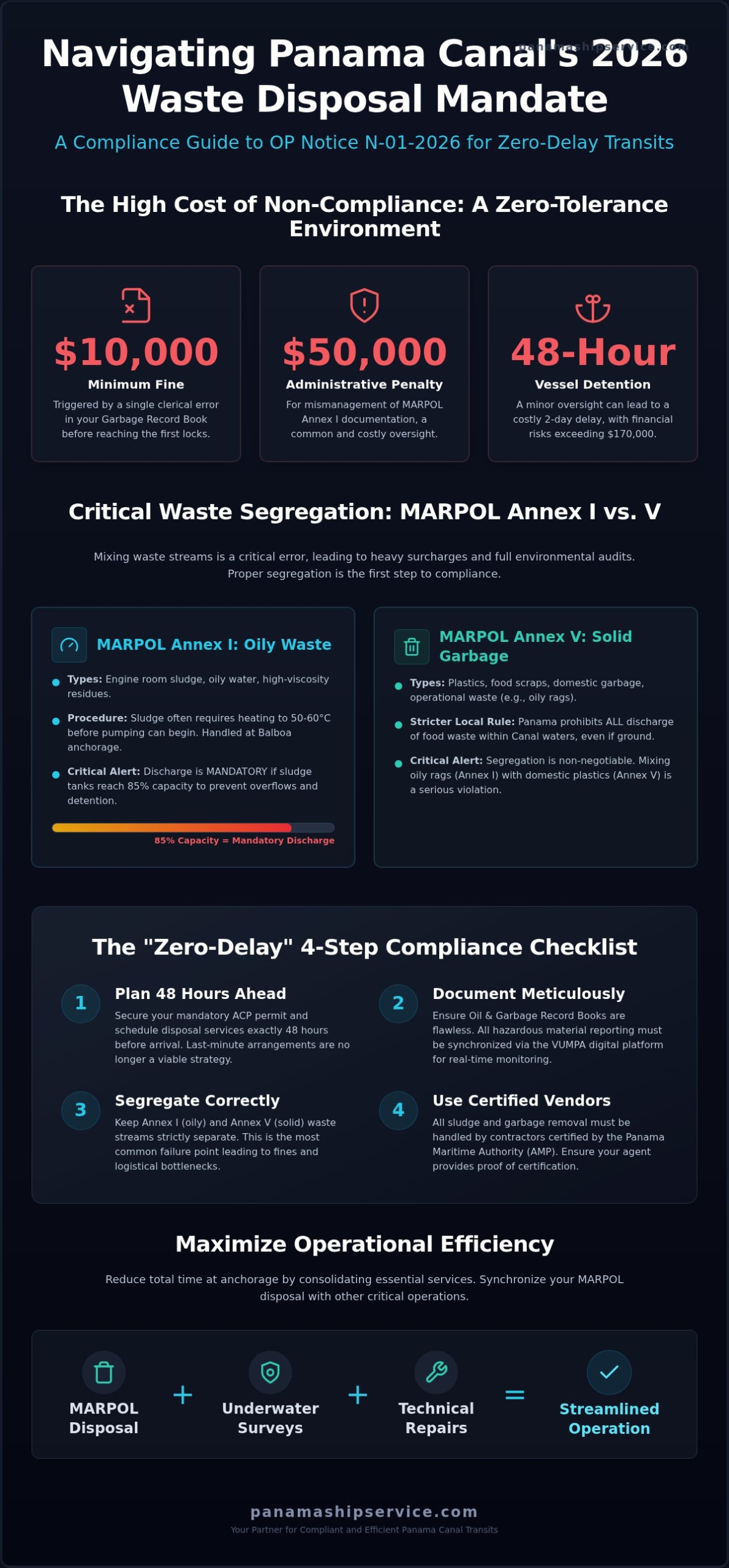
We understand that your primary goal is a seamless transit without hidden barge fees or unexpected bottlenecks. It’s frustrating to face massive financial risks over documentation that should be routine. This guide gives you the exact blueprint to master the latest 2026 compliance standards and synchronize your MARPOL disposal with your transit schedule to eliminate delays entirely. We’ll examine the critical shifts in waste reporting, explain how to avoid the $85,000 risk of a 12-hour delay, and show you how consolidated billing for repairs and disposal can streamline your entire operation.
Key Takeaways
- Navigate the strict OP Notice N-01-2026 regulations to prevent $50,000 administrative fines and 48-hour transit delays.
- Select the optimal anchorage for ship sludge removal in Panama by aligning your disposal needs with Northbound or Southbound transit schedules.
- Master the 48-hour pre-arrival notification process to secure mandatory ACP permits and ensure logbook compliance before boarding inspections.
- Identify the critical segregation requirements for MARPOL Annex I, IV, and V waste to eliminate hazardous waste surcharges and logistical bottlenecks.
- Maximize operational efficiency by consolidating MARPOL disposal with technical repairs or underwater surveys to reduce total time at anchorage.
Understanding Ship Waste Disposal in Panama: The 2026 Landscape
The Panama Canal Authority (ACP) operates under a zero-discharge mandate that transforms the 50-mile transit into a high-stakes compliance zone. Within this jurisdiction, MARPOL-compliant waste disposal refers to the strictly documented offloading of oily residues and garbage to certified local vendors. Panama serves as a strategic hub for ship sludge removal panama because it allows vessels to clear their tanks before embarking on trans-Pacific or trans-Atlantic voyages. However, the introduction of OP Notice N-01-2026 has tightened the window for error. Efficiency now depends on a “Zero-Delay” philosophy. You must secure your ACP permit exactly 48 hours before arrival. Waiting until you reach the anchorage to arrange services is no longer a viable operational strategy.
The High Cost of Non-Compliance in 2026
The ACP has increased its scrutiny of the Garbage Record Book and Oil Record Book. A single clerical error now carries a $10,000 fine. If a vessel mismanages MARPOL Annex I documentation, the penalty can jump to $50,000. Environmental inspections at the Miraflores and Gatun locks are more frequent, as boarding officers now cross-reference digital declarations with physical tank levels. A 48-hour transit delay caused by waste mismanagement represents a financial risk exceeding $170,000 for a Neopanamax vessel when accounting for fuel, operational costs, and missed arrival slots. Reliability in your documentation is as critical as the physical disposal itself.
MARPOL Annex V and Beyond: Local vs. International Rules
While the MARPOL 73/78 international convention provides a global baseline, the ACP enforces stricter local protocols to protect the Canal watershed. For instance, the discharge of food waste is prohibited even if ground, a rule that exceeds international standards. All ship sludge removal panama must be handled by contractors certified by the Panama Maritime Authority (AMP). In 2026, all hazardous material reporting must be synchronized through the Single Window for Maritime Commerce (VUMPA) digital platform. This automated system allows the ACP to monitor waste volumes in real-time, making proactive coordination with a local agent essential for a smooth transit.
Categorizing Maritime Waste: Sludge, Slops, and Solid Garbage
Proper categorization of waste is the first step in avoiding administrative bottlenecks during a canal transit. The Panama Canal Authority (ACP) adheres to the strict standards set by the International Maritime Organization (IMO), which classifies waste into distinct streams based on its environmental impact. For operators, the biggest mistake is failing to segregate hazardous materials from domestic garbage. Mixing Annex I oily rags with Annex V plastics doesn’t just result in heavy surcharges; it can trigger a full environmental audit. Efficient ship sludge removal panama directly impacts your vessel’s Carbon Intensity Indicator (CII) rating, making precise waste logistics a matter of long-term commercial viability.
Passenger vessels face even tighter scrutiny near the locks. Gray water and food waste handling must be managed with zero-discharge precision to protect the local watershed. Since the 2016 expansion, waste volumes have increased by nearly 35%, leading to an 18% surge in environmental inspections. If your sludge tanks are at 85% capacity or higher, scheduling a discharge is mandatory to prevent accidental overflows and subsequent vessel detention. Proactive segregation ensures that your vessel remains compliant while avoiding the logistical headaches of contaminated waste streams.
MARPOL Annex I: Sludge and Oily Water Recovery
Technical procedures for ship sludge removal panama often take place at the Balboa anchorage. High-viscosity sludge typically requires heating to at least 50-60 degrees Celsius before pumping can begin. Accurate volume estimation is critical here because underestimating your sludge levels leads to logistical failures. A second barge mobilization can cost approximately $3,500, and barge standby fees often exceed $400 per hour. Once the transfer is complete, you’ll receive a mandatory Safe Disposal Certificate. This document must be kept for three years and is the primary evidence used by boarding officers to verify compliance during inspections.
MARPOL Annex V: Solid Waste and Domestic Garbage
The 2026 “No Discharge” rules mean that every piece of plastic, food scrap, and operational garbage must stay on board until it’s offloaded to a certified contractor. At the Cristobal anchorage, handling incinerator ash and dunnage requires specific ACP permits. Managing this flow is essential to prevent deck congestion, which can interfere with crew operations during the complex canal transit. For vessels with tight schedules, coordinating these services through professional MARPOL disposal partners ensures that waste offloading doesn’t conflict with technical repairs or supply deliveries.
Logistical Strategy: Balboa vs. Cristobal Disposal Points
Choosing between Balboa and Cristobal is a strategic maneuver that dictates the efficiency of your ship sludge removal panama. The decision typically depends on your transit direction. Northbound vessels usually prefer the Pacific entrance to offload waste before entering the lock system. Conversely, Southbound vessels often wait until they reach the Atlantic side to clear their tanks. This approach helps you avoid the logistical bottleneck of carrying excess waste through the canal watershed, where discharge is strictly prohibited. Local intelligence is your best defense against “Barge Waiting” fees, which can quickly erode your operational budget if your ETA isn’t perfectly synchronized with barge availability.
Barge availability and local weather conditions also play critical roles in your logistical planning. At the Pacific entrance, deep-water anchorages accommodate VLCCs and large bulkers with ease. However, seasonal swells can occasionally disrupt barge operations. On the Atlantic side, Cristobal offers more sheltered conditions but experiences higher traffic from massive container fleets. Synchronizing your arrival with barge schedules is essential to avoid standby fees, which often exceed $400 per hour. Relying on a partner who understands these localized nuances ensures you don’t pay for idle time at either entrance.
Balboa (Pacific Side) Logistics
Offloading waste at Balboa is the preferred method for Northbound vessels. Clearing sludge and oily water before the locks ensures you won’t face detention due to tank capacity issues during the transit. The Pacific anchorages are specifically designed for high-tonnage vessels, offering the depth required for tankers and bulkers. Coordination with bunkering services at Balboa allows you to consolidate barge movements, effectively reducing your time at anchorage. This proactive approach minimizes the risk of logistical overlaps that often lead to expensive delays before you even reach the Miraflores locks.
Cristobal (Atlantic Side) Logistics
Southbound vessels exiting the Gatun locks find Cristobal to be the most efficient point for waste management. This port is a critical hub for container ships that generate high volumes of solid waste during their voyage. Cristobal provides access to specialized shore reception facilities and recycling centers that are highly efficient at minimizing vessel turnaround time. Utilizing these facilities helps you manage ship sludge removal panama while simultaneously clearing Annex V materials. This keeps your decks clear and your crew focused on the next leg of the journey rather than managing waste congestion during the voyage across the Caribbean.
The 48-Hour Pre-Arrival Checklist for Waste Offloading
Operational success in the Panama Canal depends on a strict 48-hour notification window. The Panama Canal Authority (ACP) requires precise waste declarations to be submitted via the Single Window for Maritime Commerce (VUMPA) exactly 48 hours before your vessel reaches the anchorage. Failing to meet this deadline or submitting inaccurate data isn’t just a logistical oversight; it’s a financial liability. Boarding officers frequently cross-reference your digital manifest with the physical state of your engine room and deck storage. To ensure a zero-delay transit, your ship sludge removal panama must be treated as a mission-critical technical operation rather than a routine administrative task.
Step 1: Documentation and Digital Reporting
Accuracy in your Oil Record Book (ORB) and Garbage Record Book (GRB) is your primary defense against the $10,000 administrative fines that have become common under 2026 enforcement. Your digital reporting on the ACP platform must reflect exact volumes and categories of waste. Discrepancies between your reported sludge levels and actual tank readings can lead to immediate vessel detention. Before the barge arrives, verify that all MARPOL certificates are current and that your chosen vendor holds a valid Panama Maritime Authority (AMP) certification. This proactive verification prevents the risk of using unauthorized contractors, which can result in significant legal complications and transit cancellations.
- Update VUMPA with precise sludge, bilge water, and Annex V volumes.
- Audit the Oil Record Book for clerical consistency to avoid $10,000 penalties.
- Ensure the Safe Disposal Certificate from previous ports is readily available for inspection.
Step 2: Physical Vessel Preparation
Technical readiness is what separates a smooth offloading operation from an expensive bottleneck. Vessels must be equipped with a standard International Shore Connection (ISC) featuring a 215mm outside diameter flange to ensure compatibility with local barges. If you’re handling high-viscosity engine room sludge, start heating the tanks to at least 50-60 degrees Celsius well before the barge’s ETA. This ensures a high pumping rate and prevents barge standby fees, which often exceed $400 per hour. Precise volume measurement is mandatory to prevent barge overflows and the subsequent environmental fines that can exceed $100,000 in Panamanian waters.
Crew safety briefings should prioritize the handling of hazardous materials and the prevention of spills during the transfer. Once the operation is complete, secure your Safe Disposal Certificate immediately and ensure it is signed by both the Master and the authorized contractor. If you want to eliminate the stress of coordinating these complex requirements, contact us to manage your 2026 MARPOL compliance and logistics. We handle the technical and administrative burdens so your crew can focus on the transit itself.
Maximizing Efficiency: Consolidating Disposal with Technical Services
Panama Ship Service is the logical partner for global fleets seeking consolidated maritime solutions. Most operators treat waste disposal and technical maintenance as isolated events. This oversight leads to redundant mobilization fees and unnecessary administrative friction. By adopting a one-stop-shop model, you can delegate the complexity of ship sludge removal panama to a single provider while our technical teams address your vessel’s mechanical needs. This strategic consolidation simplifies your communications and significantly reduces the total time spent at the Pacific or Atlantic anchorages.
Combining tank cleaning with MARPOL Annex I disposal creates a unique operational synergy. Instead of scheduling separate windows, we manage both tasks under a single point of contact. While our barge handles the offloading of engine room sludge and slops, our technicians can perform mechanical ship repairs or conduct essential maintenance in the engine room. This overlap is particularly beneficial for vessels with tight schedules during the 2026 transit season. It ensures that your vessel is technically sound and fully compliant with all environmental regulations before it enters the lock system.
Technical Synergy: Repairs and Waste
Efficiency extends to the hull as well. It’s highly effective to schedule underwater hull services during your waste offloading window. Propeller polishing and hull cleaning can be completed without adding extra days to your port call. This proactive approach to maintenance improves your vessel’s fuel efficiency and overall environmental rating. By handling these technical tasks while at anchorage for ship sludge removal panama, you eliminate the downtime that typically follows a canal transit. Reducing vessel downtime by overlapping these service windows is a critical advantage for maintaining profitability.
Reliability and Trust in the Panama Canal Hub
Reliability in the Panama Canal hub is built on a 20-year history of excellence. Panama Ship Service has supported thousands of transits by providing dependable, high-value services to global fleets. You can easily request a consolidated quote for MARPOL disposal panama and technical repairs through our streamlined booking process. Our commitment to environmental stewardship ensures that your waste is handled with zero-discharge precision. We focus on protecting your bottom line and ensuring a zero-delay transit, allowing your crew to focus on safe navigation through the locks.
Securing Your 2026 Transit with Integrated Compliance
The landscape of maritime waste management in Panama has fundamentally shifted with the 2026 regulations. To protect your vessel from $10,000 administrative fines or 48-hour transit delays, you must prioritize accurate digital reporting and strict MARPOL Annex segregation. Efficient ship sludge removal panama is no longer just a utility service; it’s a strategic logistical maneuver that requires 48-hour pre-planning and technical precision at the anchorages. By aligning your waste offloading with mechanical repairs or hull services, you eliminate redundant downtime and streamline your operational overhead.
Panama Ship Service provides the expertise needed to navigate these complexities with confidence. As a one-stop-shop, we offer full MARPOL and AMP certification alongside 24/7 operational support to ensure your fleet remains compliant and on schedule. Don’t let minor logbook errors or barge bottlenecks disrupt your canal passage. Request a Consolidated Quote for Waste Disposal and Ship Repairs today to secure a zero-delay transit. We look forward to supporting your next successful crossing.
Frequently Asked Questions
What is the most common reason for waste-related fines at the Panama Canal?
The most common reason for waste-related fines is a clerical error in the Garbage Record Book or Oil Record Book. Under the 2026 regulations, even a minor administrative mistake can trigger a $10,000 fine. Boarding officers frequently cross-reference digital declarations with physical tank levels to find discrepancies. Ensuring your documentation matches your actual waste volumes is the most effective way to prevent these penalties and avoid transit delays.
Can I offload ship garbage while the vessel is in transit through the locks?
No, you cannot offload ship garbage while the vessel is in transit through the locks or any active Canal waters. Safety regulations strictly prohibit barge operations during the transit process. All waste disposal must take place at designated anchorages in Balboa or Cristobal either before or after the passage. Attempting to discharge any material during transit can lead to fines exceeding $100,000 and immediate vessel detention by the Panama Canal Authority.
What documentation is required to prove MARPOL compliance in Panama?
To prove MARPOL compliance, you must provide a Safe Disposal Certificate issued by an AMP-certified contractor. You also need to maintain an updated Oil Record Book and Garbage Record Book that reflect all recent discharges. Boarding officers will verify these documents against your mandatory ACP permit, which must be secured 48 hours before arrival. Keeping these records for at least three years is a requirement for all vessels transiting the Panama Canal.
How much lead time is needed to schedule a sludge removal barge in Balboa?
You must finalize waste quantities and secure the mandatory ACP permit exactly 48 hours before arrival for ship sludge removal panama. We recommend starting the booking process at least 72 hours in advance to ensure barge availability and avoid standby fees. This lead time allows for the synchronization of digital reporting via the VUMPA system. Early coordination is essential to prevent logistical bottlenecks that could result in a 48-hour transit delay.
Are there specific restrictions on food waste disposal in the Panama Canal watershed?
Yes, the Panama Canal watershed is a zero-discharge environment where the disposal of all food waste is strictly prohibited. This rule applies even if the food waste has been ground or comminuted. All organic waste must be kept on board in sealed containers until it can be offloaded to a certified contractor at the anchorage. Violating this policy can result in significant environmental fines and mandatory inspections at the Miraflores or Gatun locks.
What happens if the volume of waste exceeds the initial manifest?
If your waste volume exceeds the initial manifest, you will likely face significant logistical delays and additional costs. A second barge mobilization fee is approximately $3,500, and you’ll incur barge standby fees exceeding $400 per hour while the new arrangements are finalized. Accurate tank measurements are critical because the ACP uses automated systems to cross-reference your digital declarations. Underestimating your volumes often leads to administrative fines and a loss of your transit slot.
Does Panama Ship Service provide Safe Disposal Certificates for all offloads?
Yes, Panama Ship Service provides a mandatory Safe Disposal Certificate for every MARPOL offload we manage. This document is essential for your vessel’s records and is the primary evidence required by ACP boarding officers to verify compliance. We ensure that all disposal processes meet both international MARPOL standards and the specific local requirements of the Panama Maritime Authority. These certificates provide the legal protection you need to demonstrate environmental stewardship and avoid detention.
Is it possible to combine waste disposal with underwater inspections?
It’s highly efficient to combine ship sludge removal panama with underwater inspections or propeller polishing while at the anchorage. Overlapping these service windows allows you to maximize your time at the Pacific or Atlantic entrances without adding extra days to your port call. This “one-stop-shop” approach reduces administrative overhead and minimizes the total number of barge movements around your vessel. It is a strategic way to improve your vessel’s environmental rating while maintaining a tight transit schedule.