
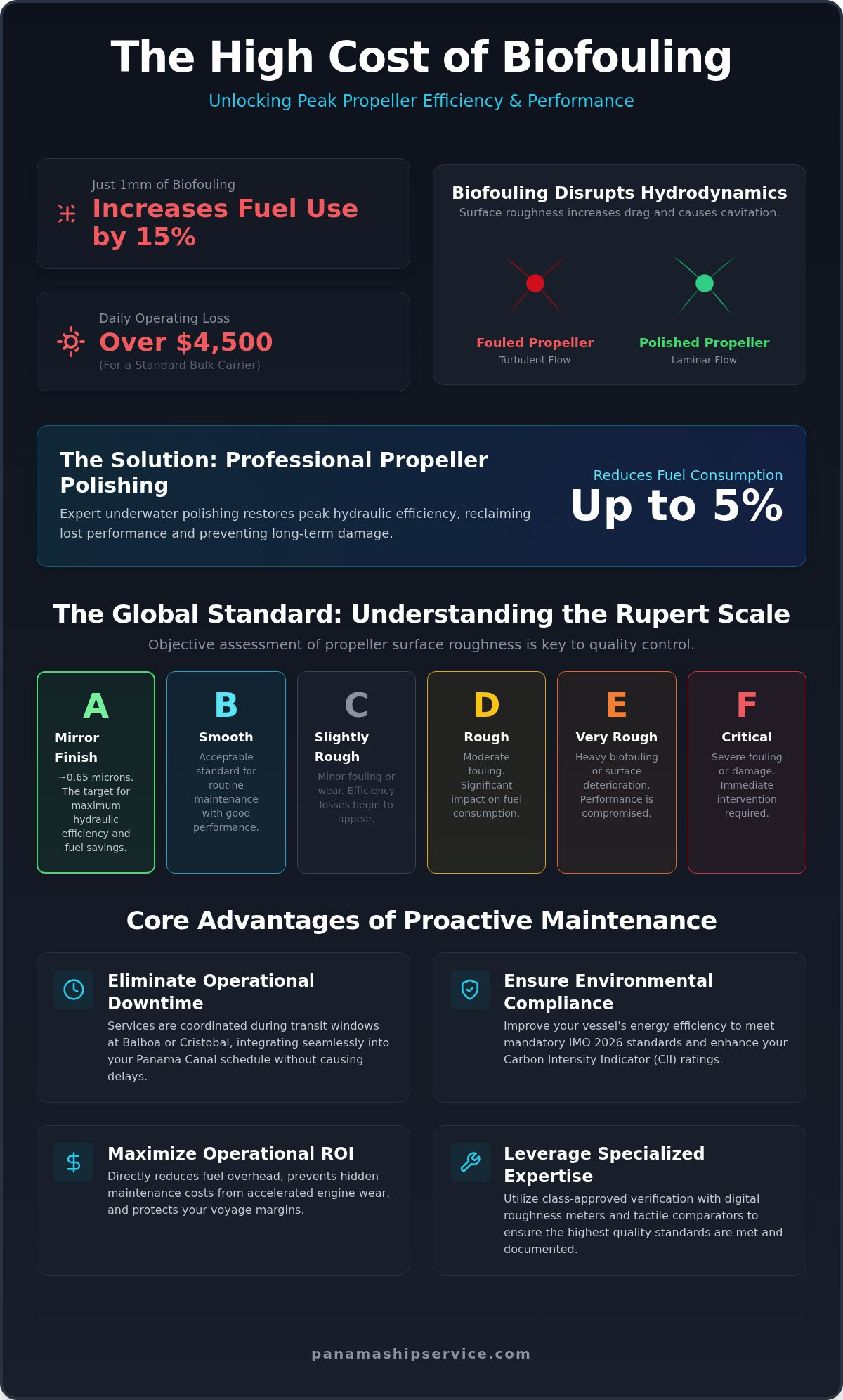
A single millimeter of biofouling on a vessel’s hull can increase fuel consumption by 15%, costing a standard bulk carrier over $4,500 in daily operating expenses. For fleet managers, these inefficiencies are unacceptable, particularly when navigating the high-stakes transit windows of the Panama Canal. Utilizing professional propeller polishing panama services offers a strategic solution to reclaim this lost performance while your vessel is at anchorage.
You understand that maintaining a smooth propeller surface is critical for vessel speed and maneuverability. Biofouling doesn’t just waste fuel; it threatens your compliance with mandatory IMO 2026 energy efficiency standards and can lead to expensive delays if not managed by authorized contractors. Uncertainty regarding contractor quality or potential transit disruptions often causes hesitation, but the cost of inaction is far higher.
This guide explains how expert polishing reduces fuel consumption by up to 5% and provides the Rupert Scale Grade A finish required for peak hydraulic efficiency. You’ll learn how to integrate this vital maintenance into your transit schedule, ensuring you meet environmental standards and maximize your operational ROI without risking a single hour of downtime.
Key Takeaways
- Understand how even microscopic biofouling increases drag and leads to significant daily fuel waste.
- Identify the specific Rupert Scale grades required to achieve a mirror finish and peak hydraulic efficiency.
- Discover how professional propeller polishing panama can reduce fuel overhead by up to 5% while improving your 2026 CII ratings.
- Learn to coordinate underwater hull services during transit windows at Balboa or Cristobal to eliminate operational downtime.
- Leverage specialized technical expertise to ensure your vessel meets environmental and class standards without disrupting canal schedules.
The Impact of Propeller Biofouling on Vessel Performance
Biofouling isn’t just about visible barnacles or tube worms. It starts as a microscopic slime layer that fundamentally alters how water moves across your propeller blades. In the warm, nutrient-rich tropical waters surrounding the Panama Canal, propeller biofouling occurs at an accelerated rate compared to colder climates. This biological growth creates surface roughness that disrupts the precision engineering of your vessel’s propulsion system. The result is a measurable loss in thrust and a sharp increase in drag. Choosing professional propeller polishing panama services during your transit window addresses this issue before it compounds into a major financial drain on your operations.
Hydrodynamics and Propeller Efficiency
Effective propulsion relies on maintaining a stable boundary layer where water flows smoothly over the blade surface. When roughness exceeds even a few micrometers, it disrupts this laminar flow and creates localized turbulence. This turbulence doesn’t just slow the ship; it increases the risk of cavitation. Cavitation occurs when vapor bubbles form in low-pressure areas and collapse violently against the metal, causing physical pitting and erosion over time. Professional polishing removes these microscopic irregularities and restores the original design profile of the blades. This ensures the propeller operates at its peak hydraulic efficiency, converting engine power into forward motion with minimal loss.
The Cost of Neglect: Fuel Consumption Penalties
The financial impact of a fouled propeller is immediate and cumulative. Industry data indicates that moderate fouling can increase fuel consumption by 5% to 15%. When the propeller surface is compromised, the main engine must work harder and run at higher RPMs to maintain the same cruising speed. This increased workload forces the engine outside its optimal performance curve, leading to higher exhaust gas temperatures and increased fuel injection. Beyond the direct fuel cost, this constant strain accelerates engine wear and shortens maintenance cycles for critical mechanical components. For a standard bulk carrier, the daily cost of fouling can exceed $4,500 in wasted fuel alone. Scheduling propeller polishing panama is a proactive measure that prevents these hidden costs from eroding your voyage margins during long transoceanic crossings.
The Science of Surface Roughness: Understanding the Rupert Scale
The Rupert Scale is the definitive global standard for assessing the surface condition of marine propellers. It provides a technical framework that moves beyond subjective visual assessments to provide objective, measurable data. For ship owners and technical managers, understanding these grades is essential for evaluating the quality of propeller polishing panama services. A clean propeller isn’t merely one free of visible growth; it’s a component engineered to specific micron-level tolerances that dictate its hydraulic performance.
Rupert Grades Explained
The scale categorizes surface roughness into six distinct grades, ranging from A to F. Achieving a Grade A finish is the primary objective of a professional polish. This grade corresponds to a surface roughness of approximately 0.65 microns, often referred to as a “mirror finish.” This level of smoothness is mandatory for maximizing Fuel Efficiency and Speed Gains in modern shipping. Grades B and C represent acceptable standards for routine maintenance but offer diminishing returns in fuel savings. Grades D through F indicate critical fouling or physical deterioration. At these levels, the propeller’s efficiency is severely compromised, requiring immediate mechanical intervention to restore the blade’s profile.
Measurement and Verification Protocols
Technical reporting relies on specialized measurement tools rather than simple underwater photography. Specialized dive teams use tactile comparators, which allow them to physically match the propeller’s surface against known Rupert Scale standards while submerged. For higher precision, digital roughness meters provide micron-specific readings that are essential for class-approved surveys and energy efficiency documentation. These measurements are recorded both before and after the service to provide owners with a clear record of the improvement. This data is critical for complying with IMO 2026 reporting requirements and verifying the ROI of the maintenance work.
Objective reporting ensures that the service delivered meets the technical specifications required for your specific vessel type. If your fleet requires documented proof of performance to maintain its EEXI compliance, coordinating a professional underwater hull service at the Panama Canal is the most efficient way to secure these results. Our teams provide the technical expertise and specialized equipment necessary to achieve a Grade A finish and provide the comprehensive reporting your technical department demands.
Calculating the ROI: Fuel Efficiency and Speed Gains
Investing in propeller polishing panama isn’t just a maintenance expense; it’s a high-yield financial strategy. Most technical managers find the service pays for itself within weeks of a single transoceanic voyage. By restoring the propeller’s surface to a mirror finish, you eliminate the hydrodynamic drag that forces engines to consume more fuel to maintain cruising speed. This direct reduction in fuel overhead is essential for protecting profit margins in an era of volatile bunker prices and strict environmental mandates.
According to International Maritime Organization data, regular propeller polishing can lead to immediate fuel savings of 3% to 4%. These gains are critical for improving a vessel’s Carbon Intensity Indicator (CII) ratings, which become increasingly stringent through 2026. Beyond fuel, a clean propeller typically yields a speed increase of 0.5 to 1.0 knot. While this seems minor, it provides the operational buffer needed to meet tight delivery windows and avoid the massive costs associated with missing a Neo-Panamax canal slot.
Mechanical health is a significant secondary benefit. A fouled propeller creates uneven hydrodynamic forces that lead to increased vibration. Over time, these vibrations cause premature wear on the tailshaft bearing and mechanical seals. Routine propeller polishing panama identifies early signs of cavitation damage or hairline cracks, allowing for scheduled repairs rather than emergency dry-docking. This proactive approach ensures the long-term integrity of the propulsion train.
Performance Metrics: Polished vs. Unpolished
The relationship between surface condition and fuel consumption is quantifiable. The following table estimates the fuel increase based on the Rupert Scale roughness grades discussed in the previous section:
- Grade A (0.65 μm): 0% fuel penalty (Baseline)
- Grade B (2.5 μm): 1% to 2% fuel increase
- Grade C (8.5 μm): 3% to 4% fuel increase
- Grade D (20 μm): 6% or higher fuel increase
For a standard bulk carrier, a 4% reduction in fuel consumption can save over $1,200 per day. For high-consumption container ships, these savings are even more pronounced, often exceeding $3,000 daily. These figures demonstrate that the cost of neglect far outweighs the price of professional underwater maintenance.
Preventative Maintenance vs. Emergency Repair
Regular polishing is significantly less invasive than restorative grinding. Frequent, gentle polishing preserves the original metal of the blades and maintains the precision-engineered profile. If fouling is allowed to calcify, divers must use aggressive abrasive tools that can remove the protective surface layer of the bronze alloy. By maintaining a Grade A finish through consistent intervals, you extend the total service life of the propeller and ensure the vessel remains in compliance with environmental and class standards throughout its operational cycle.
Logistical Excellence: Polishing During Panama Canal Transit
Efficiency is the priority for any vessel transiting the Panama Canal. The strategic advantage of scheduling propeller polishing panama during this window is the ability to perform critical maintenance while the ship is at anchorage awaiting its transit slot. This approach effectively eliminates operational downtime. The service is completed during a period when the vessel would otherwise be idle, turning wait time into productive maintenance. Coordination with the Panama Canal Authority (ACP) schedules ensures that our dive teams are mobilized and ready the moment your vessel arrives, allowing for a seamless integration into your itinerary.
Location Matters: Balboa vs. Cristobal
Choosing the correct side of the canal for service depends on your vessel’s direction and the duration of your stay at anchorage. Balboa, on the Pacific side, and Cristobal, on the Atlantic side, both offer secure anchorages for underwater operations. We handle the logistical complexities of equipment mobilization and dive team transport to either location. Our teams are fully versed in local environmental regulations and ACP permit requirements. We ensure all propeller polishing panama activities are conducted in strict compliance with Panamanian law. This prevents the risk of environmental fines, which start at $15,000 for unauthorized cleaning operations in canal waters.
Streamlining the Process for Ship Managers
Managing multiple contractors in a high-pressure environment like the Panama Canal creates unnecessary administrative overhead. We operate as a comprehensive one-stop-shop, allowing you to integrate polishing with broader underwater hull services. This consolidated model simplifies communication. It ensures that all technical requirements are met under a single point of responsibility, reducing the burden on your shore-based technical department.
Technical efficiency extends to the engine room as well. You can combine underwater work with critical mechanical ship repairs to maximize the value of your port call. Our proactive approach includes delivering real-time digital reports and high-resolution video footage of the propeller condition before the vessel even begins its transit. This immediate feedback allows technical managers to verify the quality of the work and update performance logs without delay. To secure your transit window and optimize your vessel’s performance, schedule your underwater maintenance with our technical team today.
Panama Ship Service: Professional Underwater Propeller Maintenance
Panama Ship Service provides the technical proficiency required to maintain high-value maritime assets in the world’s most critical transit hub. Our specialized approach to propeller polishing panama focuses on achieving the exact Rupert Grade A finish necessary for peak hydraulic performance. We understand that for technical superintendents, reliability is as important as the service itself. Our operations are designed to protect your vessel’s propulsion system while ensuring that every minute at anchorage contributes to your bottom line.
The Panama Ship Service Advantage
Our specialized teams utilize hydraulic tools specifically calibrated for high-performance marine alloys to deliver superior propeller polishing panama results. Unlike generic cleaning services, we treat the propeller as a precision instrument rather than just a metal component. Every project includes comprehensive photo and video reporting; this provides you with high-resolution visual evidence of the blade condition before and after our intervention. This transparency is vital for owner records and class-approved survey documentation. Our deep familiarity with Panama Canal Authority (ACP) protocols means we handle the administrative and safety requirements, allowing your crew to focus on transit preparations.
Beyond Polishing: A Full Technical Suite
Our capability extends beyond surface maintenance. We offer a comprehensive suite of technical services designed to simplify vessel management. You can schedule marine surveys in Panama alongside your polishing to identify potential mechanical issues before they lead to failure. If our divers detect cavitation damage or cracks during a polish, our mechanical repair teams are available to provide immediate solutions.
We also manage complex operational requirements such as MARPOL disposal, ensuring your vessel remains in full environmental compliance without needing multiple local agencies. This consolidated service delivery reduces administrative overhead and minimizes the risk of logistical delays. Technical superintendents can delegate these complexities to us, knowing that we prioritize the efficiency and safety of their fleet. Contact our operations department to coordinate your next technical service at either Balboa or Cristobal.
Secure Your Vessel’s Performance and Efficiency in Panama
Propeller maintenance is a strategic investment that directly impacts your voyage profitability and long-term asset health. By achieving a Grade A Rupert Scale finish, you eliminate the hydrodynamic drag caused by biofouling and secure immediate fuel savings. Integrating these technical services into your Panama Canal transit window prevents operational downtime and ensures compliance with 2026 environmental standards like EEXI and CII. You don’t have to choose between a tight schedule and a clean hull.
Professional propeller polishing panama transforms idle anchorage time into a high-yield maintenance opportunity. Our expert underwater teams are available 24/7 at both Balboa and Cristobal to provide the technical precision your fleet requires. We offer comprehensive Rupert Scale reporting and the reliability trusted by global ship managers. By delegating these complexities to a consolidated service provider, you simplify your operations and maximize your ROI. Request a technical quote for propeller polishing in Panama to optimize your vessel’s hydraulic efficiency today. We look forward to supporting your next successful canal transit with our specialized technical solutions.
Frequently Asked Questions
How often should a ship’s propeller be polished in Panama?
Ships should generally schedule propeller polishing panama every six to twelve months depending on their operational profile. In the tropical waters of the canal, biofouling accumulates rapidly, which accelerates surface roughness. Regular maintenance ensures the blades maintain a Rupert Grade A finish, preventing the need for more aggressive restorative grinding later. Most technical managers coordinate this service during each transit to maintain peak hydraulic efficiency and ensure compliance with energy reporting standards.
How long does a typical underwater propeller polishing take?
A standard underwater propeller polishing typically takes between four and six hours to complete. The exact duration depends on the propeller’s diameter and the initial level of fouling. Our specialized dive teams utilize high-speed hydraulic tools to achieve a mirror finish within this window. Because the process is efficient, it’s easily completed while the vessel is at anchorage, ensuring the service doesn’t interfere with the assigned canal transit schedule.
Can propeller polishing be performed while the vessel is loading or discharging cargo?
Yes, propeller polishing can often be performed during cargo operations at specific terminals or anchorages in Balboa and Cristobal. This allows ship managers to consolidate technical services without extending the port call. However, coordination with the port authority and terminal operator is essential to ensure safety protocols are followed. Performing these underwater services during loading or discharging is a highly effective way to maximize operational time while the vessel is already stationary.
Does propeller polishing require a class-approved diver?
Yes, utilizing class-approved divers is critical for ensuring that the technical reports are accepted by classification societies and insurance providers. Our dive teams are certified to perform underwater inspections and maintenance that meet international standards. This certification guarantees that the Rupert Scale measurements and video documentation provided after the service are accurate and technically sound. It also ensures that the work is performed according to recognized safety and quality management protocols.
What is the difference between propeller cleaning and propeller polishing?
Propeller cleaning focuses solely on removing visible marine growth like barnacles and tube worms. In contrast, propeller polishing panama involves using specialized abrasive discs to reduce the microscopic surface roughness of the metal itself. While cleaning restores some thrust, only polishing achieves the Rupert Grade A mirror finish required to minimize hydrodynamic drag. Polishing is a more technical process that delivers significantly higher fuel efficiency gains compared to basic cleaning.
Will propeller polishing affect the vessel’s transit schedule through the Panama Canal?
No, professional propeller polishing won’t disrupt your transit schedule if it’s performed while the vessel is at anchorage awaiting its slot. We coordinate closely with local agents and the Panama Canal Authority to ensure our teams are on-site during your scheduled wait time. Since the service typically takes less than six hours, it’s easily completed well before your vessel is called for transit, making it a zero-downtime maintenance solution.
How much fuel can I realistically expect to save after a propeller polish?
Most vessel operators realistically expect fuel savings between 3% and 5% immediately following a professional polish. According to International Maritime Organization data, even minor surface roughness can lead to significant consumption increases. For a standard bulk carrier, this reduction in fuel overhead can save over $1,200 in daily operating costs. These savings are cumulative, meaning the service often pays for itself within the first few weeks of a transoceanic voyage.
Is it safe to polish propellers during the rainy season in Panama?
It’s entirely safe to perform propeller polishing during the Panamanian rainy season. Since the work is conducted underwater, surface weather conditions like rain or wind don’t typically impact the quality of the finish or the safety of the divers. Our teams are experienced in managing the localized currents and visibility changes that can occur during the wet season. We maintain a 24/7 operational readiness to ensure your vessel receives expert technical support regardless of the time of year.