
With daily Neopanamax transit slots reduced to just nine and unbooked wait times often exceeding ten days, the cost of a Panama Canal arrival has never been more volatile. You’re likely managing mounting demurrage costs and the logistical strain of an auction system that feels increasingly restrictive. Identifying the common causes of Panama Canal transit delays is the first step toward regaining control over your schedule and protecting your bottom line.
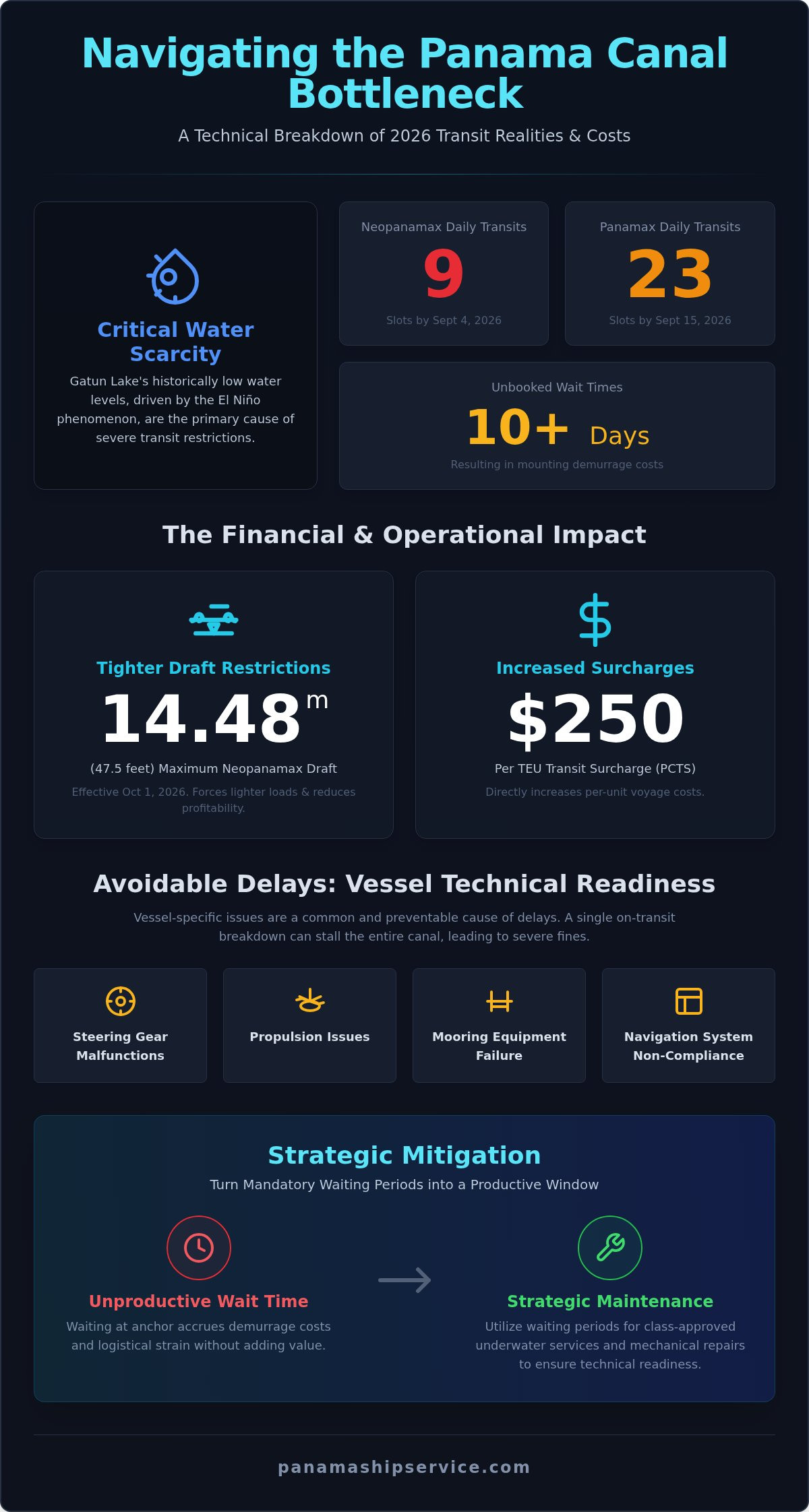
This guide provides a technical breakdown of 2026 transit realities, including the $250 per TEU surcharge and the tightening draft restrictions effective October 1. We’ll explore actionable strategies to minimize financial impact and show you how to utilize mandatory waiting periods for essential maintenance. By scheduling underwater inspections or mechanical repairs while at anchor, you turn a logistical bottleneck into a strategic window for technical readiness. This guide previews the latest auction group modifications and the specific booking rule changes you need to know to maintain operational efficiency in this high-pressure environment.
Key Takeaways
- Identify the critical environmental and operational drivers, including Gatun Lake water levels and lock maintenance, that constitute the common causes of Panama Canal transit delays in 2026.
- Evaluate the financial impact of increased transit surcharges and auction prices to refine your vessel’s fiscal planning and demurrage projections.
- Understand how the 2026 booking system modifications and specific market group divisions affect your ability to secure a transit slot.
- Discover how to utilize mandatory waiting periods as strategic maintenance windows for class-approved underwater services and mechanical repairs to minimize future downtime.
- Strengthen your operational efficiency by aligning technical readiness with the latest ACP requirements to avoid compounding existing transit delays.
Climatic and Environmental Drivers of Canal Congestion
Climatic volatility remains the primary disruptor for maritime logistics in the region. Unlike sea-level waterways, the system relies entirely on freshwater from Gatun Lake to lift vessels through its locks. When rainfall patterns shift, the resulting water scarcity becomes one of the most significant common causes of Panama Canal transit delays. In 2026, the ongoing El Niño event has forced the Panama Canal Authority (ACP) to implement aggressive conservation measures. This environmental pressure directly reduces daily transit slots, which are scheduled to drop to just nine for Neopanamax locks by September 4, 2026. For a comprehensive Panama Canal operational overview, it’s vital to recognize that every transit consumes millions of gallons of lake water, making the watershed’s health synonymous with throughput capacity.
Gatun Lake Water Levels and Draft Restrictions
There’s a direct correlation between Gatun Lake’s depth and the maximum allowable draft for transiting vessels. As levels recede, the ACP issues mandatory draft adjustments to prevent groundings. The maximum authorized draft for Neopanamax locks is set to decrease to 14.48 meters (47.5 feet) by October 1, 2026. These restrictions force carriers to offload cargo or sail with lighter loads, which severely impacts the profitability of Neopanamax vessels. Shippers aren’t just facing longer waits; they’re also contending with the Panama Canal Transit Surcharge (PCTS), which is increasing to USD 250 per TEU as a response to these water-level challenges. This reduction in cargo capacity means higher per-unit costs for every voyage, making every centimeter of draft a critical financial factor.
Climate Adaptation and Infrastructure in 2026
The ACP is currently accelerating water management projects to stabilize transit numbers. These include the development of new reservoir systems and water-saving basins designed to recycle freshwater during lockages. While these infrastructure upgrades aim to mitigate the impact of prolonged drought cycles, environmental volatility remains an unpredictable factor. The transition between El Niño and La Niña cycles in 2026 continues to create logistical uncertainty. Panamax locks will see their own reductions, moving to twenty-three slots by September 15, 2026. For ship owners, this means technical readiness and schedule flexibility aren’t just advantages; they’re operational necessities. High-stakes transit requires a partner who understands that climate is now a permanent variable in the global supply chain.
Operational Bottlenecks and Vessel Technical Readiness
While environmental factors dominate headlines, vessel-specific issues represent some of the most avoidable common causes of Panama Canal transit delays. Operational efficiency at the canal is a delicate balance. Any interruption, whether from planned lock maintenance or an unplanned mechanical failure, ripples through the entire queue. The Panama Canal Authority (ACP) maintains rigorous schedules for the Neo-Panamax and Panamax locks to ensure long-term reliability. However, when these maintenance windows coincide with daily transit slot reductions, the remaining capacity is stretched to its limit. If your vessel arrives with unresolved technical discrepancies, you risk being pushed to the back of the line or denied transit entirely.
Common technical failures that trigger delays include:
- Steering Gear Malfunctions: Critical for navigating the narrow Culebra Cut safely.
- Propulsion Issues: Any loss of power during lockage is an immediate safety hazard.
- Mooring Equipment: Faulty winches or degraded lines can halt lock operations.
- Navigation Systems: Non-compliance with the latest ACP electronic chart requirements.
The High Cost of On-Transit Mechanical Failures
A single vessel breakdown within the canal system can stall the entire transit schedule for hours. The financial consequences of such an event are severe. Beyond the immediate demurrage and lost time, the ACP imposes substantial fines for blocking transit lanes. These penalties are designed to discourage operators from attempting transit with known mechanical risks. Proactive mechanical ship repairs performed at anchor in Balboa or Cristobal are significantly cheaper than the fines associated with a mid-transit breakdown. Ensuring your machinery is in peak condition is a strategic necessity for 2026 operations.
ACP Technical Compliance and Inspections
ACP boarding officers utilize a comprehensive inspection checklist for every vessel. In 2026, there’s an increased focus on rudder and propeller integrity to ensure safe maneuvering under restricted draft conditions. If an inspector identifies a deficiency, the vessel is often ordered to the anchorage for repairs, leading to missed slots and expensive auction losses. Utilizing professional marine surveys in Panama before your scheduled transit date allows you to identify and rectify these issues early. Our team provides the technical oversight needed to satisfy ACP standards. You can delegate this technical complexity to Panama Ship Service to ensure your vessel meets all compliance requirements without unnecessary complication.
Market Dynamics: Traffic Volume and the Booking System
Demand for the canal remains high because it’s still the most efficient route for US East Coast to Asia trade. However, market dynamics are shifting. The imbalance between vessel demand and available slots is one of the primary common causes of Panama Canal transit delays. As accelerating climate change is threatening global supply chains, the ACP has tightened its prioritization. Ships are now categorized into four distinct market groups for auctions. Group 1 includes LNG and LPG, while Group 2 covers dry bulk and general cargo. Group 3 is reserved for container vessels and RoRo, and Group 4 handles tankers. This creates a tiered system where high-value cargo often pays a massive premium to secure a predictable schedule.
Booking Strategies for Modern Ship Operators
The reservation system operates in three distinct periods. Period 1 booking fees currently range from USD 25,000 to 50,000. Period 2 fees range from USD 12,500 to 35,000. Operators must decide early if they’ll commit to these fees or risk the unbooked queue. Effective August 21, 2026, the ACP allows only one booking slot per customer per day, which limits the flexibility of large fleets. If you choose to wait at anchor, expect wait times of 3 to 10+ days. Special auction slots have occasionally reached seven-figure premiums in 2026. These auctions allow vessels to bypass the queue, but the financial threshold is high. Successful operators use these windows for technical services to offset the cost of waiting.
Global Shipping Rerouting Trends
Volatility in alternative routes has forced a cost-benefit analysis for every voyage. While the Suez Canal faces its own challenges, the Cape Horn route is becoming a viable option for some bulk carriers despite the extra distance. This is largely due to the Panama Canal Transit Surcharge (PCTS) of USD 250 per TEU. LNG and LPG carriers are driving auction price volatility because their specialized requirements limit their slot options. The “just-in-time” arrival model is struggling in this congested environment. Shippers are increasingly adopting “just-in-case” buffers. Navigating the common causes of Panama Canal transit delays requires a focus on fiscal responsibility and schedule optimization. You can delegate the complexity of these logistical hurdles to a reliable partner who understands the local auction landscape.
The Financial Fallout: Quantifying the Cost of Waiting
The fiscal impact of a delayed transit extends far beyond the initial toll or auction premium. While environmental factors and booking bottlenecks are common causes of Panama Canal transit delays, the secondary financial fallout is often where profit margins disappear. For a Panamax bulker, total transit costs typically range between USD 160,000 and 230,000, but this figure doesn’t account for the daily charter hire lost while sitting at anchor. When a vessel is stuck in an unbooked queue for 10 days, the cumulative loss from idle time can quickly exceed the cost of the transit itself.
Catch-up steaming represents a significant indirect cost that operators often overlook. Once a vessel finally clears the canal, the crew may be ordered to increase speed to meet original port schedules. This “sprint” significantly increases fuel consumption, negating any savings achieved through slow-steaming on the approach. Beyond fuel, reputational damage looms; missed delivery windows lead to supply chain penalties and the potential loss of long-term contracts with cargo owners who prioritize schedule integrity.
Demurrage and Charter Party Disputes
Determining who pays for the wait remains a primary source of friction between charterers and owners. In 2026, standard charter party contracts have evolved to include specific clauses addressing Panama Canal congestion. These clauses define whether the time spent at anchor counts as laytime or if the vessel is considered “off-hire.” To mitigate these disputes, accurate and transparent port agency reporting is essential. Discrepancies in arrival times or readiness notices can lead to months of legal arbitration. Operators must ensure their local agents provide real-time, verifiable data to support demurrage claims and protect their financial interests.
The Hidden Cost of Hull Biofouling
Tropical water anchorage is a catalyst for rapid marine growth. When a vessel remains stationary in the warm waters of Balboa or Cristobal for extended periods, biofouling begins to accumulate on the hull and niche areas. This organic growth increases hydrodynamic drag, which can degrade fuel efficiency by as much as 10 to 15 percent on the next leg of the voyage. Identifying this as one of the common causes of Panama Canal transit delays in terms of operational efficiency is vital for long-term cost management.
Because of this, underwater hull services are no longer just a periodic maintenance item; they are a strategic response to anchorage delays. Professional cleaning and class-approved inspections while at anchor ensure your vessel leaves the canal in peak condition. You can delegate the technical complexity of hull maintenance to a reliable partner to optimize your performance. Contact Panama Ship Service today to schedule an underwater inspection and protect your vessel’s fuel efficiency.
Strategic Mitigation: Turning Delays into Productive Windows
While the common causes of Panama Canal transit delays are often viewed as purely restrictive, they present a unique tactical advantage for proactive ship operators. A 10-day wait at anchor doesn’t have to be dead time; it’s a strategic window to consolidate technical services that would otherwise require separate, costly deviations. By shifting your perspective from lost revenue to a scheduled maintenance opportunity, you can improve your vessel’s long-term operational efficiency. Navigating the administrative hurdles of the ACP requires local expertise and a systematic approach to technical readiness.
One of the most effective ways to utilize this time is by addressing regulatory requirements. Managing MARPOL disposal in Panama while at anchor ensures your vessel remains compliant with international environmental standards without interrupting its voyage. Consolidating waste disposal, technical surveys, and supply replenishment into a single window reduces the total overhead of your transit and prepares your crew for the next leg of the journey.
The “One-Stop-Shop” Technical Approach
Maximizing your time at the Balboa or Cristobal anchorages involves scheduling high-impact services that improve vessel performance. Propeller polishing and hull cleaning are essential for maintaining fuel efficiency, especially after the biofouling risks discussed in previous sections. You can also conduct class-approved UWILD (Underwater Inspection in Lieu of Drydocking) surveys while waiting for your slot. This prevents the need for future downtime and ensures your hull integrity meets ACP standards before you enter the locks. Additionally, sourcing ship supplies at the Panama Canal allows you to restock provisions, spare parts, and technical equipment during the waiting period. This integrated approach ensures that when the “Proceed” order arrives, your vessel is in peak condition.
Emergency Repairs and Technical Support
Technical readiness is the best defense against compounding the common causes of Panama Canal transit delays. If an inspection reveals a deficiency, you need immediate resolution to avoid losing your hard-won transit slot. Utilizing 24/7 mechanical ship repairs in Panama provides the rapid response necessary for critical issues involving steering gear, propulsion, or mooring systems. Our team handles the technical logistics, allowing you to focus on navigation and schedule management.
Masters should follow a final readiness checklist before transit:
- Confirm all steering gear and main engine tests are documented and successful.
- Verify that all mooring winches and lines meet current ACP specifications.
- Ensure the vessel’s draft is within the 14.48-meter limit effective October 1, 2026.
- Check that all navigation equipment and electronic charts are fully updated.
You can delegate these technical complexities to Panama Ship Service to ensure your operations remain grounded and reliable. We position ourselves as your comprehensive partner at this strategic hub, handling the details so you don’t have to.
Navigating the Future of Panama Canal Logistics
Managing a vessel in 2026 requires a shift from reactive waiting to proactive optimization. While climatic shifts and booking restrictions are the primary common causes of Panama Canal transit delays, your technical readiness remains the most critical factor under your direct control. By anticipating draft changes and ensuring your machinery meets rigorous ACP standards, you protect your schedule from avoidable interruptions and costly auction losses.
The differentiator for successful operators is how they utilize the mandatory anchorage period. Instead of absorbing demurrage as a total loss, you can transform these windows into essential maintenance periods. This strategy ensures your vessel leaves the canal in peak condition, ready for the next leg of its voyage without secondary stops. Contact Panama Ship Service to optimize your vessel’s wait time with expert technical support. Our team provides 24/7 emergency mechanical repairs, class-approved underwater surveys, and full MARPOL annex compliance. We handle the technical complexity so you can focus on navigating the canal with confidence.
Frequently Asked Questions
How long are the current Panama Canal transit delays in 2026?
Wait times for vessels without a reservation currently range from 3 to 10+ days. These delays are driven by reduced daily transit slots; Neopanamax locks are limited to nine transits daily starting September 4, 2026. Understanding these common causes of Panama Canal transit delays allows operators to better manage arrival windows. If you lack a guaranteed slot, you must account for these extended anchorage periods in your voyage planning.
What is the most common mechanical reason for a vessel to be delayed by the ACP?
Steering gear malfunctions and propulsion issues are the most frequent mechanical reasons for transit denial. The ACP maintains strict safety standards; any deficiency found during a boarding officer’s inspection can lead to a vessel being ordered back to the anchorage. Ensuring your steering systems and main engines are fully operational before arrival is essential to avoid compounding existing congestion with localized technical failures that can lead to expensive fines.
Can I perform hull cleaning while waiting for a transit slot at the Panama Canal?
Yes, you can perform hull cleaning and propeller polishing while at the Balboa or Cristobal anchorages. Panama Ship Service provides class-approved underwater hull services specifically designed to minimize downtime during the transit wait. Utilizing this time for cleaning prevents biofouling accumulation and improves fuel efficiency for the next leg of your voyage. This turns a mandatory delay into a strategic technical maintenance window.
How much does it cost to win a Panama Canal transit auction?
Auction premiums fluctuate based on demand but have reached seven-figure sums in 2026 for high-priority slots. Standard booking fees for Period 1 currently range from USD 25,000 to 50,000, while Period 2 fees range from USD 12,500 to 35,000. These costs are separate from the base tolls and the Panama Canal Transit Surcharge, which is set at USD 250 per TEU as of August 26, 2026.
What are the current draft restrictions for Neo-Panamax vessels?
The maximum authorized draft for Neo-Panamax vessels is 14.63 meters (48.0 feet) TFW as of September 2, 2026. A further adjustment to 14.48 meters (47.5 feet) TFW is scheduled for October 1, 2026. These restrictions are among the common causes of Panama Canal transit delays as they force vessels to carry lighter loads or offload cargo to meet the safety requirements of the receding Gatun Lake levels.
Is it cheaper to reroute around South America than to wait at the canal?
Rerouting around South America via Cape Horn is becoming a viable alternative for some bulk carriers, but the decision depends on current bunker prices and daily charter rates. You must weigh the extra distance against the USD 250 per TEU surcharge and the potential for a 10-day wait at the canal. For many container vessels, the canal remains the preferred route despite the logistical and financial hurdles of the 2026 auction system.
How do I ensure my vessel meets all ACP technical requirements for transit?
Engaging a professional agency for pre-arrival marine surveys is the most reliable way to ensure compliance with ACP technical requirements. Panama Ship Service conducts damage assessments, class approval surveys, and mechanical inspections to identify potential discrepancies early. Addressing these technical issues while at anchor prevents the ACP from denying your transit slot due to safety concerns or equipment failures discovered during the official boarding officer inspection.
What MARPOL services are available for vessels anchored at the canal?
Vessels at the Balboa and Cristobal anchorages have access to comprehensive MARPOL-compliant disposal services. This includes the legal removal of slops, sludge, and ship garbage to meet international environmental regulations. Panama Ship Service provides these disposal solutions alongside technical repairs, allowing you to handle all regulatory and maintenance needs in a single stop while waiting for your scheduled transit date to be confirmed.