
Imagine your vessel is fourth in the queue for a Neopanamax transit when a rudder sensor alert triggers a mandatory ACP inspection. In the high-stakes environment of 2026, where daily transits are capped at 32 vessels, a steering failure can lead to a $250,000 high-impact disruption charge and the immediate loss of a multi-million dollar auction slot. You know that an unplanned dry-docking in the region isn’t just expensive; it’s a logistical nightmare that can derail your entire voyage schedule for weeks.
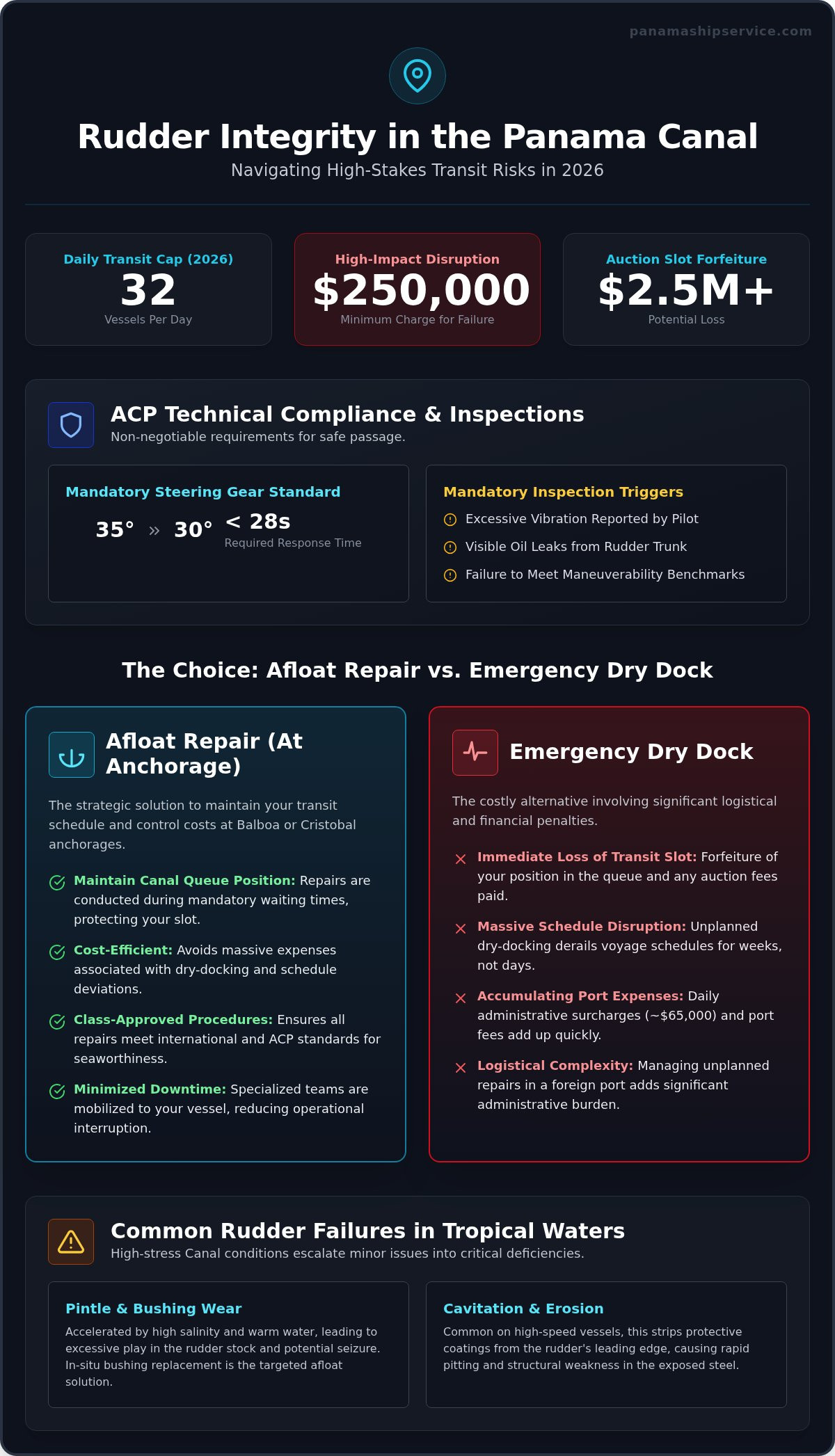
Securing a reliable ship rudder repair panama solution is now a critical risk mitigation strategy. This article explains how to resolve rudder issues through class-approved afloat repairs at Balboa or Cristobal anchorages, allowing you to restore maneuverability without abandoning your position in the Canal queue. We’ll examine the technical advantages of afloat mechanical services, the latest ACP technical compliance standards, and how to utilize mandatory waiting times for essential maintenance. By the end, you’ll understand how to protect your transit slot while minimizing operational downtime and avoiding unnecessary port expenses.
Key Takeaways
- Learn how to mitigate the risk of $250,000 high-impact disruption charges by maintaining strict rudder integrity according to current ACP safety standards.
- Understand the technical advantages of class-approved afloat ship rudder repair panama services to address pintle wear and cracked welds during scheduled wait times.
- Compare the cost-efficiency of in-situ repairs at Balboa or Cristobal against the significant expenses and schedule deviations associated with emergency dry-docking.
- Discover the essential coordination steps for mobilizing specialized mechanical teams while maintaining your position in the 2026 Canal transit queue.
- Identify how a consolidated service model combining mechanical repairs, surveys, and MARPOL disposal reduces administrative burden and port expenses.
The Strategic Necessity of Rudder Integrity for Panama Canal Transits
The Panama Canal represents one of the most demanding navigational environments in the global maritime industry. For a vessel to safely traverse the narrow reaches of the Culebra Cut or enter the high-precision locks, rudder integrity is a non-negotiable requirement. The Panama Canal Authority (ACP) views any compromise in steerage not just as a mechanical fault, but as a severe threat to the entire waterway’s operational flow. Gaining a technical baseline by understanding ship rudders and their response times is essential for masters and superintendents preparing for transit.
In 2026, the stakes for technical compliance have reached an all-time high. With daily transits capped at 32 vessels due to sustained drought conditions, the ACP cannot afford delays. Under the current OP Notice to Shipping N-1-2026, “Vessel Requirements,” any rudder deficiency identified during a pre-transit inspection can result in an immediate loss of transit priority. If a vessel is deemed a safety risk, it is relegated to the anchorage until a certified ship rudder repair panama solution is implemented and verified by a marine surveyor.
ACP Safety Inspections and Technical Compliance
Canal authorities trigger mandatory rudder inspections based on several factors. These include reports of excessive vibration from pilots, visible oil leaks from the rudder trunk, or a failure to meet the maneuverability benchmarks required for lock passage. Vessels must demonstrate that their steering gear can move the rudder from 35 degrees on one side to 30 degrees on the other within 28 seconds. To prove seaworthiness, you must provide the ACP with updated maintenance logs and, if repairs were recently performed, a Class-approved certificate of completion.
The Financial Risk of Steerage Failure
A steering failure mid-transit is a catastrophic financial event. A disruption charge is a penalty for blocking Canal traffic due to mechanical failure. For a Neopanamax vessel in 2026, this high-impact disruption charge can reach $250,000. This fee does not include the standard transit costs, which have reached record highs of $2.5 million for certain priority slots. When a vessel loses its steerage, the secondary costs accumulate rapidly:
- Mandatory tug assistance at specialized hourly rates.
- Forfeiture of multi-million dollar auction fees for priority slots.
- Daily surcharges of approximately $65,000 for administrative oversight.
- Unplanned port stay extensions for emergency ship rudder repair panama.
Proactive mechanical intervention at the Balboa or Cristobal anchorages is the only way to avoid these penalties. By identifying and resolving steerage issues before the pilot boards, operators protect their voyage profitability and ensure a seamless transit through the Canal’s high-traffic corridors.
Common Rudder Failures and Technical Repair Standards in 2026
Technical failures often manifest during the heavy maneuvering required for Canal transits. The high-stress environment of the Neopanamax locks places immense pressure on steering components; any existing weakness quickly escalates into a critical deficiency. Identifying these issues early is the only way to avoid the disruption charges discussed in the previous section. Operators must focus on the specific wear patterns that occur in the unique environment of the Isthmus.
Pintle and Bushing Wear Analysis
Tropical waters around the Panama Canal present unique challenges for rudder assemblies. High salinity and elevated water temperatures accelerate galvanic corrosion and biological fouling, which can compromise seal integrity. Dive teams measure clearances to identify excessive play in the rudder stock, often finding that wear rates exceed standard projections. Utilizing proactive underwater hull services allows for the identification of these wear patterns before they cause a mechanical seizure. In-situ bushing replacement is a specialized ship rudder repair panama technique that restores steerage without the need for a dry dock.
Cavitation and erosion also plague the leading edges of rudders, especially on high-speed container vessels. When cavitation strips protective coatings, the exposed steel suffers from rapid pitting. Our technicians use ultrasonic thickness gauging to assess the extent of the damage. We then implement localized repairs to restore the hydrodynamic profile of the blade, ensuring the vessel maintains full maneuverability during the transit.
Underwater Welding and Steel Fabrication
Structural failures, such as cracked welds in the rudder trunk or hull attachments, require immediate intervention to meet Panama Canal maritime regulations. Executing a ship rudder repair panama at anchorage requires strict adherence to Class-approved welding procedures. The choice between wet welding and cofferdam-assisted dry welding depends on the structural criticality of the repair and the metallurgical requirements of the steel.
Wet welding is often suitable for non-structural patches or sacrificial anode replacement. However, critical structural repairs generally necessitate the use of a cofferdam. This creates a dry environment subsea, allowing for pre-heating and controlled cooling cycles that prevent hydrogen embrittlement. All structural repairs must be verified by surveyors from major societies like ABS, DNV, or Lloyd’s to ensure long-term reliability. Our team provides these high-precision Mechanical Ship Repairs to keep your vessel compliant and moving through the waterway without delay.
Afloat vs. Dry Dock: Minimizing Downtime and Port Expenses
When a rudder deficiency is identified, technical managers face a critical choice: attempt an in-situ repair at anchorage or commit to an emergency dry-docking. In the high-pressure environment of 2026, where Neopanamax vessels without reservations face wait times of up to 11 days, the decision has profound financial implications. Choosing ship rudder repair panama at the Balboa or Cristobal anchorages allows operators to turn these mandatory delays into productive maintenance windows. By performing repairs while the vessel is already in the queue, you eliminate the massive costs associated with voyage deviation and off-hire time.
The financial logic for afloat intervention is compelling. Industry data indicates that performing repairs at Panama’s anchorages can reduce maintenance bills by 40% to 60% compared to traditional dry-docking. This is largely due to the elimination of dry dock daily rates, expensive tugage fees, and the logistical complexity of moving a vessel into a graving dock. Furthermore, the ACP supports these initiatives through Panama Canal’s preventive maintenance programs, which emphasize the importance of vessel readiness to ensure a safe and reliable waterway.
The Cost-Benefit of In-Situ Maintenance
Mobilizing specialized mechanical teams to an anchorage is significantly more efficient than the alternative. Afloat repairs offer significantly lower administrative overhead compared to the multi-layered scheduling and permit requirements of regional dry docks. While the vessel remains at anchorage, owners can simultaneously conduct other essential activities:
- Bunkering and ship supply replenishment
- Cargo operations (in specific designated areas)
- Crew changes and marine surveys
- MARPOL disposal and hull cleaning
This “One-Stop-Shop” approach ensures that once the ship rudder repair panama is complete and Class-certified, the vessel is fully prepared for transit without further stops.
Avoiding the “Dry Dock Trap” in Panama
In 2026, regional dry dock availability is extremely limited due to a surge in vessels diverting from other global chokepoints. A technical manager opting for dry-docking may find themselves waiting weeks for a slot, during which time the vessel remains entirely unproductive. We advocate for an “afloat first” strategy. By integrating mechanical ship repairs into your wait time, you can resolve even complex issues like bushing replacements or structural welding without losing your position in the transit queue.
Consider the impact on off-hire time. A typical emergency dry-docking for a rudder issue can easily consume 14 to 21 days when accounting for deviation, docking, and undocking procedures. In contrast, an anchorage-based intervention often resolves the same issue in 3 to 5 days. For a vessel earning high spot rates in 2026, saving 10+ days of off-hire time represents a massive preservation of voyage profitability.
Logistical Coordination: Managing Repairs During Canal Wait Times
Executing a ship rudder repair panama is a high-precision operation that requires perfect synchronization with the vessel’s transit schedule. Because the Panama Canal Authority (ACP) operates on a rigid timeline, any mechanical intervention must be choreographed to prevent the loss of a transit slot. The process begins the moment a deficiency is suspected. Effective coordination ensures that the 48-hour repair window remains a productive interval rather than a source of further delay.
The logistical workflow follows a four-step sequence designed for maximum efficiency:
- Step 1: Notification. Immediately inform Class and the ACP. Transparency is vital to avoid the high-impact disruption charges mentioned earlier and to secure the necessary permits for anchorage-based work.
- Step 2: Mobilization. Specialized dive and mechanical teams are deployed to the vessel’s position at the Balboa or Cristobal anchorage.
- Step 3: Execution. Repairs are performed within a strictly defined window. With Neopanamax wait times often exceeding 10 days in 2026, this window is typically sufficient for even complex mechanical tasks.
- Step 4: Certification. A final inspection by a Class surveyor and the ACP technical team verifies the repair, allowing the vessel to proceed to the locks.
Balboa and Cristobal: Strategic Repair Hubs
Choosing the correct anchorage depends on your vessel’s arrival direction and the nature of the repair. Balboa, on the Pacific side, offers extensive support for Neopanamax vessels, while Cristobal provides a strategic base for Atlantic-bound traffic. Both hubs maintain a fleet of heavy-lift barges and mobile welding units capable of handling major rudder components subsea. Consolidating marine surveys in Panama during this period allows for a single, comprehensive inspection that satisfies both Class and ACP requirements, reducing administrative friction.
The Tripartite Coordination Process
Success at the anchorage relies on the “Tripartite” communication model between the repair team, the Class surveyor, and the ACP. Managing this flow of information is complex; you must secure permits for “hot work” and “diving operations” well before the teams arrive. A local partner acts as the central point of contact, ensuring that the ACP is updated on repair progress in real-time. This proactive communication prevents the vessel from being “skipped” in the queue due to perceived unreadiness.
By delegating these complex logistics to an experienced local team, ship operators can focus on their broader voyage requirements. If you are facing a technical discrepancy before transit, contact our team to coordinate your Mechanical Ship Repairs and protect your schedule from unplanned disruptions.
Panama Ship Service: Your Partner for Rudder & Mechanical Excellence
Panama Ship Service operates as a dedicated partner for technical managers navigating the complexities of the 2026 Canal environment. We provide 24/7 emergency response for critical steerage failures, ensuring that mechanical issues don’t escalate into the massive financial penalties described in previous sections. Our team understands that in the maritime industry, time is the most valuable commodity. We focus on rapid mobilization and expert execution to resolve technical discrepancies before they impact your transit schedule.
Consolidated Technical Solutions
Our service model is designed to minimize administrative burden and reduce port expenses through a unified approach. By combining ship rudder repair panama with essential services like MARPOL disposal in Panama, we allow you to optimize your port stay. This “One-Stop-Shop” strategy means you coordinate with a single entity for repairs, surveys, and waste management. This integration eliminates the need for multiple service providers and simplifies the logistical coordination required for a successful Canal transit.
We maintain a specialized fleet of service boats and mobile workshops stationed in both Balboa and Cristobal. These units are fully equipped for subsea steel fabrication, high-precision mechanical overhauls, and underwater hull services at anchorage. Additionally, our direct access to high-quality marine spare parts within the Canal zone ensures that repairs aren’t delayed by international shipping lead times. We maintain a robust inventory of seals, bushings, and specialized welding consumables to handle the most common rudder failures on short notice. We handle the technical complexity so your crew can focus on safe navigation.
Expertise You Can Trust
Reliability in high-stakes environments comes from a proven track record. Panama Ship Service maintains deep expertise in ACP technical compliance, ensuring that every ship rudder repair panama meets the governing standards for transit safety. Our work is performed in strict adherence to international maritime safety standards and is regularly approved by major Class societies like ABS and DNV. We understand the specific requirements of Neopanamax vessels and the high-precision maneuverability they must demonstrate to the Canal pilots.
We prioritize transparent reporting and fixed-window execution. You receive detailed documentation of all clearances, ultrasonic thickness measurements, and mechanical tolerances. This provides the technical evidence required for rapid ACP and Class verification. Our proactive communication ensures that all stakeholders are aligned, from the moment our dive team boards until the final certification is issued. Don’t risk your transit slot on unverified solutions. Contact Panama Ship Service for an immediate rudder repair assessment.
Securing Your 2026 Transit with Proactive Mechanical Excellence
Maintaining rudder integrity is a strategic requirement for navigating the Panama Canal in 2026. By choosing afloat solutions at our strategic Balboa and Cristobal locations, you avoid the high costs of emergency dry-docking and protect your transit slot from high-impact disruption charges. Our 24/7 Technical Response Team specializes in Class-approved afloat procedures that restore maneuverability during your vessel’s scheduled wait time. This consolidated approach allows you to address mechanical failures while simultaneously handling surveys and MARPOL requirements.
Navigating the Canal’s strict technical regulations requires a partner who understands the operational stakes. We ensure your vessel meets every ACP benchmark, providing the documentation needed for immediate transit approval. Don’t let a steerage discrepancy derail your voyage schedule or result in record-breaking penalties. Delegate the technical complexity to a seasoned veteran in the region to ensure your fleet remains operational and compliant.
Request an Emergency Rudder Repair Quote in Panama to secure your vessel’s performance. Our team is ready to assist with your ship rudder repair panama needs with efficiency and precision. We look forward to supporting your next successful transit.
Frequently Asked Questions
Is ship rudder repair in Panama available at both Balboa and Cristobal anchorages?
Yes, comprehensive ship rudder repair panama services are available at both Balboa and Cristobal anchorages. Our 24/7 technical response teams are strategically positioned at both the Pacific and Atlantic entrances to the Canal. This dual-location coverage ensures that whether your vessel is arriving from the North or South, our mobile workshops and dive teams can mobilize immediately to your specific anchorage position without requiring a canal transit for the repair itself.
Can rudder bushing replacement be performed underwater without dry-docking?
Rudder bushing replacement can be performed in-situ through specialized afloat mechanical procedures. Our technicians utilize underwater hull services and specialized tooling to measure clearances and replace bushings while the vessel remains at anchorage. This method avoids the high costs and lengthy lead times associated with emergency dry-docking. By performing these repairs afloat, owners maintain operational readiness and can continue with other essential port activities like bunkering or crew changes during the wait.
What is the typical lead time for mobilizing a rudder repair team in Panama?
We provide 24/7 emergency response for critical mechanical failures at the Panama Canal. For most rudder-related issues at Balboa or Cristobal anchorages, our teams can mobilize within hours of receiving the initial technical report. This rapid response is essential for vessels facing strict transit windows. We maintain a fleet of service boats and mobile workshops ready for immediate deployment, ensuring that technical discrepancies are addressed before they impact your scheduled transit priority.
Does the Panama Canal Authority (ACP) allow afloat repairs during the transit wait time?
The ACP permits afloat repairs during scheduled wait times provided the work is coordinated and permitted in advance. Utilizing these mandatory delays for essential maintenance is a strategic way to resolve technical deficiencies identified during pre-transit inspections. All work must be performed by Class-approved contractors and must not interfere with the safety of the waterway. Our team manages the necessary permits for hot work or diving operations to ensure full compliance with Canal regulations.
Will a rudder repair in Panama affect my scheduled Canal transit slot?
A professionally managed ship rudder repair panama is designed to protect your transit slot rather than jeopardize it. By performing repairs at anchorage during your vessel’s existing wait time, we aim for zero deviation from the planned voyage schedule. However, failure to address a known rudder issue before the pilot boards can lead to a $250,000 disruption charge and the immediate loss of your priority slot if the vessel is deemed unseaworthy by the ACP.
Do I need a Class surveyor present for rudder welding repairs in Panama?
Class surveyors are typically required to witness and certify structural rudder repairs to ensure long-term seaworthiness. For structural welding or pintle repairs, we coordinate directly with the vessel’s classification society, such as ABS or DNV. Our technicians follow Class-approved afloat procedures, providing the ultrasonic thickness measurements and metallurgical documentation required for immediate verification. This tripartite coordination between the repair team, Class, and the ACP is vital for a successful transit approval after any repair.
What documentation does the ACP require after a rudder repair is completed?
The ACP requires a comprehensive technical report and a certification of seaworthiness from a recognized Class surveyor before a vessel can proceed. This documentation must prove that the steering gear meets the maneuverability benchmarks outlined in the latest OP Notice to Shipping. We provide detailed reports of all mechanical tolerances and repair steps taken. This transparency ensures that Canal authorities have the technical evidence needed to clear the vessel for lock passage without further delay or administrative surcharges.
How do tropical water conditions affect rudder pintle wear for Canal transits?
Tropical water conditions significantly accelerate galvanic corrosion and biological fouling due to high salinity and elevated temperatures. These factors can lead to faster degradation of protective coatings and seal integrity in rudder assemblies. Increased pintle and bushing wear rates are common for vessels frequently transiting the region. Regular underwater inspections are essential to identify these wear patterns early, preventing catastrophic steerage failure during the high-stress maneuvering required within the Panama Canal’s narrow reaches.