
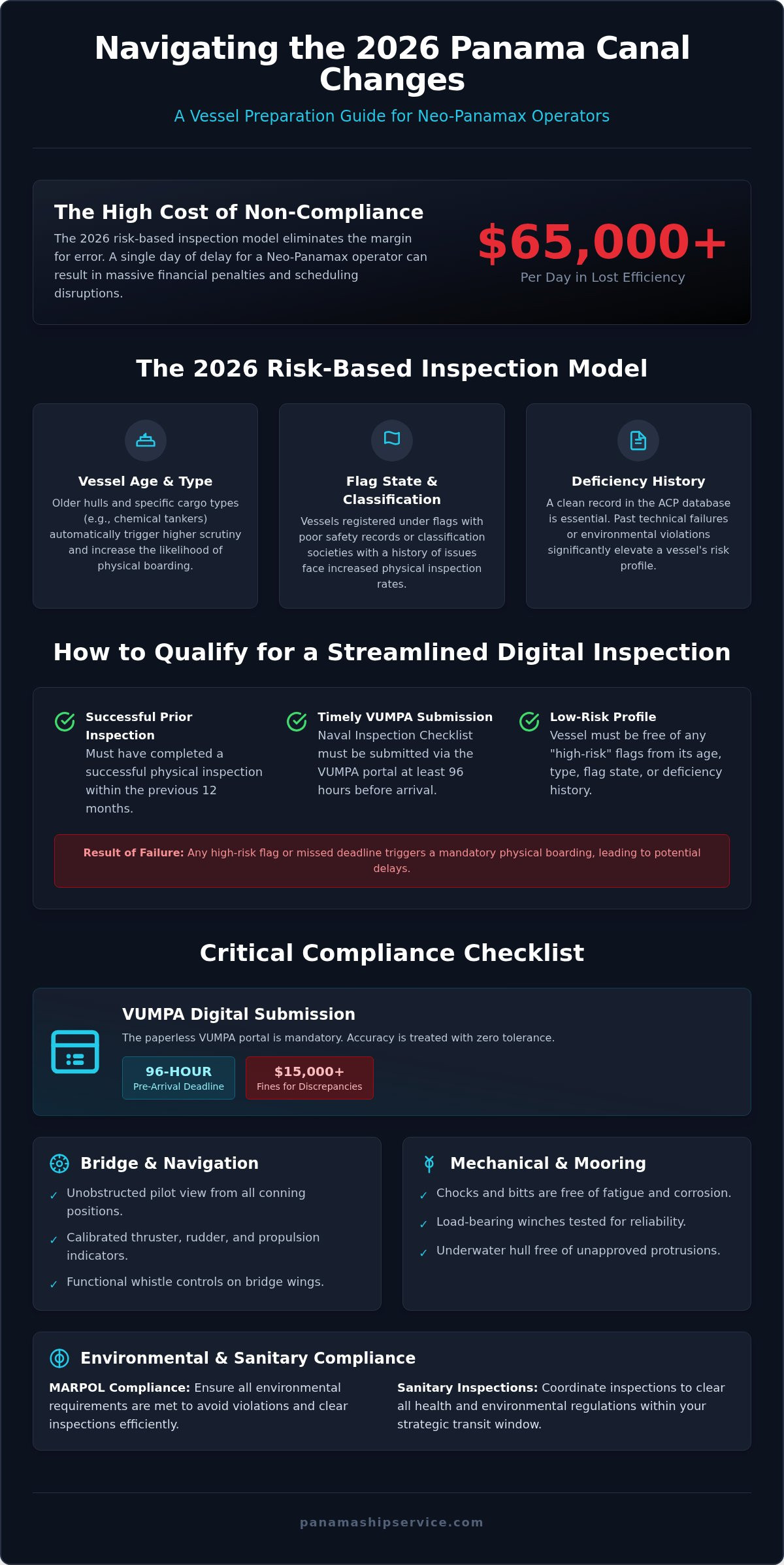
A single day of delay for a Neo-Panamax operator in 2026 now costs upwards of $65,000 in lost efficiency and overhead. With the Panama Canal Authority’s move to a mandatory risk-based inspection model, the margin for error has disappeared, making a comprehensive panama canal vessel preparation checklist more critical than ever. Accuracy is no longer optional. You’re likely concerned about the complexity of the new digital VUMPA submissions or the threat of a failed inspection leading to a costly transit forfeiture. It’s a high-pressure environment where technical compliance is your only safeguard against massive financial penalties and scheduling disruptions.
Our 2026 guide ensures your fleet meets every new standard, from the 96-hour digital filing deadline to the latest mechanical and underwater requirements. We’ll simplify the transition to the paperless portal and address the current draft restrictions caused by the severe El Niño conditions. You’ll gain a clear roadmap for managing pre-arrival documentation, mechanical readiness, and MARPOL compliance to guarantee a seamless transit. This article covers the essential technical updates and proactive maintenance strategies necessary to maintain your schedule and minimize overhead in the canal zone.
Key Takeaways
- Learn how the 2026 risk-based inspection model uses vessel age and flag state to prioritize boardings, allowing you to prepare for potential scrutiny.
- Implement a detailed panama canal vessel preparation checklist to ensure bridge visibility and communication equipment meet the latest ACP technical standards.
- Identify critical mechanical and underwater hull maintenance requirements that prevent maneuverability delays and the risk of transit forfeiture.
- Navigate the mandatory VUMPA digital submission process with precision to meet the strict 96-hour pre-arrival deadline and avoid automated rejections.
- Coordinate MARPOL compliance and sanitary inspections to clear all environmental requirements efficiently during your strategic transit window.
Understanding the 2026 Risk-Based Vessel Inspection Model
The Panama Canal Authority (ACP) officially mandated the risk-based vessel inspection model on January 1, 2026. This shift replaces the traditional 100% physical inspection requirement with a data-driven hybrid model. For operators, this means the Panama Canal is no longer just a physical passage; it’s a digital compliance hurdle that begins weeks before arrival. Integrating a panama canal vessel preparation checklist into your pre-arrival routine is now a requirement for maintaining a low-risk status. The system evaluates every vessel based on specific risk variables to determine if a physical boarding is necessary or if a digital inspection will suffice.
Key risk factors analyzed by the ACP include:
- Vessel Age and Type: Older hulls and specific cargo types, such as chemical tankers, trigger higher scrutiny.
- Flag State and Classification Society: Vessels registered under flags with poor safety records face increased physical inspection rates.
- Deficiency History: A clean record in the ACP database is essential. Past technical failures or environmental violations significantly raise your risk profile.
Maintaining a clean deficiency history is the most effective way to streamline your transit. When a vessel qualifies for a digital inspection, it reduces the time spent at anchor. This efficiency allows more time for critical support services like provisioning, bunkering, or MARPOL disposal without disrupting the transit schedule. Proactive maintenance is the key to avoiding the “high-risk” flags that lead to expensive delays.
Criteria for Digital Inspection Eligibility
Not every vessel qualifies for the streamlined digital process. To be eligible, your ship must have completed a successful physical inspection within the previous 12 months. You must also submit your Naval Inspection Checklist via the VUMPA portal at least 96 hours before arrival. Any high-risk flags will trigger a mandatory physical boarding. Using a panama canal vessel preparation checklist helps your crew verify these data points before the submission deadline.
The Role of the Panama Canal Admeasurer
Even with high digital compliance, the Panama Canal Admeasurer remains a central figure. Physical inspections are mandatory for first-time transits or vessels with structural changes. Your crew must prepare pilot transfer arrangements to exact ACP standards for admeasurer boarding. Inaccurate declarations are treated with zero tolerance. If the admeasurer finds discrepancies between your VUMPA submission and the actual vessel condition, expect delays and potential fines exceeding $15,000.
Technical Compliance: Bridge, Navigation, and Equipment
Technical failures during a lockage or channel transit create immediate operational hazards that the Panama Canal Authority (ACP) will not tolerate. For this reason, the Panama Canal Authority Maritime Regulations dictate specific equipment standards that must be verified well before arrival. Your panama canal vessel preparation checklist should prioritize bridge visibility and the redundancy of critical signaling systems. If a pilot can’t clearly see the waterline from the conning positions or if whistle controls fail to respond from the bridge wings, the transit will be suspended. These delays lead to significant financial losses and potential forfeiture of your slot.
Mooring and towing equipment must be in peak condition to handle the unique stresses of the canal locks. The Canal’s locomotives, known as “mules,” exert significant force on a vessel’s chocks and bitts. Any signs of structural fatigue, corrosion, or improper placement according to ACP technical drawings will result in a failed inspection. Winches must be tested for load-bearing reliability to ensure the vessel remains centered within the lock chambers. Before your arrival, conducting detailed marine surveys can identify these technical gaps before they trigger an ACP deficiency report.
Navigation and Conning Position Standards
ACP pilots require unobstructed views from bridge wings and all normal conning positions. This includes ensuring that cargo, cranes, or other structures don’t interfere with the required lines of sight. Thruster and rudder indicators must be placed where they’re easily visible to the pilot during maneuvering. Accuracy is paramount; steering and propulsion indicators must be calibrated with zero margin for error. A discrepancy in rudder angle feedback is grounds for mandatory tugboat assistance. Given that Neopanamax tugboat charges are currently $30,000, ensuring indicator accuracy is a matter of fiscal responsibility.
Signaling and Lighting Requirements
Night transits are standard, requiring specialized lighting configurations. Your vessel must be equipped with Panama Canal specific steering lights, positioned exactly as required by the ACP. Whistle controls must be accessible from all conning stations, including the bridge wings, to ensure the pilot can signal at any moment. High-intensity bridge wing spotlights are also mandatory for night operations. Don’t overlook the functionality of high-frequency radiotelephones; communication between the bridge, tugs, and lock stations is the foundation of a safe transit. Testing these systems 48 hours before arrival is a best practice for every crew.
Operational Readiness: Mechanical and Hull Integrity
Physical readiness is where digital data meets operational reality. While the VUMPA system handles the documentation, your vessel’s mechanical systems must withstand the unique stresses of lockage. The Panama Canal involves frequent engine starts, stops, and sustained low-speed maneuvering that can overwhelm poorly maintained auxiliary cooling systems. A failure in the main engine or steering gear during transit doesn’t just cause a delay; it triggers emergency tugboat interventions and massive surcharges. Consult the latest Advisories to Shipping to stay updated on current operational requirements, especially as water levels fluctuate due to the 2026 El Niño event.
Precise control is non-negotiable. Draft restrictions have become increasingly tight, with Neopanamax limits expected to reach 14.78 meters (48.5 feet) by August 15, 2026. These shallow margins mean that even minor rudder or propeller deficiencies can lead to grounding or lock wall contact. Your panama canal vessel preparation checklist must include a rigorous verification of all propulsion indicators and emergency backup systems. If your crew identifies any vibrations or sluggish response times during the approach, immediate action is required to avoid being flagged as high-risk by the ACP admeasurer.
Propulsion and Steering Gear Maintenance
Reliability starts with pre-arrival testing of the steering gear and all emergency backups at least 48 hours before entering canal waters. Auxiliary engines must be capable of handling rapid load changes without tripping. If your vessel requires technical attention, ensuring that all mechanical ship repairs are finalized before reaching the breakwater is essential. Vessels arriving with unresolved machinery issues face immediate transit suspension. These ships are often relegated to the back of the queue, incurring daily delay costs that exceed $65,000 for Neo-Panamax operators.
Underwater Services and Inspections
The condition of your hull directly dictates maneuverability and fuel efficiency in the narrow channels. Excessive biofouling increases drag and can interfere with the precision required for lock entry. Utilizing professional underwater hull services for cleaning and propeller polishing before arrival is a strategic investment. Scheduling a Class-approved UWILD survey allows you to identify hull punctures or rudder deficiencies before the ACP boarding. This proactive approach ensures you pass the physical inspection phase of the new risk-based model without the need for emergency repairs in the canal zone.
Environmental and Sanitary Compliance
Environmental compliance in the Panama Canal is governed by zero-tolerance policies regarding pollutants and waste management. Your panama canal vessel preparation checklist must account for the Panama Canal Shipboard Oil Pollution Emergency Plan (PCSOPEP). This plan is mandatory for all vessels carrying 400 metric tons or more of persistent oil. Failure to comply results in a minimum fine of $15,000. Beyond oil pollution, the Panama Canal Authority (ACP) enforces strict ballast water management rules to prevent the introduction of invasive species into Gatun Lake. Vessels must ensure that ballast water exchange or treatment occurs according to approved international standards before entering canal waters.
Hazardous cargo reporting is another critical area where documentation errors lead to immediate transit rejection. All dangerous goods must be declared through the VUMPA system at least 96 hours before arrival. Discrepancies between the manifest and the physical cargo will flag the vessel as high-risk, triggering intensive physical inspections and potential fines. Accuracy in these digital filings is the only way to maintain a streamlined transit schedule and avoid the high costs of emergency remediation.
Waste Management and Disposal
Managing shipboard waste requires precise coordination with local authorities to avoid environmental penalties. Scheduling MARPOL disposal in Panama ensures that your vessel meets Annex I, IV, and V requirements without delaying your transit window. Ship garbage must be segregated into specific categories, including plastics, food waste, and operational waste, to allow for compliant offloading at Balboa or Cristobal. Documentation for sludge and bilge water disposal is scrutinized during the digital inspection process. Having certified receipts ready for the ACP admeasurer prevents administrative bottlenecks that can stall your departure.
Health and Pest Control
Sanitary inspections by Panama health authorities are a mandatory component of the arrival process. You must ensure that all crew health declarations are updated and that valid deratting or fumigation certificates are on board. For specific cargo types, particularly agricultural products, professional fumigation services may be required to clear local health protocols. Inaccurate health reporting can lead to quarantine measures, which are both costly and operationally devastating. To ensure your vessel meets all environmental and health standards, book your compliance services with a reliable local partner.
Navigating the VUMPA and Digital Submission Process
The transition to a fully paperless environment is now complete. The Ventanilla Única Marítima de Panamá (VUMPA) serves as the sole channel for all pre-arrival documentation. Under the 2026 regulations, the complete VUMPA package must be submitted at least 96 hours before your vessel’s estimated time of arrival in Canal waters. There’s no grace period for late or incomplete filings. Inaccurate submissions result in the immediate forfeiture of your transit slot. This digital transformation means data accuracy is now the primary driver of your risk profile. Your panama canal vessel preparation checklist must include a final audit of all digital entries to ensure they perfectly match the physical vessel condition.
The 2026 version of the ACP Maritime Service Portal utilizes machine-level validation. This system automatically cross-checks your submitted data against various global databases. Any discrepancies trigger an immediate rejection. This automated scrutiny has significantly increased the rejection rate for first-time submissions throughout 2026. Managing this complexity requires a systematic approach to data entry and document management. You don’t want to discover a data mismatch when your vessel is already at the breakwater; the financial consequences are too high.
Step-by-Step VUMPA Submission
Effective coordination with your shipping agency is the foundation of a successful submission. You must provide them with high-resolution digital copies of your Registry, Tonnage, and Safety certificates well in advance of the 96-hour window. Once the agency uploads the data, the system generates a “Risk Level” status. This status determines whether you’ll be granted a digital inspection or if a physical boarding by an admeasurer is mandatory. Monitoring this status in real-time allows you to adjust your operational plans and avoid unexpected delays.
Preparing for the Physical Inspection
Even if your vessel qualifies for a digital-first evaluation, you must remain prepared for a physical boarding. ACP admeasurers frequently conduct spot checks to verify digital declarations. Vessels must ensure pilot ladders and transfer arrangements strictly adhere to current ACP technical standards. Failure to provide safe access results in immediate transit suspension. You should also organize all bridge and engine room logs for quick review. Professional marine surveys in Panama can pre-verify your VUMPA declarations, identifying potential conflicts before they reach the ACP portal. It’s the most effective way to validate your panama canal vessel preparation checklist and ensure your data withstands automated validation.
Securing Your 2026 Transit Efficiency
The operational landscape of the Panama Canal in 2026 demands a shift from reactive maintenance to data-driven readiness. Success now depends on the precision of your VUMPA submissions and the verified reliability of your vessel’s mechanical and environmental systems. By implementing a rigorous panama canal vessel preparation checklist, you eliminate the technical discrepancies that trigger high-risk flags and automated rejections. Proactive underwater hull cleaning and mechanical audits are no longer just best practices; they’re essential safeguards against the escalating costs of transit delays and emergency surcharges.
Panama Ship Service provides the authoritative support needed to navigate these complexities. As a MARPOL and Class-approved service provider, we specialize in minimizing vessel downtime through 24/7 technical support at both the Balboa and Cristobal terminals. Whether you require urgent mechanical repairs or a pre-arrival survey to validate your digital declarations, our team ensures your fleet meets every ACP standard. Request an inspection or repair quote from Panama Ship Service today to protect your schedule. We’re here to ensure your transit remains seamless and cost-effective.
Frequently Asked Questions
What is the new risk-based vessel inspection model for 2026?
The risk-based model is a data-driven evaluation that determines if a vessel requires a physical boarding or a digital-only inspection. Mandatory since January 1, 2026, it utilizes variables like vessel type, age, and flag state safety records. The system prioritizes physical inspections for high-risk vessels while allowing low-risk ships to proceed more quickly. This shift rewards operators who maintain a clean deficiency history in the Panama Canal Authority database.
How do I know if my vessel is eligible for a digital Panama Canal inspection?
Eligibility depends on your vessel’s history and the accuracy of your pre-arrival data. To qualify for a digital inspection, your ship must have completed a successful physical inspection within the previous 12 months. Additionally, your VUMPA submission must be flawless and free from high-risk flags related to technical deficiencies or environmental violations. Maintaining your panama canal vessel preparation checklist ensures all documentation aligns with these eligibility requirements before the 96-hour deadline.
What happens if my vessel fails the initial Naval Inspection Checklist?
Failing the initial checklist triggers an immediate mandatory physical inspection by an ACP admeasurer. If the discrepancies are severe, you risk the forfeiture of your transit slot and significant financial penalties. Technical failures identified during the approach often lead to emergency tugboat requirements, which are extremely costly. Proactive maintenance and pre-arrival surveys are the most effective ways to resolve mechanical issues before they result in a failed inspection report.
Are there specific bridge visibility requirements for the Panama Canal?
Yes, the ACP enforces strict visibility standards to ensure safe navigation through the locks and narrow channels. Pilots must have an unobstructed view of the waterline from all conning positions and bridge wings. Any cargo or structural obstructions that interfere with these lines of sight will result in transit suspension. Verification of these visibility parameters is a critical component of a comprehensive panama canal vessel preparation checklist to avoid mandatory tugboat assistance.
How does vessel age affect my Panama Canal risk assessment?
Vessel age is a primary variable in the ACP’s risk-calculation algorithm. Older hulls are statistically more likely to experience mechanical failures, which leads the system to flag them for mandatory physical inspections. While age is a fixed factor, operators can offset this risk by maintaining a perfect record of technical compliance and deficiency-free transits. Consistent investment in mechanical reliability demonstrates to the authorities that the vessel remains a low-risk asset despite its years in service.
Can I perform hull cleaning while waiting for my transit slot?
Yes, scheduling underwater hull cleaning or propeller polishing while at anchor is a strategic way to improve transit efficiency. Professional underwater services help your vessel meet the maneuverability standards required for the locks, especially given current draft restrictions. Removing biofouling reduces drag and fuel consumption during the passage. It’s essential to use a Class-approved service provider to ensure all work meets the environmental and technical standards expected by the Panama Canal Authority.
What MARPOL documents are mandatory for Panama Canal transit?
Mandatory documents include the Panama Canal Shipboard Oil Pollution Emergency Plan (PCSOPEP) for vessels carrying 400 metric tons or more of persistent oil. You must also provide certified receipts for sludge and bilge water disposal and updated garbage segregation logs. These documents prove compliance with MARPOL Annexes I, IV, and V. Having these records organized for digital submission or physical review prevents administrative delays and protects you from environmental fines during the boarding process.
What is VUMPA and how do I access it?
VUMPA stands for the Ventanilla Única Marítima de Panamá, the mandatory digital portal for all maritime submissions. It consolidates requirements for the ACP, health authorities, and customs into a single window. Access is managed through your authorized shipping agency, which coordinates the 96-hour pre-arrival data entry. The system uses machine-level validation to cross-check your technical certificates, making it imperative that all uploaded information is accurate and matches the vessel’s current physical state.