
With daily transits at the Panama Canal scheduled to drop to just 32 by September 15, 2026, every hour your vessel spends idle is a direct hit to your bottom line. You’re likely already feeling the friction of fragmented vendor management, where a lack of coordination between cargo handlers and technical teams leads to extended port stays and mounting costs. It’s frustrating to watch your schedule slip because of administrative bottlenecks that should have been streamlined. Reliable cargo handling services panama must do more than just move containers; they must act as a synchronized extension of your vessel’s transit strategy.
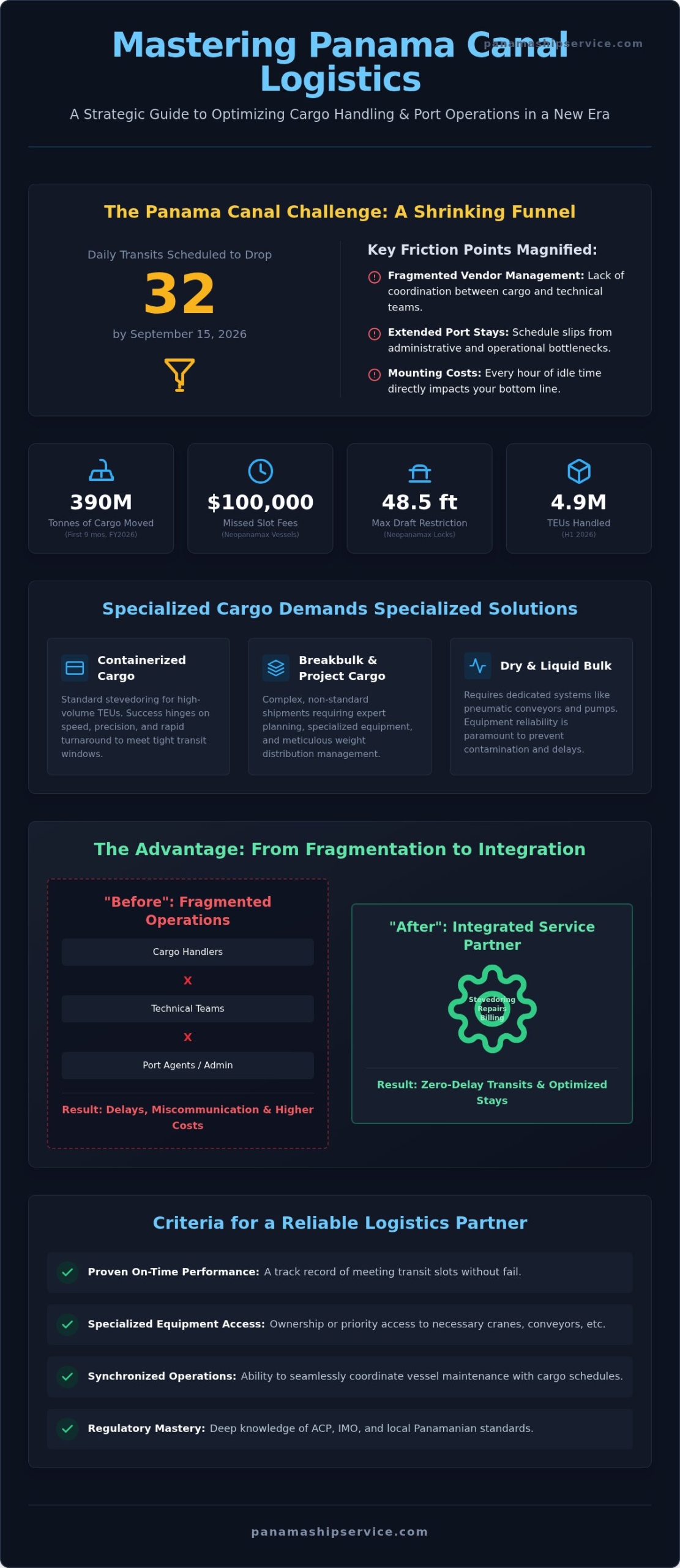
We’ll show you exactly how to master these logistical complexities by integrating stevedoring, port operations, and service consolidation into a single managed window. You’ll learn how to achieve seamless loading and unloading while benefiting from consolidated billing that reduces your administrative burden. This guide previews the current shifts in port management at Balboa and Cristobal, providing the expert insights needed to ensure zero-delay transits through the canal’s tightening operational landscape. By the end, you’ll have a clear roadmap for optimizing your port stays and protecting your margins.
Key Takeaways
- Learn to manage the technical distinctions between standard containerized loading and the complex requirements of breakbulk or project cargo.
- Navigate the operational differences between the Balboa and Cristobal hubs to select the most efficient terminal for your specific cargo type.
- Streamline your operations by integrating specialized cargo handling services panama with essential vessel maintenance into a single, coordinated window.
- Maximize transit efficiency by synchronizing mechanical ship repairs with loading schedules to eliminate redundant port stays.
- Establish criteria for selecting reliable logistics partners based on specialized equipment access and a proven record of on-time performance.
Optimizing Cargo Handling Services in Panama: Navigating Canal Logistics
Panama acts as the central nervous system for global trade. It isn’t merely a transit point; it’s a strategic transshipment hub where the efficiency of port operations determines the profitability of an entire voyage. Understanding the Panama Canal’s history and expansion reveals how this waterway became the standard for maritime logistics. Today, the cargo handling services panama provides are essential for managing the nearly 390 million tonnes of cargo that moved through the canal in the first nine months of the 2026 fiscal year. Efficient handling isn’t just a convenience. It’s a necessity when daily transits are capped at 32 vessels.
Modern cargo handling encompasses a wide range of technical operations. This includes standard container stevedoring, the management of breakbulk, and the complex coordination of project cargo. When turnaround times are tight, any delay in loading or unloading ripples through your schedule. With the Panamanian government assuming control of the Balboa and Cristobal ports in early 2026, the operational landscape is shifting. Navigating these changes requires a partner who understands the new interim operators and the strict requirements of the Panama Canal Authority (ACP).
The Logistics of Transit and Cargo Coordination
Success in Panamanian waters depends on perfect timing. You must synchronize your cargo operations with your assigned canal transit slot. A missed window results in heavy reservation fees, which can reach $100,000 for Neopanamax vessels. Your port agent acts as the primary coordinator, managing the flow of documentation and customs clearance. They ensure that stevedoring teams are ready the moment the vessel berths. This eliminates the “dead time” that often occurs when technical services and cargo handlers aren’t in communication.
Regulatory Compliance and Safety Protocols
Safety is the baseline for every operation. Cargo handling in Panama must adhere to both international IMO standards and specific local mandates. The transition of Balboa and Cristobal to government oversight has reinforced the need for strict adherence to safety protocols. You need to verify that your service provider maintains comprehensive insurance and liability coverage. This is especially true for non-standard shipments where draft restrictions, currently limited to 48.5 feet for Neopanamax locks, affect vessel stability and loading patterns. Reliability comes from following these rules without exception.
Technical Aspects of Stevedoring and Specialized Cargo Solutions
Technical proficiency is the cornerstone of effective cargo handling services panama. It goes beyond the simple movement of containers; it involves the complex physics of weight distribution and vessel stability. In the first half of 2026, Panamanian ports managed 4.9 million TEUs, a volume that demands high-level technical coordination. Whether you’re dealing with standard containerized goods or specialized shipments, the speed of your turnaround depends on the precision of the stevedoring team. Efficiency here ensures you stay within your scheduled window and avoid the steep surcharges currently implemented by major carriers.
Dry and liquid bulk handling requires specialized equipment like pneumatic conveyors or dedicated pumping systems. These systems must be meticulously maintained to prevent contamination and ensure environmental compliance, especially given Panama’s strict standards. Efficiency in bulk handling directly impacts the time spent at the terminal, making equipment reliability a top priority. If you need to ensure your specialized shipments are handled according to these technical standards, working with a comprehensive service provider can simplify your logistics chain and reduce the risk of operational delays.
Precision in Loading and Unloading Operations
Proper weight distribution isn’t optional. It’s a safety requirement. Incorrectly secured cargo or uneven loads can compromise a vessel’s draft. This is particularly sensitive now, as the ACP has implemented strict draft cuts, currently set at 48.5 feet for Neopanamax locks with further reductions scheduled for late 2026. Advanced terminals like Manzanillo International Terminal (MIT), which handled over 1.6 million TEUs in early 2026, utilize sophisticated gantry systems to maintain a rapid pace while ensuring cargo integrity. Verification at each stage of the loading process prevents damage and costly insurance claims.
Specialized Handling for Sensitive Shipments
Not all cargo fits into a standard 40-foot box. Breakbulk and oversized project cargo require heavy-lift equipment and custom lashing plans. These operations are high-stakes and require specialized labor. Handling hazardous materials (HAZMAT) requires strict adherence to international protocols and local Canal zone regulations. Similarly, maintaining the cold chain for perishables or pharmaceuticals is critical. Modern refrigerated cargo management uses remote monitoring to ensure temperature stability throughout the port stay. This technical depth is supported by Panama’s logistics and connectivity infrastructure, which links maritime hubs with rail and air networks to ensure a seamless flow of sensitive goods.
Strategic Port Operations: Balboa vs. Cristobal Logistics
Choosing between the Pacific and Atlantic hubs isn’t just about geography; it’s a strategic decision that impacts your entire supply chain. The operational landscape for cargo handling services panama shifted significantly in February 2026 when the government assumed control of Balboa and Cristobal terminals. APM Terminals now manages Balboa while Terminal Investment Limited (MSC Group) oversees Cristobal. This transition has caused a temporary shift in volumes, making it vital to understand where your vessel can achieve the fastest turnaround. Decisions should be based on real-time port performance data, often found in Panama Canal Authority Annual Reports, to avoid congested windows.
Efficiency depends on matching your cargo type with the specific infrastructure of the port. While Balboa and Cristobal are the traditional anchors, other terminals like Manzanillo International Terminal (MIT) and Colon Container Terminal (CCT) have absorbed a significant portion of diverted traffic. In the first half of 2026, MIT saw a 23.1% increase in container movements, handling 1.6 million TEUs. Selecting a port based on its current throughput and crane availability is essential to minimize the high costs associated with extended port stays.
Balboa: The Pacific Gateway for Global Trade
Balboa serves as the primary entry point for vessels arriving from Asia and the West Coast of the Americas. It’s the logical choice for Northbound transits. You have the option of handling cargo pier-side or at anchorage, depending on the urgency and nature of the shipment. Despite a recent 11.9% decrease in TEU volume during the management transition, Balboa remains a powerhouse for Pacific-rim trade routes. Its connectivity to the Panama Canal Railway allows for rapid intermodal transfers, providing a release valve when canal transit slots are limited by draft restrictions.
Cristobal and Colon: The Atlantic Logistic Hub
The Atlantic side is a complex ecosystem of multiple terminals, including Cristobal, MIT, and CCT. This hub is ideal for Southbound transits and Caribbean distribution. One major advantage of operating on this side is the ability to integrate cargo handling with other essential requirements. For example, you can easily schedule MARPOL disposal in Panama while your vessel is berthed or at the Colon anchorage. This synchronization is a hallmark of efficient logistics; it prevents the need for separate stops and keeps your transit on track. Integrating cargo windows with waste management or technical repairs ensures you maximize every hour spent in Panamanian waters.
The One-Stop-Shop Advantage: Consolidating Cargo and Technical Services
Fragmented vendor management is a primary cause of transit delays. When your cargo handlers don’t communicate with your repair teams, you lose precious hours in port. By choosing integrated cargo handling services panama, you eliminate the coordination gap. This model allows you to treat your port stay as a single operational window rather than a series of disconnected events. Delegating this complexity to a single, experienced partner simplifies your oversight and protects your margins.
Technical Synergy: Repairs and Cargo Handling
Efficiency is found in the overlap. You can conduct mechanical ship repairs while cargo is being loaded or unloaded. This parallel processing ensures your vessel is technically sound before it enters the canal locks. If an emergency failure is identified during cargo operations, having a team already on-site allows for immediate response. You can also source marine spare parts during the same stop, ensuring that mechanical ship repairs in Panama are completed without extending your scheduled stay.
Operational Efficiency and Cost Management
Administrative overhead carries significant hidden costs. Consolidating your needs under one agent results in unified billing and reporting for cargo, repairs, and ship supplies. This transparency simplifies your fiscal responsibility and reduces communication errors. You can also maximize your time at anchor by performing underwater hull services during cargo ops. This proactive approach ensures your hull is clean for optimal fuel efficiency during the next leg of your journey. Marine surveys in Panama provide the necessary verification for both cargo integrity and technical compliance. Every requirement is handled within a single, managed window to ensure your transit remains on schedule.
To protect your schedule and reduce operational complexity, contact Panama Ship Service to coordinate your next integrated port call.
Choosing a Reliable Cargo Handling Partner in Panama
Selecting a maritime partner in Panama is a high-stakes decision that directly impacts your vessel’s safety and schedule integrity. Reliability in this region is measured by a provider’s ability to navigate the shifting operational landscape without causing delays. When evaluating cargo handling services panama, you must look for a track record of on-time performance and strict adherence to international safety standards. A partner who fails to coordinate effectively with port authorities can cause you to miss your canal transit slot, leading to significant financial penalties.
Transparency in reporting is another critical factor. You need a partner who provides clear, professional documentation and maintains responsive communication protocols. In an industry where timing is everything, 24/7 availability isn’t a luxury; it’s a requirement. Your provider should offer real-time updates and have the infrastructure to handle technical failures or last-minute changes in your loading plan. This level of responsiveness ensures that your port stay remains efficient and your administrative burden stays low.
Evaluation Criteria for Fleet Managers
Fleet managers should begin their assessment by reviewing a provider’s reputation at the Panama Canal. References from other ship operators provide valuable insight into a company’s reliability and problem-solving capabilities. You should also evaluate the breadth of their offerings. Can they handle specialized cargo like HAZMAT or oversized project shipments? Do they have access to the necessary heavy-lift equipment and skilled labor? A provider with limited scope often creates bottlenecks when unexpected needs arise. Finally, ensure they offer English-speaking support to prevent communication errors during critical operations.
Why Panama Ship Service is Your Strategic Partner
Panama Ship Service understands the operational pressures of canal transits. We’ve built our reputation on a commitment to minimizing vessel downtime through consolidated solutions. Our team provides comprehensive expertise in cargo handling, mechanical repairs, and MARPOL-compliant disposal. By managing these diverse needs within a single operational window, we eliminate the friction of multiple vendor coordination. We act as a seasoned veteran in the Panamanian maritime hub, providing the grounded and reliable support you need to maintain your schedule.
If you’re ready to simplify your logistics and protect your margins, contact Panama Ship Service for an integrated cargo and technical quote. We’re prepared to handle your requirements with the proficiency and urgency your business demands.
Maximizing Efficiency in the Panama Maritime Hub
The complexity of Panama Canal logistics demands a proactive approach to vessel management. Successfully navigating the recent transition of major terminals while adhering to strict draft restrictions requires more than just standard stevedoring; it requires technical synchronization. By integrating cargo handling services panama with maintenance and compliance tasks, you eliminate the administrative friction that leads to costly port stays. You’ve seen how choosing the right hub and consolidating services can protect your schedule and your bottom line.
Panama Ship Service provides the authoritative expertise needed to manage these high-stakes operations. We offer a true one-stop-shop for repairs and cargo, backed by 24/7 emergency support and MARPOL-compliant logistics. Our team handles the technical details so you can focus on your transit goals without unnecessary complication. Streamline your port operations with consolidated cargo and repair services from Panama Ship Service. We look forward to ensuring your next Panama Canal transit is your most efficient yet.
Frequently Asked Questions
What types of cargo handling services are available in Panama?
The cargo handling services panama offers include containerized stevedoring, breakbulk management, and handling for oversized project cargo. Specialized equipment is used for dry and liquid bulk logistics at both Pacific and Atlantic terminals. These services ensure that non-standard maritime shipments are loaded with precise weight distribution. By utilizing a comprehensive provider, you can manage these diverse cargo types while also scheduling necessary vessel surveys or supplies during the same window.
Can cargo be loaded or unloaded while a vessel is waiting for transit?
Cargo operations can be conducted at anchorage or pier-side while your vessel waits for its scheduled transit slot. This strategy effectively turns idle time into productive windows for loading or unloading. Coordinating these activities requires strict adherence to Panama Canal Authority regulations. Successful operators use this time to synchronize stevedoring with other technical needs, such as underwater inspections or repairs, to ensure the vessel is ready for its canal passage without additional delays.
Which port is better for cargo handling: Balboa or Cristobal?
Choosing between Balboa and Cristobal depends primarily on your vessel’s route and the cargo’s final destination. Balboa is the strategic gateway for Pacific-rim trade and Northbound transits. Cristobal serves as the Atlantic hub, ideal for Southbound transits and Caribbean logistics. Each port features different terminal operators and infrastructure capacities. You should evaluate current throughput data and crane availability at each location to determine which terminal offers the most efficient turnaround for your specific cargo.
How do you ensure the safety of sensitive or high-value cargo in Panama?
Safety for sensitive or high-value cargo is maintained through strict adherence to international maritime standards and local safety protocols. Providers use specialized heavy-lift equipment and custom lashing plans for project cargo. Additionally, marine surveys are conducted to verify cargo integrity at each stage of the handling process. This systematic approach, combined with professional documentation and experienced stevedoring labor, minimizes the risk of damage and ensures compliance with all insurance and liability requirements during port stays.
Can I coordinate mechanical ship repairs and cargo handling through one agent?
You can consolidate mechanical ship repairs and cargo handling through a single agent like Panama Ship Service. This one-stop-shop model eliminates the need to manage multiple vendors, which reduces communication errors and administrative overhead. Coordinating these services ensures that technical maintenance happens in parallel with loading windows. It’s a strategic way to minimize vessel downtime, as repairs are completed while the cargo is being handled, keeping your transit schedule strictly on track.
What documentation is required for cargo handling at the Panama Canal?
Standard documentation includes the Bill of Lading, cargo manifests, and customs declarations required by Panamanian authorities. For vessels transiting the canal, specific Panama Canal Authority (ACP) forms and admeasurement certificates are also necessary. Your port agent handles the submission and verification of these documents to prevent administrative bottlenecks. Professional management of this paperwork is essential for ensuring that your cargo moves through the port and the canal without regulatory interruptions or costly fines.
Is 24/7 support available for emergency cargo handling needs?
Panama Ship Service provides 24/7 operational availability to address both emergency and scheduled cargo handling needs. High-stakes maritime operations don’t follow a standard workday, so having a responsive partner is critical for managing last-minute changes or technical failures. This constant support includes access to skilled labor and specialized equipment at any hour. It ensures that your vessel receives immediate attention, protecting your transit window and preventing the high costs associated with unexpected idle time in port.
How does cargo handling integration with MARPOL services benefit ship owners?
Integrating cargo handling with MARPOL services allows you to manage waste disposal during your primary port stay. You can offload slops, sludge, and ship garbage while stevedoring teams handle your cargo. This synchronization ensures your vessel remains compliant with international environmental regulations without requiring a separate stop. It simplifies your logistics chain and reduces port fees. By handling disposal and cargo simultaneously, you maximize operational efficiency and maintain a cleaner, more profitable transit schedule.