
A single 24-hour delay at the Panama Canal in 2026 can cost a vessel’s operating budget approximately $65,000. You know that unscheduled downtime during a transit isn’t just a logistical hurdle; it’s a direct hit to your bottom line. Securing reliable ship steel fabrication panama is often a race against the clock, especially when you’re trying to avoid the high costs of emergency dry-docking for minor structural issues. You need a partner who understands that technical proficiency must be matched by operational speed to keep your voyage on track.
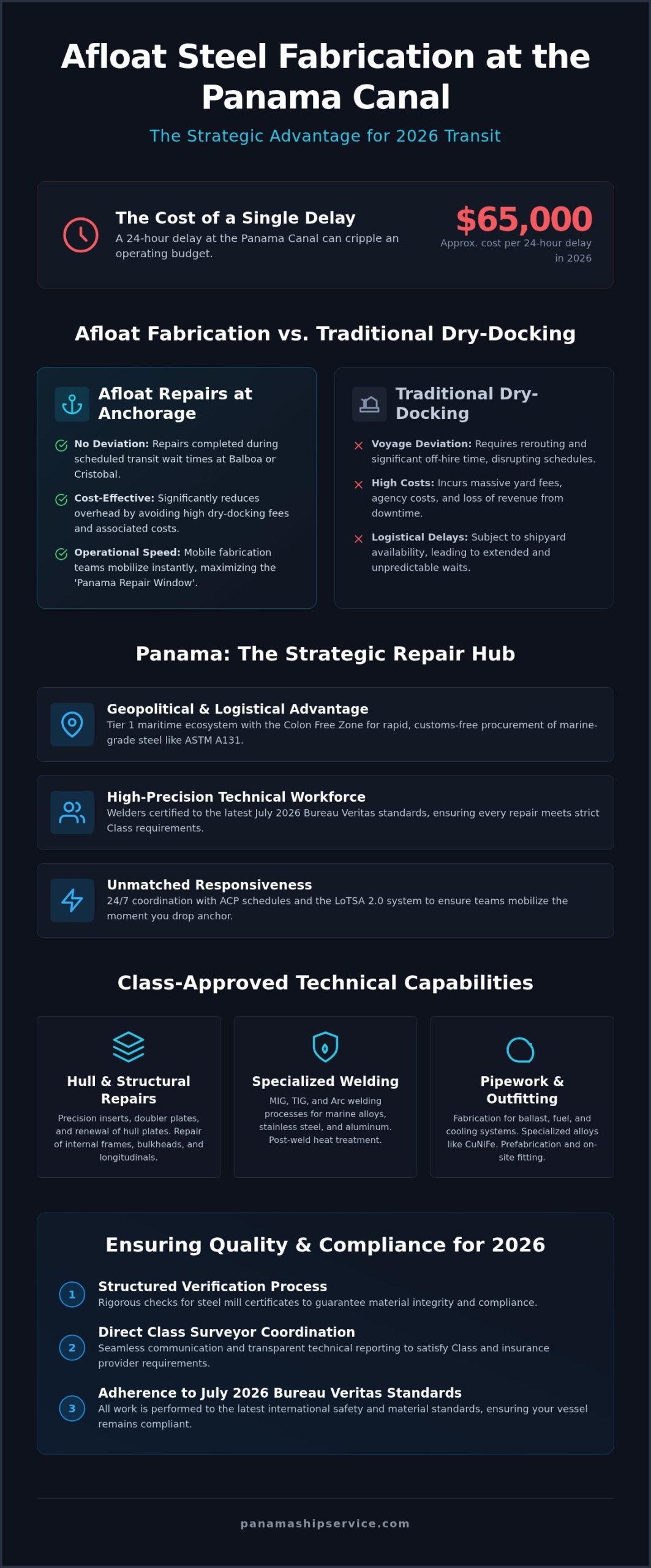
This guide provides the technical roadmap you need to execute class-approved repairs at anchorage. We’ll show you how to navigate the July 2026 Bureau Veritas standards and current ACP draft restrictions without missing your transit window. You’ll learn how to utilize mobile fabrication teams to complete complex work while your vessel is at the Balboa or Cristobal anchorages. The following sections examine the logistical synchronization of afloat repairs, the impact of the LoTSA 2.0 reservation system, and the process for obtaining transparent technical reporting that satisfies Class surveyors and insurance providers alike.
Key Takeaways
- Maximize operational efficiency by utilizing Panama Canal transit wait times to execute critical afloat repairs at Balboa or Cristobal anchorages.
- Reduce overhead significantly by identifying structural and hull repairs that can be safely completed without the high costs and delays of dry-docking.
- Ensure regulatory compliance by following a structured verification process for steel mill certificates and coordinating directly with Class surveyors.
- Streamline your technical requirements by integrating ship steel fabrication panama with mechanical and underwater services for a consolidated service model.
- Navigate the 2026 LoTSA 2.0 reservation system and ACP draft restrictions by synchronizing fabrication schedules with your specific transit window.
Why Panama is the Strategic Hub for Ship Steel Fabrication in 2026
Panama has evolved from a simple transit point into a critical mission-ready hub for technical management. For vessel owners, the mandatory stop at the Canal provides a unique opportunity to address structural wear and tear that would otherwise require a costly deviation. Utilizing ship steel fabrication panama during idle anchorage time transforms a logistical wait into an operational win. As global shipping trends in 2026 shift toward leaner maintenance cycles, container and LNG fleets are increasingly prioritizing afloat repairs over traditional yard stays to maintain tight delivery schedules. This strategic positioning allows for high-precision ship steel fabrication panama to be executed without adding a single day to the voyage charter.
The Cost of Transit Delays vs. Repair Efficiency
With a single day of delay costing upwards of $65,000, your technical interventions must be surgical. Performing mechanical ship repairs and steel fabrication simultaneously is the most effective way to maximize ROI. The 2026 update to the LoTSA 2.0 transit reservation system has shortened allocation windows, leaving no room for technical errors or slow mobilization. Every hour spent at the Balboa or Cristobal anchorages is an opportunity to renew hull plates or repair internal frames. The ‘Panama Repair Window’ is the strategic interval between arrival at anchorage and the assigned pilot boarding time, representing the only period where major structural work can be completed without extending a vessel’s time in water.
Geopolitical and Logistical Advantages
The history and expansion of the Panama Canal has fostered a Tier 1 maritime ecosystem that rivals any global port. This infrastructure includes the Colon Free Zone, which allows for the rapid procurement of marine-grade steel like ASTM A131 or A572 without the typical customs delays found in other regional hubs. You aren’t just getting materials; you’re getting specialized labor. Panamanian welders are certified to the latest July 2026 Bureau Veritas standards, ensuring that every weld meets strict Class requirements. Our 24/7 coordination with ACP schedules means that fabrication teams mobilize the moment you drop anchor. This level of responsiveness is essential for mid-transit structural work, allowing you to bypass regional competitors that lack Panama’s integrated logistics and high-precision technical workforce.
Technical Capabilities: Hull Repairs, Pipework, and Structural Welding
Executing structural work while a vessel is afloat requires a higher degree of technical control than traditional shipyard environments. In Panama, the ship steel fabrication panama sector has adapted to meet the stringent safety protocols mandated by the Panama Canal Authority. Our teams specialize in hull plate renewal, performing precision inserts and doubler plates that adhere strictly to Class society specifications. Beyond external skin work, we address internal structural fatigue by repairing frames, bulkheads, and longitudinals while the vessel remains operational at anchorage.
Specialized Welding Processes for 2026
The 2026 maritime environment demands proficiency in diverse welding standards. We utilize MIG, TIG, and Arc welding processes tailored to specific marine alloys. For high-value assets like LPG and LNG carriers, we provide specialized stainless steel and aluminum fabrication. Critical structural areas often require pre-heating and post-weld heat treatment to prevent stress fractures and hydrogen-induced cracking. These technical safeguards ensure that every repair meets the July 2026 Bureau Veritas rules for metallic materials. By delegating these complexities to our certified welders, you ensure that your vessel remains compliant with the latest international safety standards.
Pipework and Outfitting
Pipe system failures can lead to immediate transit delays. Our fabrication services cover ballast, fuel, and cooling systems with a focus on specialized alloys like CuNiFe for seawater applications. To accelerate the repair timeline, we utilize a hybrid model of prefabrication and on-site fitting. This approach allows us to prepare complex sections in our workshop and perform final integration at the anchorage. Every installation undergoes rigorous hydro-testing and Non-Destructive Testing (NDT) to confirm integrity before the vessel proceeds.
We also fabricate and reinforce mounts for deck machinery, including cranes, winches, and mooring gear. These foundations must withstand extreme dynamic loads, requiring precise alignment and robust structural welding. If your vessel requires immediate technical intervention during its transit window, our mobile fabrication teams are equipped to mobilize alongside your schedule. This integrated approach to ship steel fabrication panama ensures that structural repairs do not become a bottleneck for your voyage.
- Hull Inserts: Precision cutting and welding of marine-grade steel to Class specs.
- Internal Frames: Repairing structural members to maintain vessel rigidity.
- Deck Foundations: Reinforcing heavy-duty mounts for cargo handling equipment.
- Specialized Alloys: Welding services for CuNiFe, stainless steel, and aluminum systems.
Afloat Steel Fabrication vs. Dry-Docking at the Panama Canal
Deciding between afloat fabrication and dry-docking is a critical decision for technical managers. While dry-docking offers a controlled environment, the associated costs and schedule disruptions are often prohibitive for minor to mid-sized structural repairs. In 2026, the strategic use of ship steel fabrication panama at anchorage allows you to address hull inserts, internal stiffeners, and pipework without leaving the water. It’s a method that provides the ‘Afloat Advantage’ for vessels with tight delivery windows. However, success depends on navigating ACP ‘Hot Work’ permits. These regulations require strict adherence to safety protocols, including gas-free certifications and fire watch standby, which our teams manage as part of our consolidated service model.
We often employ a hybrid approach to maximize efficiency. By pre-fabricating complex components in our shore-based workshops while your vessel is en route, we reduce the actual installation time at the anchorage. This method is highly effective for large-scale pipe sections or specialized deck machinery foundations. Given Panama’s role in the International Maritime Organization, the quality of these repairs must meet global standards. This ensures that your temporary or permanent fixes are accepted by Class surveyors without further complication or the need for rework during your next scheduled dry-dock.
Port Logistics: Balboa vs. Cristobal Supply Chains
The choice between Balboa and Cristobal anchorages depends on your transit direction and sourcing needs. Balboa, located on the Pacific side, is ideal for vessels awaiting northbound transit. It offers robust anchorage support and easier access for heavy equipment barges required for major steel work. Conversely, Cristobal on the Atlantic side provides immediate proximity to the Colon Free Zone. This allows for faster procurement of technical stores and specialized marine alloys that might not be readily available elsewhere. To maximize your wait time, we recommend syncing steel repairs with underwater hull services. Performing hull cleaning or inspections alongside steel work ensures your vessel is in peak condition before entering the Canal locks.
Weather and Environmental Considerations
Panama’s tropical climate presents unique challenges for high-precision welding. During the rainy season, we utilize custom-built protective enclosures and humidity control systems to maintain weld integrity and prevent contamination. Tropical heat also impacts steel expansion; our technicians calculate fit-up precision with these thermal variables in mind to prevent stress points. Safety protocols remain our priority in high-traffic anchorages. We maintain constant communication with ACP pilots and port authorities to ensure that ship steel fabrication panama proceeds without interfering with the flow of traffic or compromising the safety of the crew. Don’t let environmental variables dictate your repair quality; our experienced teams are trained to handle these specific regional conditions.
Ensuring Quality: Class Approvals and Welding Standards in Panama
Quality assurance in afloat repairs is a multi-step process that begins long before the first arc is struck. For ship steel fabrication panama, the objective is a permanent repair that satisfies the world’s leading classification societies, including ABS, Lloyd’s Register, and DNV. We follow a rigorous protocol to ensure every structural intervention meets international safety standards. This starts with an immediate review of the repair plan with the on-site Class surveyor to align our methodology with the vessel’s structural needs and the July 2026 Bureau Veritas rules for steel ships.
Material verification is the next critical phase. Every steel plate used must have a valid mill certificate to prove its marine-grade properties. We also provide Welder Qualification Records (WQR) and Procedure Qualification Records (PQR) for the specific alloys being joined. To verify the work, we utilize Non-Destructive Testing (NDT) such as ultrasonic and dye-penetrant inspections. The process concludes with the delivery of a comprehensive technical report and the surveyor’s endorsement for the vessel’s permanent record, ensuring the repair is recognized during future inspections.
The Role of NDT in Afloat Repairs
Precision is non-negotiable when working on high-stress structural areas at anchorage. Ultrasonic thickness (UT) gauging is the essential first step to determine the extent of steel wastage before fabrication begins. We also employ Magnetic Particle Inspection (MPI) to detect surface and near-surface stress cracks in critical foundations or rudder components. By coordinating with marine survey teams, we provide independent verification that gives vessel managers total confidence in the repair’s longevity and compliance.
Compliance with MARPOL and Local Regulations
Performing ship steel fabrication panama at anchorage requires strict environmental management to prevent contamination. We implement containment systems to prevent grinding dust and welding slag from entering the water. Managing fabrication waste is equally vital; we coordinate MARPOL disposal for all old steel scrap and technical debris. Our fire-watch protocols are designed to exceed both international standards and the specific hot-work requirements set by the ACP. If you need a technical partner who handles these complexities without interrupting your transit schedule, contact our team today to discuss your repair plan.
Panama Ship Service: Precision Steel Fabrication and Integrated Repairs
Panama Ship Service stands as the primary technical partner for vessel managers requiring ship steel fabrication panama under tight operational constraints. Our 2026 commitment focuses on delivering high-precision results within your specific transit window, ensuring that structural needs never compromise your pilot schedule. We operate with a deep understanding of the urgency inherent in Canal transits. By maintaining a veteran presence in the region, we’ve developed the logistical foresight to handle complex technical tasks without the usual complications of multi-vendor coordination.
Our ‘One-Stop-Shop’ model provides a distinct advantage over fragmented service providers. We don’t just handle steel work; we integrate it with mechanical repairs and underwater hull services to maximize your time at anchorage. This consolidated approach allows you to delegate the entire technical scope to a single, accountable entity. Our mobile fabrication teams remain available 24/7 at both Balboa and Cristobal anchorages, equipped with the tools and certifications required to execute Class-approved work on short notice. Whether you’re managing a container fleet or an LNG carrier, our track record with major Class societies and international ship managers ensures your vessel remains in compliance.
Case Study: Rapid Hull Insert at Balboa Anchorage
Technical efficiency was recently demonstrated when a vessel arrived at the Balboa anchorage with a critical hull fracture. We completed a Class-approved hull insert in just 48 hours, allowing the ship to meet its scheduled pilot boarding time. This required precise logistical coordination between our service barge, the welding teams, and the ACP authorities. By performing this work afloat, the owner avoided the logistical nightmare of an emergency dry-docking. The cost savings compared to an emergency dry-docking and the associated off-hire time were substantial, proving the financial viability of our afloat repair model.
Request a Technical Consultation
Securing an accurate quote for ship steel fabrication panama starts with clear technical data. To expedite the process, please provide detailed drawings, thickness reports, and the latest Class surveyor comments. Our technical managers are available 24/7 to review your requirements and mobilize a team to meet your vessel upon arrival. We understand that structural emergencies don’t follow a schedule, which is why our response teams are always on standby. Optimize your structural integrity with Panama Ship Service to ensure your next Canal transit is both safe and efficient.
Secure Your Voyage with Certified Afloat Repairs
Maximizing the efficiency of your Panama Canal transit requires a proactive approach to structural maintenance. Utilizing the strategic wait times at Balboa or Cristobal anchorages allows you to address critical hull and pipework issues without the prohibitive costs of emergency dry-docking. Our specialized technical guidance ensures every repair meets the latest 2026 international standards, keeping your vessel compliant and seaworthy for the next leg of its journey.
Panama Ship Service provides the technical expertise and logistical coordination needed to execute complex repairs within your pilot window. Our Class-certified welders (ABS, DNV, Lloyd’s) and 24/7 afloat repair teams are equipped to handle urgent interventions with precision. We integrate our fabrication work with broader husbandry and technical services to provide a seamless experience that protects your bottom line and minimizes off-hire time.
Don’t let minor structural defects escalate into major voyage disruptions. Request a Technical Quote for Ship Steel Fabrication in Panama today to optimize your vessel’s performance. We’re ready to ensure your next transit is safe, compliant, and on schedule.
Frequently Asked Questions
Can major steel fabrication be done at the Panama Canal without dry-docking?
Yes, afloat repairs at the Balboa or Cristobal anchorages provide a viable alternative to dry-docking for many structural requirements. This approach allows for hull plate renewals, internal framing repairs, and pipework while the vessel waits for its transit slot. Panama Ship Service utilizes specialized barges and mobile technical teams to perform these interventions. By executing repairs afloat, vessel managers can avoid the high costs and significant schedule disruptions associated with emergency shipyard stays.
Which Class societies approve steel repairs performed by Panama Ship Service?
Our welding and fabrication processes are recognized by all major international classification societies, including ABS, DNV, and Lloyd’s Register. We strictly adhere to the July 2026 Bureau Veritas rules for steel ship classification and welding standards. Every repair plan is reviewed with the on-site Class surveyor before the first arc is struck. This ensures that all ship steel fabrication panama results in permanent, class-endorsed documentation for the vessel’s technical record.
What is the typical lead time for sourcing marine-grade steel in Panama?
Marine-grade steel, such as ASTM A131 or A572, is typically available within 24 to 48 hours through the Colon Free Zone. This rapid procurement is essential for meeting the Panama Canal Authority’s tight pilot schedules. Our logistics team maintains active relationships with established importers to ensure all plates arrive with the necessary mill certificates. This efficiency allows us to mobilize materials and begin fabrication as soon as the vessel reaches the designated anchorage.
Are hot work permits required for steel fabrication at the Balboa anchorage?
Yes, the Panama Canal Authority (ACP) requires specific hot work permits for any welding or grinding performed at the anchorages. We manage the entire application process, which includes coordinating gas-free certifications and fire-watch standby protocols. These safety measures are mandatory under the 2026 ACP regulations. Our teams ensure that all ship steel fabrication panama complies with local maritime safety requirements to prevent any delays or fines during the vessel’s transit.
Can you perform steel repairs while the vessel is transiting the Canal?
No, major structural repairs and hot work are strictly prohibited while the vessel is physically transiting the locks or the Culebra Cut. All technical work must be completed at the designated Balboa or Cristobal anchorages. This is why we synchronize our fabrication schedules with the ACP pilot boarding times. We utilize the idle waiting period to execute repairs so the vessel is ready for a safe transit without compromising the flow of Canal traffic.
What type of NDT (Non-Destructive Testing) do you provide for welding verification?
We provide a comprehensive suite of NDT services, including Ultrasonic Thickness (UT) gauging, Dye-Penetrant Inspection (DPI), and Magnetic Particle Inspection (MPI). These tests are essential for verifying weld integrity and identifying stress cracks in critical structural foundations. Our technicians provide detailed technical reports that satisfy both Class surveyors and insurance requirements. This rigorous verification process confirms that the ship steel fabrication panama meets international maritime safety and quality standards before the voyage continues.
How do you coordinate steel fabrication with the ACP pilot schedule?
We maintain 24/7 communication with the Panama Canal Authority to monitor your vessel’s assigned transit slot in real time. Our fabrication teams are mobilized to the anchorage the moment the ship arrives, maximizing the available technical window. If the pilot schedule shifts, we adjust our labor shifts to ensure the work is completed or safely paused without causing a transit delay. This logistical synchronization is a central component of our consolidated service model.
Do you offer pre-fabrication services for ship components in Panama?
Yes, we utilize our shore-based workshops to pre-fabricate large structural components or complex pipe sections while the vessel is still en route. This hybrid approach significantly reduces the time required for on-site installation at the anchorage. By providing drawings or thickness reports in advance, we can have the necessary inserts or foundations ready for immediate fitting upon arrival. This proactive method is highly effective for reinforcing deck machinery mounts or replacing seawater systems.