
With the forfeiture of a Neo-Panamax transit slot now costing upwards of $65,000 per day, a single undetected hull fracture or mechanical failure is no longer just a technical issue; it’s a massive financial liability. You understand that in the high-stakes environment of the Panama Canal, time isn’t just money; it’s your reputation with charterers and the Panama Canal Authority (ACP). Dealing with unexpected vessel damage while facing the strict 2026 risk-based inspection protocols is enough to stress even the most seasoned operator. Securing a professional ship damage survey panama is the most effective way to protect your schedule and your bottom line.
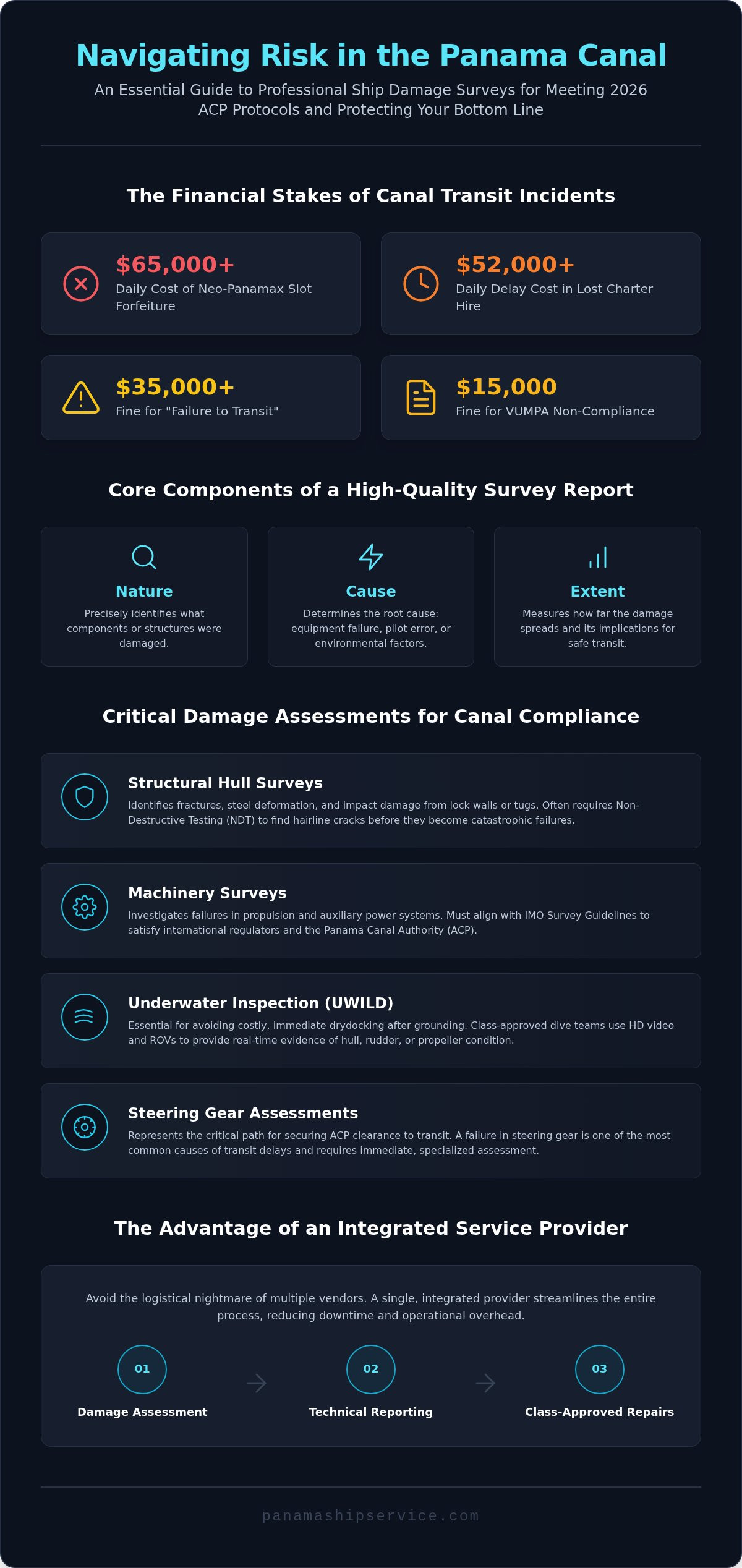
This guide ensures you navigate the complexities of maritime damage assessments with technical precision and speed. We’ll show you how to secure Class-approved documentation and move from assessment to repair without missing your transit window. We’ll also examine the latest ACP investigation requirements under OP Notice N-9-2026, strategies for accelerating insurance claims, and how integrated technical services prevent the logistical nightmare of managing multiple vendors.
Key Takeaways
- Understand why a professional ship damage survey panama is mandatory for meeting the 2026 ACP safety protocols and avoiding catastrophic transit delays.
- Identify the specific requirements for structural hull and machinery surveys to ensure your vessel remains compliant with IACS and insurance standards.
- Learn how to optimize your timeline by coordinating survey teams at anchorage and preparing technical documentation before your vessel arrives.
- Reduce operational overhead by transitioning seamlessly from technical damage assessment to mechanical repairs with a single, integrated service provider.
Critical Ship Damage Surveys at the Panama Canal
A ship damage survey panama is a specialized technical investigation into structural or mechanical failure. It’s not a routine inspection; it’s a critical assessment required whenever a vessel experiences an incident within the canal’s jurisdiction. Whether it’s a lock wall strike or a steering gear failure, immediate action is required to maintain seaworthiness certificates. The Panama Canal Authority (ACP) mandates these reports to ensure that no vessel poses a risk to the waterway’s infrastructure or other transiting ships.
The stakes are exceptionally high in the canal’s locks and approach channels. Because these areas are narrow and heavily trafficked, even a minor grounding can lead to massive delays. According to 2026 operational data, the daily cost of delay for a Neo-Panamax vessel exceeds $52,000 in lost charter hire. To mitigate these losses, surveyors apply fundamental Naval Architecture Principles to determine if the hull’s integrity or the vessel’s stability has been compromised.
The Strategic Importance of Local Expertise
Local surveyors provide a level of insight that international generalists cannot offer. They’re deeply familiar with ACP OP Notice N-9-2026, which requires investigations to be finished before a vessel departs canal waters. Rapid reporting is essential for preserving your transit slot and avoiding the $15,000 fine for VUMPA non-compliance. By leveraging a surveyor with local logistical reach, you reduce the overhead associated with coordinating external teams and ensure the assessment begins the moment your ship reaches anchorage.
Legal and Insurance Implications of Damage Findings
The final survey report serves as the primary evidence for P&I and H&M insurance claims. It’s vital that findings are documented “without prejudice” to protect your interests in maritime disputes. A high-quality report establishes three critical facts:
- Nature: What exactly was damaged?
- Cause: Was the damage due to equipment failure, pilot error, or environmental factors?
- Extent: How far does the damage spread, and what are the implications for safe transit?
This technical clarity prevents protracted legal battles and ensures that underwriters have the data required to process claims quickly. Accuracy at this stage is often the difference between a seamless repair process and a denied insurance claim. It’s about turning a complex technical failure into a manageable business outcome.
Types of Marine Damage Assessments and Inspections
A thorough ship damage survey panama isn’t limited to a single area of the vessel. Modern canal operations require a multi-disciplinary approach to verify that every critical system meets safety standards. These assessments typically fall into four categories: structural hull, machinery, underwater, and cargo. Each serves a specific purpose in confirming that the vessel can safely navigate the locks without risking a “failure to transit” fine, which can exceed $35,000.
Structural hull surveys focus on identifying fractures, steel deformation, and impact damage resulting from contact with lock walls or tugs. These inspections often require non-destructive testing (NDT) to find hairline cracks that could lead to catastrophic failure under the pressure of a full load. Meanwhile, machinery surveys investigate failures in propulsion and auxiliary power. These must align with the IMO Survey Guidelines to satisfy both international regulators and local authorities. Cargo surveys assess how vessel damage might have compromised the freight, providing essential documentation for P&I clubs to determine if the vessel’s structural issues have led to water ingress or contamination.
Underwater Inspection in Lieu of Drydocking (UWILD)
When a vessel makes contact with the canal bottom or a lock sill, a UWILD is often the only way to avoid an immediate and costly drydocking. Class-approved diving teams use high-definition video to provide real-time evidence of the hull’s condition to surveyors and class representatives on the surface. These underwater hull services are essential for identifying rudder or propeller issues that aren’t visible from the surface. For Neo-Panamax ships, where slot forfeiture costs $65,000 daily, getting a fast, accurate underwater assessment is the priority. Using ROVs in specific scenarios can also speed up the process by providing rapid visual confirmation without the setup time required for a full dive team.
Mechanical and Steering Gear Assessments
Steering gear surveys represent the critical path for securing Panama Canal Authority clearance after a mechanical failure. During canal maneuvers, the rudder and propeller are under intense stress. Our surveyors conduct diagnostic testing on hydraulic systems and electrical control units to pinpoint the root cause of failures. We don’t just identify the problem; we provide the technical data needed for immediate mechanical intervention. This diagnostic precision is vital for vessels flagged under the ACP’s risk-based inspection model. If you’re facing a potential delay, coordinating a professional marine survey can help you resume your transit schedule quickly.
Compliance: Meeting Class Society and Insurance Standards
Compliance in the maritime industry isn’t just about paperwork; it’s about maintaining the technical validity of your vessel’s operating permits. When you commission a ship damage survey panama, the resulting report must satisfy the rigorous standards of IACS members such as ABS, Lloyd’s Register, or DNV. Without this recognition, your survey won’t hold weight with the Panama Canal Authority or your insurance providers. A professional surveyor manages the complex interplay between the Independent Surveyor, the Class Surveyor, and the Underwriter’s Representative to ensure all parties reach a technical consensus on the damage.
Documentation standards are the bedrock of a successful claim. We utilize high-resolution photographic evidence, ultrasonic thickness measurements (UTM), and detailed material analysis to provide a complete picture of the failure. This level of detail is vital for preventing ‘hidden damage’ claims from being rejected months after the incident. If the initial survey lacks precision, underwriters may argue that subsequent issues weren’t related to the original canal incident. Thorough reporting ensures that every fracture and deformation is logged immediately, protecting your interests during future audits.
IACS Standards and Reporting Protocols
Reports must provide clear, objective data that follows established structural failure protocols. The priority is always maintaining the vessel’s ‘In Class’ status. This often involves negotiating with Class surveyors to approve temporary or permanent repairs that allow for safe transit or departure. Our teams coordinate closely with Class representatives for immediate attendance at Balboa or Cristobal anchorages, ensuring that technical delays don’t turn into multi-day scheduling disasters. We focus on delivering reports that Class societies can accept without further clarification, speeding up the approval of repair specifications.
P&I Club and Underwriter Coordination
A surveyor acts as a neutral fact-finder, providing the technical foundation insurance adjusters need to process H&M or P&I claims. We assist masters in drafting the ‘Letter of Protest’, ensuring it’s backed by empirical survey data rather than general observations. This technical alignment is a core component of our marine surveys in Panama. By establishing the nature and extent of damage immediately, we provide the legal clarity required to resolve maritime disputes without unnecessary litigation. This proactive approach simplifies the recovery of costs and ensures all parties are working from the same set of verified facts.
Optimizing the Process to Minimize Vessel Downtime
Minimizing vessel downtime requires a proactive approach that begins long before the surveyor boards the vessel. In a maritime hub where a delay of a few hours can result in missing a scheduled transit window, efficiency is the only metric that matters. A professional ship damage survey panama is most effective when it is integrated into the vessel’s arrival sequence rather than treated as a separate, reactive event. By coordinating technical teams in advance, operators can ensure that the assessment begins the moment the ship reaches the Pacific or Atlantic anchorage.
Conducting surveys at anchorage is a strategic choice that avoids the high costs of berth hires and port fees. Our teams utilize 24/7 availability to match the non-stop operations of the Panama Canal, ensuring that the time spent waiting for a transit slot is used productively for technical inspections. Utilizing “one-stop” providers who can perform the survey and then immediately initiate mechanical repairs further reduces the administrative overhead and logistical friction of managing multiple vendors. This consolidated model is the most reliable way to maintain your schedule while meeting stringent safety requirements.
Preparation Checklist for Ship Masters
To accelerate the survey process, ship masters should have the vessel prepared for immediate inspection upon arrival. Providing the survey team with digital copies of vessel drawings and incident logs prior to boarding allows for a more focused technical investigation. We recommend the following steps to ensure a smooth assessment:
- Access and Safety: Isolate the damaged area and ensure it is safe for entry. This includes proper gas-free certification for tank inspections.
- Documentation: Prepare the bridge log, engine log, and relevant VDR data for immediate review by the surveyor.
- Environment: Ensure that internal lighting and ventilation are adequate, especially for confined space inspections where visibility is critical for identifying stress fractures.
Coordinating with the Panama Canal Authority (ACP)
The relationship between the survey findings and the Panama Canal Authority’s requirements is the most critical aspect of the process. Navigating the ACP’s specific “Vessel Inspection and Damage” protocols requires a surveyor who understands the nuances of local regulations. The surveyor’s report must be comprehensive enough to satisfy the Board of Inspectors and secure the necessary “Permission to Proceed” for the transit. ACP clearance is the ultimate goal of any survey in Panama. To ensure your vessel meets these requirements without delay, contact Panama Ship Service for immediate technical support.
Panama Ship Service: Integrated Survey and Repair
Panama Ship Service provides a streamlined transition from technical assessment to operational recovery. Performing a comprehensive ship damage survey panama is only the first step in resolving a maritime incident. Our model eliminates the lag time between identifying a fault and executing a fix. With 24/7 response teams stationed at both the Atlantic and Pacific entrances, we attend to vessels the moment they arrive at anchorage. This geographic positioning ensures that emergency inspections don’t wait for office hours or logistical windows.
Beyond technical assessments, we provide a full suite of auxiliary services. This includes MARPOL disposal for waste management and the delivery of essential ship supplies. By handling these requirements simultaneously, we help vessel operators clear all ACP requirements in a single window. It’s about reducing the administrative burden on the master and the management office during a high-pressure situation.
Afloat Repair Solutions in Panama
Competitors often suggest that any structural damage requires immediate drydocking. This isn’t always the case. We specialize in afloat repair solutions that keep your vessel moving. Our teams provide steel fabrication and welding certified for marine applications, alongside mechanical ship repairs for engines, pumps, and deck machinery. We address the root cause of the survey findings immediately.
If the damage is below the waterline, our underwater technicians deploy cofferdams for dry-space welding or perform propeller cropping to restore balance. These interventions satisfy Class requirements for permanent or temporary repairs without the massive expense and delay of a shipyard visit. It’s a pragmatic approach to maintaining seaworthiness under tight canal schedules. We ensure the repair specification matches the surveyor’s findings exactly, leaving no room for technical discrepancies.
The One-Stop-Shop Advantage for Ship Managers
Managing a vessel in distress is complex. Consolidating billing and communication through a single technical partner simplifies the process. It reduces the risk of miscommunication that often happens when a third-party surveyor passes findings to an unrelated repair crew. When our surveyors identify a fracture or a mechanical fault, our repair teams are already briefed on the specific tools and materials required. This eliminates redundant inspections and speeds up the “Permission to Proceed” from the ACP.
This integrated workflow ensures that the technical data gathered during the survey translates directly into an efficient repair plan. You don’t have to explain the situation twice. We handle the technical complexity so you can focus on your chartering obligations. For immediate assistance at either canal entrance, contact Panama Ship Service for immediate damage survey attendance. Our teams are ready to respond now.
Securing Your Vessel’s Schedule in 2026
The maritime environment at the Panama Canal is more demanding than ever. Meeting the 2026 ACP safety protocols requires technical precision and rapid response. You’ve learned that a professional ship damage survey panama isn’t just a regulatory hurdle; it’s a strategic tool to prevent slot forfeiture and ensure insurance claim validity. By choosing an integrated model that combines IACS-compliant reporting with immediate mechanical repairs, you eliminate the friction of managing multiple vendors. This consolidated approach is the most effective way to minimize downtime and control operational costs.
Our teams in Balboa and Cristobal provide 24/7 emergency technical support to keep your operations moving. We handle the complexity of local regulations and technical documentation so you can focus on your transit schedule. Don’t let a technical failure turn into a permanent delay. We’re committed to providing the technical clarity and rapid intervention needed to secure your “Permission to Proceed” without unnecessary overhead. Our experts are positioned to board your vessel the moment it reaches the anchorage.
Request an Urgent Ship Damage Survey in Panama to protect your vessel and your bottom line. We’re ready to assist you at either canal entrance with the expertise and speed your operations demand.
Frequently Asked Questions
How quickly can a damage surveyor attend my vessel in Panama?
Panama Ship Service provides 24/7 emergency technical support, allowing a surveyor to attend your vessel immediately upon arrival at the Balboa or Cristobal anchorage. Because we maintain permanent teams at both the Atlantic and Pacific entrances, we eliminate the transit delays typical of international firms. This rapid response is critical for meeting the ACP’s strict investigation deadlines and avoiding the forfeiture of your scheduled transit slot.
Are your damage surveys approved by major Class Societies like ABS or DNV?
Yes, our technical team conducts class-approved surveys recognized by all major IACS members, including ABS, Lloyd’s Register, and DNV. We ensure that every ship damage survey panama meets the specific reporting standards required by these societies and the Panama Canal Authority. Our reports provide the objective, empirical data necessary to maintain your vessel’s “In Class” status and support complex insurance claims with maritime underwriters.
What information should the Master have ready for the surveyor?
The Master should have the bridge and engine room logbooks, VDR data, and relevant vessel drawings ready for immediate review. It’s also essential to provide copies of the incident report and any initial damage assessments conducted by the crew. Ensuring the damaged area is safe for entry and properly illuminated will further accelerate the survey process, allowing the technical team to focus on identifying structural or mechanical failures.
Can you perform underwater damage surveys during a Panama Canal transit?
We conduct underwater damage surveys at the Atlantic or Pacific anchorages before or after a transit, but safety regulations generally prohibit diving operations while a vessel is actively moving through the locks. These inspections utilize class-approved divers or ROVs to assess the hull, rudder, and propeller for impact damage. Completing these surveys at anchorage ensures compliance with ACP safety protocols while minimizing interference with the canal’s schedule.
What happens if the survey reveals damage that prevents canal transit?
If the survey identifies damage that compromises safety, the Panama Canal Authority will withhold the “Permission to Proceed” until repairs are completed. In these cases, Panama Ship Service transitions immediately from assessment to mechanical or structural repairs. Our goal is to implement Class-approved temporary or permanent fixes afloat, allowing your vessel to secure ACP clearance and resume its transit without the need for a costly shipyard diversion.
Do you provide surveys for both hull and machinery damage?
We provide comprehensive technical surveys covering both structural hull integrity and machinery failures. This includes investigating impact damage, steel deformation, and fractures, as well as diagnostic testing for propulsion, auxiliary power, and steering gear systems. By assessing the entire vessel, we ensure that all technical risks are identified and documented according to IACS standards, providing a complete picture for owners and insurance adjusters.
How does a damage survey differ from a pre-purchase or condition survey?
A damage survey is a targeted technical investigation into a specific structural or mechanical failure, focusing on the nature, cause, and extent of the damage. In contrast, pre-purchase or condition surveys are broader assessments of a vessel’s overall maintenance and value. Damage surveys require specific “without prejudice” reporting to support insurance claims and must meet the immediate regulatory requirements of the Panama Canal Authority following an incident.
Can Panama Ship Service assist with the repairs identified in the survey?
Panama Ship Service operates as a one-stop-shop, providing seamless integration between survey findings and necessary repairs. Our mechanical and steel fabrication teams are ready to address findings immediately, performing afloat repairs at anchorage to save time and expense. This consolidated model reduces the risk of miscommunication between different vendors and ensures that all repairs meet the technical specifications required for ACP clearance and Class approval.