
Could a single bent propeller blade really cost your company over $425,000 in a single afternoon? In 2026, the reality of Panama Canal transits is more demanding than ever. Vessel operators understand that even minor hydrodynamic drag or high vibration levels can trigger a failed ACP inspection and lead to exorbitant “failure to transit” fines. You’re likely already feeling the pressure of rising fuel costs and the critical need for peak engine performance during your approach.
This guide demonstrates how to utilize class-approved underwater propeller repair in Panama to restore propulsion efficiency and protect your valuable transit slot. By addressing damage while afloat, you avoid the $250,000 base cost of emergency dry-docking and keep your operational schedule intact. We will explore the technical standards of ACP Notice to Shipping N-1-2026, the impact of propeller polishing on fuel consumption, and the specific steps required for a successful in-water restoration at the Balboa or Cristobal anchorages. You’ll learn how to transform a potential operational crisis into a controlled, class-approved maintenance event that ensures your vessel remains compliant and maneuverable.
Key Takeaways
- Learn how to navigate the strict maneuverability requirements of ACP Notice to Shipping N-1-2026 to prevent transit denials.
- Understand the technical advantages of in-water blade cropping and hydrodynamic balancing to restore vessel efficiency without emergency dry-docking.
- Discover why professional underwater propeller repair panama serves as a critical financial hedge against the rising costs of unbooked transit slots.
- Compare the operational logistics between Balboa and Cristobal anchorages to optimize your repair schedule during your Canal approach.
- Identify how a consolidated service model reduces overhead by managing Class-approved repairs and logistics through a single strategic partner.
Impact of Propeller Damage on Panama Canal Transits
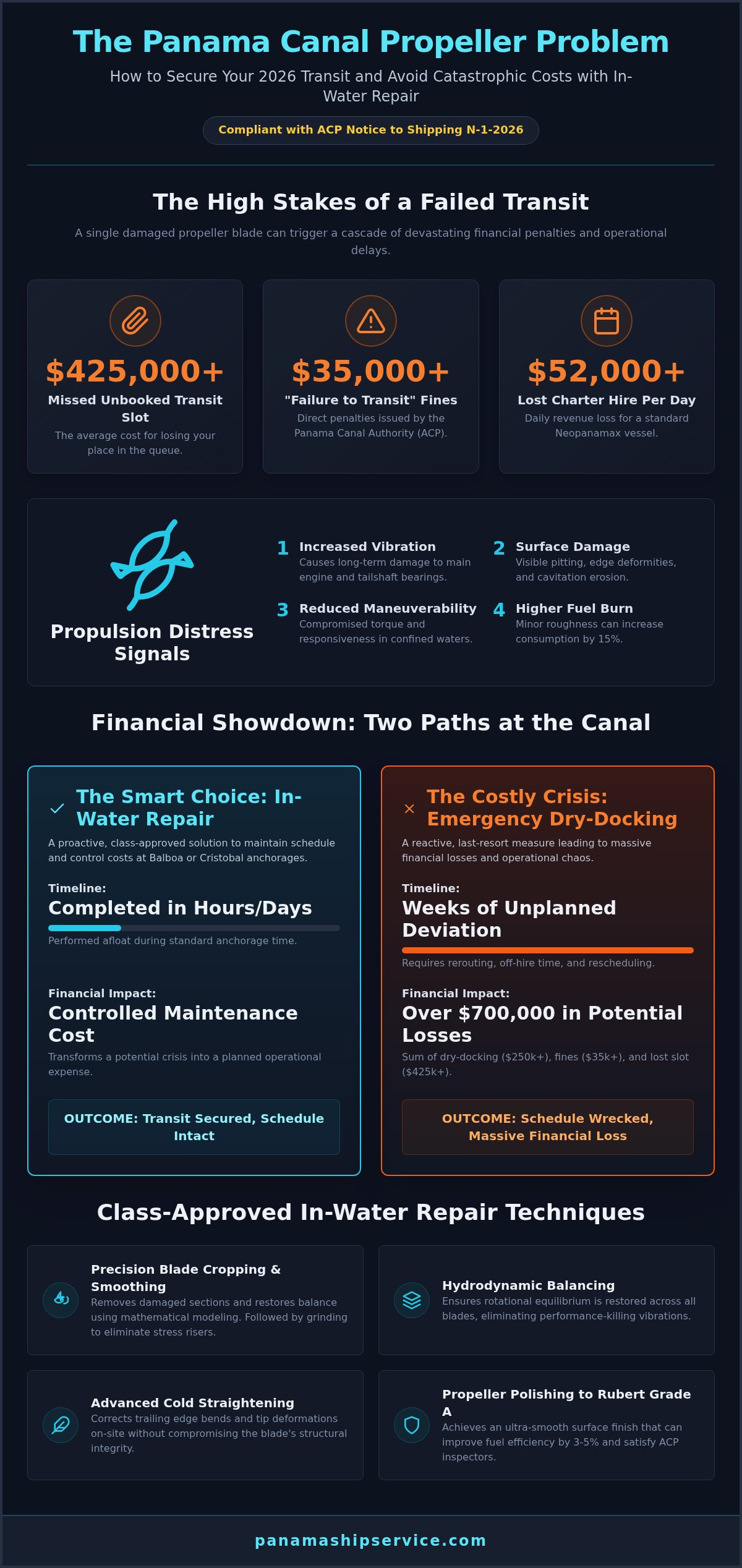
In the 2026 maritime environment, propulsion integrity is the primary gatekeeper for successful Panama Canal operations. The Panama Canal Authority (ACP) has intensified its pre-transit inspection protocols, focusing heavily on mechanical stability at the Balboa and Cristobal anchorages. If your vessel displays signs of propulsion distress, inspectors won’t hesitate to deny your transit. This isn’t just a scheduling inconvenience; it’s a massive financial liability. Missing an unbooked transit slot now carries an average cost of $425,000, while “failure to transit” fines frequently exceed $35,000. For a Neopanamax vessel, a single day of delay can trigger over $52,000 in lost charter hire and rescheduling fees.
The technical requirements are clearly defined in the ACP Notice to Shipping N-1-2026. This regulation mandates that all vessels maintain strict maneuverability standards to navigate the locks safely. A damaged propeller compromises torque and responsiveness, making the ship a liability in confined waters. Beyond the immediate transit risk, bent blades cause significant hydrodynamic imbalance. This imbalance translates into high vibration levels that threaten the long-term health of the main engine and tailshaft bearings. Addressing these issues through underwater propeller repair panama before the pilot boards is the only reliable way to protect your investment and your schedule.
Symptoms of Propeller Distress and Performance Loss
Identifying the early signs of propulsion failure is essential for avoiding emergency dry-docking costs. Hydrodynamic issues such as propeller damage and cavitation often manifest as surface pitting, edge deformities, or unusual acoustic signatures. Cavitation doesn’t just erode the metal; it destroys efficiency. Even a single millimeter of surface roughness or biofouling can trigger a 15% increase in fuel consumption. For a standard bulk carrier, this equates to roughly $4,500 in extra daily operating expenses based on current VLSFO prices. Ship managers should utilize vibration analysis and diver-led inspections to diagnose these issues before they escalate into a failed ACP inspection.
The Regulatory Stakes at the Canal in 2026
ACP inspectors are prioritizing propulsion efficiency this year to ensure the smooth flow of traffic through the expanded locks. They require detailed documentation to prove a vessel’s reliability. This often includes recent survey reports and clear visual evidence of the propeller’s condition. The use of real-time underwater CCTV monitoring has become the standard for regulatory transparency. It allows Class surveyors and ACP officials to verify that any underwater propeller repair panama meets IACS standards. By providing this level of digital proof, vessel operators can demonstrate compliance with N-1-2026 and secure their transit without the risk of costly last-minute delays.
Class-Approved Underwater Propeller Repair Techniques
Restoring propulsion efficiency in a high-stakes environment requires IACS-compliant technical interventions that satisfy the latest Panama Canal vessel requirements. When a ship sustains impact damage, the objective is to restore hydrodynamic balance while the vessel remains afloat. Professional underwater propeller repair panama utilizes specialized hydraulic tools and precision grinding equipment to rectify deformities at the Balboa or Cristobal anchorages. These methods are recognized by major classification societies like ABS, DNV, and Lloyd’s Register, allowing operators to maintain their schedules without the massive overhead of a dry-docking deviation.
Precision Blade Cropping and Smoothing
If a blade tip is fractured or severely deformed, precision cropping is often the most effective way to restore balance. This technique relies on mathematical modeling to calculate the exact amount of material to remove from the damaged blade and its counterparts to maintain rotational equilibrium. Divers utilize hydraulic cutters to perform the primary crop, followed by detailed grinding to eliminate stress risers that could lead to further propagation of cracks. Rubert Grade A is the gold standard for surface finish. Achieving this level of smoothness through regular polishing not only satisfies inspectors but can also provide efficiency gains of 3% to 5%, significantly reducing fuel consumption during the subsequent voyage.
Advanced Cold Straightening and Restoration
For trailing edge bends or tip deformations that haven’t reached the point of structural failure, cold straightening provides a non-destructive restoration path. Technicians employ portable hydraulic jacks and custom strongbacks to apply controlled pressure, gradually returning the blade to its original geometric design. This method is critical for maintaining metallurgical integrity, as it avoids the thermal stresses and potential embrittlement associated with underwater welding. Throughout the operation, real-time CCTV monitoring provides total transparency for shore-side managers and Class surveyors. For vessels nearing their transit window, engaging these specialized underwater hull services ensures that all mechanical work is documented and approved before the pilot boards, preventing any last-minute regulatory hurdles.
Financial Analysis: In-Water Repair vs. Emergency Dry-Docking
The 2026 maritime market demands a cold, analytical approach to maintenance. For a vessel manager, the choice between a 12-hour anchorage intervention and a 14-day emergency dry-docking isn’t just about the repair bill. It’s about protecting the bottom line. An emergency dry-docking carries a base cost exceeding $250,000, yet this figure ignores the devastating impact of deviation and lost charter hire. A Neopanamax vessel loses over $52,000 per day in charter fees alone. When you add 14 days of downtime, the financial damage quickly exceeds $1,000,000.
By choosing underwater propeller repair panama, operators can neutralize these risks. This is particularly critical when a vessel has already secured a transit slot. The average cost for an unbooked transit slot in 2026 is $425,000. Losing this slot due to a failed ACP inspection doesn’t just waste that capital; it also triggers “failure to transit” fines that often exceed $35,000. In-water repairs allow you to maintain your position in the queue, ensuring your investment remains secure.
Direct Cost Comparison Framework
Calculating the true cost of a repair requires looking beyond the immediate service. Emergency dry-docking forces a vessel out of its trade route, leading to massive fuel consumption during deviation. Conversely, performing repairs at the Balboa or Cristobal anchorages keeps the ship on its path.
- Time Efficiency: A 12-hour repair vs. 336 hours (14 days) in dry-dock.
- Charter Integrity: Zero loss of hire when repairs occur during the pre-transit waiting window.
- Regulatory Compliance: All work adheres to Class-Approved Propeller Repair Standards, ensuring no issues with subsequent inspections.
Strategic Asset Protection in Panama
Proactive maintenance at the Canal offers a unique ROI through fuel optimization. Restoring a propeller to Rubert Grade A standards can provide 3% to 5% in efficiency gains. With VLSFO prices at approximately $650 per metric ton, these savings can offset the entire cost of the underwater intervention within the first few weeks of steaming. Beyond the propeller, ship managers can leverage this time to conduct broader Mechanical ship repairs in Panama. Consolidating husbandry services during a single repair window minimizes total downtime and prevents minor blade deformities from compounding into expensive main engine vibrations or bearing failures. This systematic approach ensures that every dollar spent in underwater propeller repair panama contributes directly to the vessel’s long-term fiscal health.
Logistics at Balboa and Cristobal Anchorages
Strategic positioning is the cornerstone of a successful underwater propeller repair panama. Choosing between the Pacific and Atlantic entrances depends on your transit direction and current weather conditions. Coordination with the Panama Canal Authority (ACP) is mandatory; performing any underwater intervention without an authorized permit can result in fines starting at $15,000. Our team manages the entire permitting process, ensuring that repair schedules align perfectly with your transit window. We maintain 24/7 operational readiness at both hubs to minimize mobilization times for diver-technicians and specialized hydraulic equipment. For emergency inspections requested within 24 hours of transit, be aware that a 25% premium typically applies due to the rapid deployment of technical assets.
Balboa Anchorage (Pacific Side) Operations
Balboa Anchorage serves as the primary Pacific hub. It is the logical choice for Northbound vessels awaiting their slot. While the Pacific side experiences a significant tidal range that can impact diving windows, its proximity to major repair facilities and spare parts hubs makes it ideal for complex mechanical work. We synchronize our diving schedules with tidal patterns to maximize water clarity and safety. This ensures that Class surveyors have the visual data they need for immediate approval. Because Balboa is a central logistics node, we can easily coordinate propeller work alongside other critical ship supplies or crew change requirements, consolidating your downtime into a single, efficient window.
Cristobal Anchorage (Atlantic Side) Operations
On the Atlantic side, Cristobal Anchorage offers different operational advantages. Southbound vessels typically utilize this location. While tidal range is less of a factor here, Caribbean weather patterns and sea states can influence diving schedules. Cristobal generally provides superior water clarity, which is beneficial for high-precision tasks like Rubert Grade A polishing or detailed CCTV inspections. For deep-draft vessels, we account for a 15% surcharge in planning due to specialized decompression requirements for technical divers. For comprehensive maintenance beyond the propeller, we offer integrated Underwater hull services in Panama, allowing you to address biofouling and propulsion issues simultaneously while at anchor.
To avoid the $52,000 daily delay costs associated with Neopanamax rescheduling, you must ensure your logistics are handled by a partner that understands these local nuances. We coordinate repairs alongside bunkering or cargo operations whenever possible to maximize your time in Panama. Don’t risk your transit slot on uncoordinated logistics. Contact Panama Ship Service today to secure your repair window and protect your operational schedule.
Partnering with Panama Ship Service for Propulsion Integrity
In the high-stakes environment of the 2026 Panama Canal transit market, operational reliability is your most valuable asset. Panama Ship Service positions itself as a seasoned veteran in this complex landscape, offering the technical depth required to handle urgent mechanical challenges without unnecessary complication. We understand that a single day of delay can jeopardize your schedule and your bottom line. Our team provides class-approved underwater propeller repair panama with a focus on zero-deviation results. By maintaining 24/7 operational readiness at both Balboa and Cristobal, we ensure that your vessel receives immediate attention the moment it arrives at the anchorage. We don’t just perform repairs; we act as a dependable business partner that manages technical complexity so you can focus on your transit.
A One-Stop-Shop for Canal Transit Readiness
Efficiency in 2026 is driven by the consolidation of services. Managing multiple vendors for hull cleaning, mechanical work, and waste disposal creates administrative overhead and increases the risk of scheduling conflicts. Our consolidated service model integrates mechanical expertise with advanced underwater technical skills, allowing you to address several operational needs within a single window. Alongside propeller restoration, we provide comprehensive Marine surveys in Panama to verify hull integrity and ensure compliance with the latest ACP requirements. This holistic approach includes MARPOL disposal and ship supplies, reducing the time your vessel spends idle and ensuring you are fully prepared for the pilot’s arrival. By delegating these tasks to a single, authoritative provider, you simplify your operations and maintain strict control over your budget.
Securing Your 2026 Transit Schedule
Proactive communication is the key to avoiding last-minute transit denials. We have established direct communication protocols that allow our technical team to provide rapid-response assessments before your vessel even reaches the locks. This proactive stance is essential for meeting the rigorous maneuverability standards enforced by the Panama Canal Authority. We assist ship managers in preparing all necessary documentation for Class surveyors and ACP inspectors, ensuring total transparency through real-time CCTV reporting and detailed work logs. If your vessel is experiencing high vibration levels or noticeable fuel penalties, don’t wait for a failed inspection to take action. Contact Panama Ship Service for a technical consultation to secure your 2026 transit schedule. Our systematic approach to underwater propeller repair panama guarantees that your propulsion system is restored to peak efficiency, protecting your transit slot and your vessel’s long-term mechanical health.
Protect Your Vessel Performance and Transit Schedule
Navigating the Panama Canal in 2026 requires more than just a booked slot; it demands a vessel that meets the highest maneuverability and efficiency standards. By choosing underwater propeller repair panama, you eliminate the hydrodynamic drag and mechanical vibrations that trigger failed inspections and “failure to transit” fines. This proactive approach ensures your ship remains fully compliant with ACP Notice to Shipping N-1-2026 while avoiding the $250,000 base cost of an emergency dry-docking. You’ve seen how in-water interventions at Balboa or Cristobal can restore propulsion efficiency by up to 5%, providing a significant financial hedge against rising fuel costs.
Our class-approved technical team maintains 24/7 emergency response readiness at both Canal entrances to handle your most urgent mechanical needs. We provide the technical expertise required to navigate regulatory hurdles without complicating your transit logistics. Don’t let a bent blade or surface roughness compromise your $425,000 transit investment. Secure your transit slot with expert propeller repair today. We’re committed to helping you maintain a zero-deviation schedule and ensuring your vessel operates at peak performance throughout its voyage.
Frequently Asked Questions
Is underwater propeller repair considered a permanent fix by Class?
Underwater repairs are recognized as permanent by major classification societies like ABS or DNV when the procedure follows IACS guidelines. Our technical team ensures that every underwater propeller repair panama is monitored by a Class surveyor to verify metallurgical integrity. While some specific blade geometries might require a final inspection during the next scheduled dry-dock, the restoration allows for unrestricted vessel operation and full compliance with international safety standards.
How long does a typical in-water propeller cropping take in Panama?
A standard in-water propeller cropping operation typically takes between 12 and 18 hours at the Panama anchorages. This timeline includes the initial CCTV inspection, mathematical modeling for balance, and the mechanical cutting process. Because we maintain 24/7 readiness at both Canal entrances, we can often complete these interventions during your scheduled pre-transit waiting window, ensuring zero impact on your confirmed 2026 transit slot and avoiding costly delays.
Can propeller repairs be performed while the vessel is bunkering?
Yes, propeller repairs can often be performed concurrently with bunkering or cargo operations to maximize your time in port. This consolidated approach is a core part of our service model. By coordinating the diving team alongside other husbandry tasks, we help vessel managers reduce total port stay duration. We maintain strict safety protocols to ensure that underwater mechanical work does not interfere with fuel transfer or other topside activities.
What documentation does the Panama Canal Authority require for damaged propellers?
The Panama Canal Authority requires comprehensive technical evidence as outlined in Notice to Shipping N-1-2026. This documentation must include a detailed dive report, high-definition CCTV footage of the damaged and repaired areas, and an endorsement from a Class surveyor. Providing this package ensures regulatory transparency and proves that the vessel meets the maneuverability standards necessary for a safe transit through the locks, preventing “failure to transit” fines.
How much fuel can be saved by polishing a fouled or damaged propeller?
Regular propeller polishing to Rubert Grade A standards can add between 3% and 5% in efficiency gains. If the propeller is severely fouled or damaged, restoring its hydrodynamic profile can prevent the 15% increase in fuel consumption often caused by biofouling. With VLSFO prices at approximately $650 per metric ton, these efficiency improvements provide a direct return on investment by significantly lowering daily operating expenses for bulk carriers and Neopanamax vessels.
Does Panama Ship Service provide Class-approved reports for all repairs?
Panama Ship Service provides comprehensive, Class-approved reports for every technical intervention we perform. These reports include pre-repair assessments, real-time monitoring data, and post-repair inspections verified by on-site surveyors. Our documentation is designed to satisfy the rigorous requirements of IACS societies and the ACP, providing ship owners with the technical assurance needed for continued global trade, insurance compliance, and successful Panama Canal Authority inspections during the 2026 season.
What is the difference between cold straightening and cropping for bent blades?
Cold straightening uses hydraulic jacks to restore the original geometry of bent trailing edges without applying heat, preserving the metal’s metallurgical properties. Cropping is used when a blade is fractured or too severely deformed for straightening. In these cases, we remove the damaged section and calculate a corresponding “balance crop” on the opposite blades to restore the propeller’s hydrodynamic and mass balance, which is essential for preventing damaging engine vibrations.
Can you repair propellers at both the Balboa and Cristobal anchorages?
We provide full technical support for underwater propeller repair panama at both the Balboa and Cristobal anchorages. Balboa serves as our primary Pacific hub for Northbound vessels, while Cristobal provides Atlantic-side support for Southbound transits. Each location is fully equipped with the specialized diving gear and hydraulic tools necessary for complex mechanical repairs, ensuring your vessel remains on schedule regardless of which side of the Panama Canal you approach.