
Dry docking is an operational choice, not a regulatory necessity, for modern hull inspections. You’re likely facing mounting pressure from rising shipyard costs and the logistical headache of diverting your vessel for weeks at a time. It’s frustrating to manage your schedule around lengthy transit delays and complex class approval hurdles that threaten your bottom line. Every day your ship isn’t moving cargo, it’s costing you money, and finding ways to optimize that time is critical for your 2026 planning.
You can maintain full IACS compliance and verify vessel integrity by utilizing cost-effective alternatives to dry docking for inspection. These modern in-water techniques allow you to meet strict safety standards without the extreme expense of a shipyard visit. This article explores how advanced underwater surveys and afloat mechanical repairs can reduce your vessel’s downtime significantly. We’ll show you how to streamline your operations and lower overhead, especially when leveraging strategic technical services at the Panama Canal. Discover how to keep your fleet moving while satisfying every regulatory requirement through efficient, class-approved methods that prioritize your schedule and budget.
Key Takeaways
- Eliminate unnecessary off-hire days and shipyard fees by transitioning to modern afloat inspection strategies for your 2026 operations.
- Identify the critical regulatory requirements for UWILD surveys to maintain full IACS compliance without the need for a physical shipyard visit.
- Compare the technical advantages of diver-led and ROV technologies to select the most efficient inspection tool for your specific hull geometry.
- Follow a proven five-step roadmap to secure class approval for afloat surveys well in advance of your vessel’s next inspection window.
- Leverage the strategic advantages of the Panama Canal to access class-approved alternatives to dry docking for inspection while consolidating essential technical services.
Why Shipowners are Prioritizing Alternatives to Dry Docking in 2026
Afloat inspections refer to class-approved surveys conducted while the vessel is buoyant. As operational costs rise, shipowners are shifting their focus toward alternatives to dry docking for inspection to maintain vessel integrity without the logistical burden of a shipyard. This proactive approach allows for continuous operation, ensuring that mandatory class requirements don’t interrupt your revenue stream. By keeping the ship in the water, you bypass the rigid schedules of dry dock facilities and maintain control over your vessel’s availability.
The Panama Canal serves as a strategic hub for these technical services. By conducting inspections during transit or while at anchor, you eliminate the need for costly deviations. Panama Ship Service provides a consolidated model where underwater hull services and mechanical repairs happen simultaneously. This minimizes transit delays and optimizes your schedule in one of the world’s most critical maritime corridors. Avoiding traditional dry docks also offers environmental benefits, as it reduces the concentrated release of chemicals and waste associated with shipyard basins.
The True Cost of a Dry Dock Stay
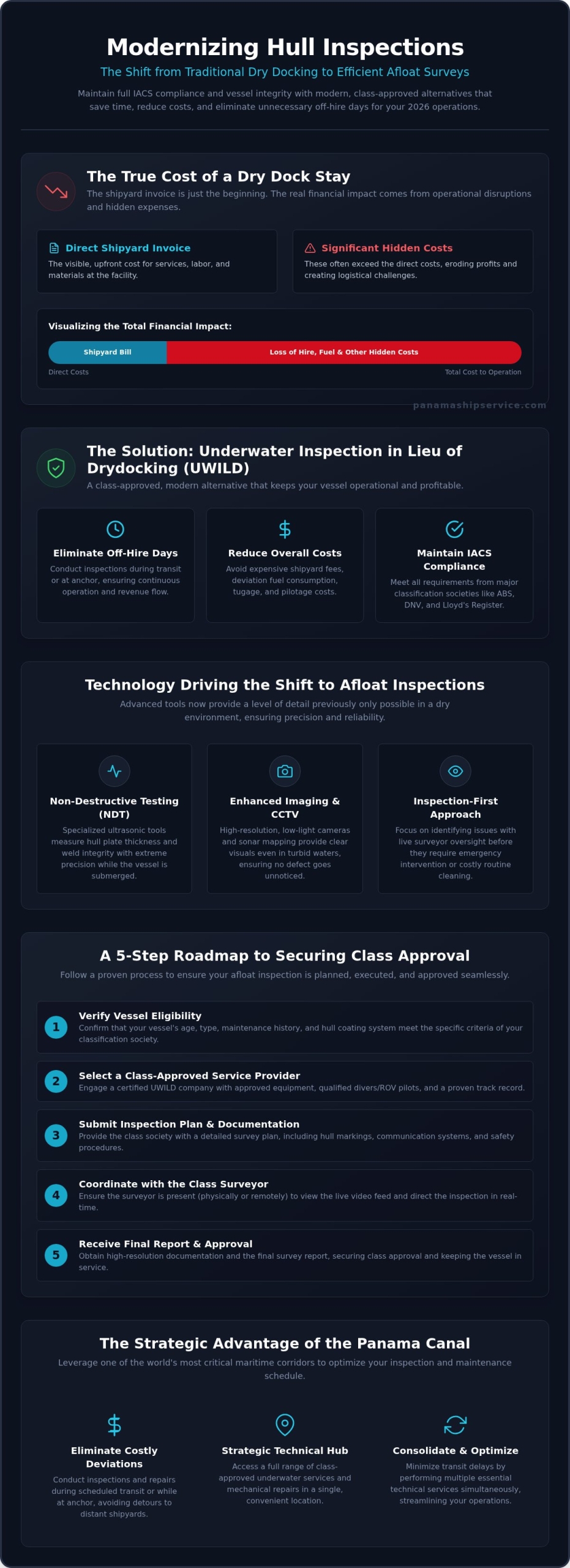
The invoice from a shipyard is only the starting point of your expenses. You must calculate the daily loss of hire, which often exceeds the cost of the repairs themselves. Hidden costs like tugage, pilotage, and increased fuel consumption during deviation quickly erode your quarterly profits. In the volatile 2026 market, where charter rates fluctuate rapidly, the risk of being off-hire for an extended period is a significant financial liability. Afloat surveys provide viable alternatives to dry docking for inspection by keeping the vessel in the water and ready for its next fixture immediately after the survey is completed.
Technological Advancements Driving the Shift
Modern technology has closed the gap between dry and wet inspections. High-resolution underwater imaging and real-time CCTV feeds provide surveyors with a level of detail previously only possible in a dry environment. These tools allow for precise assessments without the need for deballasting or docking. Key advancements include:
- Non-Destructive Testing (NDT): Specialized ultrasonic tools now measure plate thickness and weld integrity with extreme precision while submerged.
- Enhanced Imaging: Low-light cameras and sonar mapping provide clear visuals even in turbid waters, ensuring no defect goes unnoticed.
- Inspection-First Approaches: Instead of routine cleaning that might hide structural defects, modern techniques focus on identifying issues before they require emergency intervention.
These tools ensure your vessel meets IACS standards while avoiding the high-stakes pressure of a shipyard timeline. You gain a clear, documented picture of your hull’s condition, allowing for data-driven maintenance decisions that prioritize both safety and fiscal responsibility.
Understanding UWILD: The Primary Alternative for Hull Inspection
UWILD stands for Underwater Inspection in Lieu of Drydocking. It represents the primary technical standard among alternatives to dry docking for inspection. Major classification societies, including ABS, DNV, and Lloyd’s Register, provide specific frameworks for these afloat surveys. To qualify, your vessel must meet several technical criteria. Most class societies require a high-performance hull coating system, typically epoxy-based, that remains in good condition. You must also provide high-quality CCTV systems and reliable diver-to-surface communication so the surveyor can direct the inspection in real time. Age and vessel type play a role; while many modern bulkers and tankers are eligible, older vessels or specialized offshore units may face stricter scrutiny depending on their maintenance history.
IACS Requirements for In-Water Surveys
IACS requirements for in-water surveys are precise and demanding. You must ensure the hull is marked with clear reference points, such as transverse and longitudinal lines, to allow the diver and surveyor to pinpoint locations accurately. The class surveyor doesn’t just review a report after the fact. They are present during the operation, viewing the live video feed to verify the integrity of sea chests, gratings, and the rudder assembly. High-resolution documentation is mandatory to provide a permanent record of the hull’s condition. If the water clarity is poor or the hull is excessively fouled, the surveyor may reject the survey until conditions improve or cleaning is performed. Fleet managers are increasingly turning to these alternatives to dry docking for inspection to avoid the high costs of shipyard deviation and stay compliant with international safety standards.
Benefits of UWILD for Fleet Management
UWILD offers a significant reduction in vessel downtime, especially for ships on tight charter schedules. Instead of losing two weeks to a shipyard, you can complete a mandatory inspection in 24 to 48 hours. This allows for real-time decision-making regarding hull maintenance. These inspections frequently integrate with broader underwater hull services to maintain peak efficiency. For example, if the survey reveals localized fouling, you can authorize immediate cleaning to preserve fuel economy. Coordinating these surveys at a strategic hub like the Panama Canal ensures your vessel stays on its route while meeting every regulatory obligation. Contacting a reliable Panama maritime agency early in your planning phase ensures all class notifications and logistical requirements are handled correctly without complicating your transit schedule.
Comparing Inspection Technologies: Diver-Led vs. ROV Surveys
Selecting the right technology is critical when evaluating alternatives to dry docking for inspection. You must balance the need for high-resolution data with the practicalities of your vessel’s location and schedule. While robotic systems have advanced significantly, the choice between human divers and Remotely Operated Vehicles (ROVs) often depends on the complexity of the hull’s geometry and the specific requirements of your classification society. Both methods provide a path to IACS compliance without the shipyard, but they serve different operational roles. Identifying which tool fits your current port stay ensures you don’t waste time on incomplete data or repeated surveys.
Diver-Led Inspections: Tactile and Versatile
Human divers remain the industry standard for complex hull areas and niche spaces. Their ability to provide tactile feedback is something technology hasn’t fully replicated. A diver can physically reach into sea chests, inspect rudder pintle clearances, and feel for localized pitting that a camera might miss in turbid water. One of the most significant advantages of using divers is the capacity for immediate intervention. If a surveyor identifies minor fouling or surface roughness during the live feed, the diver can perform propeller polishing or clear a blocked grating on the spot. This direct communication between the diver and your onboard technical staff allows for real-time problem-solving, turning a simple inspection into a productive maintenance session. Divers are particularly effective at the Panama Canal, where they can navigate the specific mooring and anchoring conditions of the corridor with high precision.
ROV Technology: The Future of Maritime Surveys
ROV technology has transformed how we approach large-scale routine inspections. These robotic systems excel in environments where human risk is elevated, such as deep-water anchorages or areas with unpredictable currents. An ROV provides a stable platform for high-definition cameras and sonar mapping, creating a consistent digital record of the hull’s condition. Modern units are capable of automated hull scanning and 3D modeling, which offers classification societies a data-driven view of structural integrity. For routine mid-term surveys of large tankers or bulkers, ROVs offer a fast and cost-efficient solution. They eliminate the logistical needs of a dive team and can operate for extended periods without fatigue. Many operators now use ROVs as scouting tools to identify specific points of interest before deploying divers for a more detailed, tactile assessment. This hybrid approach maximizes the efficiency of your alternatives to dry docking for inspection, ensuring you get the most accurate results for your class approval while keeping operational costs low.
Securing Class Approval for Afloat Inspections: A 5-Step Guide
Securing class approval for alternatives to dry docking for inspection requires a systematic approach that begins months before your vessel reaches the canal. You cannot treat an afloat survey as a last-minute substitution for a shipyard stay. Classification societies like ABS, DNV, and Lloyd’s Register demand rigorous documentation and technical readiness. By following a structured process, you ensure that your inspection results are accepted without reservation, maintaining your vessel’s class status while avoiding the high costs of a dry dock facility.
- Early Consultation: Contact your classification society well in advance of the survey window. You must confirm that your specific vessel type and age qualify for UWILD under their current 2026 guidelines.
- Provider Selection: Select a class-approved service provider in Panama. The provider must hold valid certifications from your specific class society to ensure the survey data is legally recognized.
- Hull Preparation: Clean sea chests and verify that all underwater openings have clear reference markings. Poor visibility due to fouling can lead to a rejected survey.
- Pre-Survey Meeting: Conduct a formal meeting involving the master, the class surveyor, and the dive supervisor. This ensures everyone understands the scope and safety protocols before the first diver enters the water.
- Reporting and Resolution: Finalize the technical report immediately. If the survey identifies deficiencies, you must have a plan to address them afloat to avoid a conditional class entry.
Pre-Inspection Preparation Checklist
Preparation is the difference between a successful survey and a costly delay. Your technical team should verify that the hull coating system is compatible with in-water cleaning equipment to prevent damage during prep work. All underwater openings, including sea chests and bow thruster tunnels, must have permanent reference markings that are visible to the surveyor via the live feed. Finally, gather all previous dry dock reports and thickness measurement data. Providing this context allows the surveyor to perform a comparative analysis, which often speeds up the approval process for alternatives to dry docking for inspection.
Managing Deficiencies Without a Shipyard
Identifying a defect during an afloat survey doesn’t automatically mean a trip to the shipyard. Many mechanical ship repairs can be performed while the vessel is at anchor or during cargo operations. Class societies often allow for temporary repairs, such as doubling plates or underwater welding, provided they meet specific safety thresholds. In some cases, permanent repairs like seal replacements or propeller tip cropping are possible using cofferdams or specialized underwater habitats. Understanding the class society’s tolerance for afloat fabrication allows you to delegate complexity to your service partner and keep your vessel on schedule. To ensure your next inspection meets every regulatory hurdle, contact our technical team in Panama to coordinate your class-approved afloat survey.
Strategic Afloat Inspections at the Panama Canal with Panama Ship Service
Panama Ship Service leverages the strategic geography of the Panama Canal to provide zero-deviation technical solutions. When you choose alternatives to dry docking for inspection at this global crossroads, you eliminate the need to divert your vessel to distant shipyards. Our team coordinates directly with your schedule, ensuring that mandatory surveys happen while your ship waits for its transit slot or during cargo operations. This localized approach turns a logistical necessity into an opportunity for operational optimization. As a seasoned veteran and the preferred partner for marine surveys in Panama, we handle the technical complexity so you can focus on your voyage.
Coordinating Inspections During Canal Transit
Scheduling a survey at the Balboa or Cristobal anchorages allows for seamless integration with your canal transit. We manage all logistics with the Panama Canal Authority (ACP) to ensure our dive teams and surveyors are on-site the moment your vessel is cleared. This coordination is vital for minimizing transit delays. By choosing afloat alternatives, operators have successfully reduced what would have been a 10-day dry dock stay into a 48-hour afloat survey window. This efficiency is particularly critical in 2026, where port congestion and shipyard backlogs make traditional docking unpredictable. We provide a calm, expert presence to guide your vessel through these high-stakes windows without unnecessary complication.
Integrated Technical Solutions for Modern Mariners
Our service model functions as a one-stop-shop for technical and husbanding needs. Beyond the primary inspection, our teams are equipped to handle hull cleaning, propeller polishing, and urgent mechanical support simultaneously. This consolidated approach reduces your operational overhead by eliminating the need to manage multiple vendors. Compliance is further simplified through our MARPOL disposal panama services, ensuring all liquid and solid waste is handled according to international regulations while you are in port. By combining these essential tasks with your afloat survey, you maximize the value of your time at the canal. You can request a comprehensive technical service quote that covers everything from ship supplies to class-approved underwater repairs. We prioritize fiscal responsibility and schedule optimization, providing the tangible benefits you need to maintain a competitive fleet in today’s demanding maritime environment.
Future-Proof Your Fleet with Strategic Afloat Solutions
Embracing afloat surveys is a definitive strategy to protect your vessel’s earning potential in 2026. By utilizing class-approved technical divers and modern imaging technology, you can satisfy IACS requirements without the exorbitant costs and delays of a shipyard. Success depends on proactive planning and partnering with a service provider that understands the nuances of class approval and strategic hub logistics.
Panama Ship Service offers a consolidated technical model that simplifies your maintenance schedule. We provide 24/7 operational support at the Panama Canal, combining essential underwater hull services with mechanical repairs to minimize your time at anchor. Our team ensures that your transition to alternatives to dry docking for inspection is handled with the highest level of proficiency. It’s the most efficient way to maintain compliance while keeping your fleet moving and profitable.
Request a technical quote for your next afloat inspection in Panama to optimize your operational overhead today. We look forward to helping you achieve a more efficient and compliant year ahead.
Frequently Asked Questions
What is the difference between an in-water survey and a dry dock inspection?
An in-water survey is conducted while the vessel remains buoyant, whereas a dry dock inspection requires the ship to be lifted out of the water in a shipyard basin. In-water surveys use certified divers or ROVs to inspect the hull, sea chests, and rudder assemblies. This is one of the most effective alternatives to dry docking for inspection because it eliminates the need for complex shipyard logistics and deballasting procedures.
Can any ship undergo a UWILD inspection instead of dry docking?
Not every vessel qualifies for a UWILD. Classification societies typically approve these afloat surveys for ships less than 15 years old, though older vessels can qualify if they maintain a proven service history. The vessel must have a high-quality epoxy hull coating and specific reference markings to guide the divers. You should consult your class society to verify your vessel’s eligibility before scheduling technical services at the Panama Canal.
Is an afloat inspection as thorough as a shipyard inspection?
Modern afloat inspections provide high levels of detail through high-resolution video feeds and non-destructive testing (NDT) tools. While a shipyard allows for a tactile inspection of the entire hull surface, class-approved underwater surveys focus on critical structural areas like sea chests, rudders, and propeller assemblies. When performed by certified technical divers, these inspections meet all IACS standards for safety and integrity without the time-consuming process of docking.
How long does a typical class-approved underwater inspection take?
A standard class-approved underwater inspection usually takes between 24 and 48 hours to complete. This timeline is significantly shorter than the two weeks often required for a shipyard stay. The total duration depends on the vessel’s size, water clarity, and the amount of marine growth on the hull. By coordinating with our technical teams in Panama, you can often finish the inspection while waiting for your scheduled canal transit slot.
What happens if damage is found during an afloat inspection?
If our divers identify damage, Panama Ship Service can perform various mechanical ship repairs while the vessel remains at anchor. Minor issues like propeller nicks or localized hull pitting can be addressed immediately to maintain compliance. For more complex structural repairs, we use specialized equipment or cofferdams to create a dry environment underwater. This allows you to resolve deficiencies without deviating to a shipyard, keeping your vessel on its original schedule.
Are underwater inspections in Panama approved by all major class societies?
Yes, our underwater inspections are recognized by all major IACS members, including ABS, DNV, and Lloyd’s Register. We maintain the necessary certifications to ensure that the survey data we provide is accepted for your vessel’s official class records. Our strategic location at the Panama Canal allows us to act as a one-stop-shop for surveys, repairs, and MARPOL disposal, providing a seamless and professional compliance process for international ship operators.
How much can a shipowner save by choosing afloat alternatives?
Savings are realized primarily through the reduction of off-hire days and the elimination of shipyard fees. By utilizing alternatives to dry docking for inspection, you avoid costs related to tugage, pilotage, and fuel consumption during deviation. While exact figures depend on the vessel’s daily charter rate and the scope of work, the financial benefit of staying operational is substantial. This makes afloat surveys a preferred choice for cost-conscious fleet managers in 2026.
Do I need to clean the hull before an underwater inspection?
A clean hull is often a prerequisite for a successful class-approved survey. Excessive marine growth can obscure structural details, leading the surveyor to reject the inspection results. We recommend performing a hull cleaning or propeller polishing immediately before or during the survey to ensure maximum visibility. Panama Ship Service can consolidate these cleaning services with your inspection to streamline the process and ensure your vessel meets all technical requirements for class approval.