
A standard ship repair contract doesn’t guarantee your vessel is safe from financial loss; it only defines who pays for the next mistake. For many operators, the true cost of a faulty repair isn’t the technical fix itself, but the cascading expenses of secondary repairs and unplanned downtime. You likely expect your warranty to act as a comprehensive safety net. However, the reality of a warranty on ship repair work is often buried under dense legal jargon and the vague standard of workmanlike performance. This creates a dangerous gap between your expectations and your actual legal protections.
We understand that uncertainty about liability for faulty repairs can jeopardize your operational schedule, especially when transiting critical hubs like the Panama Canal. This guide provides the clarity you need to bridge that gap. You’ll learn how to distinguish between implied legal rights and written contract terms to ensure your vessel stays protected. We’ll examine the technical benchmarks that define high-standard repairs and provide actionable strategies for negotiating better warranty terms. By the end of this article, you’ll have the confidence to choose a repair partner in Panama that prioritizes long-term reliability over quick, temporary fixes.
Key Takeaways
- Understand the legal standard of the Warranty of Workmanlike Performance to ensure your repair yard meets mandatory maritime industry benchmarks.
- Learn the critical differences between implied legal rights and express contract terms to eliminate coverage gaps during your next negotiation.
- Identify specific warranty requirements for mechanical overhauls and steel fabrication to protect your vessel against the high cost of secondary failures.
- Navigate the technical complexities of the warranty on ship repair work by identifying time bars and liability caps that often restrict claim eligibility.
- Discover how consolidating services at a strategic hub like the Panama Canal simplifies warranty management and minimizes costly transit delays.
Defining the Standard Warranty on Ship Repair Work
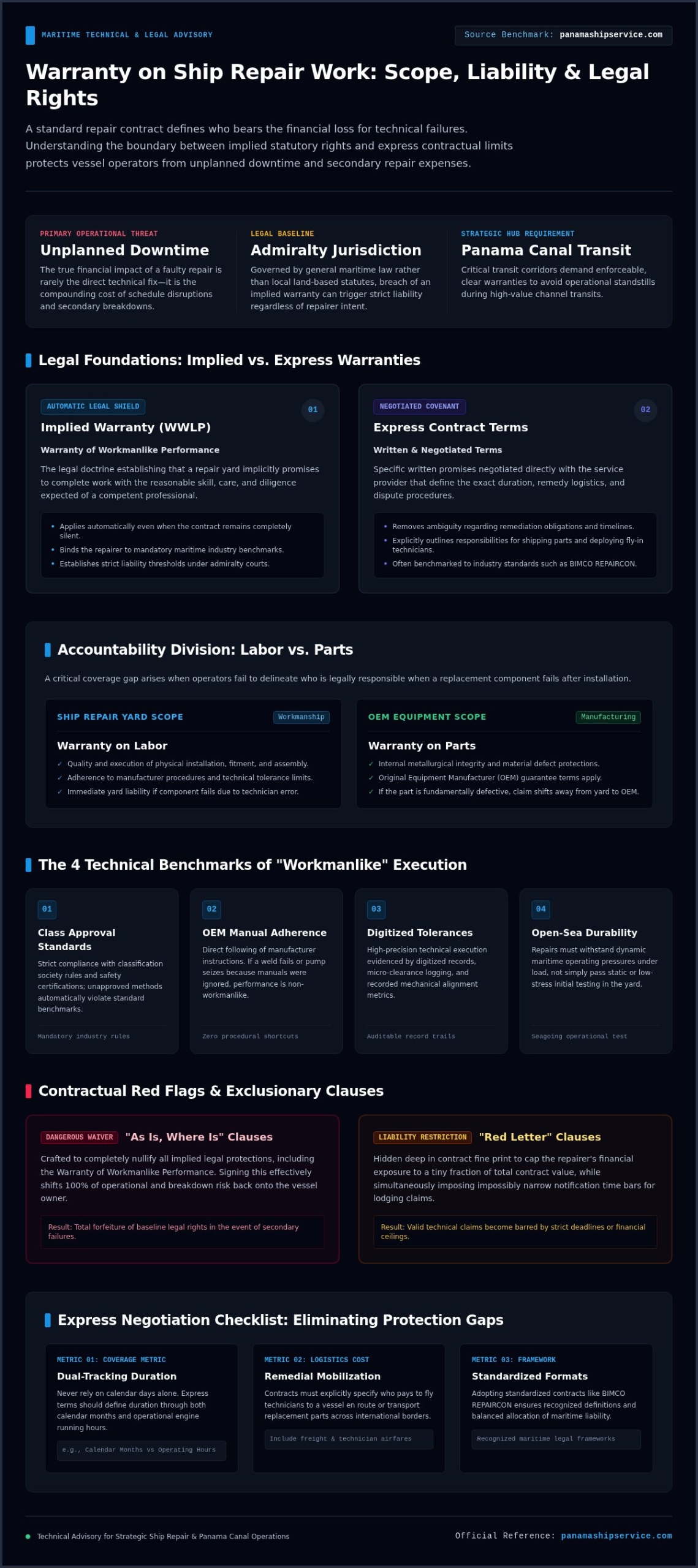
A warranty on ship repair work is a contractual and legal guarantee that a service provider will perform their duties with reasonable skill and care. It isn’t merely an administrative formality. It’s a critical risk-mitigation tool. In the maritime sector, this is formally recognized as the Warranty of Workmanlike Performance (WWLP). This doctrine establishes that a repairer implicitly promises to complete the job in a manner that a competent professional in the same field would. Compliance with ship repair industry standards is the baseline for this performance. If a repairer fails to meet these benchmarks, they may be held liable for damages even if the specific failure wasn’t explicitly mentioned in the contract.
For high-value mechanical ship repairs, the stakes are exceptionally high. A failed engine overhaul or rudder repair doesn’t just cost money; it stops the ship. Owners must distinguish between a warranty on labor, which covers the quality of the installation, and a warranty on parts. Labor is typically the yard’s responsibility. Parts, however, often fall under the original equipment manufacturer’s (OEM) guarantee. This distinction is vital when negotiating terms to avoid accountability gaps. If a new component fails due to poor installation, the yard is responsible. If the component itself is defective, the claim shifts to the manufacturer.
What Constitutes ‘Workmanlike’ in 2026?
In 2026, “workmanlike” isn’t a vague term. It requires strict adherence to class approval standards and specific manufacturer instructions. Technical proficiency is measured by the execution of skilled technicians who follow established safety and quality protocols. Industry benchmarks now prioritize digitized records and precise tolerances. If a weld fails or a pump seizes because a technician ignored a manual, the performance wasn’t workmanlike. Diligent execution means the repair must withstand the operational pressures of the open sea, not just the initial tests in the yard.
The Legal Foundation: Admiralty Jurisdiction
Ship repair contracts are governed by general maritime law rather than local land-based statutes. This provides a level of international consistency. Under admiralty jurisdiction, the breach of an implied warranty can lead to strict liability. This means the repairer might be responsible for the failure regardless of their intent. In strategic hubs like Panama, local contracts often incorporate these international doctrines. This provides ship owners with the legal certainty needed for complex transits. It ensures that the warranty on ship repair work remains enforceable across different jurisdictions.
Implied vs. Express Warranties: Knowing Your Rights
Understanding the legal layers of your repair agreement is essential for effective risk management. A warranty on ship repair work typically exists in two distinct forms: implied and express. Implied warranties are the baseline protections granted by law, even if your contract is silent. Express warranties are the specific, written promises you negotiate directly with the service provider. Both serve as your defense against poor craftsmanship, but they function differently in a legal dispute.
You must remain vigilant against “as is, where is” clauses. These are designed to nullify your implied rights and shift all operational risk to the vessel owner. You should also scrutinize “Red Letter” clauses. These terms often appear in fine print to cap the repairer’s liability at a fraction of the contract value or impose impossibly short notification windows. Reviewing these legal frameworks through maritime warranty and liability law resources is a prudent step before signing any major service agreement. For those seeking transparent and reliable technical support, choosing a reputable partner in Panama ensures these terms are clearly defined from the start.
The Power of Written (Express) Terms
Written terms provide the most reliable protection because they remove ambiguity. They should clearly define the duration of coverage, such as specific calendar months or engine operating hours. A robust express warranty also specifies the scope of remedial work. It must answer critical questions: who covers the cost of transporting replacement parts or flying technicians to a vessel in transit? Incorporating standard industry terms, such as those found in BIMCO REPAIRCON, ensures both parties operate under a clear, recognized framework that balances risk fairly.
When Implied Warranties Take Precedence
Implied rights aren’t always easily discarded by a yard’s fine print. In cases of gross negligence or willful misconduct, courts may override even the most restrictive contract disclaimers. Under the strict liability aspect of maritime law, your primary burden is proving the work was faulty. You don’t necessarily need to prove the yard intended to fail; you only need to link the repair failure directly to your resulting financial or operational loss. Proving these damages requires meticulous documentation of the failure and its immediate impact on your vessel’s schedule.
Coverage Scopes Across Specialized Marine Services
A comprehensive warranty on ship repair work isn’t a one-size-fits-all document. Different technical disciplines require specific coverage parameters based on the nature of the work and the environment where the vessel operates. For example, the criteria for validating a successful engine overhaul differ significantly from those used to assess the integrity of steel fabrication or underwater maintenance. Understanding these nuances is critical for ship managers who need to ensure that every aspect of their vessel’s maintenance is legally and technically protected.
Technical validation often relies on adherence to U.S. Coast Guard vessel maintenance regulations and other international safety standards. These regulations provide the framework for what constitutes a safe and effective repair. When a repair yard performs specialized work, the warranty must reflect the specific stressors the component will face. This is especially true for vessels transiting high-traffic areas where any failure leads to immediate operational disruption.
Mechanical and Engine Repair Warranties
Steel fabrication and underwater services present unique warranty challenges. Structural work must be warranted against weld integrity, corrosion, and stress fractures. Unlike mechanical parts, steel work is often exposed to harsh cathodic environments that can accelerate degradation if the initial repair was sub-standard. For underwater hull cleaning and propeller polishing, warranties typically focus on the immediate restoration of performance and the prevention of damage to existing coatings.
To verify these claims, marine surveys in Panama serve as an essential baseline. These surveys provide independent, class-approved documentation of the repair quality at the moment of completion. This third-party validation is often the strongest evidence available if a warranty claim arises later during the vessel’s voyage. By establishing a clear technical record, ship owners can hold repairers accountable for the durability of their work.
Navigating Liability Limits and Claim Procedures
Filing a claim isn’t just about notifying the yard. It’s a race against the “Time Bar.” Most contracts specify a strict window, often six to twelve months under standard BIMCO REPAIRCON terms, to report issues. Missing this deadline usually voids your warranty on ship repair work entirely. You also need to understand liability caps. Most yards limit their financial exposure to the original contract price. This means if a repair causes damages exceeding the initial service cost, you might only recover the original contract value unless you’ve negotiated specific extensions. Understanding these limits before a failure occurs is the only way to avoid catastrophic financial exposure.
A formal “Notice of Defect” is your primary legal tool. This document must be issued immediately upon discovery of a failure. You also have a legal duty to mitigate loss. You can’t allow a minor mechanical issue to escalate into a total system failure and expect the repairer to cover the expanded damage. Proactive management and clear communication are mandatory to maintain the validity of your claim. To ensure your repairs are backed by technical proficiency and transparent terms, contact Panama Ship Service for your next maintenance window.
How to Document a Repair Failure
Success in a warranty claim depends on the quality of your evidence. You must use logbook entries and high-resolution photos as your primary records. You need to maintain a clear timeline from the moment of repair to the moment of failure. Engaging independent marine surveys is often the most effective way to verify a defect objectively. These surveys provide a technical bridge between your crew’s observations and the yard’s legal liability, making it much harder for a repairer to dispute the cause of the failure.
Negotiating Liability and Indemnity
Don’t accept restrictive “Red Letter” clauses without a fight. These terms are designed to protect the yard’s bottom line at the expense of your vessel’s safety. You should negotiate for coverage of “hidden defects” that only surface after the ship has left the yard and completed several days of operational sea time. It’s also vital to confirm your repair partner carries professional indemnity insurance. This ensures that if a claim is valid, the financial resources exist to settle it without lengthy legal battles. Focus on choosing a partner that prioritizes accountability over fine-print exclusions.
The Panama Ship Service Approach: Reliability at the Canal
Reliability is the primary currency for any vessel transiting the Panama Canal. A mechanical breakdown in this corridor doesn’t just result in a repair bill; it leads to missed transit slots and substantial operational fines. Panama Ship Service recognizes that a warranty on ship repair work is more than a legal obligation. It’s a commitment to keeping your vessel moving through one of the world’s most demanding maritime environments. By providing 24/7 responsiveness for mechanical ship repairs in Panama, we eliminate the anxiety associated with transit delays. Our technical expertise is focused on precise execution, which significantly reduces the likelihood of ever needing to invoke a warranty claim.
Consolidating your service needs with a single, experienced partner simplifies warranty management and ensures clear accountability. When multiple vendors handle different aspects of a repair, the “blame game” often begins the moment a failure occurs. We prevent this by acting as a comprehensive technical partner. This “one-stop-shop” model means that from the initial mechanical overhaul to the final structural check, every task is performed under a unified quality control framework. This level of organization provides ship owners with the confidence that their vessel is protected by a single, reliable point of contact.
Strategic Hub for Efficient Repairs
Operating at a critical global crossroads requires an understanding of the extreme operational pressures unique to the Canal. We minimize transit delays through localized, expert intervention that addresses problems before they escalate. This proactive approach is a core part of our service model. While our technicians handle complex mechanical or steel work, we also manage essential compliance tasks. For instance, ensuring full adherence to MARPOL disposal during your repair stay allows your crew to focus entirely on the upcoming transit without administrative distractions. This integration of technical and operational services optimizes your schedule and reduces overhead.
Commitment to Technical Excellence
Our approach to technical excellence is grounded in rigorous standards for steel fabrication and mechanical repairs. We don’t just aim for a temporary fix; we aim for long-term structural and mechanical integrity. We maintain proactive communication throughout the repair process and the post-repair period to ensure the work continues to perform as expected. This systematic methodology ensures that every repair meets class approval and manufacturer specifications. By prioritizing technical proficiency over quick fixes, we position your vessel for a safe and efficient canal transit, turning potential technical complexity into a managed operational success.
Protecting Your Vessel’s Operational Integrity
A robust warranty on ship repair work is your final safeguard against the high costs of technical failure and unplanned downtime. You’ve learned that navigating these legal complexities requires a clear distinction between implied rights and express contract terms. Success depends on immediate documentation of defects and an understanding of the liability limits that govern maritime repairs. By prioritizing technical proficiency and adhering to class-approved standards, you can bridge the gap between initial repair and long-term reliability.
Panama Ship Service offers a strategic advantage for vessels transiting the Canal. We provide specialized mechanical and underwater repair expertise within a comprehensive maritime service portfolio. Our focus on efficient, one-stop-shop solutions ensures your vessel remains compliant and operational without unnecessary delays. Don’t leave your vessel’s safety to fine-print ambiguities. Secure Your Vessel’s Operational Readiness with Expert Repairs in Panama. We are ready to help you maintain a high standard of performance on every voyage.
Frequently Asked Questions
What is the standard duration for a ship repair warranty?
Standard time bars in the industry, such as those found in BIMCO REPAIRCON, usually range from six to twelve months. This period starts once the vessel is delivered back to the owner. You should check your specific agreement for exact timelines. If the contract is silent, general maritime law may provide a “reasonable” period, though relying on implied durations is risky. Always ensure these terms are explicitly stated before work begins.
Does a warranty cover the cost of docking the ship for remedial work?
Most standard contracts exclude the cost of docking, tugs, and pilotage for remedial repairs. The repairer’s liability is typically limited to the direct cost of fixing the defect itself. You’ll likely be responsible for getting the vessel back to a suitable repair facility. Negotiating “consequential loss” coverage is possible but difficult. It’s vital to clarify these logistical responsibilities during the initial contract review to avoid unexpected transit expenses.
Can a ship repairer legally disclaim all warranties?
A repairer cannot easily disclaim the implied Warranty of Workmanlike Performance under general maritime law. While “Red Letter” clauses attempt to limit liability, courts often find total disclaimers unenforceable, especially if gross negligence is involved. A warranty on ship repair work is considered a fundamental obligation of the service provider. You should remain skeptical of any contract that attempts to strip away all technical accountability for faulty craftsmanship.
What happens if a repair fails while the ship is at sea?
You must issue a formal “Notice of Defect” immediately and take all necessary steps to mitigate further damage. The repairer usually has the right to rectify the problem themselves. If the ship cannot return to the original yard, you must document the failure meticulously with photos and logbook entries. Getting prior approval before hiring a third party for emergency repairs is often a requirement to maintain your warranty claim validity.
Is the warranty on spare parts separate from the labor warranty?
These are distinct categories of protection. The yard warrants the labor and installation quality, while the hardware is covered by the manufacturer’s guarantee. If a part fails due to a manufacturing defect, your claim is with the OEM. However, if the failure results from improper installation, the repair yard is responsible. Coordinating these two layers of protection is essential for high-value mechanical ship repairs where component costs are significant.
How does the ‘Warranty of Workmanlike Performance’ apply if there is no written contract?
The Warranty of Workmanlike Performance applies to every maritime service agreement by law, regardless of whether a written document exists. This implied doctrine establishes that a repairer must perform tasks with reasonable skill and care. If there’s no written contract, the standards of the ship repair industry act as the benchmark for quality. Proving a breach in these cases often requires independent technical evidence to demonstrate that the work was substandard.
What is a ‘Red Letter’ clause in a ship repair contract?
A “Red Letter” clause is a provision designed to restrict the repairer’s liability for damages or negligence. These clauses often cap the payout at the original contract value or a specific dollar amount. They also frequently include very short notification windows for reporting defects. You should scrutinize these terms carefully. They are intended to shift the financial risk of a warranty on ship repair work back to the vessel owner or manager.
How can I prove a repair was not done in a workmanlike manner?
Proving a breach of workmanlike performance requires objective, technical evidence. You should use a combination of detailed logbook entries, high-resolution photographs, and failed component analysis. Engaging a third party for professional marine surveys is the most effective way to validate your claim. These independent reports provide the technical weight needed to hold a repairer accountable. They bridge the gap between your crew’s observations and the repairer’s legal obligations.