
A single distorted propeller blade can trigger a 15% surge in fuel consumption and risk over $250,000 in emergency drydocking fees. You likely recognize the warning signs of a bent tip: excessive hull vibration that wears down machinery and a noticeable drop in propulsion efficiency. While the instinct may be to delay repairs to avoid missing a Panama Canal transit slot, operating with compromised geometry creates a high-stakes liability for your engine and your CII rating. Specialized in-water propeller blade straightening offers a precise engineering solution that restores your vessel to its original design profile while it remains at anchor.
We understand that maintaining a strict schedule is non-negotiable for modern maritime operations. This guide explores how class-approved cold-straightening techniques at the Balboa and Cristobal anchorages eliminate the need for costly cropping or shipyard visits. You’ll discover how to restore hydrodynamic balance, prevent mechanical failure, and ensure full compliance with the latest Panama Canal Authority operational standards. By consolidating technical repairs with your mandatory Canal stop, you can protect your vessel’s mechanical integrity without adding unnecessary downtime to your voyage.
Key Takeaways
- Identify the hydrodynamic symptoms that signal propeller distortion before they cause mechanical failure.
- Evaluate why class-approved propeller blade straightening remains the industry standard for restoring OEM efficiency without drydocking.
- Determine when to choose precision straightening over cropping to avoid permanent propulsion losses.
- Navigate the coordination process with the Panama Canal Authority to secure repair windows at Balboa or Cristobal.
- Learn how to leverage your Canal transit stop to consolidate technical services and reduce agency overhead.
The Impact of Propeller Blade Distortion on Vessel Performance
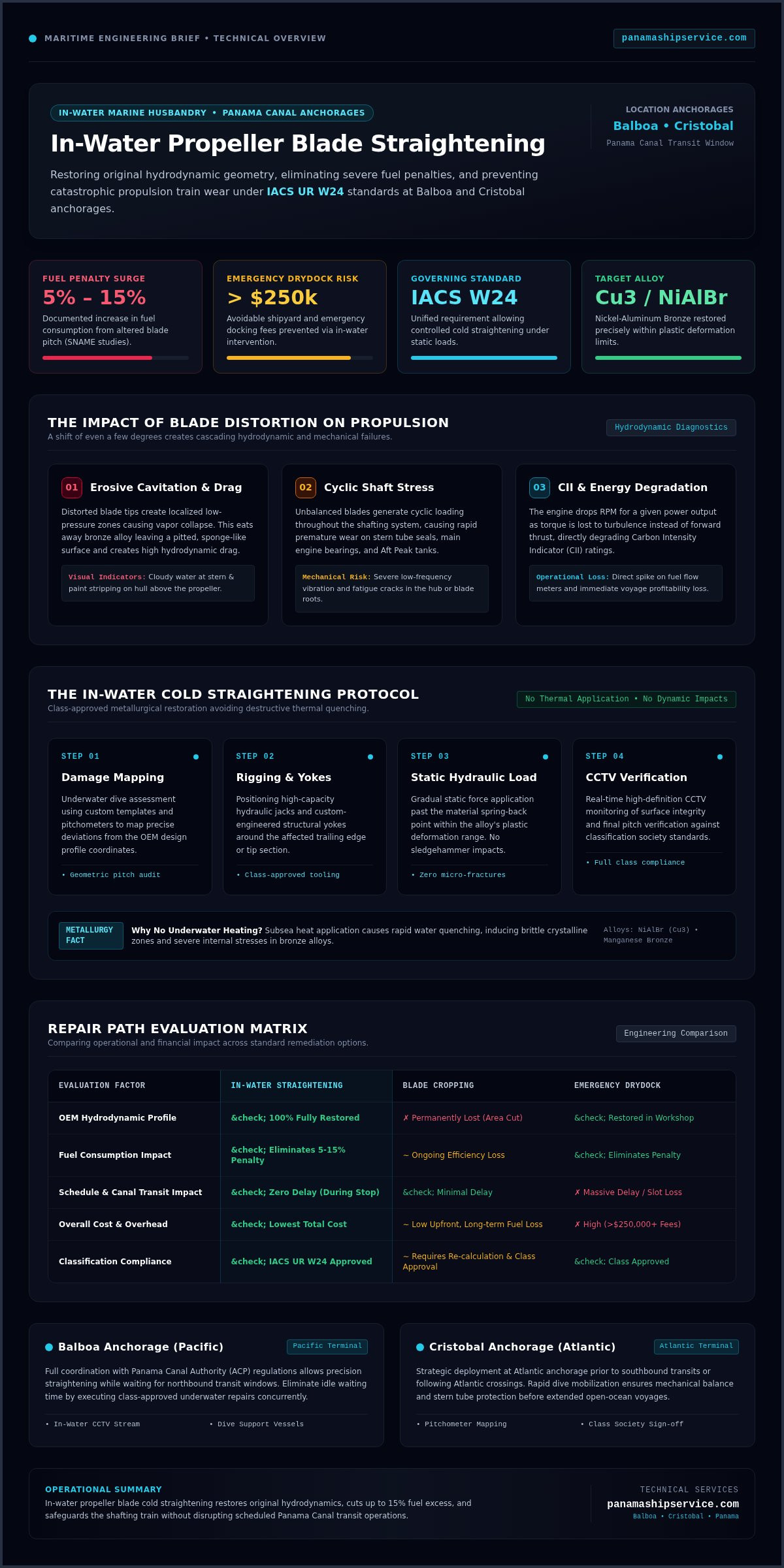
A bent propeller blade isn’t just a minor cosmetic flaw. It’s a critical mechanical failure that disrupts the precise hydrodynamic propeller design required for efficient propulsion. When blade geometry shifts even by a few degrees, the vessel’s performance degrades instantly. You’ll notice a drop in RPM for a given power setting, accompanied by low-frequency hull vibrations and distinct cavitation noise. These symptoms signal that the propeller is no longer converting engine torque into thrust effectively. Instead, it’s wasting energy and creating destructive turbulence. Neglecting these signs leads to a fuel penalty of 5% to 15% according to SNAME propulsion studies, which directly impacts your CII rating and voyage profitability.
Cavitation and Hydrodynamic Drag
Distorted blade tips create localized low-pressure zones where the water vaporizes, leading to erosive cavitation. This doesn’t just reduce lift; it physically eats away at the bronze alloy, leaving behind a pitted, sponge-like texture. During underwater inspections, our diving teams often identify trailing edge deformations that correlate exactly with spikes on fuel flow meters. Maintaining pitch accuracy is essential for operational economy. Without professional propeller blade straightening, these hydrodynamic imbalances continue to drain your budget through increased drag. Visual indicators like “cloudy” water around the stern or paint stripping on the hull above the propeller are clear warnings that the blade’s profile is compromised and requires immediate intervention.
Mechanical Stress and Vibration Analysis
The mechanical consequences extend far beyond the propeller itself. An unbalanced blade generates cyclic loading on the shafting system, which accelerates wear on the stern tube seals and main engine bearings. This persistent vibration often leads to fatigue cracks in the propeller hub or blade roots. It also stresses the Aft Peak tank components and sensitive onboard electronics. Addressing these issues requires specialized mechanical ship repairs in Panama to ensure the entire propulsion train remains aligned. By choosing propeller blade straightening at the first sign of trouble, you prevent a manageable repair from escalating into an emergency drydocking event. Modern vibration analysis confirms that even a slight correction in blade geometry can significantly extend the lifespan of your tail shaft and propulsion machinery.
The Science of In-Water Propeller Blade Straightening
In-water propeller blade straightening relies on the application of controlled, static hydraulic force to return a deformed blade to its original design coordinates. Unlike workshop repairs that often utilize localized heating, waterborne interventions must avoid thermal application. Applying heat underwater is counterproductive; the surrounding medium causes rapid quenching, which creates brittle zones and internal stresses in the metal. Instead, technicians follow established underwater ship husbandry procedures to manipulate the alloy within its plastic deformation range. This process is governed by IACS Unified Requirement W24, which permits cold straightening under static load for specific copper alloys like Nickel-Aluminum Bronze (Cu3), provided strain thresholds aren’t exceeded.
The Cold Straightening Process
Precision is the priority. The repair begins with a detailed assessment of the damage using templates and pitchometers to map the deviation from the OEM profile. Divers then position high-capacity hydraulic jacks and custom-engineered yokes around the affected area. Pressure is applied gradually. We don’t use dynamic impacts like sledgehammering, as these can cause micro-fractures. Throughout the propeller blade straightening process, technicians monitor the surface integrity via high-definition CCTV. The goal is to move the metal past its spring-back point just enough to rest at the correct pitch. If you suspect your vessel has suffered a strike, our team at Panama Ship Service can provide a rapid underwater assessment to determine the feasibility of a cold repair.
Metallurgical Considerations for Bronze Alloys
Marine propellers are typically cast from sophisticated copper alloys that possess a specific memory. Nickel-Aluminum Bronze (NiAlBr) is favored for its high tensile strength, but it requires careful handling during cold work to prevent micro-cracking. Manganese bronze is even more sensitive and often requires post-repair monitoring under strict class guidelines. To mitigate risks, we perform Non-Destructive Testing (NDT), such as dye-penetrant inspections, both before and after the straightening event. This ensures no surface defects were introduced during the correction. Finally, the blade is polished to a Rubert ‘A’ finish to restore smooth hydrodynamic flow and remove any minor surface irregularities caused by the hydraulic equipment.
Straightening vs. Cropping: Evaluating the Best Repair Path
Choosing between restoring a blade or trimming it away depends on the extent of the damage and your long-term operational goals. Precision propeller blade straightening is the preferred path whenever the blade’s structural integrity remains intact. By returning the metal to its original design, you preserve the full diameter and thrust capability of the propulsion system. Cropping, conversely, is a last-resort mitigation for severe edge tearing or terminal tip damage where the alloy’s crystalline structure is too compromised to bend safely. While cropping might resolve immediate vibration issues, it forces a permanent efficiency trade-off. You’ll lose the Expanded Blade Area Ratio (EAR), which typically results in a 3% to 8% drop in open-water propulsion efficiency. This loss persists until the next drydock, draining your profitability with every mile.
Operational ROI Comparison
The financial impact of this decision is significant. When you crop a single blade, you must also trim the opposing blades to maintain rotational dynamic balance. This turns a localized repair into a fleet-wide performance penalty. Choosing propeller blade straightening avoids these compounded losses and keeps your vessel in peak hydrodynamic condition. Timing is equally critical. Our teams execute repairs at the Balboa or Cristobal anchorages to align with your scheduled transit. Because we understand the pressure of maintaining a slot, we prioritize methods that avoid the ‘Condition of Class’ notations often associated with cropping. This ensures your vessel remains competitive and energy-efficient without the need for off-hire time.
Classification and Compliance Requirements
Regulatory status is a major differentiator in this evaluation. IACS societies generally accept cold static load straightening as a permanent repair if performed to OEM specifications. Cropping is almost universally classified as a temporary fix. This designation triggers a mandatory follow-up repair or blade restoration at the next scheduled drydock, adding future overhead. To ensure compliance, we coordinate all work with the relevant classification society and adhere to the latest Panama Canal Notices to Shipping regarding vessel seaworthiness. Every completed repair includes a comprehensive documentation package, featuring mandatory Non-Destructive Testing (NDT) results to prove surface integrity. This transparent approach simplifies your administrative burden and satisfies both Class surveyors and Canal inspectors before lock entry.
Logistics of Propeller Repairs at the Panama Canal
Executing propeller blade straightening within the Panama Canal corridor requires meticulous logistical planning to prevent schedule disruptions. Vessels arriving for transit can choose between the Balboa Anchorage on the Pacific side or the Cristobal Anchorage on the Atlantic side. We coordinate directly with the Panama Canal Authority (ACP) to secure repair windows that align with your vessel’s arrival. This proactive approach ensures that technical interventions don’t interfere with your assigned transit slot. Integrating these repairs with other underwater hull services, such as propeller polishing or sea chest inspections, allows you to consolidate maintenance into a single operational stop. Our 24/7 repair schedule is designed to match the high-speed rhythm of Canal operations, providing a one-stop-shop solution that reduces agency overhead.
Pre-Repair Inspection and Reporting
Every successful repair starts with a comprehensive damage assessment. We utilize high-definition video surveys to capture the exact state of the blade deformation before any hydraulic force is applied. These marine surveys in Panama provide the technical data required by owners and Class surveyors to approve the repair plan. We transmit this data in real-time, allowing shore-based technical superintendents to review the damage and the proposed straightening templates immediately. This transparency is vital for maintaining Class compliance and ensuring that all stakeholders agree on the repair path before the divers begin the cold-bending process.
On-Site Repair Execution
Once the repair plan is approved, we mobilize specialized dive teams and heavy-duty hydraulic equipment to the anchorage. Safety is our primary concern in high-traffic Canal zones. Our dive stations operate with strict surface-supplied air protocols and constant communication with ACP Maritime Traffic Control. The propeller blade straightening is performed using gradual pressure, with technicians frequently checking the pitch against OEM specifications. A final verification survey and pitch measurement are conducted before the vessel departs for the locks. This rigorous execution ensures your vessel enters the Canal with its propulsion efficiency fully restored. To secure your repair window and avoid costly transit delays, contact our technical team at Panama Ship Service to discuss your vessel’s requirements.
Why Panama Ship Service is the Choice for Propeller Restoration
Panama Ship Service functions as a veteran partner for international operators requiring high-stakes interventions at the world’s most critical maritime hub. We specialize in mechanical ship repairs in Panama with a singular focus on operational efficiency. Our technical teams understand that a missed Canal transit slot can cost upwards of $35,000 in disruption charges. We don’t just provide class-approved propeller blade straightening; we offer a comprehensive technical shield against mechanical downtime. By deploying 24/7 rapid response teams, we ensure that propulsion faults are addressed the moment your vessel reaches the anchorage, regardless of the hour. You can delegate the complexity of technical coordination to us while you focus on your primary voyage objectives.
Consolidated Technical Services
Managing multiple vendors during a brief port stay creates unnecessary administrative friction and increases the risk of schedule delays. We solve this by acting as a single point of contact for all mechanical ship repairs and underwater hull services. You can bundle your propeller restoration with MARPOL disposal, crew changes, or ship supply deliveries to significantly reduce agency overhead. This integrated approach simplifies your technical and operational management into a single window. It’s a strategy that has earned us a proven track record with the world’s leading ship owners who demand proficiency and fiscal responsibility. We prioritize tangible business outcomes by reducing your overhead and optimizing your transit schedule.
Strategic Geographic Advantage
Our strategic presence at both the Pacific and Atlantic entrances provides your fleet with the flexibility needed to handle unexpected damage. Whether your vessel is waiting at the Balboa or Cristobal anchorage, our mobile dive stations and hydraulic equipment are ready for immediate deployment. We maintain long-standing relationships with the Panama Maritime Authority and the ACP to facilitate smoother logistics and faster permit approvals. This localized expertise allows us to navigate complex port regulations on your behalf without unnecessary complication. We prioritize proactive communication, providing real-time updates to ensure your vessel meets its scheduled transit with its hydrodynamic balance fully restored. Our systematic approach ensures that every repair is grounded in reliability and technical excellence.
Restore Your Propulsion Efficiency at the Panama Canal
Maintaining your vessel’s hydrodynamic profile is essential for both mechanical longevity and fuel economy. By opting for class-approved propeller blade straightening over temporary measures like cropping, you preserve your propulsion system’s OEM design and avoid long-term performance penalties. Executing these repairs at the Balboa or Cristobal anchorages ensures that your technical maintenance occurs within your existing transit window, eliminating the need for costly off-hire time or emergency drydocking. Our 24/7 emergency response teams provide the specialized hydraulic equipment and class-approved diving expertise required to handle complex deformations under pressure. We focus on delivering a reliable, one-stop-shop experience that consolidates your technical needs while you wait for lock entry. You can trust our seasoned professionals to stabilize your operations and restore your vessel’s efficiency without disrupting your schedule. Request an Emergency Propeller Repair Quote in Panama and secure your transit schedule today. We’re here to keep your fleet moving at peak performance.
Frequently Asked Questions
Can a propeller blade be straightened underwater?
Yes, specialized technicians can perform propeller blade straightening while the vessel is at anchor. We utilize high-capacity hydraulic jacks and custom-made yokes to apply controlled force without removing the propeller from the shaft. This waterborne process avoids the quenching risks associated with thermal repairs. By working at the Balboa or Cristobal anchorages, our dive teams restore your blade’s geometry to OEM specifications while you wait for your Panama Canal transit window.
Will the Classification Society approve an underwater propeller straightening?
Classification societies like ABS, Lloyd’s Register, and DNV generally approve in-water cold straightening when performed under strict engineering guidelines. The process must adhere to IACS Unified Requirement W24, which governs repairs on cast copper alloy propellers. We provide full documentation, including pre-repair surveys and post-repair Non-Destructive Testing (NDT), to satisfy Class surveyors. This approach often results in a permanent repair status, unlike cropping, which is usually categorized as a temporary fix.
How long does it take to straighten a propeller blade in Panama?
A standard propeller blade straightening operation typically takes between 12 and 24 hours to complete. This timeframe includes the initial high-definition video survey, template creation, hydraulic bending, and final pitch verification. Because our teams operate 24/7 at both ends of the Panama Canal, we can often finish the work during your scheduled anchorage dwell time. This efficiency ensures that your vessel maintains its assigned transit slot without incurring costly off-hire delays.
Is cold straightening better than cropping a damaged propeller tip?
Cold straightening is the superior choice for maintaining long-term vessel performance. It preserves the original blade diameter and Expanded Blade Area Ratio (EAR), which keeps your fuel consumption and thrust at design levels. Cropping involves cutting away damaged material and trimming opposing blades to maintain balance, which permanently reduces propulsion efficiency by 3% to 8%. Straightening restores the hydrodynamic profile and avoids the “Condition of Class” notations that frequently accompany cropped propellers.
What information do I need to provide for a propeller repair quote?
To provide an accurate technical assessment, we require the propeller’s material composition, typically found in the vessel’s docking plan. Please include high-resolution underwater photos or video of the damage, the propeller’s diameter, and the number of blades. Specific details regarding the location of the bend and any visible cracks are also vital. Our technical team uses this data to calculate the required hydraulic load and ensure we mobilize the correct equipment to your location.
Can you straighten a propeller made of NiAlBr (Nickel-Aluminum-Bronze)?
Yes, Nickel-Aluminum-Bronze (Cu3 alloy) is highly suitable for cold static load straightening. It is the dominant alloy in commercial shipping due to its high tensile strength and corrosion resistance. While NiAlBr has significant “memory,” our specialized hydraulic tools can move the metal past its spring-back point to achieve the correct pitch. We perform dye-penetrant testing after the procedure to ensure the metallurgical integrity of the blade remains intact without micro-fracturing the crystalline lattice.
What happens if a propeller blade cannot be straightened?
If the damage includes severe edge tearing or terminal fractures that exceed Class-approved strain limits, cropping becomes the necessary fallback. In these cases, we trim the damaged section to a smooth radius and symmetrically crop the opposing blades to prevent destructive mass unbalance. While this resolves immediate vibration issues, it’s classified as a temporary repair. You’ll likely need to plan for a permanent blade restoration or replacement during your next scheduled drydocking.
Do I need to empty the vessel’s aft peak tank for underwater propeller work?
No, emptying the aft peak tank is generally not required for waterborne propeller repairs. Our divers perform the entire operation underwater using surface-supplied air and specialized hydraulic stations. However, in some instances, the vessel may need to be trimmed by the head to raise the propeller hub closer to the surface for better visibility or access. We coordinate these ballast adjustments with the vessel’s master to ensure a safe and efficient working environment at the anchorage.