
Could a repair plan that looks straightforward still put your vessel’s schedule at risk? A bulk carrier’s repair needs can change after its condition is assessed, while the available call window may be shaped by transit and operational commitments. When comparing bulk carrier repair services panama offers, verify the work scope and the provider’s relevant capabilities before coordinating the call.
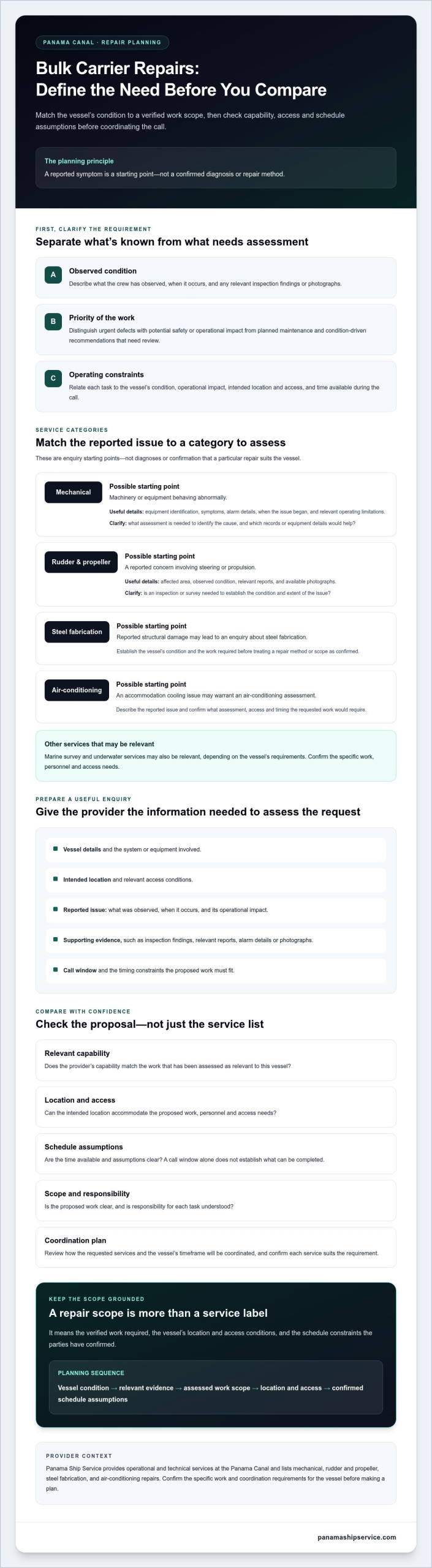
Look beyond a broad service list. Establish which repairs may suit the vessel, what information a provider needs to prepare a clear proposal, and whether the work can be coordinated at your intended location and within your timeframe. This guide explains how to assess those factors, prepare a useful enquiry, and evaluate a repair partner while limiting unnecessary handoffs and schedule uncertainty.
Panama Ship Service provides operational and technical services at the Panama Canal. Its repair categories include mechanical, rudder and propeller, steel fabrication, and air-conditioning repairs. Its marine survey and underwater services may also be relevant, depending on the vessel’s requirements. Confirm the specific work, personnel, access needs, and timing for your vessel before making a plan.
Key Takeaways
- Start with the vessel’s condition and operational priorities to identify which repair categories need assessment.
- Share relevant evidence, such as inspection findings and photographs, to help providers assess the reported issue and prepare a useful proposal.
- When comparing bulk carrier repair services panama, verify relevant capability, location access, schedule assumptions, and responsibility for each task.
- Structure your enquiry around the vessel’s details, intended location, reported issue, supporting evidence, and call window.
- Review the proposed scope and coordination plan, and confirm that each requested service suits the vessel and timeframe.
Bulk Carrier Repair Services in Panama: Define the Need Before You Compare
Choosing repair work for a bulk carrier means balancing the vessel’s condition with cargo operations and a tightly managed call window. A symptom may indicate a repair need, but it does not establish the cause or the right method. Before comparing bulk carrier repair services panama providers, separate what is known from what still needs assessment, and identify the operational constraints any proposed work must fit.
A bulk carrier is designed to carry unpackaged bulk cargo, and its repair requirements can involve machinery, structure, or operational equipment. Repair services may include assessing a reported issue and carrying out appropriate work once the scope is established. Keep three types of work distinct: urgent defects with potential safety or operational impact, planned maintenance, and condition-driven recommendations that require inspection or technical review. Do not treat a reported symptom as a confirmed diagnosis.
Which repair needs may arise on a bulk carrier?
Potential needs may fall within mechanical, rudder and propeller, steel fabrication, or air-conditioning repairs. For example, an unusual machinery symptom may prompt a mechanical assessment. A concern involving steering or propulsion may need review under rudder and propeller work. Structural damage could lead to an enquiry about steel fabrication, while an accommodation cooling issue may warrant an air-conditioning assessment. These are possible starting points, not diagnoses or confirmation that a particular method will suit the vessel.
Panama Ship Service lists these repair categories and provides services at the Panama Canal. Whether a category applies depends on the vessel’s condition and the work requested. Machinery symptoms, in particular, require technical assessment before a repair method or work scope can be proposed.
How should operators prioritize repair work?
Separate safety-critical or operational concerns from planned maintenance, then describe the impact of each issue. Share what the crew has observed, when it occurs, and any relevant inspection findings or photographs. Identify which tasks need assessment first and which can be considered if the condition and schedule allow. This gives a provider a clearer basis for follow-up questions without assuming a diagnosis.
Next, relate each requested task to four practical factors: vessel condition, operational impact, location and access, and time available during the call. Confirm whether the intended location can accommodate the proposed work, and clarify schedule assumptions before treating a completion window as feasible. The available call window alone does not establish what can be completed. Access and a verified scope matter too.
Repair scope means the verified work required, the vessel’s location and access conditions, and the schedule constraints the parties have confirmed. Use this definition to keep the initial enquiry focused. A clear scope helps you compare proposals based on relevant work and assumptions, rather than broad service descriptions that may not match the vessel’s needs.
Match Bulk Carrier Repair Scope to the Vessel’s Condition and Equipment
A useful repair enquiry links an observed defect to the relevant system without assuming the cause or repair method. Panama Ship Service lists mechanical, rudder and propeller, steel fabrication, and air-conditioning repairs. Use the table below to organize an enquiry about bulk carrier repair services panama. These categories are starting points, not a diagnosis or confirmation that a particular repair is suitable.
| Reported issue | Relevant repair category | Useful evidence | Questions for the provider |
|---|---|---|---|
| Machinery or equipment behaving abnormally | Mechanical | Equipment identification, symptoms, alarm details, when the issue began, and relevant operating limitations | What assessment is needed to identify the cause? Which records or equipment details would help? |
| Reported concern involving the rudder or propeller | Rudder and propeller | Description of the affected area, observed condition, relevant reports, and available photographs | Is an inspection or survey needed to establish the condition and extent of the issue? |
| Reported structural damage or steel condition concern | Steel fabrication | Location and description of the affected area, photographs, and relevant inspection findings | What further assessment is required before defining the work? |
| Cooling or air-conditioning concern | Air-conditioning | Equipment details, symptoms, when the issue occurs, and relevant service or defect history | What information is needed to assess the equipment and propose a scope? |
Prepare evidence without treating it as a diagnosis
Send records that relate directly to the reported defect. Depending on the issue, these may include clear photographs, a relevant survey or inspection report, equipment identification, alarm details, and a concise defect history. For machinery, include the operating status and known limitations, but do not present them as a substitute for technical assessment. For structural or underwater concerns, describe what was observed and where. Avoid prescribing repair work before the condition is verified.
A survey finding or onboard assessment may be needed to confirm the extent of damage and define the work. If class-related requirements may apply, identify them in the enquiry and verify the applicable requirements with the relevant parties. For vessel transit or operational matters, consult the Panama Canal Authority’s official information. Do not assume it determines the repair scope.
Clarify inspection needs and responsibilities
Ask whether an inspection is needed before the provider can confirm the scope, and who will carry out each assessment or repair task. A rudder, propeller, or hull-related report may require further verification before any underwater work is specified. Keep mechanical ship repairs distinct from underwater hull services, and confirm which category addresses the actual finding. You can also review Panama Ship Service’s repair information, then verify the relevant capability, location access, and timing for your vessel.
How to Compare Panama Bulk Carrier Repair Providers with Confidence
A provider’s Panama location does not prove that the required repair is available, that the vessel can be accessed at its intended position, or that the work fits the call window. Compare proposals against the vessel’s condition and operating constraints. When assessing bulk carrier repair services panama, consider technical scope, location and access, communication, schedule assumptions, and reporting, not just a general list of services.
Test technical and operational fit
Ask each provider which requested repair categories it can assess and perform for your vessel, at the intended location, and within the proposed timeframe. Confirm whether the work depends on an inspection, onboard access, particular records, or coordination with the crew. If another party will handle any task, identify that party and clarify who coordinates the work, communicates changes, and reports completion.
Before approving a proposal, ask the provider to state what is confirmed and what remains subject to assessment. This may include inspection assumptions, outstanding technical questions, access requirements, and approvals needed before work proceeds. Where the proposal concerns regulated equipment, verify which requirements apply rather than assuming a general repair standard covers every task. For example, the IMO’s international repair standards in Resolution MSC.402(96) address specified life-saving appliances and related arrangements. Check the resolution’s scope before applying it to a proposed repair.
Compare proposal scope, not just the headline figure
Two quotations may describe the same reported defect but include different work. Check each proposal’s boundaries and exclusions: what will be assessed, what repair work is included, what prerequisites must be met, and which findings could change the scope. A clear proposal should also explain how the provider will seek approval if an inspection identifies additional work.
Review schedule assumptions carefully. Ask what timing depends on, including vessel access, inspection findings, materials, or coordination with other onboard activity. Do not treat a stated window as a confirmed completion schedule unless the provider has identified its assumptions and verified that the work is feasible. Request progress updates and close-out reporting appropriate to the agreed scope.
A valid quotation requires vessel-specific details, such as the reported condition, relevant records, location, access arrangements, and intended call window. Without these, headline figures may not represent comparable work. Compare like with like, and resolve differences in scope, responsibility, and assumptions before selecting a provider.
Plan a Bulk Carrier Repair Enquiry Around the Panama Call Window
A repair request is easier to assess when it connects the reported defect to the vessel’s location and operating schedule. For bulk carrier repair services panama, give the provider enough information to review the requested scope and identify what still needs verification. Use this sequence to structure your enquiry:
- Identify the vessel and location. Provide the vessel name and type, dimensions if relevant, and current position or intended Panama location. Include the operational contact responsible for coordinating access.
- Describe the issue. State the affected equipment or area, observed symptoms or condition, current operating status, and support requested. Separate known facts from suspected causes.
- Share relevant evidence. Attach appropriate photographs, reports, drawings, equipment details, or defect history if available. Choose records that explain the issue rather than sending unrelated documentation.
- Confirm the planning window. Provide estimated arrival and departure times, the time available for assessment or work, and any known schedule changes. Treat these details as planning information, not guarantees of vessel timing or repair completion.
- Review the proposed scope. Ask what has been confirmed, what requires inspection, what access or coordination is needed, and which assumptions affect the proposed schedule.
Make the first request actionable
Keep the initial message concise but specific. Identify the person authorized to make decisions and the preferred method for technical updates. If the schedule changes, promptly share the revised planning information so the provider can reassess access and coordination needs. The repair method and feasibility still need to be confirmed against the vessel’s condition and intended location.
Set a clear approval process
Before work proceeds, agree how new findings, additional work, and approval requests will be communicated. Name who can authorize changes, and identify the vessel and shore-side contacts who need updates. Ask for the confirmed scope, outstanding assumptions, and agreed schedule information to be recorded in writing. If an inspection changes the understanding of the defect, review the revised scope and obtain the required approval rather than relying on an informal update.
This approach can reduce avoidable back-and-forth while keeping technical decisions separate from schedule expectations. Panama Ship Service provides services at the Panama Canal and offers several repair categories, but the relevant work, personnel, access, and timing should be verified for each vessel enquiry.
Review your bulk carrier repair requirements with Panama Ship Service, with the vessel’s details, reported issue, evidence, and call window ready.
Select a Panama Repair Partner That Can Coordinate the Whole Requirement
The right partner is not simply the provider closest to the vessel. Selection depends on whether the requested work matches the vessel’s verified condition, can be accessed at its intended location, and can be considered against its operational schedule. Use this checklist before nominating a provider for bulk carrier repair services in Panama:
- Relevant repair scope: Confirm the provider can assess the repair category your vessel needs, and clarify any work that would involve another party.
- Location and access: Verify the proposed work can be considered at the vessel’s intended position, including access or operational requirements.
- Clear communication: Agree on technical and operational contacts, how updates will be shared, and who can authorize decisions.
- Documented assumptions: Record what has been inspected, what remains unconfirmed, and the conditions that affect scope or schedule.
- Reporting and approvals: Confirm how findings and completed work will be reported, while keeping owner, class, and flag approvals with the appropriate parties.
Panama Ship Service provides services at the Panama Canal. Its repair categories include mechanical, rudder and propeller, steel fabrication, and air-conditioning repairs. The company also offers marine surveys and underwater services. This range may provide a local coordination point when a vessel has related requirements, but it does not establish that every service is suitable, available, or achievable within a particular call. Confirm the relevant category, personnel, access, and timeframe for the specific vessel.
When related vessel services may be relevant
A marine survey may help clarify damage or vessel condition when the available information does not establish the extent of an issue. Underwater services may be relevant when the reported condition or inspection findings support that need. Treat both as scope decisions, not automatic additions to a repair request. If you need more background before deciding whether a survey is relevant, consult a marine surveys guide and check what assessment your vessel’s case requires.
Confirm responsibilities before nomination
Before proceeding, align the proposed work with the vessel’s operational contacts and any required owner, class, or flag review. The service provider can discuss its proposed scope and report findings, but it should not be treated as a substitute for required approvals. Document who coordinates each task, who reviews new findings, and how changes to the agreed plan will be handled. These points help keep the repair plan clear as vessel and inspection information develops.
For a vessel-specific discussion, see Panama Ship Service’s contact information. Share the reported condition, intended location, and operational window so the relevant requirements can be reviewed.
Make Your Next Repair Enquiry Clear and Vessel-Specific
A sound repair decision starts with the vessel’s verified condition, then weighs the proposed work against location, access, and the call window. Share relevant evidence and ask for a proposal that makes its scope, responsibilities, and assumptions clear. These steps help you assess bulk carrier repair services panama providers without treating a general service list or a Panama location as proof that the work fits your schedule.
Panama Ship Service provides operational and technical services at the Panama Canal. Which category suits your vessel, and whether it can be supported at your intended location and within your timeframe, should be confirmed for the specific requirement.
Prepare your vessel details, reported issue, supporting records, and schedule information before making contact. Contact Panama Ship Service to discuss your bulk carrier repair requirements and clarify the next steps for evaluating the scope. A focused enquiry and documented assumptions can help you plan the repair with greater confidence.
Frequently Asked Questions
What repair services may a bulk carrier need in Panama?
A bulk carrier may need mechanical, rudder and propeller, steel fabrication, or air-conditioning repairs, depending on its condition and reported defects. These categories describe possible areas of work, not a diagnosis or guarantee that a specific repair is suitable. A provider may need technical records, survey findings, or an assessment before confirming the required scope. Describe the symptoms and affected equipment to help direct the initial enquiry.
How do I choose a bulk carrier repair company in Panama?
Choose a company by checking its relevant repair capability, access to the vessel’s intended location, communication process, and schedule assumptions. Ask which tasks it can assess and perform for your vessel, and clarify who is responsible for any work handled by another party. Review the proposal for inclusions, exclusions, inspection assumptions, and reporting. A Panama location alone does not confirm availability or prove that work fits your vessel’s call window.
Can bulk carrier repairs be completed during a Panama Canal transit?
Do not assume repairs can be carried out during transit. Feasibility depends on the requested work, vessel location, access, operational requirements, and available time, all of which should be confirmed for the specific call. A transit schedule may change, and a repair estimate is not a guaranteed completion time. Ask the provider to verify whether the proposed work can be coordinated at the intended location and how schedule changes could affect the plan.
What information should I send when requesting a ship repair quote in Panama?
Send the vessel name and type, current position or intended location, and dimensions if relevant. Describe the defect, affected equipment or area, symptoms, operating status, and support requested. Include relevant photographs, equipment details, defect history, or inspection reports where available. Provide estimated arrival and departure times as planning information, plus an operational contact and the person authorized to review technical updates and approve work.
How much do bulk carrier repair services in Panama cost?
There is not enough information to give a valid price without knowing the vessel’s condition and the work required. A provider needs vessel-specific details, location, access requirements, and any assessment findings to define a proposal. Ask for a written scope that states inclusions, exclusions, assumptions, and how additional findings or work would be handled. Compare proposals only after confirming that they cover equivalent tasks and requirements.
Do bulk carrier repairs in Panama require a survey or inspection first?
Some repair requests may need a survey or inspection before the provider can confirm the work scope, but this depends on the reported condition and available evidence. An assessment may help establish the extent of structural, machinery, or underwater concerns. Ask what inspection is needed and who will review the findings. If class, flag, or owner requirements may apply, verify them with the appropriate parties before approving work.
Can I coordinate repairs and other vessel services through one Panama provider?
Potentially. Panama Ship Service provides operational and technical services at the Panama Canal and offers repair categories alongside marine surveys and underwater services. It also lists services such as ship supplies, cargo handling, crew change, canal transit agency, and MARPOL disposal. Confirm that each requested service is suitable for your vessel, location, and timeframe, and clarify responsibility for coordinating separate tasks.