
A winch fault identified before a Panama Canal transit raises an immediate question: can it be repaired in time, and what work is necessary? The right marine winch and crane repair decision starts with the fault, not a generic equipment label. A clear diagnosis can help distinguish a targeted repair from an overhaul or replacement, while reducing uncertainty about parts and testing.
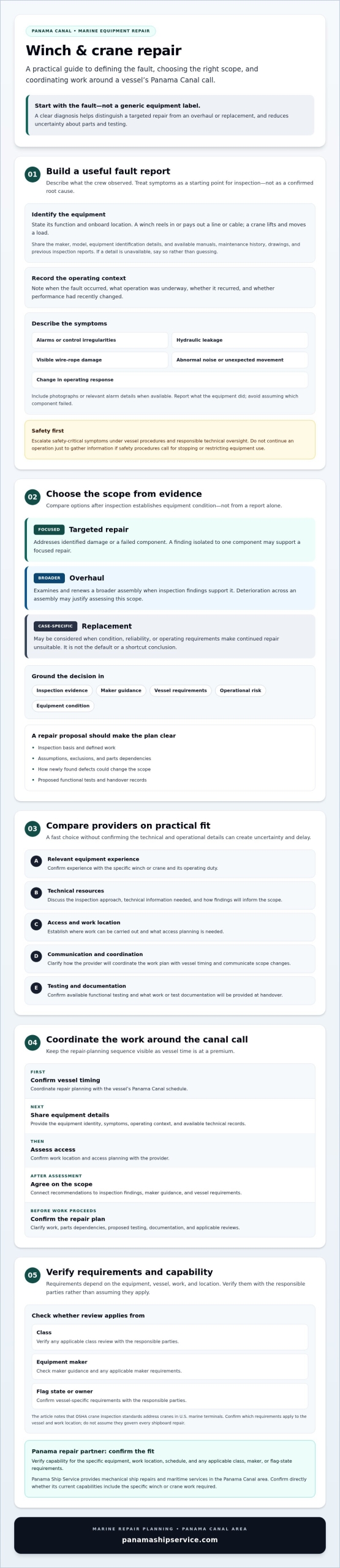
With vessel time at a premium, it’s understandable to focus on finding a provider quickly. But choosing one without confirming its experience with the equipment, technical resources, work location, and testing plan can create uncertainty and delay. This guide explains how to describe the fault, define the scope, and compare providers using practical technical and operational criteria.
You’ll also learn how to coordinate repair planning with the vessel’s Panama Canal schedule and verify any class, maker, or flag-state requirements with the responsible parties. Panama Ship Service provides mechanical ship repairs and maritime services in the Panama Canal area. Contact the company directly to confirm whether its current capabilities include the specific winch or crane work your vessel needs.
Key Takeaways
- Describe the equipment, operating duty, symptoms, and conditions clearly to give the inspection a useful starting point.
- Compare repair, overhaul, and replacement only after reviewing the equipment condition, maker guidance, and vessel requirements.
- Assess providers for relevant equipment experience, technical resources, access planning, communication, and available work or test documentation.
- Coordinate the work in sequence: confirm vessel timing, share equipment details, assess access, agree on scope, and confirm the repair plan.
- Before selecting a Panama repair partner, verify its capability for the specific equipment, work location, schedule, and any applicable class, maker, or flag-state requirements.
Marine winch and crane repair: define the problem before choosing a provider
Marine winches and cranes are deck machinery used to lift, handle, or secure loads and support mooring tasks. The required repair depends on the equipment’s function, duty, operating environment, and observed symptoms. A winch reels in or pays out a line or cable; a crane lifts and moves a load. The Winch reference offers a basic description, but the vessel’s equipment records and inspection findings should guide the repair assessment.
For marine winch and crane repair, separate what the crew observed from what an inspection confirms. A control alarm or unusual movement is a symptom, not a root-cause diagnosis. Avoid committing to an overhaul or replacement based on a report alone. Review equipment condition, maker guidance, and vessel requirements before setting the work scope.
Which winch or crane system needs attention?
Identify the equipment by function and location onboard. A cargo crane, deck crane, mooring winch, and other deck machinery can have different operating duties and repair considerations. Share the maker, model, equipment identification details, and available technical records, such as manuals, maintenance history, drawings, and previous inspection reports. If a detail isn’t available, say so rather than guessing.
Record the circumstances around the fault: when it occurred, what operation was underway, whether it recurred, and whether performance had changed recently. This context helps a technician assess the machinery and determine what further inspection may be needed.
What symptoms can indicate a repair need?
Use symptoms to prepare for inspection, not to prescribe the fix. The vessel team can document alarms or control irregularities, hydraulic leakage, visible wire-rope damage, abnormal noise, unexpected movement, or a change in operating response. Include photographs or relevant alarm details when available. Describe what the equipment did rather than assuming which component failed.
Escalate any safety-critical symptom under the vessel’s procedures and responsible technical oversight. Don’t continue an operation simply to gather more information if the vessel’s safety process calls for stopping or restricting equipment use. A clear, factual fault report gives the provider a stronger starting point and helps establish what can be assessed, which records or parts may be needed, and what inspection should precede a firm scope.
Repair, overhaul, or replacement: compare the right marine equipment scope
Once an inspection establishes the equipment’s condition, compare the proposed scope against operational needs and risk. A targeted repair addresses identified damage or a failed component. An overhaul examines and renews a broader assembly when supported by findings. Replacement may be considered when condition, reliability, or operating requirements make continued repair unsuitable. None is the default. Decisions should follow inspection evidence, maker guidance, and vessel requirements.
When might targeted repair or overhaul be considered?
Ask the provider to connect each recommendation to observed damage, wear, measurements, or test results. A finding isolated to one component may support a focused repair, while evidence of deterioration across an assembly may justify assessing a broader overhaul. When restoring worn pin connections, sheaves, or pivot housings, specialized portable equipment can often rehabilitate damaged bores on-site; learn more about Bore Repair Systems, Inc. – Bore Repair Made Easy with our USA made Lineboring and Boreweld solutions. Replacement is a case-specific option, not a shortcut conclusion. Consider equipment condition, operational risk, documentation, and vessel requirements before selecting a scope.
What should a repair proposal make clear?
Request the inspection basis and defined work in writing. The proposal should identify assumptions, exclusions, parts dependencies, and what could change the scope if further defects are found. It should also state the proposed functional tests and the records provided at handover. Check whether maker, class, flag, or owner review applies to the specific equipment and work. The OSHA crane inspection standards address cranes in U.S. marine terminals. Confirm which requirements apply to your vessel and work location rather than assuming they govern every shipboard repair.
Use this comparison to clarify what each option means before approving work:
Scope
Evidence and approvals
Operational implications
Targeted repair: Correct identified damage or a component fault.
Inspection findings; confirm any required technical approvals.
Check access, parts, testing, and expected equipment availability with the provider.
Overhaul: Assess or renew a broader assembly.
Documented condition and test results; verify applicable maker or vessel review.
Clarify work boundaries, parts dependencies, and handover criteria.
Replacement: Install alternative equipment or an assembly.
Technical suitability and required approvals.
Assess integration, procurement dependencies, and vessel operating needs.
Before authorizing work, agree on how acceptance will be judged and recorded. If you’re coordinating other mechanical ship repair needs in Panama, contact Panama Ship Service about mechanical ship repairs and confirm directly whether its current scope includes your particular winch or crane.
How to compare marine winch and crane repair providers
A provider’s service list is only a starting point. For marine winch and crane repair, assess whether its experience and plan match the actual equipment, fault, work location, and vessel schedule. Ask for project-specific answers, not broad assurances. A provider may have relevant workshop experience, for example, but still need to confirm its personnel, tools, and access arrangements for work onboard your vessel.
Which capability questions should operators ask?
Ask whether the provider has worked on the same type of winch or crane and comparable fault conditions. Clarify what its own team will perform and whether any tasks depend on another specialist. Then confirm the inspection approach, technical resources, personnel, and access plan proposed for this job. If cargo winches are involved, the OSHA cargo winch regulations provide U.S. maritime cargo-handling context. Check with the vessel’s responsible parties which requirements apply to the equipment and work location.
Compare proposals against the same practical criteria:
- Equipment fit: Experience with the equipment type and similar reported faults.
- Work plan: Inspection method, work performed directly, and any outside specialist dependencies.
- Access and safety: Proposed onboard access arrangements and how work will be coordinated with vessel operations.
- Communication: Who provides updates, reports findings, and raises changes to scope or schedule.
A clear proposal explains what’s included, what remains uncertain, and what could affect the plan. Don’t rely on a headline claim such as “full service” without confirming the specific work, dependencies, and schedule fit.
How can documentation support a confident decision?
Share relevant maintenance history, equipment drawings, manuals, and earlier inspection records. Ask providers to identify what they reviewed and what information is still missing. Where available, compare inspection findings, work records, test documentation, and references for similar jobs. These records help you evaluate the basis for a recommendation rather than comparing unsupported claims.
Before authorizing work, confirm how findings, replaced components, functional test results, and any remaining limitations will be documented at handover. Agree on acceptance criteria and confirm which approvals or reviews are needed for the specific job. For wider planning context, see this mechanical ship repair guide.
Before arranging work, ask Panama Ship Service to confirm project fit and availability for the specific equipment, location, and schedule. Its mechanical ship repair capability is relevant context, but confirm directly whether its current scope includes the winch or crane work required.
Plan marine winch or crane repairs around a Panama Canal call
A sound repair plan has to fit the vessel’s movements and access constraints. Start by confirming the expected Panama Canal call and any schedule changes with the vessel’s designated agent and technical decision-makers. Then share the equipment information, establish where inspection or repair could take place, agree on the work scope, and coordinate responsibilities. Don’t assume the work can be performed during transit. Confirm the location, access arrangements, and provider availability directly.
What information should be ready before requesting a repair assessment?
Send the details a provider needs to assess the job and its fit with the vessel’s schedule. Include:
- Vessel particulars and current or expected location.
- Equipment function, onboard location, maker, model, and identification details.
- A concise fault description, relevant alarms, and operating conditions when the issue occurred.
- Available maintenance history, manuals, drawings, photographs, and inspection records.
- Expected schedule, access limits, and the vessel contact responsible for communications.
Share records when appropriate and available. If information is missing, identify it early so the assessment can account for that uncertainty. Give the provider a reliable contact for updates and technical questions. Unclear or delayed communication can complicate coordination as vessel timing changes.
How should the repair plan protect vessel operations?
Before work is arranged, align the provider’s plan with vessel procedures and operational constraints. Define work boundaries, access arrangements, safety responsibilities, and coordination points with the vessel team. Confirm who can approve technical decisions and how proposed changes will be handled if inspection reveals additional work.
Agree on how schedule changes, new findings, parts dependencies, and scope variations will be communicated. A change in the vessel’s call timing may affect whether the proposed location or access plan remains workable. Reconfirm those details as needed rather than relying on assumptions. For broader planning considerations, see the mechanical repair and vessel downtime guide.
Once the specific marine winch and crane repair requirements are clear, discuss repair coordination in Panama with Panama Ship Service. The company provides mechanical ship repairs and maritime services in the Panama Canal area. Confirm directly whether its current scope, work location, and availability match the equipment and vessel schedule.
Select a Panama repair partner and confirm the winch or crane scope
A provider is ready for consideration when its capability, inspection basis, proposed scope, documentation, and schedule fit are clear. Treat each as a separate check. A general mechanical repair offering doesn’t by itself confirm that a provider can handle your specific winch or crane at the required location with the resources and access your vessel needs.
What makes a repair plan ready to approve?
Before authorizing work, confirm the proposal responds to inspection findings and identifies unresolved technical questions. Make sure the written scope states what is included, what is excluded, and how additional findings will be raised for approval. The vessel’s responsible parties should also confirm any applicable maker, class, flag, or owner requirements.
Agree on roles and acceptance arrangements in advance. Clarify who approves scope changes, how functional testing will be documented, and which records will be provided at handover. The vessel team should understand any remaining limitations after the work and how they affect equipment use. If work location, access, parts, or schedule remains unconfirmed, resolve that uncertainty before treating the plan as ready.
- Capability: Confirm experience and technical resources for the specific equipment and fault.
- Inspection basis: Check which findings support the recommendation.
- Scope and approvals: Define work boundaries, responsibilities, and required reviews.
- Records and testing: Agree on test criteria and handover documentation.
- Operational fit: Verify location, vessel access, availability, and schedule coordination.
How can Panama Ship Service support the next step?
Panama Ship Service provides mechanical ship repairs and related maritime services in the Panama Canal area. Its documented repair capabilities include rudder and propeller repairs, steel fabrication, and A/C repairs. This local service context may help operators coordinate vessel needs, but it doesn’t confirm that marine winch and crane repair is within the company’s current scope.
Before proceeding, ask directly whether the requested equipment type and work are supported, where the job could take place, what technical resources are available, and whether timing fits the vessel’s call. Share the equipment identification, fault summary, inspection information, and schedule so the request can be assessed clearly.
Contact Panama Ship Service to discuss vessel repair requirements and confirm whether the specific winch or crane work fits its current capabilities and availability.
Make the Next Repair Decision With Confidence
A sound marine winch and crane repair plan begins with a clear fault description and an inspection-based scope. Compare providers on relevant equipment capability, technical resources, documentation, and schedule fit. Before approving work, confirm the testing, approvals, responsibilities, and handover records your vessel requires.
Panama Ship Service provides mechanical ship repairs and maritime services at the Panama Canal, with capabilities including rudder and propeller repairs, steel fabrication, and A/C repairs. Its local service approach is intended to help consolidate vessel needs. Confirm directly whether the company’s current capabilities, work location, resources, and availability fit your specific winch or crane requirements.
Share the equipment details, available inspection records, and vessel schedule to start a focused discussion. Contact Panama Ship Service to discuss vessel repair requirements and clarify whether the requested work is a fit. With the scope and coordination confirmed, you can move forward with a more informed plan for your vessel.
Frequently Asked Questions
What is included in marine winch and crane repair?
Marine winch and crane repair can include inspection, fault assessment, targeted repair, component overhaul, or replacement, depending on equipment condition and the vessel’s needs. The work scope should identify what will be examined and repaired, any parts or specialist dependencies, and how functional testing and handover records will be handled. Confirm the proposed work with the provider after inspection rather than assuming every reported fault requires an overhaul.
How do I know whether a marine winch needs repair or overhaul?
An inspection is needed to determine whether a targeted repair or broader overhaul is appropriate. Share the symptoms, maintenance history, manuals, and previous inspection records, then ask the provider to link its recommendation to findings such as observed wear, damage, or test results. Review maker guidance and vessel requirements too. A reported alarm, leak, or operating change can prompt assessment, but it doesn’t confirm the root cause by itself.
Can a ship crane be repaired during a Panama Canal call?
Possibly, but don’t assume a repair can take place during transit. Feasibility depends on the vessel’s location and schedule, access to the equipment, repair scope, required resources, and provider availability. Coordinate with the vessel’s designated agent and technical decision-makers. Confirm directly where work could be performed and whether the plan fits the call. Recheck timing and access if the vessel schedule changes.
What information should I provide when requesting a marine winch repair quote?
Provide the vessel’s particulars and location, the winch’s function and onboard location, maker and model, and a factual description of the fault. Include relevant alarms, operating conditions, maintenance history, manuals, drawings, photos, and inspection records when available. Share the expected vessel schedule, access limits, and a reliable contact for technical questions. Flag missing information so the provider can state any assumptions or dependencies in its proposal.
What should I check before selecting a marine crane repair provider?
Confirm the provider’s experience with the same equipment type and comparable faults, what work it performs directly, and whether other specialists are needed. Ask about the inspection approach, personnel, technical resources, onboard access plan, safety coordination, and schedule fit. Compare written scopes, exclusions, parts dependencies, testing plans, and handover documentation. Relevant records or references can help support the assessment, where available. Verify that claims relate to your specific job.
Does every winch or crane repair require class approval?
Not necessarily. Approval or review requirements depend on the equipment, proposed work, and vessel-specific obligations. Before work begins, ask the responsible vessel parties whether class, maker, flag, or owner approval applies, and confirm who will obtain or document it. Don’t rely on a general answer for every vessel. The repair proposal should identify relevant approvals and responsibilities, while the vessel’s technical decision-makers verify applicable requirements.
Does Panama Ship Service repair marine winches and cranes?
Panama Ship Service provides mechanical ship repairs and related maritime services at the Panama Canal, but its current capability for a specific winch or crane repair isn’t confirmed here. Contact the company directly to verify the equipment types and work it can support, the applicable location, technical resources, and availability for your vessel’s schedule. Share equipment details and inspection information so the request can be assessed clearly before arranging work.
Contact Panama Ship Service to discuss your vessel’s repair requirements and confirm whether the specific winch or crane work fits its current capabilities and availability.