
Can an underwater CCTV inspection give you enough evidence to make the decision your vessel needs? Clear footage can document visible hull conditions, but its usefulness depends on the inspection objective, the areas covered, and whether the images meet the intended review requirements.
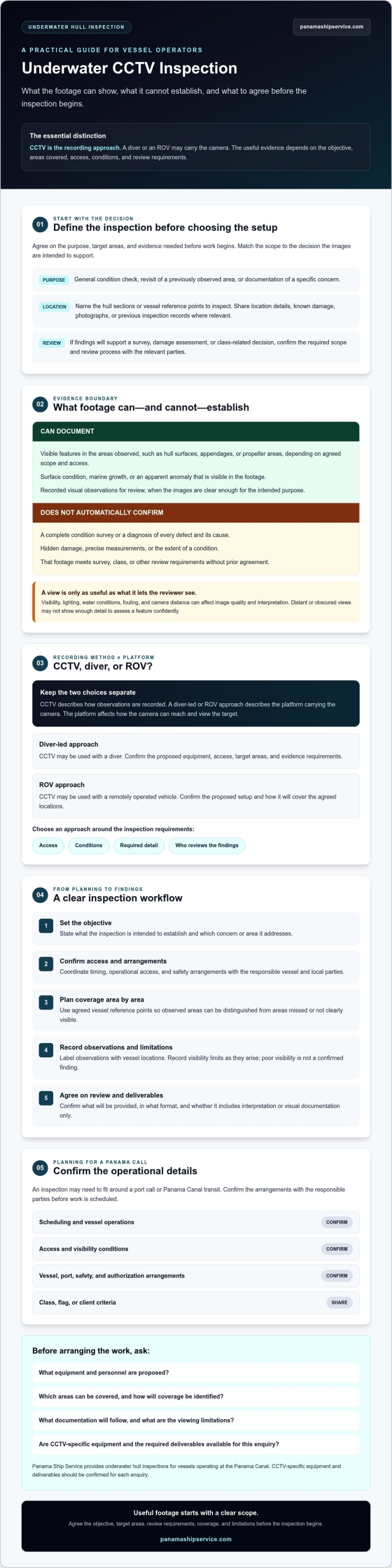
That matters when an inspection has to fit around a port call or Panama Canal transit. You need an approach suited to the task, findings clear enough to review, and a plan that accounts for vessel operations. This guide explains what CCTV footage can and cannot establish, how camera recording can be combined with diver-led or ROV approaches, and what to confirm about coverage and reporting before work is arranged.
Panama Ship Service provides underwater hull inspections for vessels operating at the Panama Canal. CCTV-specific equipment and deliverables should be confirmed for each enquiry. The practical steps below can help you prepare, including sharing any class, flag, or client criteria the inspection must satisfy.
Key Takeaways
- Set the inspection objective first, then agree on target areas and required evidence before work begins.
- Separate the recording method from the inspection platform: CCTV may be used with diver-led or ROV approaches.
- Choose an underwater CCTV inspection approach based on access, conditions, required detail, and who needs to review the findings.
- For a Panama call, confirm scheduling, access, visibility, and relevant vessel, port, safety, and authorization arrangements with responsible parties.
- Ask what equipment and personnel are proposed, which areas can be covered, and what documentation will follow.
What Is Underwater CCTV Inspection, and What Can It Show on a Ship?
An underwater CCTV inspection records a visual check of selected parts of a vessel below the waterline for review. Depending on the agreed scope and access, footage may show hull surfaces, appendages, or propeller areas. It documents what was visible during the inspection, but it is not automatically a complete condition survey or a diagnosis of every defect and its cause.
CCTV describes the recording approach, not necessarily the equipment or platform carrying the camera. Images may be captured by a diver or a Remotely Operated Vehicle (ROV). The platform affects how the camera can reach and view the target, so agree on the method as well as the areas to inspect.
What underwater CCTV footage can and cannot establish
Footage can show visible features such as surface condition, marine growth, or an apparent anomaly in the areas observed. Image quality and interpretation depend on visibility, lighting, water conditions, fouling, and camera distance. A distant or obscured view may not show enough detail to assess a feature confidently.
Visual evidence is different from confirmation of hidden damage, precise measurements, or an engineering conclusion. An image alone may not establish what caused a condition or how far it extends. Before work begins, agree on the target areas and evidence needed. Ask that the scope, viewing limitations, and any areas that could not be adequately observed are recorded.
When ship operators consider a CCTV inspection
Operators may use recorded imagery for a general condition check, to revisit a previously observed area, or to document a specific concern. The inspection is most useful when its scope matches the decision at hand. If findings will support a survey, damage assessment, or class-related decision, confirm the required scope and review process with the relevant parties before arranging the work. Requirements can vary, so do not assume footage will meet them automatically.
For a broader overview of underwater hull inspections and related work in Panama, see the underwater hull services guide. Panama Ship Service lists underwater hull inspections among its services. Confirm whether CCTV equipment and the deliverables you need are available for your enquiry.
How Does an Underwater CCTV Inspection Work from Planning to Findings?
Start with the decision the images need to support, not with a camera selection. The vessel operator and provider should agree on the target areas, access, and evidence requirements before work begins. This keeps the inspection focused and makes any limitations easier to identify and discuss.
An underwater CCTV inspection typically moves from defining the purpose and confirming access to planning coverage, recording observations, and reviewing the findings. The specific deliverables depend on the agreed scope.
Define scope, vessel access, and inspection objectives
State what the inspection is intended to establish, such as a visual check of selected hull areas or a closer look at a known concern. Share relevant vessel particulars, target locations, known damage, and available previous inspection records. For a specific area, provide a clear location reference and any photographs or notes that can help the provider identify it.
Then confirm timing, operational access, and safety arrangements with the responsible vessel and local parties. Requirements depend on the vessel and the purpose of the work. If findings may support a formal survey or another decision, confirm the required scope and review process with the relevant authority or surveyor. The U.S. Coast Guard underwater survey guidelines provide one reference for underwater surveys in their applicable context. Do not assume a particular guideline applies to every inspection.
Capture, review, and document underwater observations
Once scope and access are agreed, plan coverage area by area. Use consistent location references, such as hull sections or vessel reference points agreed in advance. This makes footage easier to review and helps distinguish an area that was observed from one that was missed or could not be viewed clearly. Record limitations as they arise rather than treating poor visibility as a confirmed finding.
Ask how observations will be labelled and dated, and how each image or note will be linked to a vessel location. Possible outputs include recorded imagery, still images, observation notes, or a scoped report, but these are not automatic. Confirm what the provider will deliver, in what format, and whether the service includes interpretation or visual documentation only.
- Define purpose: Identify the decision the inspection must support.
- Confirm access: Check target locations, timing, and arrangements.
- Plan coverage: Agree on an area-by-area recording approach.
- Record observations: Label visible findings and note viewing limits.
- Review findings: Check the evidence against the agreed scope and intended use.
For vessels at the Panama Canal, Panama Ship Service lists underwater hull inspections among its services. Operators can discuss the inspection objective and timing through its Panama underwater hull inspection support. Confirm separately whether CCTV equipment and the required deliverables are available for the enquiry.
CCTV, Diver, or ROV: Which Underwater Inspection Method Fits?
These options are not always alternatives. CCTV describes capturing and recording images; a diver or an ROV may be the platform used to position the camera. An underwater CCTV inspection could therefore be diver-operated or remotely operated, depending on the setup. Confirm the equipment and personnel proposed before comparing options.
The best fit depends on the objective, target locations, water and operating conditions, vessel requirements, and the provider’s advice. Use this comparison to guide the discussion, then confirm suitability for your vessel and intended use.
| Factor | Recorded camera approach | Diver-led inspection | ROV inspection |
|---|---|---|---|
| Visual access | Depends on the camera platform and where it can be positioned. | A diver may access selected areas directly, subject to the agreed plan and safe operating conditions. | A vehicle may reach target areas within its access and maneuvering limits. |
| Operating conditions | Image quality can be affected by visibility, lighting, and water conditions. | Conditions affect the diver’s access and ability to observe clearly. | Conditions affect camera visibility, control, and vehicle movement. |
| Target detail | Depends on camera position, image quality, and distance from the surface. | Close visual access may help with selected targets, but doesn’t remove visibility limits. | Detail depends on positioning, lighting, and the equipment used. |
| Evidence needs | Confirm whether video, stills, notes, or a report are included. | Ask whether observations are recorded and how locations are documented. | Confirm recording, location references, and reporting scope. |
| Required expertise | Ask who operates the system and interprets the observations. | Confirm the provider’s relevant personnel and experience. | Confirm the operator’s experience with the proposed vehicle and inspection objective. |
When diver-led visual inspection may be appropriate
Direct access may be useful when the scope calls for a close look at a particular area and conditions allow the work to proceed safely. Ask how observations will be recorded, labelled, and tied to vessel locations. A diver does not guarantee clear views or complete coverage, so agree how obscured or inaccessible areas will be documented.
When an ROV or recorded camera approach may fit
A remotely operated camera may suit a task when the target, access, and operating conditions support its use. Ask about camera control, lighting, maneuverability, and how the operator will verify the camera is viewing the intended location. Confirm that the equipment is suitable and available for the vessel and location, and establish who will review the resulting evidence.
Before selecting a method, match the proposed setup to the inspection scope and any vessel, client, or class review requirements. If those requirements are unclear, confirm them with the responsible parties and provider before arranging the work.
How to Prepare for Underwater CCTV Inspection During a Panama Call
During a Panama call, the inspection plan needs to fit the vessel’s operational schedule and the conditions at the agreed location. Access, visibility, vessel condition, and scope affect what can be attempted and what evidence may be obtained. Confirm arrangements early with the responsible local parties, including any applicable port, vessel, safety, or authorization requirements. Do not assume the same arrangements apply to every call.
Prepare the information below before requesting an underwater CCTV inspection. A clear brief helps the provider assess the task and identify details that still need to be confirmed.
Information to provide before requesting an inspection
- Vessel and call details: Share vessel identification, current location or call details, and known operational constraints.
- Requested coverage: Identify the hull areas or other locations of interest and explain why the inspection is needed.
- Background material: Provide relevant photographs, previous findings, or inspection records that may clarify the concern.
- Evidence needs: State whether you need recorded footage, still images, written findings, or another output. Confirm what the provider can supply and in what format.
Be specific about the decision the inspection is intended to support. A general condition check and a focused review of a known concern may require different coverage. If the work relates to a survey, damage assessment, or class matter, confirm the required scope and review arrangements with the responsible parties rather than assuming a particular recording will satisfy them.
Coordinate inspection scope around the vessel’s operation
Ask the provider to confirm the proposed method, access to target areas, expected schedule, and each party’s responsibilities. Coordinate those details with the vessel’s master, agent, and applicable port or canal stakeholders as required. Visibility and vessel condition may affect the plan, so agree how areas that cannot be adequately observed will be noted in the findings.
If the inspection may lead to follow-up work, clarify how observations will be communicated and who will assess next steps. Where repairs are being considered, the mechanical ship repair guide provides related context. For survey planning, refer to the marine surveys guide for Panama.
Panama Ship Service provides underwater hull inspections for vessels at the Panama Canal. Discuss your inspection objective and timing with Panama Ship Service, and confirm whether CCTV equipment, proposed arrangements, and requested deliverables are available for your enquiry.
Selecting Underwater CCTV Inspection Support in Panama
Choose support by matching the provider’s experience to your vessel, inspection objective, and the practical conditions of the Panama call. A general capability statement is not enough. Establish whether the proposed personnel and equipment can access the requested areas, capture useful evidence, and support the decision you need to make.
Panama Ship Service lists underwater hull inspections for vessels operating at the Panama Canal. Its service information does not specify CCTV equipment, recording formats, or availability. Confirm those details directly, and check whether the proposed inspection meets any applicable class, flag, survey, or client requirements before proceeding.
Questions to ask before confirming the service
Use the initial discussion to turn a broad request into a defined scope. Ask:
- Method and personnel: Is CCTV recording available, what platform will carry the camera, and who will conduct and review the inspection?
- Coverage and access: Which requested areas can be inspected, and what access or visibility limitations could affect the work?
- Evidence and reporting: Will the service provide video, still images, written observations, or a report? How will records be dated and linked to vessel locations?
- Timing and coordination: What schedule is proposed, who are the operational contacts, and which vessel or local arrangements need confirmation?
- Exceptions and findings: How will unclear, inaccessible, or concerning areas be documented, and how will observations requiring further review be raised?
Clear answers help establish whether the approach fits the inspection purpose, rather than simply whether a camera can be deployed. If the work is intended to support a formal survey or class-related decision, share the applicable requirements and ask the provider to confirm the scope’s suitability. Do not assume visual footage alone will meet a specific review standard.
Next steps for a Panama underwater inspection enquiry
Make the enquiry easy to assess. Include vessel identification, location or call details, requested inspection areas, operational timing, known concerns, and the evidence you need. Attach relevant previous findings or photographs when available. Ask the provider to confirm whether its underwater inspection offering matches the CCTV requirement, what equipment and personnel are proposed, and what documentation can be supplied.
Panama Ship Service can be a point of coordination for underwater inspection enquiries in Panama. Confirm CCTV-specific capability and availability for your vessel and requested scope. Contact Panama Ship Service to discuss an underwater inspection.
Plan Your Next Underwater Inspection with Confidence
Choose an inspection method based on the decision it needs to support, not the camera alone. An underwater CCTV inspection can document visible conditions, but useful evidence depends on agreed coverage, access, image quality, and clearly recorded limitations. Confirm the proposed equipment, personnel, reporting, and any class or survey requirements before arranging the work.
For a Panama Canal call, share the vessel’s location, requested inspection areas, operational timing, and evidence needs early so the proposed scope can be assessed. Panama Ship Service lists underwater hull inspections among its services and supports vessels operating at the Canal. Its marine and ship-support services may help coordinate vessel requirements, but confirm CCTV-specific capability and availability directly.
Contact Panama Ship Service to discuss your underwater inspection requirements. A clear brief is a practical first step toward selecting suitable support and obtaining findings you can use.
Frequently Asked Questions
What is an underwater CCTV inspection?
An underwater CCTV inspection records images of selected areas below a vessel’s waterline for visual review. It documents what the camera observes, but is not automatically a complete condition survey or diagnosis. The camera may be carried by a diver or an ROV, so confirm the proposed platform, inspection scope, and recording method. Agree beforehand on the evidence needed and how limitations will be recorded.
What can underwater CCTV footage show on a ship’s hull?
Footage may show visible hull-surface conditions, marine growth, or apparent areas of concern. It may also cover selected appendages or propeller areas if they are accessible and included in scope. Interpretation depends on visibility, lighting, water conditions, fouling, and camera distance. Images do not automatically reveal hidden damage, establish measurements, or explain the cause of a condition. Ask that obscured and unobserved areas be identified.
Is underwater CCTV inspection the same as an ROV inspection?
No. CCTV describes capturing or recording visual images, while an ROV is one possible platform for carrying a camera underwater. A diver may also carry a camera, and other arrangements may be used. Confirm the proposed equipment and personnel rather than assuming “CCTV” means an ROV. Suitability depends on target areas, access, operating conditions, inspection objective, and evidence requirements.
Can CCTV footage satisfy a class or survey requirement?
It may contribute evidence, but do not assume footage alone will satisfy a class or survey requirement. Acceptance depends on the applicable requirements, agreed inspection scope, method, personnel, documentation, and review process. Before arranging work, share the intended purpose with the relevant class, survey, or client representative and ask what evidence is required. Confirm with the provider whether the proposed inspection and deliverables match those requirements.
How should a ship operator prepare for underwater CCTV inspection in Panama?
Prepare vessel identification, location or call details, requested inspection areas, timing constraints, and the reason for the inspection. Include relevant photos and previous findings, and specify whether you need video, still images, written observations, or other documentation. Confirm access, the proposed method, safety arrangements, and applicable port or vessel requirements with responsible parties. Coordinate with the master, agent, and relevant local stakeholders as needed.
Does Panama Ship Service provide underwater CCTV inspection?
Panama Ship Service lists underwater hull inspections among its services for vessels operating at the Panama Canal, but its service information does not specify CCTV capability, equipment, deliverables, or availability. Contact the company with your vessel details and inspection objective to ask whether its offering matches the request. Confirm the proposed method, personnel, accessible areas, documentation, and suitability for any class, survey, or client requirements.
What should an underwater CCTV inspection report include?
The report should reflect the agreed scope and make observations traceable to vessel locations. Ask whether it will include the inspection date, areas examined, relevant footage or stills, written observations, viewing limitations, and areas not adequately inspected. Confirm whether the provider will interpret findings or supply visual records only. Reporting format and detail depend on the agreed service, so settle these points before the inspection begins.