
What if the document called a sludge and slop disposal certificate isn’t enough, by itself, to close out your vessel’s waste record? The important question is whether the disposal evidence documents the handover clearly and matches the vessel’s supporting records.
It’s reasonable to want clear proof before sludge or slops are landed. An incomplete paper trail can prompt questions during an inspection or audit. Document names and practices can vary, so check what the document actually records rather than relying on its title or assuming it replaces other applicable records.
This guide explains what to confirm with the service provider and receiving facility, how to review the documents you receive, and how to keep a coherent record of the waste transfer. Requirements can depend on the vessel and applicable authorities, so verify what applies to your operation.
For a Panama Canal transit or port call, early coordination can help keep waste handling aligned with your schedule. Panama Ship Service handles MARPOL-compliant disposal of vessel slops, sludge, and ship garbage in Panama. The sections ahead cover the questions to resolve before landing waste and the records to retain afterward.
Key Takeaways
- A sludge and slop disposal certificate should support a verifiable handover, but document names and formats can differ.
- Identify the waste stream before arranging reception, and keep sludge and slops distinct from other ship garbage in your records.
- Check the issuer, vessel details, date, waste description, quantity, and receipt confirmation. Clarify gaps or conflicting information.
- Before disposal in Panama, confirm service availability, accepted waste, collection timing, and the vessel details required.
- Panama Ship Service handles MARPOL-compliant disposal of vessel sludge, slops, and ship garbage. Confirm which disposal documents are provided.
What a sludge and slop disposal certificate is meant to prove
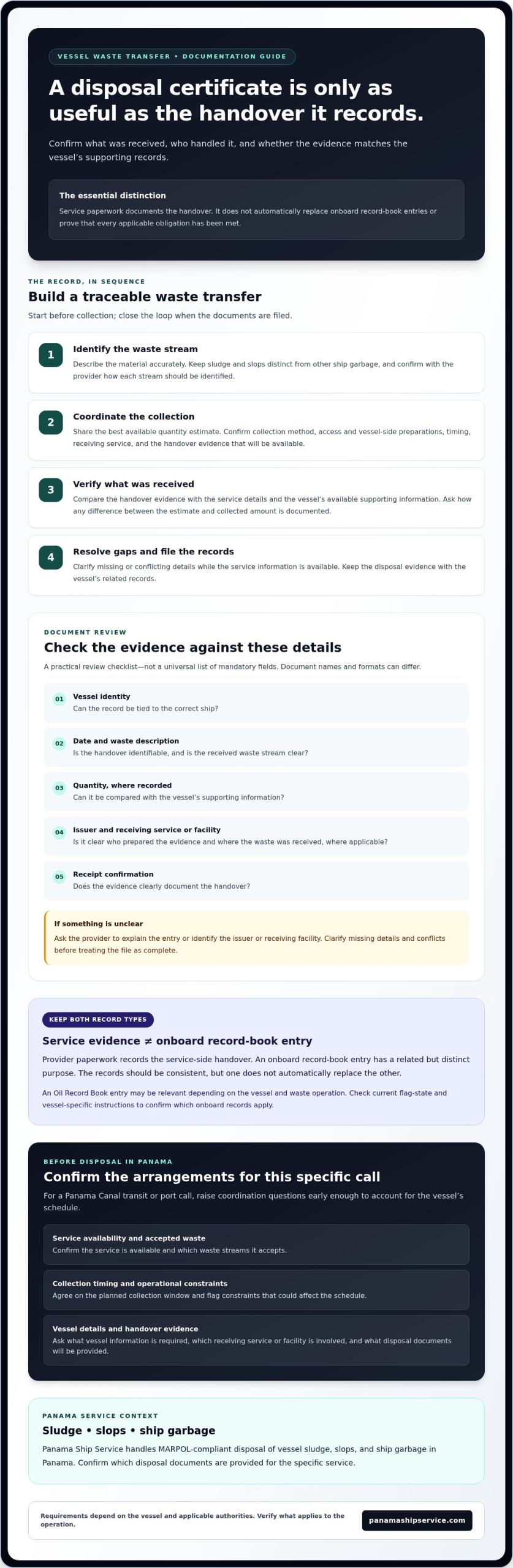
A sludge and slop disposal certificate, receipt, or other disposal evidence records a particular waste handover and identifies the service involved in receiving it. It helps connect waste removed from a vessel with the receiving service, creating a traceable record for the vessel’s files.
There isn’t one document name or format that applies universally. Depending on the service and local arrangements, you may receive a receipt, certificate, or another record. Treat the paperwork as evidence of a specific handover, not as proof that every pollution-prevention or recordkeeping obligation has been met. For context on oil-related controls, see this overview of MARPOL Annex I regulations. The requirements relevant to an operation still depend on the vessel and applicable instructions.
Clear disposal evidence supports traceability and internal controls. It can also help your crew or shore team respond to a later review by showing what was handed over and which service handled it. Keep the document with the vessel’s related records, and clarify discrepancies while the service details are still available.
What information may appear on disposal evidence?
Review the document for details that help match it to the vessel and operation. Useful checks include:
- Vessel identity, so the record can be tied to the correct ship.
- Date and waste description, to distinguish the handover and identify the stream received.
- Quantity, where recorded, so the document can be compared with the vessel’s supporting information.
- Issuer and receiving facility, where applicable, to clarify who prepared the evidence and where the waste was received.
These are practical checks, not a universal list of mandatory fields. Ask the provider to explain any unclear entry and identify the issuer or receiving facility if the paperwork doesn’t make that clear. If a detail is missing or conflicts with your records, request clarification before treating the file as complete.
Is a disposal certificate the same as a ship record-book entry?
No. Provider paperwork documents the service-side handover, while an onboard record-book entry serves a related but distinct purpose. The records should be consistent, but one doesn’t automatically replace the other. An Oil Record Book entry may be relevant depending on the vessel and waste operation. Check current flag-state and vessel-specific instructions to confirm which onboard records apply, and retain the service evidence as supporting documentation.
How sludge and slops move from vessel to documented reception
A clear record starts before collection. Identify what the vessel needs to land, coordinate the service, confirm what was received, and file the resulting paperwork with the relevant vessel records. Arrangements can vary by port call, so confirm local instructions and applicable requirements instead of assuming a process used elsewhere will apply.
Confirm waste details before arranging collection
Ask the vessel team to describe the material accurately and provide the best available quantity estimate. Keep sludge and slops distinct from other ship garbage when discussing the service. Don’t assume separate waste streams can use the same handling arrangement or appear on a single document. Confirm with the provider how each stream should be identified.
Before the call, check practical details that affect coordination:
- Waste and quantity: Share the waste description and estimated amount. Ask how any difference between the estimate and the amount collected will be documented.
- Collection arrangements: Confirm the collection method, access requirements, and any vessel-side preparations with the provider.
- Timing: Agree on the planned collection window and flag operational constraints that could affect the schedule.
- Receiving details: Ask which receiving service or facility is involved and what handover evidence will be available.
These checks help the vessel and provider work from the same information. For Panama Canal or port-call operations, raise them early enough to account for the vessel’s schedule, while verifying the arrangements for that specific call.
Match handover paperwork to the vessel’s records
After collection, compare the paperwork with the information available onboard. Check that the vessel, date, waste description, and recorded quantity are consistent across the handover evidence and relevant vessel records. These are useful cross-checks, not a guarantee that every applicable recordkeeping requirement has been met.
If a quantity differs from the estimate, or a vessel detail or waste description doesn’t match, document the issue promptly and ask the document issuer to clarify it. Keep the explanation and any supporting correspondence with the receipt or other handover evidence. Retain these materials according to company procedures and the vessel’s applicable recordkeeping instructions.
This creates a more useful trail than collecting paperwork at the end of a busy call. Operators arranging MARPOL disposal in Panama can discuss sludge, slops, and ship-garbage handling with Panama sludge and slop disposal services, and confirm the documentation provided for the planned service.
How to assess whether disposal documentation is complete and useful
A useful disposal record should let a reviewer understand who handled the waste, which vessel it came from, and what handover took place. Treat the sludge and slop disposal certificate or receipt as one part of the record set, then compare it with relevant onboard entries and your company’s document-control process. A document that appears complete does not, by itself, establish compliance with every applicable requirement.
Use this practical review to identify details that may need clarification:
- Issuer and receiving party: Can you identify who issued the document and, where applicable, the service or facility that received the waste?
- Vessel and date: Do the vessel details and handover date match the operation?
- Waste description and quantity: Is the waste stream clear, and does any stated quantity align with available vessel records and service confirmations?
- Receipt confirmation: Does the paperwork indicate that a handover took place, and is that information consistent with the supporting records?
Look for unclear descriptions, inconsistent quantities, missing dates, or an unidentified receiving party. These are reasons to ask questions, not grounds to assume automatically that a document is invalid. Compare the information with relevant onboard entries and note any mismatch for follow-up.
Resolve gaps without changing the original
If something is missing or conflicts with another record, contact the issuer and request clarification or corrected or supplementary documentation. Keep the original unchanged. Retain the follow-up with it so the file shows what was queried and how the discrepancy was addressed. Don’t silently edit a received document or make the records appear consistent without supporting confirmation.
Keep an auditable record set
File the disposal evidence with relevant service confirmations, correspondence, and vessel records under your company’s procedures. Consistent file names that identify the vessel, date, and waste operation can make retrieval easier. Follow the vessel’s onboard and shore-side document-control process, and confirm retention periods and required records with your company’s compliance lead. Check applicable flag-state and vessel-specific instructions where needed.
Completeness is a practical quality check, not a legal conclusion. Whether an operation meets its obligations depends on the requirements applicable to the vessel, waste, and location, as well as the records required for that operation. Escalate unresolved discrepancies through the appropriate compliance channel before closing the file.
What vessel operators should confirm before disposal in Panama
Waste-service coordination during a Panama port call or Canal transit depends on the vessel’s schedule, the waste involved, and the arrangements available for that call. Confirm the details with the provider before planning around a collection. Requirements and documentation practices can vary, so check the instructions that apply to the vessel and operation rather than assuming the same process fits every port call.
Before booking, make sure the provider understands which waste stream you need handled, when the vessel expects to be available, and what information is needed to assess the request. Ask about the expected handover documentation in advance. This gives the vessel team time to identify gaps before the service takes place, rather than discovering them while closing out records.
Questions to ask the disposal provider
- Which waste streams can you handle? Describe the material clearly and confirm whether sludge, slops, or ship garbage require separate arrangements.
- What vessel details do you need? Confirm what information the provider needs before it can confirm the service.
- What documentation will be supplied? Ask what receipt or other handover evidence is provided, and who issues it. Don’t assume a specific certificate format is available.
- How will quantity be recorded? Agree how the estimated amount and the final collected quantity, if different, will be documented and reconciled.
These questions help align the service request with the vessel’s records and documentation plan. For wider context on coordinating compliant waste handling in Panama, see the MARPOL disposal guide for Panama.
Coordinate waste service around the vessel’s call
Share the vessel’s expected schedule and any access or operational constraints as early as possible. If timing changes, update the provider promptly so the service plan can be reviewed against the vessel’s actual call. Confirm the agreed timing and any revised arrangements with the relevant vessel and shore-side teams.
Keep the operational plan distinct from the compliance check. Service availability and collection arrangements don’t, on their own, confirm which requirements apply. Verify applicable instructions for the vessel, waste, and port arrangements, and confirm that the handover evidence you receive can be matched to the operation.
Panama Ship Service handles MARPOL-compliant disposal of vessel sludge, slops, and ship garbage. To discuss disposal coordination in Panama, contact Panama Ship Service about waste disposal. For related onboard supply coordination, see ship supplies at the Panama Canal.
Arrange sludge and slop disposal with a clear documentation plan
A reliable plan connects the waste onboard with the reception service and the records retained afterward. Start by identifying the waste stream, then check the instructions that apply to the vessel and call. Coordinate reception details with the provider, and review the handover paperwork against the operation once disposal is complete. A sludge and slop disposal certificate or receipt can support that record, but don’t assume a particular document format or that paperwork alone confirms full compliance.
Prepare the information needed for a service enquiry
Share the practical details the service team needs to assess the request and coordinate arrangements:
- Vessel identification and the expected timing of the Panama call.
- Waste type, clearly distinguishing sludge, slops, or ship garbage, and the estimated quantity of each stream.
- Collection access constraints or operational conditions that could affect coordination.
- Documentation instructions already provided to the vessel, so any relevant requirements can be discussed in advance.
Ask the service team to confirm the proposed arrangements and identify which handover documents will be supplied and who will issue them. If the actual quantity may differ from the estimate, ask how that difference should be recorded. Clarifying these points before proceeding helps the vessel team plan the service and organize its records without presuming a specific certificate template.
Keep compliance responsibilities clear
Panama Ship Service handles MARPOL-compliant disposal of vessel sludge, slops, and ship garbage. The operator remains responsible for following the procedures and recordkeeping instructions applicable to the vessel and company. If you’re unsure which requirements apply, check with the responsible compliance contact or relevant authority before finalizing the plan.
Keep the decision path straightforward: identify the waste, verify applicable instructions, coordinate reception and timing, then check the paperwork against the handover and vessel records. Confirm unclear service or documentation details with the provider, and resolve record discrepancies through the appropriate channel.
For service coordination, share the vessel identification, waste type, estimated quantity, expected Panama call timing, and any access or documentation constraints. Contact Panama Ship Service to coordinate vessel waste disposal and confirm the arrangements and documents relevant to your request.
Make Your Next Waste Handover Easier to Verify
A clear disposal plan starts with identifying the waste, confirming the arrangements that apply to the vessel and port call, and checking the handover paperwork against vessel records. A sludge and slop disposal certificate can support traceability, but it doesn’t replace other applicable records or establish compliance on its own.
For a Panama Canal call, confirm service timing, accepted waste streams, and which documents will be provided before proceeding. Panama Ship Service handles MARPOL-compliant disposal of slops, sludge, and ship garbage in the Panama Canal operational context. Ask the team to confirm the service arrangements and documentation for your vessel.
Contact Panama Ship Service to coordinate sludge and slop disposal. With the right details confirmed in advance, you can approach the handover and recordkeeping process with greater confidence.
Frequently Asked Questions
What is a sludge and slop disposal certificate?
A sludge and slop disposal certificate, receipt, or similar document records a specific waste handover and the service involved in receiving it. Names and formats may differ by provider and local arrangements, so don’t assume there’s one universal certificate template. Keep the document with related vessel records to support traceability, and check that it corresponds to the waste operation. It doesn’t replace other records or obligations that may apply.
What information should a sludge or slop disposal certificate include?
Check whether the document identifies the vessel, handover date, waste description, and quantity, along with the issuer and receiving service or facility where applicable. These are useful details for matching the evidence to the operation, not a universal list of mandatory fields. Compare the paperwork with available service confirmations and vessel records. If information is missing or inconsistent, ask the issuer to clarify or provide supplementary documentation.
Is a disposal certificate the same as an Oil Record Book entry?
No. Provider paperwork records the service-side handover, while an Oil Record Book entry is an onboard record. They are related, but one doesn’t automatically replace the other. Whether an Oil Record Book entry applies depends on the vessel and waste operation. Check current flag-state and vessel-specific instructions, and make sure the records that do apply are consistent with the handover evidence and the company’s procedures.
Does a sludge and slop disposal certificate prove MARPOL compliance?
No. A disposal document can support the record of a particular handover, but it doesn’t independently establish that every applicable MARPOL or other compliance obligation has been met. Compliance can involve requirements beyond the service receipt, including vessel-specific procedures and records. Treat the document as one part of a verifiable record set, and confirm applicable instructions with the responsible compliance contact or relevant authority if anything is unclear.
How do I arrange sludge and slop disposal in Panama?
Identify the waste stream and estimated quantity, then share the vessel’s expected Panama call timing and any collection access constraints with the provider. Confirm service availability, waste acceptance, arrangements, and which handover documents will be supplied and by whom. Panama Ship Service handles MARPOL-compliant disposal of vessel slops, sludge, and ship garbage in the Panama Canal operational context. Confirm details for your specific call before proceeding.
What should I do if the disposal paperwork has incorrect details?
Contact the document issuer promptly and explain which detail is incorrect or unclear. Request clarification, corrected paperwork, or a supplementary record, as appropriate. Keep the original document unchanged, and retain your correspondence with the related service records so the file shows how the issue was addressed. Compare the updated information with relevant onboard entries, and follow your company’s procedures for unresolved discrepancies.
How long should a vessel retain sludge and slop disposal records?
There isn’t one retention period that can be assumed for every vessel and operation. The period and records required may depend on applicable flag-state instructions, vessel-specific requirements, and company procedures. Check with your compliance lead or other responsible contact, and confirm any applicable instructions with the relevant authority. Until you’ve verified the retention schedule, keep the disposal evidence and supporting records organized under your vessel’s document-control process.