
If you are searching for “ship sanitation certificate Panama,” the first step is to identify which document applies to your vessel. Sorting out the terminology early can prevent confusion when inspection arrangements and port-call coordination are time-sensitive.
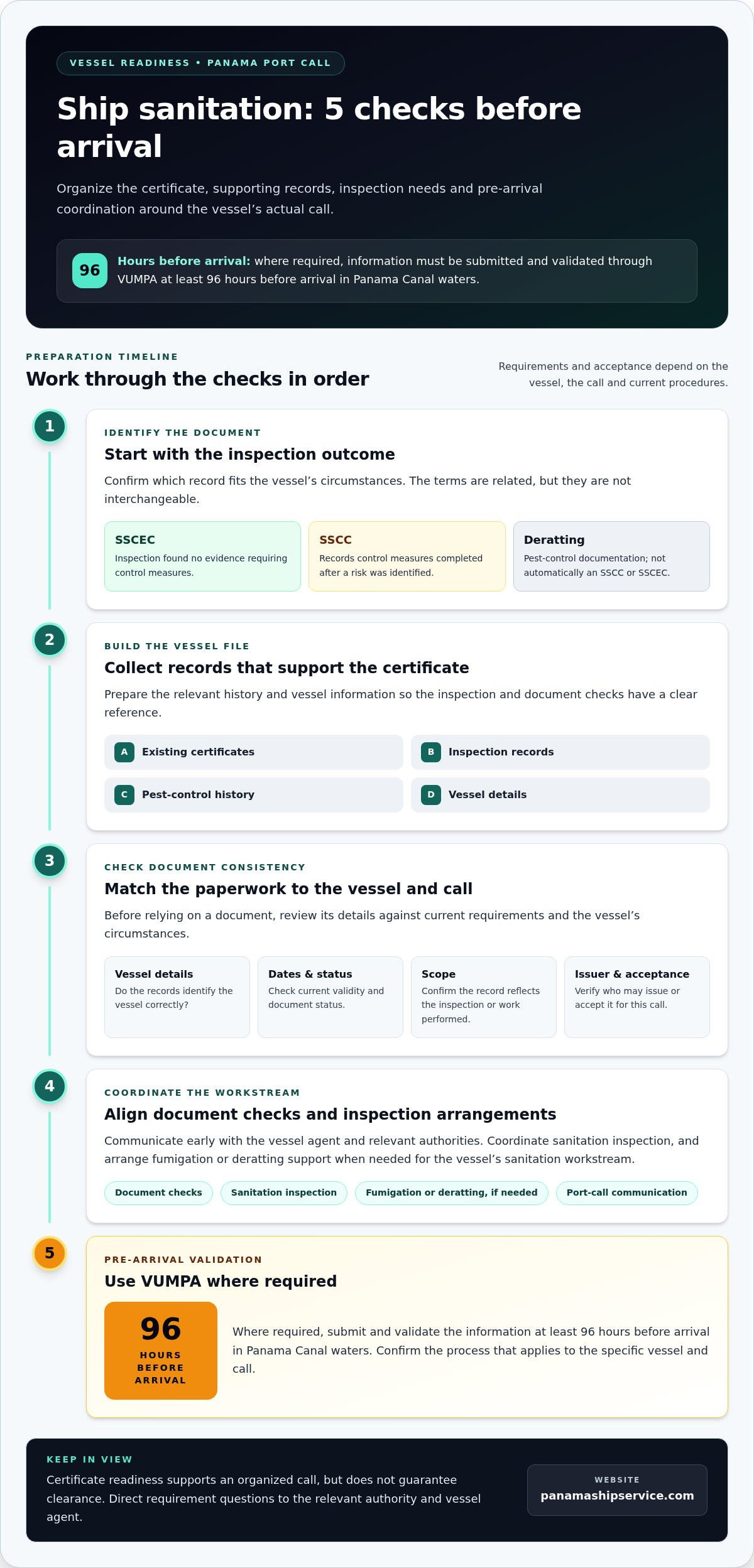
SSCC, SSCEC, and deratting documentation are often mentioned together, but they do not mean exactly the same thing. An SSCEC applies when an inspection finds no evidence requiring control measures. An SSCC records control measures completed after a public-health risk was identified. “Deratting certificate” is still used colloquially for pest-control documents and the newer certificate system.
This 2026 checklist explains the key terms, what to prepare before arrival, and how to coordinate sanitation inspection, fumigation, or deratting support. It also outlines the roles of Panama’s maritime and health authorities and the digital pre-arrival process through VUMPA. Where required, information must be submitted and validated at least 96 hours before arrival in Panama Canal waters. Use the checklist to organize records, clarify inspection needs, and reduce avoidable friction during the port call.
Key Takeaways
- Identify which ship sanitation certificate Panama documentation may apply to your vessel, and verify requirements for the specific call.
- Understand how SSCC and SSCEC differ, and why “deratting certificate” may refer to older or colloquial terminology.
- Prepare existing certificates, inspection records, pest-control history, and vessel details to support an organized inspection.
- Coordinate document checks, inspection arrangements, and port-call communication early to help reduce avoidable delays.
- Use sanitary inspections, fumigation, and deratting certificate issuance to support the vessel’s sanitation workstream in Panama.
What Is a Ship Sanitation Certificate in Panama, and When Does It Matter?
A ship sanitation certificate records the outcome of a vessel’s sanitation-control inspection under the applicable procedures. Its public-health purpose is to document whether relevant risks were identified and, where necessary, addressed. For operators, the key question is whether the document matches the vessel’s circumstances and will be accepted for the planned call.
International Health Regulations terminology includes the Ship Sanitation Control Certificate (SSCC) and Ship Sanitation Control Exemption Certificate (SSCEC). An SSCEC generally records that an inspection found no evidence requiring control measures. An SSCC records control measures after a public-health risk was identified. The Ship Sanitation Certificate overview provides background on these terms. For a particular Panama call, check the current authority procedures for validity, issuance, and acceptance.
No single document assumption fits every vessel. The relevant paperwork can depend on the vessel’s sanitation history, inspection outcome, and the procedures that apply to its destination and operations. “Deratting certificate” may appear in older records or everyday industry language, so compare the terminology in the vessel file with the document currently required.
Certificate readiness supports a well-prepared call, but it does not guarantee clearance. Keep the certificate, inspection records, and pest-control documentation consistent with the vessel’s details. Direct questions about requirements to the relevant authority and vessel agent.
What does a ship sanitation certificate document?
Think of the certificate as an official record of an inspection or sanitation-control outcome, not a substitute for the supporting vessel history. Before relying on a document, check its vessel details, dates, scope, and status against current requirements. For a ship sanitation certificate Panama call, confirm which certificate applies and who has authority to issue or accept it in that case.
Why does sanitation readiness matter during a Panama call?
Missing records, unclear certificate status, or a mismatch between paperwork and vessel details can prompt follow-up checks and add coordination during a time-sensitive port call. Panama Canal planning may involve the relevant maritime and health authorities, but the steps depend on the vessel and call. Use Balboa and Cristóbal as geographic references only when they match the vessel’s planned arrangements. Organize records and communication around the actual call rather than assuming the same process applies at every location.
SSCC, SSCEC, and Deratting Certificates: Which Documents Are Different?
The names can appear interchangeably in vessel correspondence, but they refer to different sanitation records. Under WHO terminology, an SSCC documents control measures after a public-health risk is identified, while an SSCEC records that an inspection found no evidence requiring those measures. A deratting certificate has a narrower pest-control focus and should not automatically be treated as either document.
The WHO Handbook for Ship Sanitation Certificates explains the international framework. Use the table as a terminology guide, then verify the required document, issuer, and acceptance procedure for the vessel and call.
| Document | Purpose | Typical context | Responsible authority | What to verify |
|---|---|---|---|---|
| SSCEC | Records an exemption from sanitation-control measures following inspection. | No evidence of a public-health risk requiring control measures is found. | Competent authority or authorized body under applicable procedures. | Current validity, vessel details, issuer, and acceptance for the call. |
| SSCC | Records sanitation-control measures undertaken after a risk is identified. | Inspection identifies a concern and control measures are completed. | Competent authority or authorized body under applicable procedures. | Inspection outcome, measures recorded, issuer, and local acceptance. |
| Deratting certificate | Relates specifically to rodent control or other pest-control work. | Older records, colloquial usage, or documentation connected with pest treatment. | Depends on the applicable local process and document type. | Whether it is accepted for the specific purpose, or whether a current SSCC or SSCEC is needed. |
How do SSCC and SSCEC differ?
The inspection finding is central: an SSCEC reflects an inspection with no control measures indicated, while an SSCC records measures taken to address an identified risk. This distinction does not establish a universal validity period or automatic exemption from other checks. Follow current guidance and the competent authority’s decision for the vessel’s circumstances.
Is a deratting certificate the same as a sanitation certificate?
No. Deratting documentation addresses pest control, while SSCC and SSCEC belong to the broader ship-sanitation certificate framework. Fumigation or deratting may form part of a vessel’s sanitation workstream, but the treatment record and the certificate required for a call are not automatically interchangeable. Panama Ship Service provides sanitary inspections, fumigation, and deratting certificate issuance to support this work. See the ship sanitation and deratting services when coordinating vessel preparation.
What Should a Vessel Prepare Before a Ship Sanitation Inspection in Panama?
Good preparation starts with a clear vessel file, accurate call details, and a distinction between records you can assemble now and requirements that must be confirmed for the specific call. A complete checklist supports coordination, but inspection findings and authority decisions determine the outcome.
Which vessel records should be ready?
Gather the documents already available, then confirm the required format, submission channel, and timing with the agent or competent authority. Keep the records organized so they can be matched quickly to the vessel and its planned arrival.
- Sanitation documents: Current or previous SSCC, SSCEC, deratting certificates, and related inspection reports.
- Treatment history: Fumigation or pest-control records, including dates, locations treated, and any recorded follow-up actions.
- Vessel particulars: Vessel name, identification details, flag, and other particulars used in the relevant documentation.
- Call and contact details: Intended itinerary, Panama port-call schedule, estimated arrival information, and contact details for the responsible onboard representative.
Check that names, dates, and vessel identifiers match across documents. If a record is missing or inconsistent, flag it early for follow-up rather than leaving the discrepancy unexplained.
What should the onboard team check before inspection?
Prepare a factual account of pest observations, sanitation actions, and previous treatments. Identify relevant spaces for inspection and arrange access with the onboard team. Record findings clearly, including when and where they occurred, and keep supporting documents together for review. A checklist helps organize the process, but it does not guarantee certificate issuance or clearance.
Before arrival, separate the records to assemble from the requirements specific to the call. In particular, confirm locally:
- Whether an SSCC, SSCEC, deratting document, or another record is applicable.
- Which authority or authorized body handles the inspection and certificate process.
- The required document format, submission channel, and deadlines for the vessel’s itinerary.
- Inspection arrangements, location, and access needs based on the port call.
Accurate schedule information helps vessel management, the agent, the onboard representative, the relevant authority, and the service team coordinate around the same plan. For a ship sanitation certificate panama workstream, communicate changes to the intended call promptly so document handling and inspection arrangements can be aligned.
Keep sanitation records distinct from other compliance files. MARPOL or waste-management documentation may relate to separate environmental obligations, but it does not replace a sanitation certificate. Include those records in inspection preparation only when they apply to the vessel’s separate requirements.
How to Coordinate Sanitation Certificate Preparation for a Panama Port Call
Sanitation preparation works best as a sequence, not a last-minute document request. Vessel management, the agent, the relevant authority, and the service team need consistent information about the call, the concern, and the records already available. Confirm local authority contacts, lead times, operating arrangements, and acceptance criteria for the specific vessel rather than assuming they apply uniformly across Panama.
What are the practical steps before arrival?
Start with the operating plan. Confirm the vessel’s schedule and intended port location, then identify why sanitation support is being arranged, such as certificate review, inspection, or a reported pest concern. Share accurate vessel particulars, itinerary details, existing certificates, inspection records, and relevant treatment history with the coordination contacts.
- Identify the document: Establish whether the request concerns an SSCC, SSCEC, deratting documentation, or another record. Verify the applicable requirement through current local procedures.
- Align the participants: Make sure vessel management, the agent, the relevant authority, and the service team have the same schedule and vessel information.
- Confirm the arrangements: Agree on inspection or treatment details, access requirements, location, and timing in line with applicable procedures.
- Track changes: Share schedule or scope changes promptly so inspection arrangements and documentation can be adjusted.
Identify the document, align the records, confirm the arrangements, and keep every party updated. This supports readiness but does not guarantee clearance.
How can fumigation or deratting support fit the plan?
An inspection may identify a pest-control concern that calls for further action. Depending on the findings and applicable procedures, fumigation or deratting may form part of the response. Keep treatment records specific to the work performed, including relevant dates and areas treated, and distinguish those records from the sanitation certificate itself. The document accepted for a particular Panama call depends on the requirements that apply to that vessel.
Panama Ship Service provides sanitary inspections, fumigation, and deratting certificate issuance as part of its vessel services. Coordinating these related tasks around the port-call schedule helps keep the agent and vessel team informed and can reduce avoidable friction. For support with the vessel’s sanitation workstream, Coordinate vessel sanitation services.
For a ship sanitation certificate panama workstream, keep authority verification at the center of the plan. A clear sequence helps the team distinguish what is already documented, what inspection or treatment may be needed, and which arrangements depend on local procedures.
How Panama Ship Service Supports Sanitation and Deratting Preparation
Once the vessel’s sanitation concern and schedule are clear, coordinate the work that supports inspection and documentation. Panama Ship Service provides sanitary inspections, fumigation, and deratting certificate issuance as part of its vessel services at the Panama Canal. Coordinating related tasks around the port call helps vessel management, the agent, and the service team work from the same information.
The appropriate document still depends on the vessel’s circumstances and applicable authority procedures. A deratting certificate is not automatically interchangeable with an SSCC or SSCEC, and the relevant authority’s decision determines what is accepted for a particular call. Treat service records and certificate records as connected but distinct parts of the sanitation workstream.
What sanitation-related support can operators coordinate?
A sanitary inspection provides an operational assessment of the vessel’s sanitation condition. If pest activity or another sanitation concern requires action, fumigation or deratting support may be coordinated as appropriate. Any resulting treatment documentation should accurately reflect the work performed and be organized with the vessel’s other records. This helps the team explain the inspection and treatment history without presenting a service document as a substitute for a certificate required by the authority.
For operators planning a ship sanitation certificate panama workstream, the distinction matters: inspection can inform the next step, treatment may address a specific pest-control need, and certificate issuance follows the relevant process. Coordinating these elements supports port-call planning, but cannot predetermine inspection findings or guarantee acceptance or clearance.
What information helps start a service request?
Prepare concise, accurate details so the sanitation requirement can be understood alongside the vessel’s operating schedule:
- Vessel: Name and identifying particulars.
- Location and timing: Current or intended location, planned port call, and schedule information.
- Request: A brief description of the need, such as an inspection, fumigation, or deratting documentation.
- Supporting records: Relevant certificates, inspection reports, and known treatment or pest-control history.
Send the vessel details, schedule, and available records, and include any known timing constraints. Contact Panama Ship Service to coordinate sanitation inspection, fumigation, or deratting support for the vessel’s Panama call.
Prepare Your Sanitation Workstream Before the Call
Start by identifying which document may apply to the vessel, then distinguish SSCC and SSCEC terminology from deratting records. Assemble existing certificates, inspection reports, treatment history, and accurate vessel and schedule details. Verify the applicable requirements and arrangements for the specific call with the relevant authority and coordination team.
Early organization makes a ship sanitation certificate panama workstream easier to coordinate, but documents and preparation do not guarantee clearance. Panama Ship Service supports vessel operators with sanitary inspections, fumigation, and deratting certificate issuance, alongside operational and technical vessel services in Panama.
Share your vessel’s location, schedule, sanitation concern, and relevant records to begin coordinating the work. Coordinate sanitation and deratting support for your Panama call. With clear information and the right preparation, your team can approach the port call with greater confidence.
Frequently Asked Questions
What is a ship sanitation certificate?
A ship sanitation certificate records the outcome of an inspection addressing public-health risks on a vessel. Under current WHO terminology, the main certificates are the Ship Sanitation Control Certificate (SSCC) and Ship Sanitation Control Exemption Certificate (SSCEC). The document reflects the inspection findings and any control measures required under applicable procedures. For a Panama call, verify which certificate and acceptance rules apply to the vessel and its itinerary.
Is an SSCC the same as an SSCEC?
No. An SSCC records that sanitation-control measures were carried out after an inspection identified a public-health risk. An SSCEC records that the inspection found no evidence requiring those measures. The inspection findings and competent authority’s decision determine which document is relevant. Do not assume that one certificate substitutes for the other or that either automatically removes other inspection or port-call requirements.
Is a deratting certificate the same as a ship sanitation certificate?
No. A deratting certificate relates specifically to rodent or pest-control work, while an SSCC or SSCEC documents an outcome within the ship sanitation certificate system. Older records may use “deratting certificate” terminology, but that does not make the document interchangeable with a current sanitation-control certificate. Confirm the document accepted for the vessel’s purpose and call, and keep treatment records aligned with the work performed.
Who issues a ship sanitation certificate in Panama?
The relevant certificate is issued or accepted through the competent authority or authorized body under the procedures applicable to the vessel and call. Verify the precise local roles and process with the relevant authority and vessel agent. Panama Ship Service provides sanitary inspections, fumigation, and deratting certificate issuance, but deratting documentation should not be assumed to replace an SSCC or SSCEC where one is required.
What documents should a vessel prepare for a sanitation inspection?
Assemble available sanitation certificates, prior inspection reports, and relevant pest-control or fumigation records. Include accurate vessel particulars, itinerary and planned port-call details, plus contact information for the onboard representative responsible for the inspection. Check that vessel names and identifiers are consistent across records. Confirm locally which documents are required, along with their format, submission channel, and timing, since these details may depend on the specific call.
When should a vessel arrange sanitation inspection or fumigation in Panama?
Start coordination as soon as the vessel’s schedule and sanitation concern are known. Early communication gives vessel management, the agent, the relevant authority, and service team time to align records, access arrangements, and any inspection or treatment plan. Timing depends on the vessel’s itinerary and current local procedures. If pest activity or a sanitation concern is identified, share the facts and available treatment history promptly.
Does a ship sanitation certificate guarantee port or canal clearance?
No. A certificate documents a sanitation inspection outcome or control measures, but it does not guarantee port or canal clearance. Acceptance and clearance may depend on other vessel-specific requirements, authority decisions, and the details of the call. Keep sanitation documents accurate and ready, coordinate with the vessel agent, and verify current procedures with the relevant authority. Certificate readiness supports preparation, but it cannot determine the final clearance decision.