
What if the symptom pointing to an auxiliary machinery fault isn’t the whole problem? During a Panama Canal call, unclear alarms or performance changes can make it difficult to define the repair scope and fit work around the vessel’s schedule. Planning marine auxiliary machinery repair panama starts with a clear account of what happened, when it happened, and how the machinery was operating.
A fast assessment matters, but moving ahead without useful fault information can leave important questions unanswered. Consider machinery symptoms alongside available control indications, while keeping safety and vessel readiness central to repair decisions.
This guide explains what technicians need to assess a fault, how repair approaches differ in scope and operational impact, and how to coordinate mechanical ship repairs around a Panama Canal call. It also covers how vessel teams and repair personnel can share information and align the work plan to reduce preventable delays.
Key Takeaways
- Record unusual operating changes and when they occur to give technicians a clear starting point for fault assessment.
- Planning marine auxiliary machinery repair panama is more effective when mechanical symptoms and available control indications are considered together.
- Compare repair, component replacement, and further diagnosis against equipment condition, failure evidence, and operational risk.
- Prepare for a Panama Canal call by organizing equipment details, vessel status, access needs, location, and schedule information.
- Align the repair scope and communication among the vessel team and service partners to support readiness and reduce avoidable delays.
Marine Auxiliary Machinery Repair in Panama: Recognizing the Need
Auxiliary machinery supports a vessel’s operation beyond its primary propulsion function. It is part of the working machinery environment in the ship’s engine room, where equipment condition and operating information can help crews identify a change that needs attention.
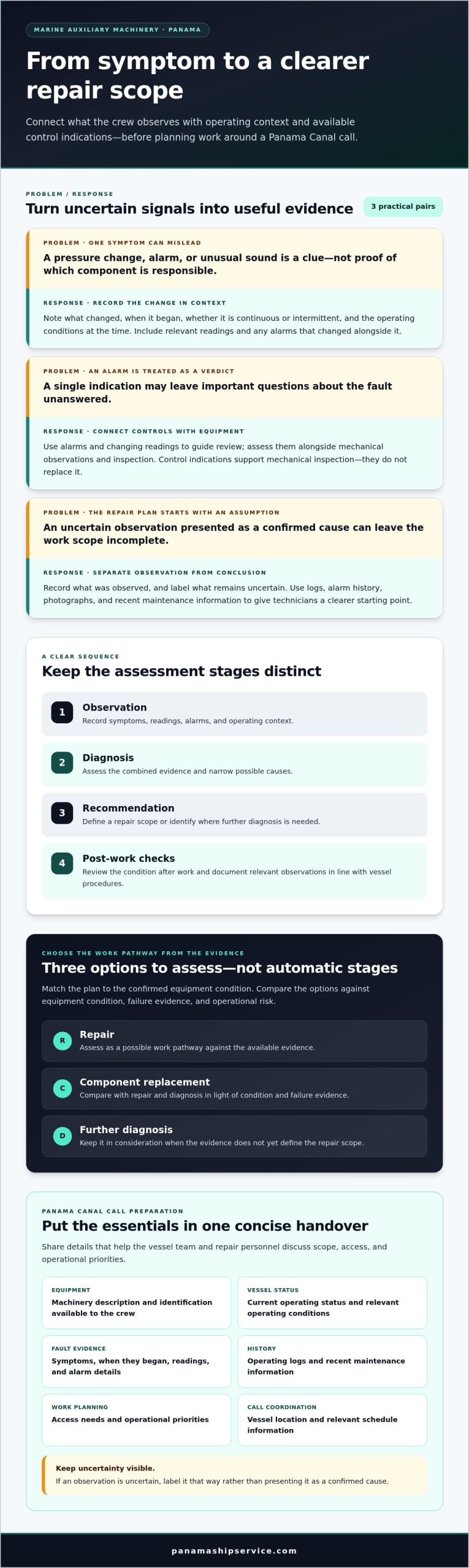
Unusual noise, vibration, temperature, pressure, or performance changes warrant assessment. These are symptoms, not diagnoses. A pressure change alone, for example, doesn’t confirm which component or system is responsible. Treating one indicator as proof can lead to an incomplete repair scope. Record the evidence and assess it in context, following vessel procedures.
Which auxiliary machinery symptoms should prompt an assessment?
Record what changed, when it began, and the conditions under which it occurred. Note whether the symptom is continuous or intermittent, whether it appears under a particular operating condition, and whether other readings or alarms changed at the same time. A written record is more useful than relying on memory alone.
Alarms, operating logs, and recent maintenance records add context. They can help show whether an indication is new, recurring, or associated with earlier work. Reliable sensor data is especially valuable for critical equipment such as bilge pumps or HVAC units; learn more about how remote monitoring and alert systems help capture these early warnings. Accurate fault information helps technicians assess the evidence, narrow the repair scope, and plan work with fewer avoidable uncertainties.
Why does repair planning matter during a Panama call?
A Panama Canal call involves a vessel schedule that must be considered alongside machinery condition. Clear information helps the vessel team and repair personnel discuss likely scope, access, and operational priorities before work is planned. Incomplete details can make it harder to assess the fault, prepare for the work, and coordinate communication.
For marine auxiliary machinery repair panama, share the machinery identification available to the crew, current operating status, recorded symptoms, alarm details, maintenance history, vessel location, and relevant schedule information. If an observation is uncertain, label it as such rather than presenting it as a confirmed cause. This helps prevent plans from being built around an unverified assumption.
Panama Ship Service provides mechanical ship repairs at the Panama Canal and can coordinate related vessel services to support planning. For more on repair coordination, see the mechanical ship repairs guide for Panama.
How Auxiliary Machinery Fault Diagnosis Connects Equipment and Controls
Fault diagnosis turns operating evidence into a reasoned repair scope. It starts with reported symptoms and available records, then considers possible causes before determining whether further inspection or repair is appropriate. An alarm is a clue, not a verdict. Repair decisions should reflect the evidence rather than a single indication.
What information helps assess an auxiliary machinery fault?
Build a concise record that connects the equipment, the symptom, and the conditions at the time. Useful details include:
- Equipment description and identification available to the vessel team.
- What changed, when it began, and whether the issue is persistent or intermittent.
- Operating conditions when the symptom occurred, along with relevant readings.
- Alarm history, operating logs, photographs, and recent maintenance information.
Be precise about what was observed and what remains uncertain. For example, record that an alarm appeared at a particular point in operation rather than concluding that a specific component has failed. This gives technicians a basis to investigate the reported condition without treating an assumption as a confirmed finding.
How can machinery and control indications be considered together?
Mechanical observations and available control-system information can each contribute to the assessment. An alarm or changing reading may point to a condition or time period for closer review. Inspection can then assess the physical equipment and compare findings with the reported evidence. Neither source alone should be treated as a diagnosis.
Control indications support mechanical inspection; they don’t replace it. Keep evidence and conclusions distinct, particularly when planning marine auxiliary machinery repair panama around vessel operations.
Keep the stages distinct:
- Observation: Record symptoms, readings, alarms, and operating context.
- Diagnosis: Assess the combined evidence and narrow possible causes.
- Recommendation: Define a repair scope or identify where further diagnosis is needed.
- Post-work checks: Review the condition after work and document relevant observations in line with vessel procedures.
For Panama calls, coordinate the repair plan with vessel readiness and applicable operational requirements. The Panama Canal Authority provides official information on Panama Canal maritime regulations; consult its published guidance when planning relevant vessel operations. For mechanical ship repairs in Panama, Panama Ship Service’s repair support can form part of a coordinated approach to vessel services.
Repair, Replacement, or Further Diagnosis: Comparing Auxiliary Machinery Options
Once the available evidence has been reviewed, match the work plan to the confirmed equipment condition. Repair, component replacement, and further diagnosis are different pathways, not automatic stages or universal solutions. For marine auxiliary machinery repair panama, the appropriate recommendation depends on inspection findings, failure evidence, operational risk, and the vessel’s requirements.
| Option | When it may be considered | Scope and operational impact |
|---|---|---|
| Repair | Inspection findings indicate that the affected equipment or area can be addressed through repair. | Scope is based on the condition found and the work required. The vessel team considers operational risk and how the work fits its schedule. |
| Component replacement | Findings indicate that replacing a component is suitable for the condition identified. | The plan must account for the replacement scope and its effect on vessel operations. A quick substitution alone doesn’t establish that the underlying fault is resolved. |
| Further diagnosis | Symptoms or available evidence don’t yet establish a sufficiently clear fault or repair scope. | Targeted assessment can narrow uncertainty before repair work proceeds, helping avoid a plan based on an unverified assumption. |
When might repair or component replacement be considered?
Condition, damage extent, and technical findings guide the choice. Repair may be considered when inspection supports addressing the affected condition. Replacement may be considered when the evidence supports changing a component. Neither approach is a fixed rule. The machinery, vessel requirements, and operational consequences all matter. The recommendation should explain what the findings support and what work falls within the agreed scope.
The fastest apparent fix may not be the most effective if it addresses a visible symptom without resolving the cause. A recommendation should connect the observed failure evidence to the proposed work and identify any remaining uncertainty. That gives operators a clearer basis for weighing scope against operational risk.
When is further diagnosis the responsible next step?
Further diagnosis may be appropriate when symptoms are intermittent, evidence points in more than one direction, or inspection has not established the extent of the condition. A targeted assessment can clarify what is known before the repair scope is set. When a broader condition review is relevant, consult the marine surveys guide for ship operators.
Final recommendations should follow inspection findings and vessel-specific requirements. Separating confirmed facts, open questions, and proposed work helps the vessel team make a practical decision and coordinate next steps.
Preparing Auxiliary Machinery Repairs Around a Panama Canal Call
A repair plan is easier to coordinate when the vessel team shares practical details early. For marine auxiliary machinery repair panama, location, operating status, equipment access, and vessel schedule all help shape a realistic work scope. Use this sequence to give vessel representatives and repair coordinators a clear starting point.
- Document the reported problem. Record the equipment identifier, observed symptoms, when they began, operating conditions, and relevant alarm history. Include maintenance notes or photographs that help explain what the crew observed.
- Describe the vessel’s current status. Clarify whether the machinery is operating, restricted, or out of service, and share immediate operational considerations. Keep observations separate from assumptions about the cause.
- Explain access and safety constraints. Identify where the equipment is located, how the work area can be accessed, and any vessel-specific precautions or restrictions relevant to planning.
- Share location and schedule priorities. Provide the vessel’s current location and relevant timing constraints early. This helps the parties discuss how work may fit around the call without assuming a particular completion time.
- Align the repair scope. Distinguish the reported problem from inspection findings, proposed work, and the scope ultimately agreed by the relevant parties.
What should the vessel team prepare before repair work?
Gather equipment details, symptom records, alarms, and maintenance notes in one accessible summary. Confirm the current operating condition, then describe access arrangements and safety constraints. Sharing schedule priorities early gives repair coordinators useful planning context. Clear, organized information reduces back-and-forth and keeps the discussion focused on the work the vessel needs.
How can repair scope and communication stay clear?
Agree on a communication path between the vessel representative and repair coordinator. Identify who will receive updates and who should be informed if inspection reveals new findings or the proposed work needs to change. Keep reported symptoms, confirmed findings, recommendations, and the agreed scope distinct. This makes changes easier to discuss and helps prevent assumptions from becoming part of the plan.
Timing depends on the work required and findings during assessment, so don’t treat an initial estimate as a promise of completion. For more planning considerations, read the mechanical repairs guide to minimizing vessel downtime.
For mechanical ship repair coordination around a Panama call, discuss your vessel’s repair requirements with Panama Ship Service.
Coordinate Mechanical Ship Repairs in Panama with One Service Partner
A well-coordinated repair plan links a clear understanding of the fault, an agreed work scope, and a reliable communication path between the vessel and those coordinating the repair. These steps help the parties plan around the ship’s actual condition and operational priorities, rather than making decisions from incomplete information.
For marine auxiliary machinery repair panama, vessel readiness depends on more than identifying a possible fault. The vessel team needs to understand what has been observed, what inspection has established, and what work has been agreed. If new findings change the scope, a defined communication point helps the relevant people review the change and its operational impact.
What makes a repair plan easier to coordinate?
Start with accurate fault information and keep reported symptoms separate from confirmed findings. Agree on the proposed scope and how updates will be shared. Then consider the vessel’s location, operating status, access, and schedule priorities together. This supports practical planning and helps reduce avoidable delays while keeping the work plan grounded in the vessel’s circumstances.
Panama Ship Service provides mechanical ship repairs at the Panama Canal and can coordinate related maritime services when they support the vessel’s needs. For example, a marine survey may be relevant when a broader condition assessment is needed. Coordinating relevant work through one service partner can streamline arrangements and supports the company’s aim of minimizing expenses and transit delays.
What details should a repair inquiry include?
Give the repair coordinator a concise summary so the discussion can begin with the vessel’s situation and machinery concern. Include:
- Vessel name or identifying details, current location, and operational status.
- Machinery description and equipment identifiers available to the vessel team.
- Reported symptoms, when they began, and the conditions in which they occur.
- Relevant alarms, operating logs, maintenance records, and inspection findings.
- Access considerations and schedule context, including the vessel’s planning priorities.
Label uncertain details clearly. This helps prevent assumptions from being mistaken for inspection findings and gives the parties a sound basis for discussing scope. Timing depends on the work required and what assessment establishes, so share priorities without assuming a completion time.
For mechanical ship repairs during a Panama call, coordinate mechanical ship repairs in Panama with Panama Ship Service. Provide the available vessel and fault details to begin a focused discussion of the repair requirements and operational context.
Plan Your Next Repair with Clear Information
A sound repair decision starts with evidence. Record symptoms and available operating information, then distinguish observations from confirmed findings. Repair, component replacement, or further diagnosis should follow the equipment condition and vessel’s operational requirements, not an assumption based on one indicator.
For marine auxiliary machinery repair panama, early coordination matters too. A clear scope, relevant vessel details, and an agreed communication path help align mechanical work with the Panama Canal call and support vessel readiness.
Panama Ship Service provides mechanical ship repairs at the Panama Canal, alongside related maritime support that can help consolidate relevant vessel services. The company aims to minimize expenses and avoidable transit delays through coordinated planning. Share the machinery description, reported symptoms, vessel location, and schedule context to start a focused discussion.
Coordinate mechanical ship repairs in Panama with Panama Ship Service. Clear information and practical planning can help your team move forward with confidence.
Frequently Asked Questions
What is marine auxiliary machinery on a vessel?
Marine auxiliary machinery is equipment that supports vessel operations beyond the main propulsion function. It helps keep the ship’s systems and activities operating as intended. The exact machinery aboard varies by vessel, so identify equipment using its onboard description or records rather than relying on a generic list. This helps the crew communicate which machinery is involved when reporting a concern or planning an assessment.
What are common signs that auxiliary machinery needs repair?
Unusual noise, vibration, temperature, pressure, or performance changes can signal that machinery needs assessment. An alarm, a change from normal operation, or a recurring irregularity is also useful to record. These signs don’t confirm a specific failure on their own. Note when the change began, the operating conditions, and whether it continues or comes and goes. Share relevant logs and alarms so the condition can be assessed in context.
How is an auxiliary machinery fault diagnosed?
Fault diagnosis involves gathering operating evidence, assessing possible causes, and establishing an appropriate repair scope. Technicians can use the crew’s description, equipment details, operating conditions, alarm history, maintenance records, and inspection findings to build a clearer picture. Keep observations separate from conclusions: an alarm or symptom is evidence, not proof of root cause. The findings then guide whether repair, component replacement, or further diagnosis should be considered.
Can auxiliary machinery repairs be coordinated during a Panama Canal call?
Yes. Panama Ship Service provides mechanical ship repairs at the Panama Canal, and repair planning can account for the vessel’s location, operational status, access, and schedule priorities. Clear fault information and an agreed scope help the relevant parties coordinate work around the call. Timing depends on the assessment and work required, so share schedule context early. Planning marine auxiliary machinery repair panama this way can help reduce avoidable coordination delays.
How do I decide between repairing and replacing auxiliary machinery?
Base the decision on inspection findings, equipment condition, failure evidence, operational risk, and vessel-specific requirements. Repair may be appropriate when findings support addressing the affected condition; replacement may be considered when the evidence supports changing a component. Neither option is right in every case. If the available symptoms don’t establish a clear fault, further diagnosis may be the more responsible step before agreeing on a scope.
What information should I send when requesting auxiliary machinery repair?
Provide vessel identifying details, current location and operating status, the machinery description, reported symptoms, and schedule context. Include when the issue began and the conditions in which it occurs, along with relevant alarms, operating logs, maintenance records, and inspection findings. Note access arrangements or safety constraints that could affect planning. Be clear about which details are observations and which are still uncertain, so the initial discussion starts from an accurate picture.
Do control-system alarms identify the cause of a machinery fault?
No. An alarm can point to a condition or operating period that deserves investigation, but it doesn’t necessarily identify the root cause or confirm that a particular component has failed. Consider available control-system indications alongside reported symptoms, operating records, and mechanical inspection findings. Together, these clues can guide assessment and repair planning. Treating an alarm as a confirmed diagnosis risks defining work around an assumption instead of the equipment’s actual condition.