
A developing engine fault can become an operational crisis before the schedule has room for it. Preventing catastrophic engine failure starts with recognizing changes early, but an alarm or unusual reading needs context. A single fluctuation may not tell the whole story. Patterns in temperature, vibration, or exhaust smoke can help identify a concern that needs attention.
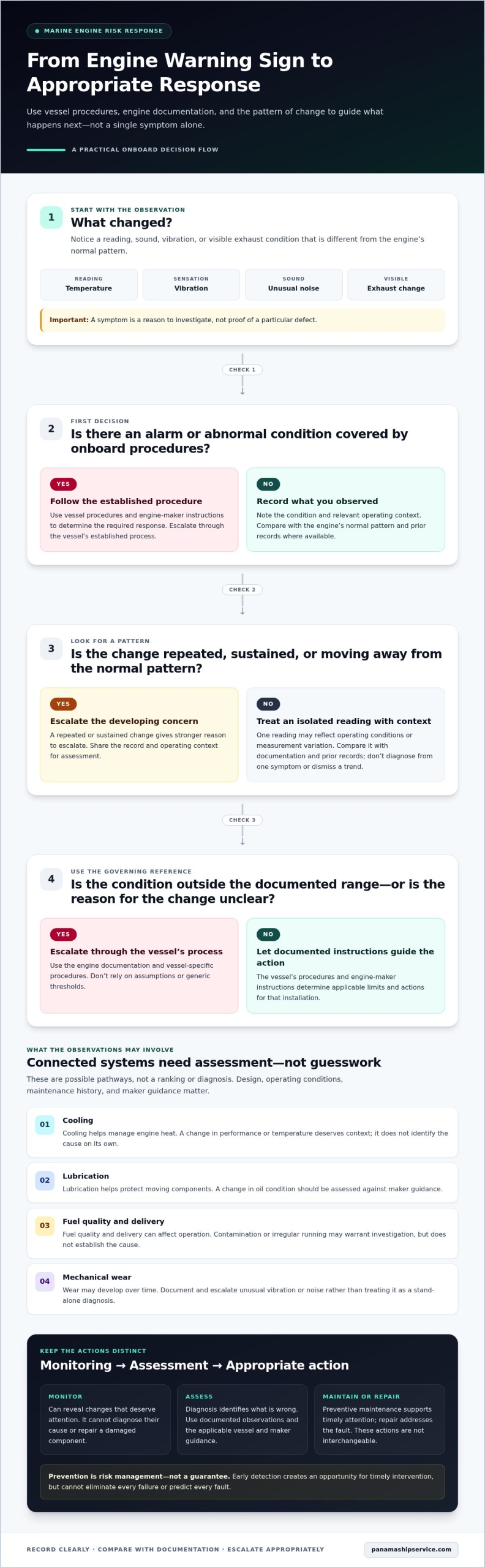
For marine operators, the challenge is deciding what needs attention now, what to monitor, and when maintenance or specialist support is the practical next step. This guide explains how to assess warning signs against vessel documentation, escalate concerns appropriately, and prioritize preventive action while maintaining operational readiness, safety, and cost awareness.
You’ll also find a repeatable approach to monitoring and maintenance, along with guidance on when a mechanical concern calls for repair support. Panama Ship Service provides preventive maintenance and ship repair support at both sides of the Panama Canal, helping connect developing technical issues with coordinated operational response.
Key Takeaways
- Preventing catastrophic engine failure depends on treating warning signs as developing risks, not automatic diagnoses.
- Understand how lubrication, cooling, fuel quality, and mechanical wear can affect engine reliability.
- Compare scheduled maintenance, watchkeeping, and condition-led assessment to clarify what each can reveal and who should act.
- Use a consistent process to record abnormal conditions, assess them against vessel procedures and engine-maker instructions, and escalate appropriately.
- Learn when a documented concern may call for preventive maintenance or mechanical repair support to help limit operational disruption.
Preventing catastrophic engine failure starts with understanding the risk
Catastrophic engine failure is severe damage or a loss of function that prevents an engine from operating as required. The consequences can extend beyond the machinery itself: a propulsion or power-generation problem may affect vessel operations, safety decisions, and schedules. Not every fault can be anticipated or prevented. The practical aim is to identify developing risks and make informed decisions before a manageable concern becomes a major disruption.
Early detection creates an opportunity for timely intervention, but it does not guarantee that a failure can be prevented. Monitoring can reveal changes that deserve attention, but it cannot diagnose their cause or repair a damaged component. General principles help crews organize a response, while the vessel’s procedures and engine-maker instructions determine the applicable limits and actions.
Why small engine abnormalities deserve attention
A developing fault may affect reliability before it causes an immediate breakdown. A change in a reading, sound, vibration, or visible exhaust condition is a reason to investigate, not proof of a particular defect. For example, a gradually changing temperature or vibration reading may warrant comparison with the engine’s normal operating pattern and maker guidance. These are illustrative observations, not universal alarm criteria.
Context is essential. One isolated reading may reflect operating conditions or measurement variation, while a repeated or sustained change gives a stronger reason to escalate. Record observations with relevant operating context and compare them with prior records where available. Don’t dismiss a trend because the engine is still running, and don’t diagnose a failure from a single symptom. Follow onboard procedures whenever an alarm or abnormal condition occurs.
What prevention can, and cannot, achieve
Preventive maintenance and routine monitoring help reduce avoidable risk by supporting timely attention to machinery condition. They cannot eliminate every failure, predict every fault, or replace assessment of an existing problem. Preventive action maintains readiness and responds to signs of deterioration; diagnosis identifies what is wrong, while repair addresses the fault. These steps may overlap, but they are not interchangeable.
For a broader overview of engine failure types, including classifications used in turbine-engine discussions, see Wikipedia. This aviation-focused reference can help clarify general terminology, but it isn’t a source for marine-engine limits, alarm meanings, or maintenance procedures.
For shipboard decisions, use the engine’s documentation and vessel-specific procedures as the governing reference. Generic advice cannot establish a safe operating threshold for every installation. When a reading or condition falls outside the documented range, or the reason for a change is unclear, escalate it through the vessel’s established process rather than relying on assumptions.
Preventing catastrophic engine failure is a disciplined risk-management effort, not a promise of fault-free operation. Treat abnormal changes seriously, record them clearly, and distinguish observation from diagnosis. This gives the responsible crew and technical support a better basis for deciding what action is appropriate.
How common failure pathways develop in marine engines
Marine engine faults can involve connected systems. A cooling concern may affect operating temperature, while lubrication condition, fuel delivery, and mechanical wear can each influence reliable operation. These are examples of possible failure pathways, not a universal ranking or a diagnosis for every engine. The specific design, operating conditions, maintenance history, and maker guidance all matter.
For crews, the useful question is not whether one symptom proves a failure. Ask whether an observation is new, recurring, or changing, and whether it calls for action under the vessel’s procedures. Record what was observed and when, then compare it with relevant engine documentation. Avoid applying generic thresholds to an installation with different specifications.
Cooling and lubrication problems
Cooling systems help manage engine heat, while lubrication helps protect moving components. A change in cooling performance or oil condition may deserve attention, but neither alone identifies the underlying cause. An abnormal temperature reading, for example, could have several explanations. Oil that looks different from its usual condition also needs assessment against the maker’s guidance. Treat these as observations to report, not proof of a specific defect.
Use the engine documentation for alarm meanings, limits, and required responses. Don’t dismiss a developing change because the engine remains operational, and don’t interpret a warning outside the vessel’s procedures. A clear record of the reading, operating context, and any related observations helps the responsible crew assess what to do next.
Fuel-system and mechanical concerns
Fuel quality and delivery can affect engine operation. Contamination or irregular running may warrant investigation, but the symptom alone doesn’t establish the cause. Mechanical wear can also develop over time. Document and escalate unusual vibration or noise according to onboard procedures rather than treating it as a stand-alone diagnosis. The correct interpretation depends on the engine and its operating history.
Keep observations specific: note what changed, when it occurred, and whether other readings or conditions changed at the same time. This information gives technical personnel a more useful starting point than a broad report that the engine “sounds wrong.” Follow maker instructions before taking action, especially when alarms or abnormal operating conditions are present.
The National Marine Manufacturers Association describes its marine product certification program. Certification information can provide context about products, but it doesn’t replace the operating limits, maintenance instructions, or fault assessment for a vessel’s installed engine.
Preventing catastrophic engine failure depends on connecting observations with suitable assessment, not guessing at a fault from one symptom. When a developing concern needs preventive maintenance or mechanical repair support, Panama Ship Service’s Marine Repairs & Services includes preventive maintenance of marine engine and navigation components.
Compare engine monitoring and maintenance approaches before choosing a response
No single approach gives operators a complete picture of engine condition. Scheduled preventive maintenance keeps planned work aligned with the vessel’s maintenance plan and engine documentation. Routine watchkeeping captures what the crew observes during operation. Condition-led assessment gives closer attention to relevant readings or documented changes. Together, these methods support better decisions than treating one observation or maintenance record as conclusive.
Scheduled maintenance versus condition monitoring
Planned maintenance provides structure by identifying work due under the vessel’s plan and the engine-maker’s instructions. Condition monitoring focuses on evidence from operation, such as a recurring abnormal observation or a change in recorded readings. Neither approach replaces the other. Don’t add generic intervals or assume a particular instrument is required. The appropriate plan and methods depend on the vessel and engine.
A simple comparison in the vessel’s maintenance records can clarify what each approach contributes, what it can’t establish, and who should act on findings:
- Scheduled preventive maintenance: Shows which planned tasks are due and whether they’re recorded as completed. The responsible onboard personnel act under the maintenance plan, and an unusual finding still needs assessment.
- Routine watchkeeping: Captures operating observations and changes during normal duties. The watchkeeper records and reports concerns through onboard procedures, but an observation alone may not explain the cause.
- Condition-led assessment: Brings relevant records and changes together for closer review. Qualified technical personnel guide further assessment or action when the evidence is unclear, recurring, or outside documented guidance.
This comparison separates routine work from emerging concerns and clarifies ownership. That way, observations don’t remain in a log without being reviewed or escalated.
Use the right evidence for the decision
An operator’s observation is valuable evidence, but it isn’t the same as a technical inspection, test, or diagnosis. Maintenance records add context by showing what was previously observed, what work was completed, and whether a concern has changed or returned. Clear records help technical personnel assess patterns without turning a single symptom into a conclusion.
- Record the observation with relevant operating context and the time it occurred, following vessel procedures.
- Compare it with available records and the engine-maker’s documentation, without creating unofficial limits or overriding instructions.
- Escalate for qualified technical assessment when the concern recurs, remains unexplained, or requires a decision beyond routine onboard observation.
For operators, preventing catastrophic engine failure means combining planned upkeep with attentive watchkeeping and evidence-led assessment. If a documented concern points to a need for mechanical repair support, explore Panama Ship Service’s mechanical repair support as part of planning the next operational step.
Build a practical onboard process for early detection and escalation
A reliable response process gives the crew a clear path from first observation to documented action. The sequence below is a planning framework, not a substitute for vessel-specific operating or emergency procedures. When an alarm or abnormal condition arises, follow onboard procedures and the engine-maker’s instructions. They take precedence over generic guidance.
Record observations that help diagnose a developing issue
Useful records describe what happened without assuming why. Capture relevant alarms, readings, operating conditions, and observed changes using the vessel’s established logs or reporting system. Include when the concern began, whether it recurred, and what actions were taken under procedure. Don’t write a suspected cause as though it were confirmed. Accurate notes help the responsible engineer or technical specialist assess the situation.
Escalate concerns without improvising
Escalation should be controlled and traceable. Follow the vessel’s alarm, shutdown, and reporting procedures rather than adapting instructions found online. Don’t restart or continue operating contrary to onboard procedures or qualified direction. Record who was notified, what guidance was received, what decisions were made, and what remains unresolved. Clear handovers help the next responsible person understand the status without relying on memory.
- Observe: Note the alarm, abnormal reading, sound, vibration, or other change, following safe onboard practice.
- Record: Enter the relevant details and operating context in the vessel’s required records. Note the time and any action already taken.
- Assess: Compare the observation with engine-maker documentation and vessel procedures. Don’t create a new threshold or infer a diagnosis from one sign.
- Report: Notify the designated responsible person through the established chain. Share records and distinguish clearly between what is observed and what is not yet understood.
- Act and hand over: Follow the applicable instructions, document decisions and outcomes, and brief the next watch or responsible team on outstanding concerns.
This workflow supports consistent communication, but it doesn’t authorize a crew member to override a safety procedure or make a technical diagnosis beyond their role. If the condition is unclear, recurring, or requires assessment beyond routine onboard duties, escalate it to the responsible engineer or a qualified technical specialist. Keep the written record with the concern so the assessment accounts for its history rather than treating each report as an isolated event.
For context on how repair support fits into vessel operations, the mechanical ship repair guide outlines relevant considerations. A timely, well-documented handover helps connect an onboard concern with the next technical decision. Arrange mechanical ship repair support when a developing issue calls for repair assistance.
Arrange marine engine support before a developing fault disrupts operations
A documented concern can be a reason to arrange preventive maintenance or mechanical repair support before it interferes with vessel operations. The right next step depends on the condition, the vessel’s procedures, and technical assessment. A recurring observation may warrant planned attention; an active fault may call for repair support. Neither is a confirmed diagnosis without appropriate assessment.
Preventing catastrophic engine failure involves more than onboard monitoring. It also means connecting the information gathered by the crew with a suitable technical response. Clear records, timely communication, and realistic coordination help operators make decisions with the vessel’s operational requirements in view. Maintenance cannot guarantee a fault-free voyage.
Coordinate technical support around vessel operations
When reporting a concern, provide the relevant observations, operating context, actions already taken, and applicable onboard instructions. Accurate information helps establish what has changed and supports a focused discussion of next steps. Share operational details that affect coordination, such as the vessel’s location and schedule, while continuing to follow onboard procedures for any alarm or abnormal condition.
Panama Ship Service supports vessels at both sides of the Panama Canal and has international service capability. Its Marine Repairs & Services include preventive maintenance of marine engine and navigation components, while On-Time Repairs support time-sensitive vessel needs. Contact is available 24/7.
Match the support request to the need. Preventive maintenance can complement the vessel’s maintenance plan, while a repair request addresses a reported mechanical concern. Sharing the distinction, along with available records and relevant operational context, helps keep technical and operational communication clear.
Keep prevention connected to the wider repair plan
Maintenance findings should inform the vessel’s next technical actions. Record what was identified, what action was taken, and any follow-up that remains, then keep that information available to the responsible personnel. This creates continuity between observation, maintenance, and repair planning. For operators weighing a mechanical issue against operational disruption, the mechanical repair and vessel downtime guide provides related planning context.
Share the operational requirement through Panama Ship Service’s contact channel, including the concern and relevant vessel context. Clear communication supports coordinated consideration of the next step. The vessel’s procedures and qualified technical guidance remain central to decisions about operating or repairing machinery.
Contact Panama Ship Service for marine engine support.
Turn engine-risk awareness into operational readiness
Make engine-risk decisions usable during a busy watch, not just clear on paper. Build time into operational planning to review how mechanical concerns are communicated, who owns follow-up, and how unresolved findings are carried forward between responsible personnel. A process that fits the vessel’s actual workflow is easier to apply when schedules tighten and decisions matter.
Keep the focus on sound judgment. No maintenance plan can remove every uncertainty, but clear ownership and timely technical support can help the team make informed choices before a concern becomes harder to manage. That’s the practical value of preventing catastrophic engine failure: creating space to act responsibly, in line with vessel procedures, rather than relying on assumptions under pressure.
If a developing concern needs professional attention, take the next step with Panama Ship Service. Contact Panama Ship Service for marine engine support and share the operational requirement so the discussion can start with the information that matters to your vessel.
Frequently Asked Questions
Can catastrophic engine failure always be prevented?
No. Preventive maintenance and attentive monitoring can reduce avoidable risk, but they can’t guarantee that machinery will remain failure-free. A component may deteriorate unexpectedly, and operating conditions differ between vessels. Use the engine-maker’s instructions and vessel procedures for the specific installation. The general principles behind preventing catastrophic engine failure can help frame decisions, but they aren’t a diagnosis or a substitute for onboard emergency instructions or a technical assessment.
Does an engine alarm always mean the engine must be shut down immediately?
Not necessarily. The correct response depends on the alarm, the engine’s condition, and the vessel’s alarm-response procedure. Consult the relevant onboard instructions and maker guidance rather than relying on a generic rule. The response to a warning during a change in operating condition must still be determined by the applicable procedure. Don’t ignore the alarm or continue operating contrary to instructions; notify the responsible engineer.
Can contaminated fuel contribute to engine problems?
Yes, fuel condition may be relevant when investigating irregular operation, but a symptom doesn’t prove that fuel is contaminated. Record what happened and the circumstances, then follow the vessel’s fuel-handling and testing procedures. For example, note whether the irregularity appeared after a fuel change without treating that timing as proof of cause. Seek qualified assessment before altering operating practices or replacing components based only on suspicion.
Is a rising coolant temperature always a sign of imminent engine failure?
No. A rising temperature deserves attention, but it doesn’t identify the cause or establish the level of risk by itself. Compare the reading with the engine’s specified operating limits and follow the vessel’s alarm-response instructions. Record the trend alongside relevant operating conditions, then report it to the responsible engineer. Don’t use a generic temperature threshold from an article or assume that one reading tells the whole story.
Can an engine be restarted after it has been shut down because of an abnormal condition?
Only follow the vessel’s procedures and engine-maker instructions when deciding whether operation can resume. A shutdown may indicate a condition that requires investigation, so restarting based on a general rule isn’t appropriate. Record the alarm or observation, notify the responsible engineer, and obtain technical direction as required by onboard procedures. Never restart against a safety instruction or continue operation contrary to qualified guidance.
What information should the crew share when reporting an engine concern?
Share the exact alarm or observation, when it began, relevant readings, operating context, and actions already taken. Keep confirmed observations separate from suspected causes. For example, report that a reading changed during a particular operating condition rather than stating an unverified diagnosis. Accurate, time-sequenced details give the responsible engineer or technical specialist a clearer basis for assessment. Follow vessel reporting procedures and handle operational information under company practice.
How does prolonged low-load operation affect marine engine reliability?
Its effect depends on the particular engine, operating profile, and maker’s guidance, so there isn’t one rule for every vessel. Review the approved operating instructions and maintenance plan for the installation. If low-load operation is recurring or associated with an observed change, record the circumstances and raise the concern with the responsible technical team. Don’t adjust operating practices based solely on generalized advice that doesn’t account for the engine.