
What if a hidden hull issue is already affecting your vessel before it becomes obvious in day-to-day operations? The benefits of regular hull inspection include a clearer view of underwater condition, helping operators spot fouling or damage and consider maintenance before it becomes an operational surprise. For vessel teams, the challenge is knowing when the hull needs attention and fitting inspection and any follow-up work around a demanding schedule.
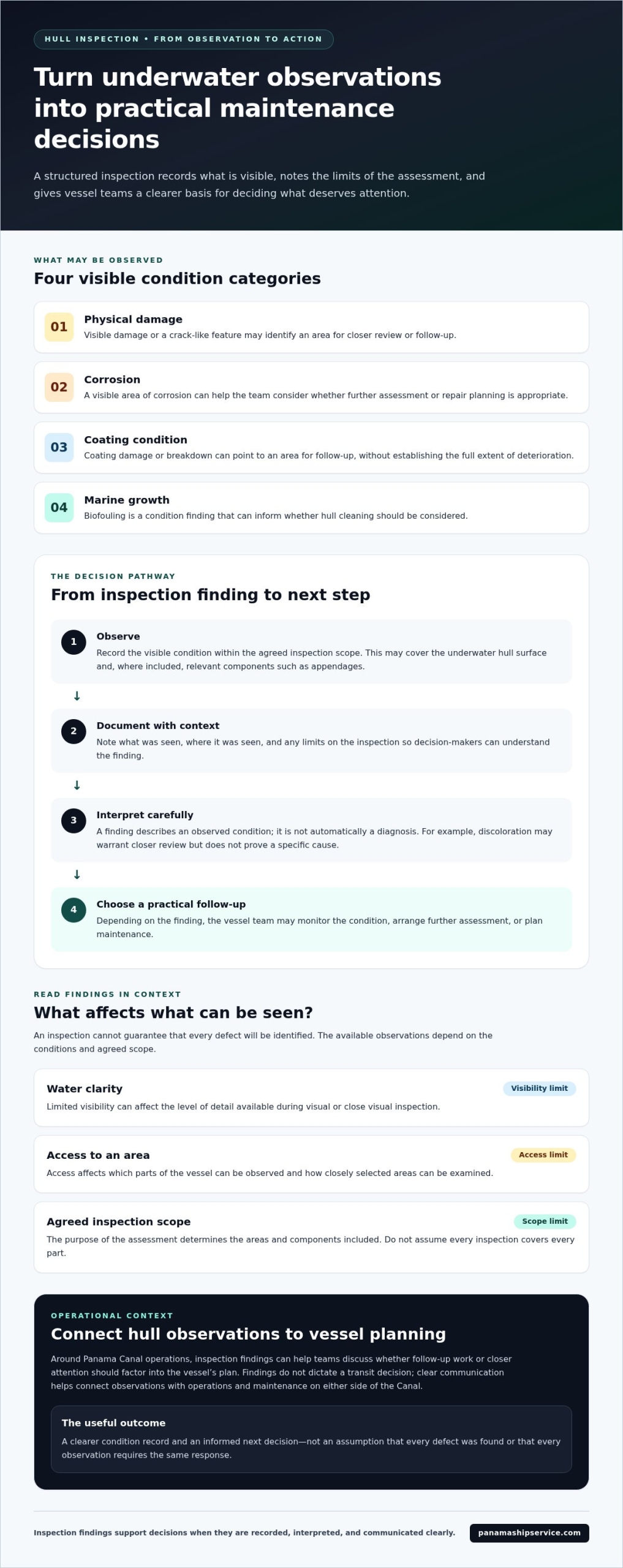
Routine inspection turns underwater observations into information for vessel management. It can help you identify what needs attention, prioritize maintenance decisions, and track hull condition as operating plans evolve. This guide explains what inspections can reveal and how findings can support decisions about underwater work. It also covers how inspection can fit into Panama Canal operations, where coordinated support on either side of the Canal can help keep vessel planning informed.
Key Takeaways
- Set a clear purpose for an inspection so its findings can support a specific vessel-management decision.
- The benefits of regular hull inspection include earlier awareness of visible damage, corrosion, and biofouling, without assuming every defect will be identified.
- Inspection is most useful when findings point to a practical next step, such as further assessment or maintenance.
- Record findings and communicate them clearly to help prioritize follow-up and coordinate work with vessel schedules.
- Panama Ship Service provides Underwater Inspection / Underwater Work for vessels on both sides of the Panama Canal and internationally.
Why regular hull inspection matters for vessels transiting the Panama Canal
What can routine inspection reveal before a concern escalates? A structured assessment of a vessel’s underwater condition gives operators a clearer picture of what is visible below the waterline. That information can help them decide whether to monitor a condition, arrange further assessment, or plan maintenance. The benefits of regular hull inspection begin with replacing assumptions about underwater condition with observations that can inform vessel management.
Hull inspection is a structured assessment of a vessel’s underwater condition that records visible findings operators can use to guide maintenance and operational decisions. It cannot guarantee that every defect will be found. Its value lies in documenting what can be observed within the agreed scope and making those findings useful for the next decision. Vessel safety surveys can also consider hull structure; Vessel safety surveys often include hull inspections, alongside other safety-related assessments.
What parts of a vessel can a hull inspection assess?
Findings may relate to physical damage, corrosion, coating deterioration, or marine growth. These conditions raise different maintenance questions: fouling concerns the accumulation of organisms on underwater surfaces, while damage or corrosion may call for a different kind of follow-up. Clear observations help the vessel team understand what was seen and decide whether further assessment is appropriate.
Why does hull condition matter during Panama Canal operations?
A canal transit is one part of a vessel’s wider operating plan. Operators coordinate schedules, vessel condition, and next steps around the transit, so reliable information about the underwater hull can support better-informed planning. An inspection finding does not dictate a particular transit decision, but it can help the team decide whether follow-up work or closer attention should factor into operations.
This is especially useful when a vessel’s schedule leaves limited room for unexpected maintenance. If observations indicate fouling or visible damage, the operator has a basis for discussing next steps rather than relying only on assumptions. If no notable concern is observed within the inspection scope, that information can also contribute to the vessel’s condition record. In either case, findings are most useful when communicated clearly to the people coordinating vessel operations and maintenance.
The Panama Canal is an important operating context, not a separate definition of hull inspection. Underwater condition information can support planning on either side of the Canal by helping teams connect inspection observations with vessel operations and potential underwater work. Panama Ship Service’s underwater hull services guide provides further context on underwater support for vessels in Panama.
How regular hull inspections reveal damage, corrosion, and biofouling
An inspection turns underwater observations into information the vessel team can use. It may identify visible concerns such as coating breakdown, corrosion, physical damage, or marine growth, but it cannot guarantee that every defect will be seen. Water clarity, access to an area, and the agreed inspection scope all affect what can be observed. Interpret findings with those limits in mind.
An inspection finding describes an observed condition; the maintenance decision is the next step, based on that finding and any further assessment needed. Keeping these stages distinct helps avoid treating an observation as a diagnosis or assuming every concern calls for the same response. This is one of the practical benefits of regular hull inspection: it gives operators a more informed basis for deciding what deserves attention.
What can visual and close visual inspection identify?
A general visual inspection provides an overview of visible underwater condition. A close visual inspection examines selected areas in greater detail. Depending on the purpose and scope, observations might include a crack-like feature, coating damage, corrosion, or unusual discoloration. These are examples, not guaranteed findings. Limited visibility or access can affect the level of detail available in either approach.
Interpretation matters. Discoloration is an observation that may warrant closer review, not proof of a specific underlying cause. Visible coating breakdown can identify an area for follow-up without establishing the full extent of deterioration. Record what was observed, where it was seen, and any limits on the inspection so decision-makers have the necessary context.
How can biofouling and structural findings guide follow-up?
Marine growth on the hull is a condition finding that can inform whether cleaning should be considered. Biofouling may affect hull performance, but an observation alone does not quantify a vessel’s fuel use or emissions. Those outcomes depend on more than whether growth is visible. The IMO guidelines on biofouling management provide context for why managing biofouling matters to vessel operations and the marine environment.
Structural observations call for the same disciplined approach. A visible area of corrosion or damage can help the vessel team decide whether further assessment or repair planning is appropriate. The next step depends on the finding, its location, and the information available, rather than on a single observation in isolation. Clear communication between the inspection team and vessel decision-makers helps keep that distinction in view.
Panama Ship Service provides underwater inspection and underwater work, including hull cleaning. For vessels operating in Panama or internationally, underwater inspection support can help connect condition findings with practical follow-up decisions.
Do regular hull inspections justify the time and operational effort?
They can, when the inspection has a defined purpose and its findings help the vessel team decide what to do next. Scheduling an assessment takes coordination, but waiting until a suspected issue disrupts planning can leave less time to understand the condition and consider suitable follow-up. Inspection is not a guarantee against failure or a way to avoid every maintenance requirement. Its value is better-informed decisions, not a promised outcome.
The benefits of regular hull inspection are clearest when operators use findings to prioritize attention, plan further assessment, or consider maintenance in context. There is no universal interval that fits every vessel. Scope and timing should reflect the vessel’s circumstances and operational plans.
| Inspection purpose | Typical value | Planning consideration |
|---|---|---|
| Build condition awareness | Provides observations of underwater condition for vessel records and planning. | Define which areas or concerns the assessment is intended to address. |
| Follow up on a known concern | Can provide relevant observations to help determine whether further assessment is appropriate. | Allow the inspection scope to reflect the concern and the information needed. |
| Inform maintenance planning | Gives the team a basis for considering possible underwater work alongside other operational needs. | Coordinate timing with the vessel schedule and any potential follow-up. |
Routine inspection versus waiting for a suspected problem
Scheduled condition assessments give operators a chance to review visible findings before a concern becomes urgent. A reactive assessment, by contrast, begins after a suspected issue has already raised questions for the vessel team. Earlier information may help the team prioritize whether to monitor, assess further, or plan maintenance. It will not reveal every developing issue, but it can provide a clearer basis for discussing next steps than assumption alone.
When can underwater inspection support vessel planning?
Underwater inspection can be considered alongside port calls, transit plans, and other vessel work, rather than treated as a decision separate from operations. Appropriate scope and timing depend on the vessel’s circumstances, the reason for inspection, and available planning windows. Findings can then inform whether follow-up fits the current schedule or should be considered later.
Where the question involves a broader assessment of vessel condition, a marine surveys guide can help explain how surveys relate to inspection and operational decision-making. The practical test is straightforward: identify what the team needs to learn, then consider whether the findings will inform a real maintenance or planning decision. This keeps inspection effort focused and useful.
How to turn hull inspection findings into practical maintenance decisions
An inspection is most useful when the vessel team knows what decision the findings should support. A clear process connects the reason for the assessment to its scope, the observations recorded, and the follow-up assigned. This keeps observations from becoming a disconnected report and gives operators a practical way to prioritize maintenance without treating every finding as equally urgent.
Turn inspection observations into documented maintenance priorities by recording what was seen, assessing what it means, and assigning a clear follow-up. The benefits of regular hull inspection depend in part on this handoff: clear reporting and communication help the right people review findings and decide what happens next.
A practical sequence for planning an inspection
Start with the operational question. Then align the scope and timing with the vessel’s circumstances and the decision the team needs to make. A focused plan makes inspection easier to coordinate with vessel operations and the Panama Canal call.
- Define the purpose. State the concern or question prompting the inspection, such as understanding a reported condition or reviewing underwater condition for maintenance planning.
- Set a relevant scope. Align the assessment with the vessel, the areas that can be accessed, and the decision the team needs to make. Record any limits that affect what can be observed.
- Coordinate the timing. Consider vessel operations, port calls, and the Panama Canal schedule when planning the work. Coordination helps the team consider inspection and possible follow-up alongside other operational requirements.
What should operators do with inspection findings?
Once findings are available, record the location and observed condition clearly enough for the vessel team to review them later. Separate observations that appear to need prompt attention from those that call for further technical assessment. Avoid setting a response based on an unsupported threshold or assuming that a visible sign alone establishes the cause or full extent of a condition.
Then assign a suitable next step. Depending on the observation and the information available, this may mean monitoring the area, considering cleaning, planning a repair, or arranging further assessment. If the finding is unclear, preserve that uncertainty in the record and direct it for appropriate review rather than turning a possibility into a conclusion.
Communication completes the process. Ensure that the people responsible for vessel operations and maintenance understand what was observed, what remains uncertain, and who owns the follow-up. For fouling findings that lead to consideration of cleaning, the in-water hull cleaning guide provides relevant context. A consistent handoff helps teams incorporate decisions into wider plans without implying that inspection alone determines the required work.
For underwater inspection and follow-up support, Panama Ship Service’s hull inspection support connects condition assessment with practical coordination.
Arrange underwater hull inspection support with Panama Ship Service
Panama Ship Service provides Underwater Inspection / Underwater Work for vessels operating on both sides of the Panama Canal and internationally. An inspection can help clarify underwater condition and inform decisions about possible follow-up. The company’s one-stop-shop approach brings underwater inspection together with ship services, repairs, and supplies, with an emphasis on clear communication, practical solutions, and cost-conscious efficiency.
Good coordination starts with a clear understanding of the vessel’s situation. Sharing the inspection objective and relevant schedule details helps frame a useful service discussion around vessel operations, including a planned Canal call.
What to share when arranging underwater inspection
Provide the vessel’s identity, current operating context, location, and the concern or objective prompting the assessment. For example, explain whether the team wants a general view of underwater condition or has a specific area or concern in mind. Share scheduling constraints, such as the vessel’s planned port call or transit timing, so coordination can account for the operating plan. Clear initial information supports an efficient discussion without presuming a particular turnaround or inspection result.
It also helps to distinguish what is known from what the team wants to learn. A suspected condition is a reason to define the inspection purpose, not a confirmed diagnosis. This gives the discussion a practical starting point and helps align the assessment with the decision the vessel team needs to make.
Coordinate inspection and related underwater work
Inspection, cleaning, and repair serve different purposes. Inspection provides observations of underwater condition. Hull cleaning addresses marine growth when cleaning is considered an appropriate next step. Repair work addresses damage or other conditions that call for repair planning. Inspection findings may inform discussions about these activities, but one does not automatically determine the need for another.
For example, observations of fouling may prompt a conversation about hull cleaning, while a structural concern may lead the vessel team to consider further assessment or repair planning. Keeping those decisions distinct helps avoid treating an observation as a final diagnosis. If findings point toward mechanical repair planning, the mechanical ship repairs guide offers relevant context for work around the Canal.
Panama Ship Service supports vessel operations on both sides of the Canal and internationally, with communication focused on practical coordination and clear next steps. The vessel’s location, inspection objective, and timing requirements help frame underwater inspection support around its operational context.
Put your next hull decision on a clear footing
Connect underwater condition information with the people responsible for acting on it. Keep inspection observations, open questions, and assigned follow-up accessible to the vessel team so they can inform maintenance planning as operating needs change. The benefits of regular hull inspection become more practical when condition awareness supports an ongoing decision process, not just a one-time review.
Panama Ship Service provides Underwater Inspection / Underwater Work, including hull cleaning, with a cost-conscious, efficient approach and 24/7 contact availability. Support is available for vessels on both sides of the Panama Canal and internationally. A focused discussion about the vessel’s context and inspection objective can help connect the service to its operating plan.
Discuss your vessel’s underwater inspection requirements with Panama Ship Service to move from uncertainty toward an informed next step.
Frequently Asked Questions
How often should a ship’s hull be inspected?
No single inspection interval suits every vessel. Plan inspection frequency around the vessel’s observed condition, operating circumstances, assessment purpose, and requirements set by the responsible parties. A change in operating context or a recorded concern may prompt the team to review its plan rather than wait for a fixed calendar date. One benefit of regular hull inspection is that condition information can inform professional assessment and appropriate follow-up.
Can a hull inspection be carried out underwater without dry docking?
Yes, underwater inspection can assess accessible submerged areas while a vessel remains afloat, but that does not mean every vessel or inspection can avoid dry docking. The suitable approach depends on the vessel, inspection purpose, access to areas of interest, and applicable operational or class requirements. Inspection gathers condition information; it is not the same as repair. If observations indicate work may be needed, repair planning is a separate decision.
What is the difference between a general visual inspection and a close visual inspection?
A general visual inspection gives a broad overview of visible hull condition, while a close visual inspection examines a selected area in greater detail. An overview may help show where attention is warranted; closer examination can provide more specific observations in that area. Neither label alone defines exactly what will be seen. Access, lighting, and agreed scope affect the view, so the approaches offer different levels of detail.
Does hull fouling increase fuel consumption?
Biofouling can affect water flow around the hull and may influence fuel consumption. The actual effect varies with the vessel and the nature and extent of growth, so a visible fouling observation alone cannot quantify fuel use or predict a particular saving. Operators can treat inspection findings as condition information, then consider them alongside vessel-specific performance data and operating context before deciding whether cleaning or further review is appropriate.
What happens if an inspection finds hull damage?
Document the observation and have it reviewed to decide whether monitoring, further assessment, or repair planning is appropriate. Record its location and visible characteristics so the vessel team can discuss the finding with relevant technical personnel. Not every observation is urgent, and an inspection may not reveal all damage. The next step depends on the nature and location of the finding and its operational context, not a universal threshold.
Can hull inspections identify marine growth or biofouling?
A visual inspection can identify visible marine growth where the relevant hull area is accessible and observable. The extent of what can be seen depends on conditions and the agreed scope, so an inspection should not be treated as proof that all growth has been found. Observed fouling can inform a discussion about follow-up, such as hull cleaning. Inspection assesses condition; cleaning is a separate activity intended to address growth.
Who can arrange underwater hull inspection at the Panama Canal?
Panama Ship Service provides Underwater Inspection / Underwater Work for vessels on both sides of the Panama Canal and internationally. To begin coordination, share the vessel’s identity, location, inspection objective, and relevant schedule constraints. The company has 24/7 contact availability, so operators can raise their requirements in the context of vessel operations. Timing and inspection outcomes depend on the circumstances and scope of the work.