
What if the first cargo sample reveals a problem but not where it began? A cargo contamination survey brings samples, vessel-system condition and cargo records together to investigate possible sources and establish a clearer timeline. One sample or inspection may show only part of the picture, so evidence needs to be considered in context.
For ship operators, uncertainty about when or where contamination occurred can quickly add pressure. At the same time, evidence needs to be preserved without disrupting operations more than necessary. This guide explains how an investigation may examine cargo samples, tank or system condition, previous cargo information and relevant records, and why findings have limits. It also outlines practical steps for preserving evidence and coordinating marine survey support around a Panama Canal transit.
Panama Ship Service provides marine surveys and operational support on both sides of the Canal and internationally. The sections ahead cover the investigation process, representative sampling, records and observations that can help connect evidence, and ways to organize support efficiently during a voyage.
Key Takeaways
- A cargo contamination survey organizes available evidence to investigate suspected damage without treating an initial concern as confirmed contamination.
- Trace possible sources systematically by defining the issue, reviewing records, inspecting relevant systems and assessing samples.
- Interpret samples alongside physical observations and cargo records. Laboratory analysis may be relevant depending on cargo specifications and investigation scope.
- When contamination is suspected, document the concern, preserve relevant records, coordinate sampling and arrange inspection in line with vessel procedures and safe access requirements.
- Share vessel timing, incident stage and survey objectives early to help coordinate marine survey and operational support around a Panama Canal transit.
Cargo contamination survey: what it can establish
A suspected change in cargo condition raises a practical question: what can the available evidence actually show? A cargo contamination survey is a structured examination of suspected cargo quality damage and relevant evidence. It helps document observations and assess possible explanations. It does not, by itself, prove that cargo failed its specification or establish who is responsible.
What counts as cargo contamination?
Cargo contamination generally refers to unintended mixing, residues or another substance that affects the quality or intended use of a shipment. In liquid cargo operations, possible concerns include petroleum products mixed with remnants from a previous cargo, chemical residues, or unintended substances in edible oils. These are examples to investigate, not conclusions about a particular parcel. A visible difference or reported change in appearance alone may not identify what is present or where it came from.
Specifications matter because they set the criteria relevant to a cargo’s agreed quality and intended use. Those criteria differ by cargo and contract, so there is no single threshold that applies universally. A concern becomes a confirmed specification failure only when suitable test results are assessed against the applicable requirements. Until then, describe it accurately as suspected contamination or a reported quality concern.
Contamination concerns can lead to quality disputes, interrupted cargo operations and commercial claims. Their practical impact depends on the cargo, the evidence and the decisions made by the parties involved. Shipping also has broader pollution pathways. The Environmental impact of shipping provides context on those impacts, which are distinct from proving contamination in a specific cargo parcel.
What a survey contributes to an investigation
A cargo contamination survey is a structured review of suspected cargo quality damage, vessel or cargo-system condition, and relevant operational evidence. Its value lies in creating a clear record of what was observed and the circumstances surrounding the concern. Depending on the assignment, an inspection may document visible condition, relevant equipment or system observations, and cargo-handling circumstances reported or recorded during the operation.
Keep evidence separate from the decisions that follow. Survey observations can support an investigation, but they don’t automatically determine whether cargo should be accepted, whether a party is liable, or whether an insurance claim is covered. Those decisions involve other considerations, including applicable specifications, contracts and insurance terms; shippers and logistics operators seeking comprehensive protection against transit losses can find specialized sea freight policies through cargoinsureonline.com.
Precise language helps keep the investigation useful. Record what was observed, when it was reported and what information is still missing. Treat potential sources as explanations to examine, not established causes. A survey can help organize the facts, but its conclusions are limited by the inspection scope and the evidence available.
How a cargo contamination survey traces possible sources
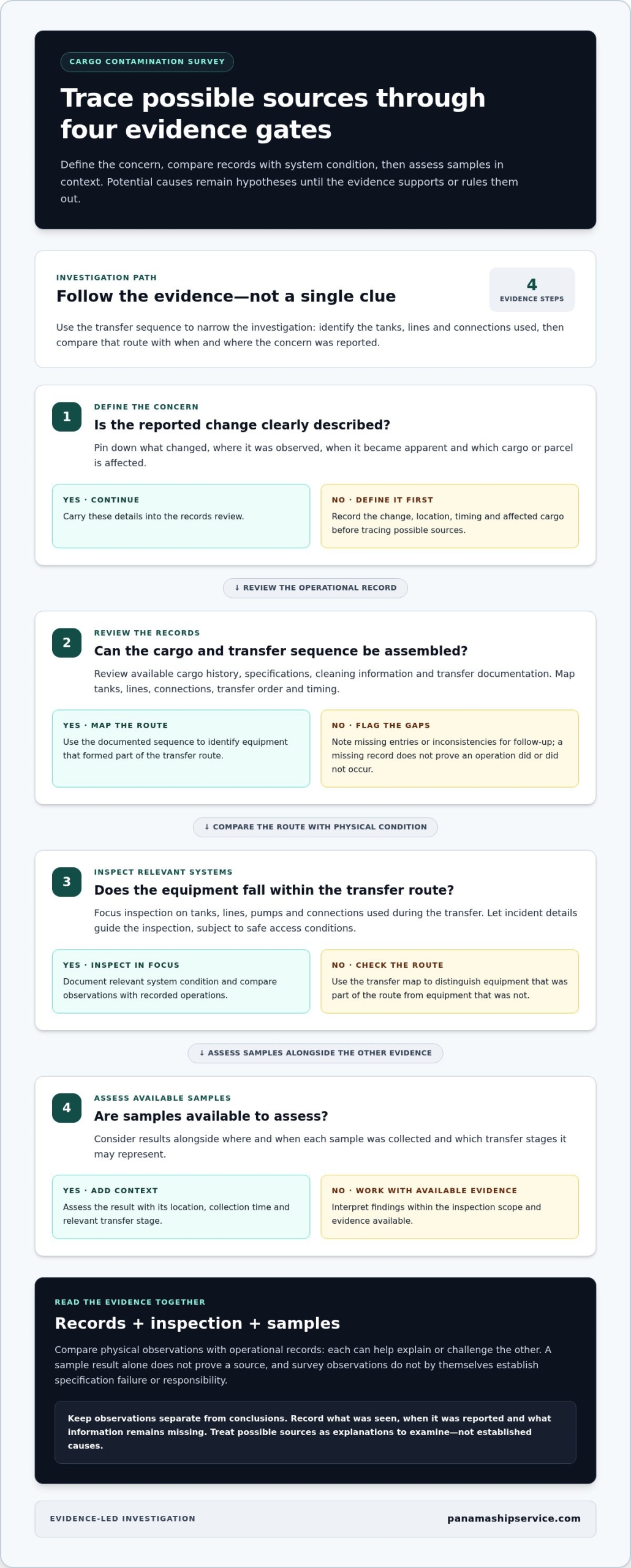
Source analysis works best as a sequence, not a search for a single obvious culprit. The cargo transfer sequence helps narrow the investigation: identify which tanks, lines and connections were used, then compare that route with when and where the quality concern was reported. Possible causes remain hypotheses until evidence supports or rules them out.
A structured investigation can proceed in four steps:
- Define the concern. Record what change was reported, where it was observed, when it became apparent and which cargo or parcel is affected.
- Review the records. Assemble cargo history, specifications, cleaning information and transfer documentation to establish the planned and recorded sequence of operations.
- Inspect relevant systems. Focus the physical inspection on equipment and connections used during the transfer, guided by the incident details and safe access conditions.
- Assess available samples. Consider sample results alongside their location, collection time and the transfer stages they may represent. Don’t treat a result as proof of a source without supporting evidence.
Source analysis is most useful when physical inspection is compared with operational records, because each can help explain or challenge the other. A recorded transfer route, for example, can direct attention to the equipment used. Inspection findings can then be compared with the documented condition and operation of that equipment.
Review cargo history and transfer records
Gather available details for the previous and current cargoes, relevant cleaning records, cargo specifications and transfer logs. Map the operation from loading through the stage when a change was reported. Note the tanks and lines involved, connections used, transfer order and timing. This helps distinguish equipment that formed part of the route from equipment that did not.
Review procedures and records as evidence, not as a complete account by default. A missing entry does not prove that an operation did or didn’t occur. Compare documents with inspection observations and reported events, and flag gaps or inconsistencies for follow-up.
Inspect tanks, lines and transfer equipment
Use the transfer map to focus inspection on relevant tanks, pumps, valves, manifolds, lines and connections. Depending on the incident, investigators may consider visible residue, equipment condition, line configuration or a possible backflow path as leads. These observations guide further examination, but none alone establishes that contamination occurred or identifies its source.
Keep the inspection scope tied to the incident facts and safe access conditions. A concern associated with one transfer route may not justify examining every system on board. Findings should distinguish what was inspected, what was observed and what could not be assessed, so later review doesn’t mistake a limited inspection for a vessel-wide conclusion.
Clear coordination helps align the investigation with vessel operations. Panama Ship Service provides marine survey and operational support on both sides of the Panama Canal and internationally. Explore marine survey and operational support.
How to assess samples, inspections and cargo records together
Evidence is strongest when each item is read in context, not treated as a standalone verdict. A sample can indicate a cargo characteristic at a particular place and time. An inspection records observable conditions. Cargo records help reconstruct what happened during handling. Compare all three, and distinguish a direct observation from an analytical result or a conclusion about cause.
A compact evidence matrix helps make connections and gaps visible:
- Samples: Record the sample’s source, collection time, identification details and available analysis. Note what cargo or transfer stage it represents.
- Physical inspection: Note the area examined, observable condition and inspection limits. Relate findings to the tanks, lines or equipment involved.
- Operational records: Match dated transfer, cleaning and equipment records to the cargo movement. Identify missing entries or inconsistencies without assuming what they prove.
Laboratory analysis may be relevant when the cargo specification or investigation scope calls for it. Interpret any result against the applicable specification and the details of the sample. A result alone may establish a measured property, but it does not necessarily identify when, where or how a change occurred.
What samples can and cannot show
Sample interpretation depends partly on timing, location, handling and identification. A sample collected at one point may not represent every tank, line or stage of a transfer. Compare it with relevant reference samples and cargo specifications where available, while recording any limits on the comparison. Don’t infer that the full cargo system is unaffected from one satisfactory sample or inspection.
Keep the distinction clear: an observation describes what was seen; an analytical result reports what was measured; a causal conclusion explains how the condition may have arisen. Each step needs appropriate evidence. A sample may support or challenge a hypothesis, but it doesn’t automatically establish the source.
Build a coherent evidence record
Build a timeline that aligns dated observations and sample details with the cargo transfer sequence. Include photographs, inspection notes and available cleaning or equipment records as context. Use consistent identifiers for samples, tanks and relevant system components so each item can be matched to the event under review.
Then check whether the evidence agrees. If a record describes a system condition that differs from an inspection observation, preserve both accounts and note the discrepancy. State what remains unresolved rather than smoothing over conflicting information. This makes the cargo contamination survey findings easier to review and keeps conclusions proportionate to the evidence available.
What to do when cargo contamination is suspected
Act promptly, but don’t disturb potential evidence. A measured response helps preserve useful information while the vessel team coordinates operational needs. Follow applicable vessel procedures and safe access requirements throughout any inspection, and keep observations separate from assumptions about cause or responsibility.
Use this sequence to organize the initial response:
- Document the concern. Record when and where the change was first observed, who reported it, the cargo or parcel involved, and the condition described. Note whether the concern arose during loading, carriage or discharge.
- Preserve relevant records. Keep available cargo documents, transfer records, cleaning records, procedures, communications and inspection notes together. Retain existing photographs and identify the equipment or cargo area they show.
- Coordinate sampling. Arrange the next sampling steps with the relevant parties, recording sample source, time and identification details. Avoid treating an isolated result as representative of the entire system.
- Arrange an inspection. Share the incident timeline and relevant transfer route so the inspection can focus on areas connected to the concern. Access must remain subject to vessel procedures and safe conditions.
Preserve evidence and maintain clear communication
Before anything is changed, cleaned or discarded, document its observed condition where safe and operationally appropriate. Record who made each observation and when. Keep documents and notes in an organized incident file, and log later additions so the sequence remains clear.
Coordinate updates among the vessel, cargo stakeholders and survey personnel. Share verified facts, outstanding questions and changes to vessel timing without assigning blame prematurely. A guide to marine surveys in Panama provides broader context for organizing survey requirements around vessel operations.
Address equipment or residue issues separately
Investigation and corrective work are related, but they serve different purposes. Record relevant equipment condition before a repair or cleaning activity alters it, where safe and practicable. If an inspection identifies a mechanical defect, mechanical ship repairs at the Panama Canal address repair planning, which is distinct from assessing cargo evidence.
Residue management is also separate from determining cargo condition. Where residues require disposal, use applicable vessel procedures and keep disposal documentation distinct from sample results and cargo analysis. The guide to MARPOL disposal in Panama covers that operational topic without treating disposal as proof of contamination.
For a cargo contamination survey, a concise incident summary helps focus coordination. Include the vessel’s location and timing, the stage of the operation, the concern observed, records available and inspection objective. Panama Ship Service provides marine surveys and operational support on both sides of the Panama Canal and internationally. Coordinate marine survey support around the vessel’s operational requirements.
Arrange survey support for a Panama Canal transit
Survey coordination during a voyage depends on clear information and practical timing. For a cargo contamination survey, early communication about the vessel’s schedule, incident stage and questions to be addressed helps shape a focused request. Share the current situation even if some details are still being gathered, and distinguish what is known from what remains uncertain.
Prepare a concise survey brief
A concise brief gives the survey team an operational starting point. Include the suspected issue, when it was first reported, the vessel’s location and current schedule, and the stage of loading, carriage or discharge. State the specific question the survey should address, such as which part of the operation or system needs inspection.
- Summarize the concern and relevant dates.
- Provide current vessel timing and the next operational milestones.
- List available cargo documents, transfer records, samples and inspection notes.
- Identify known evidence gaps or access constraints.
This summary helps avoid repeated information requests and supports efficient coordination around a Canal call. If the schedule changes, update the brief so survey planning reflects the vessel’s current position and operational window. Don’t delay initial communication while waiting for every record; note what is available and what may follow.
Coordinate vessel support through Panama Ship Service
Panama Ship Service provides marine surveys and operational and technical support for vessels on both sides of the Panama Canal, as well as internationally. Founded in 1999, the company takes a personalized, cost-conscious approach to vessel support. Contact is available 24/7, helping operators communicate survey requirements as voyage circumstances develop.
Describe the survey objective and operational constraints clearly. Panama Ship Service can discuss survey requirements, provide a tailored quote and coordinate relevant support as part of its broader vessel-service approach. Consolidating operational needs through one partner can simplify communication, while keeping the survey scope aligned with the assignment and information provided.
For a useful first exchange, include the vessel name, location, schedule, incident stage, survey objective and available records. Specify any access limitations or upcoming operational milestones that may affect coordination. Clear details support a practical discussion of the work required, without presuming what the inspection will find or promising a particular outcome.
Request survey support for your vessel through Request survey support for your vessel and share the relevant schedule and incident details to receive a tailored quote.
Turn survey findings into stronger voyage planning
A survey’s value extends beyond the immediate incident when documented findings inform future operational planning. Once the investigation is complete, consider how relevant observations can be carried into cargo handovers, equipment checks and preparation for the next loading operation. Keep confirmed findings distinct from unresolved questions, so future decisions are based on evidence rather than assumptions.
For operators planning a vessel call in Panama, early coordination can help align survey requirements with the voyage’s operational schedule. Share the vessel’s current circumstances and the support needed, then discuss a scope suited to the assignment. A cargo contamination survey can inform decisions, but its conclusions depend on the evidence available and should be considered within the wider operational context.
Panama Ship Service provides marine survey and operational support for vessels around the Canal and internationally. Request survey support for your vessel to discuss your requirements and obtain a tailored quote. Clear planning gives your team a practical next step and a stronger basis for the voyage ahead.
Frequently Asked Questions
What is a cargo contamination survey?
A cargo contamination survey is an evidence-led examination of suspected cargo quality damage. It can help organize observations about cargo condition, related vessel systems and available operational information. The scope matters: a report should make clear what was examined and what evidence was available. Findings from one tank or transfer stage, for example, shouldn’t be read as conclusions about parts of the operation that weren’t assessed.
Can a cargo contamination survey identify who is responsible?
A survey can document evidence relevant to possible causes and timing, but it doesn’t automatically assign responsibility. That assessment may depend on the full facts, records, contractual arrangements and further analysis. A useful report separates what was directly observed from interpretation and unresolved questions. An equipment condition may be documented as a finding, for example, while whether it caused a cargo change requires supporting evidence and consideration of the wider circumstances.
Does cargo contamination always make a shipment unusable?
No. Whether cargo remains suitable depends on its nature, the applicable quality requirements and any confirmed change in condition. A visual difference, such as unexpected colour or appearance, doesn’t by itself establish that a shipment fails its specification. Relevant analysis may help assess quality, but acceptance, further use or other commercial decisions belong to the appropriate cargo stakeholders, guided by cargo requirements and available evidence.
Can contamination occur even after a tank inspection or first-foot sample?
Yes. A satisfactory inspection or first-foot sample reflects the location and time assessed; it can’t rule out every possible issue elsewhere or later in the transfer. An observation from one tank, for example, doesn’t automatically describe another tank or a separate line. Interpret each finding within its actual scope, and consider the transfer arrangement and other available evidence before drawing broader conclusions about the cargo system.
Does a cargo contamination survey always require laboratory testing?
No. Whether laboratory analysis is relevant depends on the suspected issue, cargo specification, available evidence and investigation objective. A visual observation can document appearance, but it shouldn’t be described as an analytical result. If testing is part of the investigation, interpret the result in context, including the sample’s source and timing. The appropriate analysis and its meaning depend on the question being investigated and applicable cargo requirements.
What information should a vessel provide for a contamination survey?
Provide a concise incident brief with the vessel’s schedule, the cargo involved, when the concern arose and the operational question to be addressed. Useful supporting material may include relevant cargo documents, transfer records, sample identifiers and inspection notes. Also identify records that are unavailable or still being gathered. This gives the investigation a clear picture of the known facts without treating gaps in the file as evidence of a particular cause.
How quickly should a suspected cargo contamination issue be reported?
Report the concern promptly to the relevant vessel and cargo stakeholders so the circumstances can be recorded while information is available. Include when the condition was noticed and any related operational stage, then preserve relevant records and follow vessel procedures. There isn’t a fixed response duration that fits every incident; timing depends on the situation, access to evidence and vessel operations. Avoid delaying communication while waiting for a complete investigation file.