
The greener choice usually protects the goods while using less material and creating less waste. Eco-friendly ship supplies can include durable reusable items, recyclable packaging, and biodegradable paper-based materials selected for onboard use and waste-handling requirements. Material choice matters, as do storage, use, and disposal under applicable marine environmental rules.
Performance, cost, and compliance all matter when provisioning a vessel. This guide explains how to compare packaging materials, reduce unnecessary volume, and account for environmental rules that affect marine operations. It also covers the trade-offs of biodegradable and recyclable supplies, helping you make practical purchasing decisions that support vessel operations and waste reduction.
Key Takeaways
- Choose packaging for the cargo and handling conditions, then reduce excess material with right-sized boxes and reusable or recyclable options.
- Compare paper-based choices such as corrugated packaging, paper void fill, and water-activated paper tape by their protective function and disposal route.
- For cleaning products, assess marine suitability and disposal instructions rather than relying on a biodegradable label alone.
- Plan sustainable supply purchases around vessel requirements, delivery logistics, material choice, and order volume.
- Compare total operational value, not just the purchase price: sustainable packaging costs vary by material and volume.
2. Exploring biodegradable materials and package designs
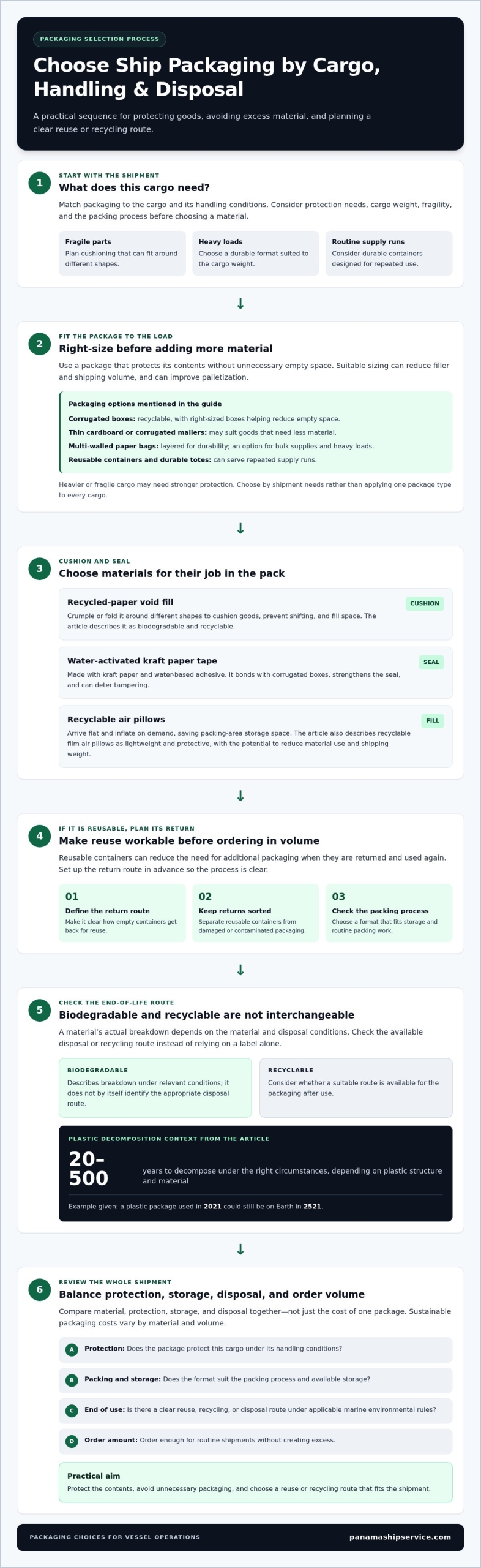
Reusable shipping containers and durable totes can serve repeated supply runs. Corrugated boxes and paper void fill are recyclable options, while recycled paper can cushion equipment. Water-activated kraft paper tape seals corrugated cartons without plastic tape.
Match each package to its shipment. Right-sized corrugated boxes reduce empty space, filler, and shipping volume, while suitable sizing can improve palletization. For fragile parts, recycled-paper void fill can be crumpled or folded around different shapes to cushion goods. It is biodegradable and recyclable.
Water-activated paper tape uses kraft paper and water-based adhesive to bond with corrugated boxes. It strengthens the seal and can deter tampering. Multi-walled paper bags use layers for durability without relying on plastic, making them an option for bulk supplies and heavy loads. Choose based on cargo weight and handling needs.
Biodegradability and recyclability are not interchangeable. Paper-based packaging can be recyclable and biodegradable, but actual breakdown depends on the material and disposal conditions. Plastics can take anywhere from 20 to 500 years to decompose under the right circumstances, depending on their structure and material. A plastic package used in 2021 could still be on Earth in 2521.
Plan a return process for reusable containers before ordering them in volume. For example, businesses can invite customers to return empty containers for reuse, reducing the need for additional packaging. Make the return route clear, and separate returned containers from damaged or contaminated packaging.
For high-volume purchasing, compare material, protection, storage, and disposal together. Recyclable air pillows arrive flat and inflate on demand, saving packing-area storage space. Paper void fill can also be used with dispensers. Choose a format that fits the packing process, then order enough for routine shipments without creating excess.
Eco-friendly packaging costs vary by material and volume, so assess the whole shipment rather than a single package. Thin cardboard or corrugated mailers may reduce material use for suitable goods, while heavier or fragile cargo needs stronger protection. The practical aim is friendly packaging that protects its contents, avoids excess, and has a clear reuse or recycling route. That approach supports sustainability by reducing waste without treating every cargo type alike.
In the same way, eco-friendly shipping means reducing waste and considering the environmental impact of packaging materials. Recyclable and biodegradable options are available for fragile, heavy, and bulk products, so choose according to the shipment’s protection needs rather than relying on a single default. Recycled-paper void fill cushions items, prevents shifting, and is biodegradable and recyclable. Recyclable film air pillows are lightweight and protective, and can reduce material use and shipping weight.
Businesses can encourage recycling by making it easy for customers to return used packaging. A clear return option can help packaging reach an appropriate recycling route while keeping the process simple for customers. The listed items are described as made from 100% recyclable materials. Consider that material claim alongside protection, packing efficiency, and the available return or disposal route when choosing supplies.
3. What eco-friendly supplies are available for ships and boats?
Ship operators can look beyond packaging to supplies used in the galley, cabins, and maintenance areas. Reusable serviceware, refillable containers, recycled-content paper products, and energy-efficient lighting are practical categories to assess. The right choice depends on the task, storage conditions, cleaning routines, and how the item will be disposed of at the end of its service life.
Start with routine consumables. Replace single-use cups and cutlery with durable items that can be washed and reused onboard. In cabins, use refillable soap dispensers instead of repeatedly replacing small bottles. For office and recordkeeping needs, recycled-content paper and refillable writing tools can reduce disposable supplies. Choose products that suit the vessel’s cleaning and storage procedures.
- Galley: Reusable plates, cups, cutlery, and food-storage containers can serve repeated meal and provisioning cycles.
- Cabins: Refillable dispensers and washable cloths can reduce the turnover of small, disposable items.
- Maintenance: Durable hand tools and rechargeable work lights can replace some single-use or frequently discarded alternatives.
- Office: Recycled-content paper, refillable pens, and digital forms can limit routine disposable supplies.
- Deck operations: Reusable buckets and cleaning tools can support recurring work without repeated replacement.
Evaluate each item across its full use cycle, not by its label alone. For a rechargeable work light, consider access to charging, battery replacement, and repair options. For washable cloths, plan where crews will store used items and how they will be cleaned. A reusable product reduces waste only when it remains practical to maintain and use.
Build a supply list around tasks and storage locations. Separate galley, cabin, deck, and maintenance stock, then note which items are reusable, refillable, or made with recycled material. This clarifies ordering and helps crews return reusable items to the right work area. It also shows where a disposable product still serves a specific operational need.
For each proposed substitute, compare function, durability, cleaning requirements, and disposal route. A product that works in a cabin may not suit a wet deck or maintenance task. Trial a small quantity in its intended setting, gather crew feedback, and update the purchasing list before making it a routine supply. This keeps environmental aims aligned with onboard operations.
When building a vessel’s inventory, ship supplies can be organized around the work crews perform and the spaces where items are used. A clear category list helps align purchasing with practical onboard requirements.
4. Which biodegradable cleaning products are safe for marine use?
A biodegradable label alone does not show that a cleaner is suitable for use aboard a vessel. Choose products based on their stated purpose, ingredients, dilution instructions, and disposal guidance. A cleaner for galley surfaces may have different requirements from one for deck equipment or a machinery space.
Use a practical screening process before adding a product to the cleaning locker. Read the container and safety data sheet, then match the instructions to the surface and task. Confirm, for example, that the product is intended for the material being cleaned, and follow its stated dilution and handling directions. Don’t infer marine suitability from terms such as “natural” or “plant-based.”
- Galley detergent: Review the label for dishwashing directions, dilution, and disposal instructions before use near food-preparation areas.
- Deck cleaner: Match the product to the deck material, soil type, and stated application method.
- Cabin cleaner: Select a product intended for the surface, such as hard counters or washable fittings.
- Bilge or machinery-area cleaner: Read the safety data sheet and disposal guidance carefully before introducing any chemical to the area.
- Concentrated cleaner: Measure and dilute it exactly as directed instead of applying extra product.
Keep cleaning water and chemical residues out of the sea unless the vessel’s applicable procedures allow that specific discharge. Collect used cleaning solutions when required by onboard waste-handling practices, and keep them separate from clean water. This is especially important after removing oil, grease, paint residue, or other contaminants from tools and surfaces.
Give crew members a simple product record that notes each cleaner’s intended use, dilution directions, storage location, and disposal instructions. Keep the original label accessible, and store incompatible products separately according to their handling guidance. For example, don’t pour an unidentified leftover mixture into another container.
Test a new cleaner on a small, inconspicuous surface if the product instructions permit it. Check for discoloration, residue, or damage before using it over a larger area. Then assess whether it achieved the required cleaning result at the directed concentration. Using more than directed can increase residue and complicate onboard handling.
For marine operations, choose a product with clear, task-specific directions and a disposal route crews can follow. Treat biodegradability as one selection factor alongside surface compatibility, handling instructions, and waste procedures. This makes purchasing decisions more precise and helps crews use each cleaner consistently.
A biodegradable label does not establish that a product is suitable for marine use, and “natural” or “plant-based” claims are not enough. Check the product’s intended use, ingredients, dilution directions, and disposal guidance.
5. Where can U.S. ship operators buy sustainable marine supplies?
U.S. ship operators can source sustainable supplies through marine chandlers, ship-supply distributors, packaging wholesalers, and manufacturers. The best route depends on the item, delivery point, quantity, and vessel schedule. A nearby port supplier may suit urgent replenishment, while a manufacturer or wholesaler may fit planned bulk orders. Identify the product category first, such as reusable galleyware, recycled-content paper, or recyclable packaging.
Online procurement platforms can help purchasing teams search across product categories and coordinate orders between departments. Use product specifications, rather than broad search terms, to narrow results. Record the material, intended use, order quantity, delivery point, and required arrival window. Apply the same criteria to supplier quotes so teams can compare equivalent items.
For a reliable sourcing workflow, follow these steps:
- Map demand: Group recurring needs by galley, cabin, deck, maintenance, and packaging use.
- Set criteria: Note required function, preferred material, storage limits, and disposal route for each item.
- Choose a channel: Use a port-area chandler for coordinated vessel provisions, or a wholesaler for planned volume orders.
- Compare quotes: Review specifications, pack size, delivery location, and order quantity together.
- Record the selection: Save the chosen product details in the purchasing list for repeat orders.
Delivery logistics matter as much as the product. A sustainable item that arrives after the vessel’s planned call won’t meet the operational need. Match the delivery point to the vessel’s port call, and keep a backup specification for critical consumables. For shore-side teams and operations coordinating time-critical parcels or replacement parts, consulting logistics resources such as Postal Xpress N More can help clarify carrier options and delivery requirements. For example, define acceptable paper-based packaging formats before placing a time-sensitive order.
Separate supply sourcing from environmental compliance decisions. A supplier’s product description identifies its material and use, while onboard procedures determine handling and disposal. Keep labels and product documentation with purchasing records, especially for cleaning materials or items used near waste streams. This gives crews a practical reference for use and future replenishment.
Organize sustainable purchasing around repeatable specifications, delivery coordination, and usable quantities. This helps teams source suitable supplies without disrupting provisioning schedules or filling limited storage with products crews cannot use.
5. How much do eco-friendly ship supplies cost compared with conventional products
There is no single price difference between sustainable and conventional marine supplies. Sustainable packaging costs vary by material and volume, so compare equivalent products and order sizes. Recycled-paper products and reusable containers have different purchase and use patterns. A fair comparison uses the same function, quantity, delivery requirements, and protection needs.
Purchase price is only one part of operating cost. A reusable item may require cleaning, storage, and return handling, while a disposable alternative requires repeat purchasing. For example, compare a reusable galley container over its expected service cycle with disposable containers bought for the same purpose. Include handling time and replacement needs, not just the initial invoice.
- Material: Compare products with the same practical purpose, such as paper void fill and another protective filler.
- Order volume: Check how case size and purchasing quantity affect unit cost and storage demand.
- Use frequency: Estimate how often a reusable item returns to service before replacement.
- Waste handling: Consider whether a recyclable or reusable format fits the vessel’s disposal process.
- Shipment design: Assess whether lighter or right-sized packaging can reduce shipment weight and volume.
For packaging, test the complete configuration. A right-sized corrugated box may need less filler than an oversized one, while a fragile part may require extra cushioning. Compare each option using the same cargo and handling conditions. Track damaged goods, packaging use, and unused material across repeat shipments. These records show whether a lower unit price also meets operational needs.
Volume changes the comparison. A supplier’s price can depend on material and order quantity, while large orders may require more storage and create excess stock. Compare the cost of the amount used with the cost of the amount purchased. For example, a bulk order that takes up scarce storage may not suit a vessel with limited capacity.
Market research reports that over two-thirds of purpose-driven shoppers would pay a premium of 35% or more for sustainable purchases, including recycled or eco-friendly goods. That consumer finding is not a marine procurement benchmark. Ship operators should base purchasing decisions on actual specifications, quantities, use cycles, and onboard handling needs.
Build a simple comparison sheet with product, material, order volume, expected use, storage demand, and disposal route. Review it alongside supplier quotes for equivalent items. To align procurement with vessel requirements, discuss ship supply needs with Panama Ship Service.
Total operational expenses depend on the full use cycle, replacement rates, and storage demand. Keep estimates separate from confirmed costs, and revisit them when purchasing quantities or onboard requirements change. Survey findings may inform a wider business case, but they do not establish a marine product premium or guarantee savings: 87% of consumers said they would have a more positive image of a company that supports environmental issues, and 92% of consumers said they would be more likely to trust a company that supports environmental issues. Treat those responses as context rather than a substitute for comparing equivalent supplies, actual invoices, use, and handling.
Panama Ship Service: Mechanical Ship Repairs
Panama Ship Service provides Mechanical Ship Repairs for vessels requiring mechanical attention during operations. Sustainable supply decisions support day-to-day work, while repair needs call for technical service. Turn to mechanical repairs when equipment problems affect vessel readiness or planned operations. For hull-related requirements, Underwater Hull Services address work below the waterline, while Marine Surveys support vessel assessments. MARPOL Disposal is available for disposal needs.
These services support operational and technical needs alongside supply planning. Identify the vessel’s requirement and how it relates to the operating schedule to determine the next step. For a mechanical issue, share the repair need; for a hull concern, describe the underwater service required. Contact Panama Ship Service to discuss your vessel’s operational needs.
Put Your Supply Decisions Into Practice
Make sustainability part of the vessel’s routine purchasing process. Assign responsibility for reviewing specifications, tracking repeat orders, and keeping crew procedures aligned with onboard supplies. This turns individual purchasing choices into a consistent operational practice and makes future decisions easier to manage.
Supply planning is only one part of vessel readiness. When operational work also needs attention, Panama Ship Service offers Mechanical Ship Repairs, Underwater Hull Services, and MARPOL Disposal. These services address distinct vessel requirements alongside supply planning. Choose the next step based on the work your vessel needs, then coordinate it with your operational schedule.
Take the next step with a clear view of your vessel’s priorities. Discuss how eco-friendly ship supplies fit into your broader operating needs, and identify any technical or disposal requirements that also need attention. Contact Panama Ship Service today to discuss your vessel’s requirements and move forward with confidence.
Frequently Asked Questions
How can a vessel reduce single-use plastics and packaging?
Start with a vessel-wide audit of disposable items, then remove avoidable packaging from recurring orders. Ask suppliers to combine compatible goods into fewer shipments and avoid extra wrapping where cargo protection allows. Set up clearly marked collection points near the galley, stores, and work areas so crews can promptly sort reusable containers and recyclable packaging. Review disposal records alongside the purchasing list, then target items that generate the most repeat waste.
What certifications or labels indicate that marine products are environmentally safe?
A biodegradable, “natural,” or “plant-based” label alone does not establish marine suitability. Check the product’s stated purpose, ingredients, handling directions, and disposal guidance.
Are eco-friendly paints, lubricants, and antifouling coatings effective and compliant?
Applying the correct anti-fouling paint to the appropriate hull area can result in fuel savings of 3-8%.