
The quickest repair isn’t always the most cost-effective. Managing unexpected ship repairs starts with assessing the fault, its effect on vessel safety and operations, and what needs attention before agreeing on a repair plan. Clear findings help prioritize urgent work and limit avoidable delays.
An unexpected breakdown can disrupt schedules and put pressure on decisions about repairs, parts, and downtime. A structured response helps separate immediate needs from work that can be planned, while keeping owners, operators, and repair teams aligned.
This guide explains how to review equipment condition and maintenance history, work effectively with repair teams, and document inspection findings. It covers planning around vessel operations and dry-docking, then compares practical ways to manage repair time and costs. The aim is to support informed decisions from the first assessment through completion.
Key Takeaways
- Use maintenance records and equipment condition to distinguish urgent faults from work that can be scheduled.
- Keep repair teams and vessel stakeholders aligned with clear updates, defined priorities, and written approvals for added work.
- Record inspection findings with photos or videos so the repair scope and any changes are easy to review.
- Plan repairs around vessel operations, port access, and dry-dock requirements to reduce avoidable disruption.
- Compare repair options by considering downtime, parts, turnaround time, and the long-term value of the work.
1. Checking equipment condition and maintenance history
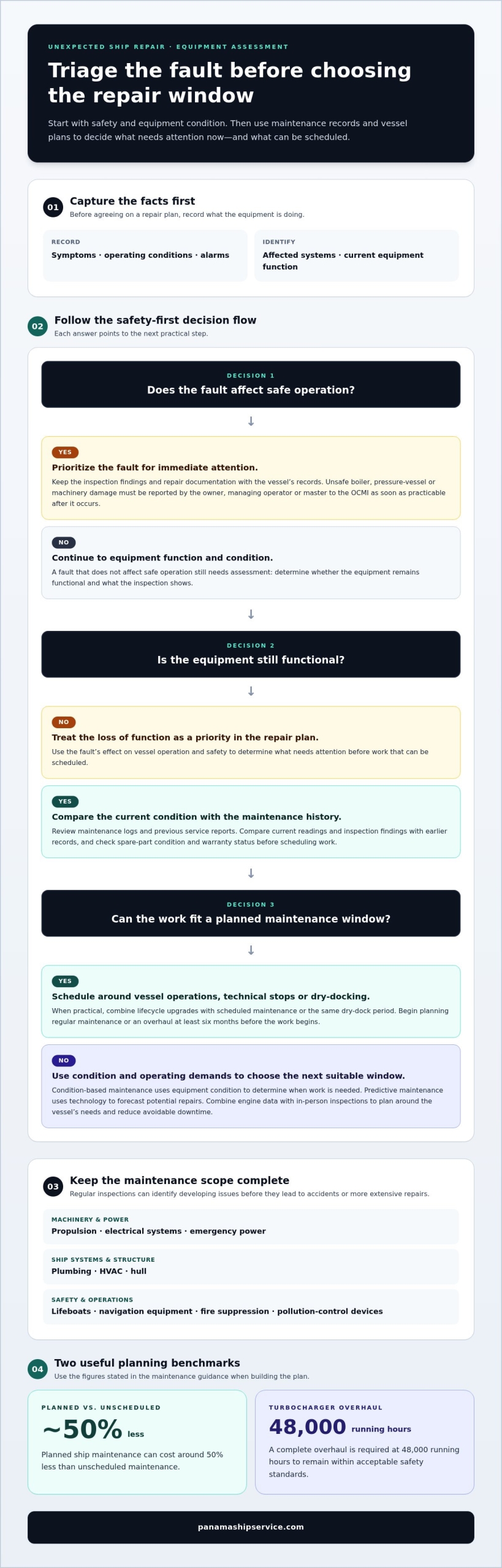
When a ship has an unexpected repair issue, first assess the fault, its effect on safe operation, and whether the equipment remains functional. Record symptoms, operating conditions, alarms, and affected systems before deciding what needs immediate attention. Check the maintenance log and previous service reports for related failures or recent work.
To help prevent recurring failures, compare inspection findings with maintenance history, then schedule work around equipment condition and operating demands. Regular inspections can identify developing issues before they cause an accident or lead to more extensive repairs. Include propulsion, electrical, plumbing, HVAC, hull, lifeboats, navigation equipment, fire suppression, and emergency power systems.
Plan technical stops around known maintenance needs instead of waiting for a breakdown to dictate timing. Ship operators should ideally begin planning regular maintenance or an overhaul at least six months before the work begins. Routine tasks can include oil changes and alignment checks. A turbocharger requires a complete overhaul at 48,000 running hours to remain within acceptable safety standards.
Condition-based maintenance uses equipment condition to determine when work is needed, while predictive maintenance uses technology to forecast potential repairs. Combine engine data with in-person inspections, then prioritize findings by their effect on operation and safety. These approaches can help operators choose a suitable maintenance window and reduce avoidable downtime.
- Compare current readings and inspection findings with earlier service records.
- Review spare-part condition and warranty status before scheduling maintenance.
- Include safety equipment and pollution-control devices in the maintenance programme.
Accurate records also support insurance and compliance decisions. Ship owners should keep maintenance logs and records of completed work as evidence of upkeep. According to the Office of the Federal Register, the owner, managing operator, or master must report unsafe boiler, pressure-vessel, or machinery damage to the OCMI as soon as practicable after it occurs. Keep inspection notes and repair documentation with the vessel’s records.
Use planned maintenance to coordinate upgrades with scheduled work, including the same dry-dock period when practical. Combining lifecycle upgrades with regular maintenance can reduce downtime costs by avoiding a separate work period. Planned ship maintenance can cost around 50% less than unscheduled maintenance, making early identification and sound records useful tools for controlling disruption.
Planned ship maintenance can cause downtime, so use records to guide decisions rather than relying on a single inspection. Before arranging equipment work, review maintenance history, logs, and previous service reports. Regular maintenance schedules can help prevent unexpected breakdowns, while preventive maintenance can identify issues before they escalate. Ship repair and maintenance is a proactive process of inspecting key onboard systems regularly and carrying out necessary work to keep them in optimum working condition.
Condition-based maintenance can help operators extend engine overhaul intervals and schedule work at a convenient time. Data-driven ship maintenance combines vessel and engine data analysis with in-person inspections to plan maintenance. Together, these approaches relate equipment condition to maintenance timing and help plan work around the vessel’s needs. Regular preventive maintenance can identify issues before they escalate, rather than waiting for a fault to require attention. Reviewing records alongside inspection findings keeps maintenance planned and focused on onboard systems.
2. Building relationships with repair service providers
A reliable working relationship starts before a failure. Give the repair team an up-to-date equipment list, maintenance history, vessel schedule, and clear description of the fault. Include recent photographs when they show the affected area. These details help the team prepare for the vessel’s condition and reduce delays caused by missing information.
Set communication expectations early. Agree who can approve work, which channel to use for urgent updates, and how findings will be reported. Owners, operators, and the master should know who coordinates decisions. A clear contact chain prevents conflicting instructions when repairs affect vessel operations.
Define the working arrangements in writing before routine work begins. A service agreement can describe the repair scope, responsibilities, reporting process, access requirements, and how added work is approved. For unexpected repairs, record the initial scope and any changes separately. The repair team should explain why additional work is needed, its operational effect, and the revised estimate before proceeding.
Repair time depends on the fault, diagnosis, equipment access, technician availability, and parts readiness. Ask for a work sequence with milestones such as inspection, fault isolation, parts confirmation, repair, and testing. If the vessel schedule changes, share the new arrival or departure window promptly. This helps coordinate the work around operational constraints without treating an estimate as a guaranteed completion time.
Ships should carry spare parts and contingency supplies based on installed equipment, maintenance history, and the consequences of component failure. Use equipment manuals and the vessel’s parts inventory to identify compatible critical spares. Check each item’s condition and warranty status, and keep identifying details available for replacement orders. Crews can use parts from failed or redundant units when suitable, while shore teams can help identify requirements.
For specialized machinery, involve the original equipment manufacturer (OEM) when its technical knowledge, parts specifications, or repair procedures are relevant. Share model details and equipment records with the repair team so components can be matched correctly. Keep the vessel operator informed if OEM guidance changes the proposed scope or testing process.
Consistent coordination makes repair work more efficient. For vessels whose repair planning also involves parts readiness, ship repair and supply coordination can connect the work scope with operational needs.
Ship owners can build relationships with marine service providers to support efficient repairs. At the start of a job, providers should request recent vessel photos and may ask new customers for a survey of the vessel’s maintenance history.
Providers should update customers when they arrive on site or check in the vessel, so customers know work has begun and when to expect an update. Ship operators and repair teams can use clear communication channels to report issues quickly and expedite repairs.
3. On-site inspection and documentation
Assess urgency by identifying whether the fault affects the hull, propulsion, steering, electrical supply, navigation, fire suppression, or emergency power. Compare the affected system’s current function with the vessel’s operating needs, then prioritize findings that compromise safe operation or risk further damage.
Start the on-site inspection with the reported fault, but don’t stop there. A qualified repair team should examine surrounding components and related systems, since damage beyond the initial symptom can change the repair scope. For example, inspect nearby connections if a pump failure follows a leak.
Capture evidence throughout the inspection. Take clear photos or videos of the affected equipment, its surroundings, visible damage, and identification plates. Note the location, symptoms, operating conditions, and any readings taken. A consistent record helps owners compare findings with maintenance reports and understand why the repair plan changes.
- Record the reported problem and the crew’s observations.
- Document visible damage and related components with photos or video.
- Note inspection findings that differ from the reported condition.
- Link each finding to a proposed repair or further diagnostic step.
Compare the actual condition with the information used for the initial estimate. If the inspection reveals a discrepancy, explain promptly what changed and how it affects the scope and estimate. Separate the originally requested work from newly identified repairs so decision-makers can distinguish tasks addressing the immediate fault from those intended to prevent related failures.
Before proceeding with additional work, provide a revised estimate and obtain written customer approval. Explain why each added repair is necessary and describe its operational benefit. This gives owners a clear decision point, limits misunderstandings, and ensures an inspection finding is not treated as automatic authorization.
Use the inspection record to assess disruption as well as equipment condition. Identify which systems must be isolated, what access the work requires, and whether testing can confirm the repair. For example, document the fault location, work completed, and test results for a repaired electrical connection. This information supports handover and helps the crew monitor the system afterward.
A post-repair report should summarize completed work and include before-and-after photos. Keep it with the vessel’s maintenance records, then compare future inspection findings with the documented repair. The record can reveal recurring faults, guide maintenance planning, and reduce repeated diagnosis or unnecessary replacement.
4. Repair planning around vessel operations and dry docking
An unexpected fault can disrupt an operating schedule, so first map the repair against the vessel’s next port calls, cargo work, and departure commitments. Identify which systems must be restored before sailing and which tasks can be completed during a planned stop. This separates immediate operational needs from work that can wait for a later maintenance window.
If repairs cannot be completed at the current port, options include arranging a temporary repair onboard, diverting to another port for technicians or spare parts, or scheduling permanent work at a suitable facility. The master and operator should weigh the fault’s effect on safe operation, parts availability, crew capability, and repair access at the next port.
Ship crews can carry out repairs at sea when they have the necessary skills and parts. Shore teams can also provide step-by-step repair guidance. If a permanent repair cannot be completed underway, a temporary or jury-rigged fix may allow the vessel to return to port for further work.
Some jobs require a controlled repair environment. High winds, salt spray, and vessel movement make exterior hull painting near the waterline difficult to carry out safely at sea. A shipyard can sandblast hull sections to bare metal in a contained environment, then apply epoxy paint or antifouling coatings under suitable dry conditions.
Plan major overhauls well ahead of the operational window. Ship operators should begin planning a major overhaul around 12 to 18 months before work begins. That lead time supports coordination of the scope, materials, tools, equipment, personnel, and vessel schedule. It also gives operators a chance to combine lifecycle upgrades with scheduled maintenance.
For near-term coordination, a four-week look-ahead schedule can identify people, materials, tools, equipment, information, and worksite conflicts. Use it to match each task with access and resource needs. For example, a hull coating job requires dry conditions and curing time, while machinery work may need technicians and replacement parts ready before the vessel arrives.
Use dry docking for work that depends on hull access or cannot be completed afloat. Workers can replace sacrificial zinc anodes attached to the hull while the vessel is out of the water. Grouping suitable hull tasks within the same docking period can reduce repeated scheduling disruptions.
- Match each repair to the vessel’s route, port call, and operating requirements.
- Confirm required people, parts, tools, and worksite access in the schedule.
- Separate temporary repairs from permanent work planned for port or dry dock.
5. Marine service trends and cost-effective solutions
Cost-effective decisions consider more than the immediate repair scope. Ship owners managing unexpected ship repairs should weigh turnaround time, downtime, repair frequency, and customer satisfaction together. A repair that takes longer but prevents repeat faults may be more efficient than a quick temporary fix. Track these measures across completed jobs to see whether the chosen approach improves vessel availability.
Build a detailed scope and separate essential repairs from optional improvements. For each task, identify the fault it addresses, its operational effect, and how completion will be tested. If inspection reveals extra work, compare the revised scope with the original findings. Obtain written approval before proceeding so each decision is tied to documented needs.
Parts readiness affects repair quality and schedule. Match replacement parts to equipment specifications, then consider availability and delivery method. Sea freight is usually the cheapest and most environmentally friendly way to transport ship parts compared with air freight. However, the delivery method must fit the repair schedule, since delays can keep critical equipment unavailable.
Technology can support diagnosis and work planning. Predictive maintenance uses equipment data to forecast potential repairs, while in-person inspection assesses actual condition. Technicians trained in current technologies and innovative repair techniques can help reduce repair time. Choose an approach based on the fault, equipment, and required outcome.
Crews may use parts from failed or redundant units to restore critical equipment, provided the component is compatible and suitable. A do-it-yourself repair may suit tasks within crew skills and onboard resources. Complex machinery or safety-critical systems need appropriate technical expertise and robust safety protocols. Managing unexpected ship repairs effectively means matching the method to the risk, not choosing solely for speed.
When downtime is tight, operators can consider two work shifts to optimize workforce operations. This requires coordinated task sequencing, safe handovers, and access to tools and materials. At each shift change, record completed tasks, outstanding issues, and the next work step. These measures make managing unexpected ship repairs more organized without compromising continuity.
Marine service options also include hull-related work. Regular hull and propeller cleaning can improve vessel efficiency and reduce fuel consumption. If underwater condition affects repair planning, arrange underwater hull services to assess the hull alongside other operational needs.
Review outcomes after each repair. Compare planned and actual turnaround, downtime, recurring faults, and customer satisfaction. These measures show whether the strategy is delivering durable results or whether parts planning, inspection intervals, or work sequencing need adjustment. The most cost-effective choice addresses the fault, limits repeat work, and fits the vessel’s operating needs.
Panama Ship Service: Mechanical Ship Repairs
Panama Ship Service provides Mechanical Ship Repairs for vessels needing technical repair support during operations at the Panama Canal. Use the service when an equipment fault needs assessment and repair planning around the vessel’s schedule. For hull-related concerns, Underwater Hull Services and Marine Surveys support inspection and condition assessment. MARPOL Disposal is also available when waste handling is part of the vessel’s operational needs.
Prepare the fault description, relevant maintenance records, and inspection findings before arranging the next step. These details help connect the repair need with the vessel’s operational priorities. To discuss repair support for your vessel, contact Panama Ship Service.
Make the next repair decision with confidence
Use the next maintenance decision to strengthen vessel readiness, not just close out the immediate fault. A clear record of what was repaired, why it was needed, and what should be monitored gives the crew a practical reference for future operations. That discipline makes managing unexpected ship repairs part of a consistent approach to vessel reliability.
When repair or inspection support is needed, Panama Ship Service offers Mechanical Ship Repairs, Underwater Hull Services, and MARPOL Disposal. These services support different operational needs, from mechanical faults and underwater hull concerns to waste handling.
Keep the repair scope and vessel priorities at the center of the next conversation. Contact Panama Ship Service to discuss support for your vessel. A clear next step helps you move forward with an informed repair plan.
Frequently Asked Questions
How can you find and vet emergency ship repair yards and marine contractors?
Match the repair team’s technical capabilities to the fault, vessel type, and work location. For a propulsion fault, relevant mechanical repair experience matters; for hull damage, inspection and underwater access may be central. Review the proposed scope, parts plan, work sequence, and reporting arrangements together. Confirm the team can coordinate with vessel personnel and provide documentation for the owner’s maintenance records.
How long do common unexpected ship repairs take, and how can downtime be reduced?
Repair duration depends on diagnostic certainty, equipment access, parts readiness, repair scope, and testing requirements. A straightforward component replacement differs from a fault requiring connected machinery to be dismantled or a specific part to arrive. Reduce downtime by sharing equipment details early, aligning access and materials with the repair sequence, and preparing a temporary operating plan for affected systems while permanent work proceeds.
What regulations and class society rules apply to emergency ship repairs and returning to service?
Applicable requirements depend on the vessel, its flag, class status, and the damaged system. Identify relevant notification, inspection, testing, and approval steps before considering repairs complete. According to the Office of the Federal Register, the owner, managing operator, or master must report unsafe boiler, pressure-vessel, or machinery damage to the OCMI as soon as practicable after it occurs. Retain evidence of required checks and approvals.
How should shipowners manage repair approvals, vendor contracts, and documentation during an emergency?
Name a decision-maker and set written authorization limits so urgent work doesn’t stall over unclear approval authority. Record each decision’s time, approver, scope, and operational reason in a shared repair log. Keep the purchase order, revised work scope, invoices, parts identifiers, test results, and handover notes together. Separating technical acceptance from operational approval also makes the final record easier to review and use in future maintenance planning.