
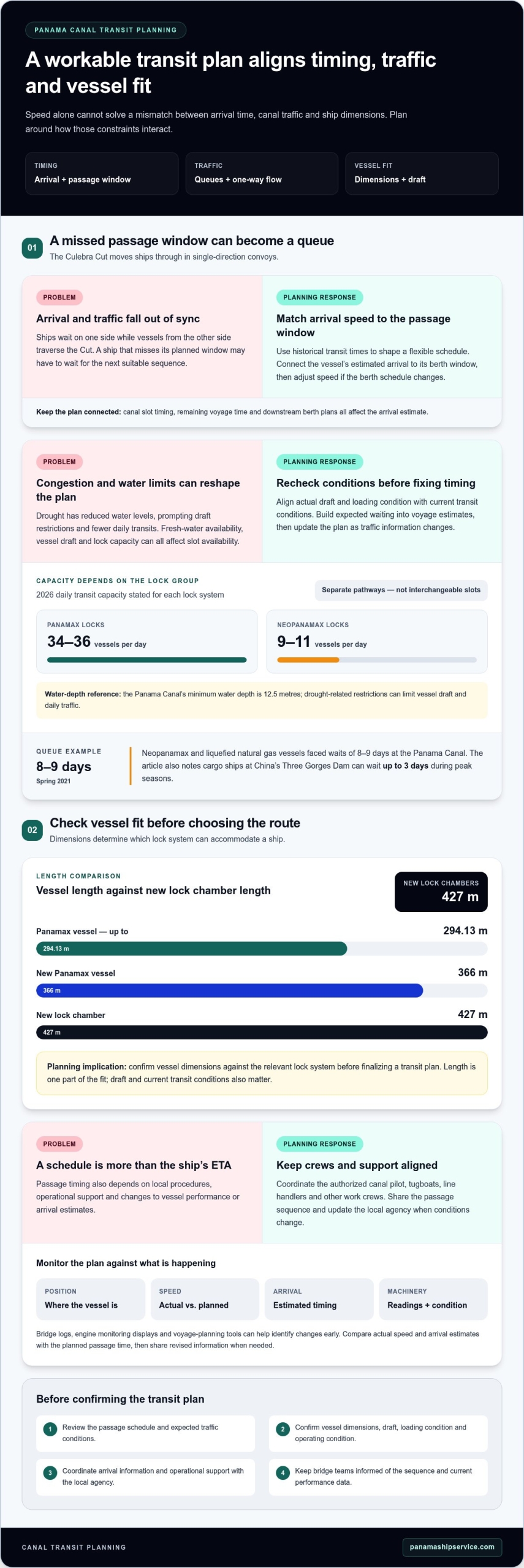
A faster ship isn’t automatically a better-scheduled ship. Optimizing vessel performance for canal transit means coordinating arrival speed and passage timing with congestion and the vessel’s dimensions. Panama Canal lock fit matters: Panamax vessels can be up to 294.13 metres long, while New Panamax vessels are 366 metres long; the new lock chambers are 427 metres long.
When a transit window is tight, it is easy to focus on sailing speed. But speed alone cannot resolve a mismatch between arrival time, canal traffic, and vessel size. A well-coordinated schedule considers how these factors interact, helping operators make informed timing and performance decisions.
This article explains how scheduling systems and one-way traffic through the Culebra Cut affect passage timing, how congestion and speed shape transit plans, and why vessel dimensions determine which locks can accommodate a ship. It also shows how coordinating these factors can support more efficient canal operations.
Key Takeaways
- Coordinate arrival plans with canal traffic patterns and operational resources to reduce scheduling conflicts at bottlenecks.
- Factor congestion and water availability into passage planning, since delays can change the most efficient operating plan.
- Balance sailing speed against the required arrival time, vessel type, cargo, and weather conditions.
- Assess vessel dimensions against the lock system before finalizing a transit plan; size affects which route and passage options are practical.
- Track fuel use, arrival-time performance, and time spent waiting to identify where scheduling decisions affect vessel efficiency.
Coordinating vessel schedules at waterway bottlenecks
At a canal bottleneck, an efficient voyage depends on matching vessel arrival, passage windows, and traffic flow. Historical transit data can make schedules more practical than speed targets alone.
The Panama Canal Authority’s new system was intended to use historical operational data, including transit times, to improve customer timing and slotting information. Operators can use this information to build a flexible plan around expected passage conditions. It does not remove constraints such as one-way traffic, vessel dimensions, or changes to arrival estimates.
The Culebra Cut shows why coordination matters. Ships pass through it in single-direction convoys, so vessels wait on one side while ships entering from the other side traverse the Cut. A vessel that misses its planned window may have to wait for the next suitable sequence. Matching arrival speed to the passage window can reduce avoidable waiting and help align the voyage with downstream berth plans.
Virtual port arrival connects a vessel’s estimated arrival with its berth window before it reaches port. Operators can adjust sailing speed as the berth schedule changes, rather than arriving early and waiting at anchor. For example, if a berth window shifts, the revised plan can account for remaining voyage time, canal slot timing, and the ship’s ability to change speed. This coordination links port readiness to the canal schedule.
Agency and Transit Coordination
Agency and transit coordination aligns vessel timing and operational support with local canal procedures. A passage schedule depends on more than the ship’s arrival: the Panama Canal requires an authorized canal pilot for the vessel’s category, and operations schedule tugboats, line handlers, and other work crews. Coordinating these elements gives crews a shared transit plan and helps them respond when timing changes.
Before canal transit, crews should review the passage schedule, confirm the vessel’s dimensions and operating condition, and coordinate arrival information with the local agency. They should also ensure bridge teams understand the planned sequence and have current vessel-performance data available.
The main safety and machinery risks include equipment failure, loss of propulsion or steering, and poor coordination during close-quarters operations. Machinery failure accounts for nearly 50% of maritime accidents, so crews should monitor critical systems and report changes promptly.
Performance Monitoring Data and Tools
Performance monitoring uses vessel position, speed, estimated arrival, machinery readings, and transit-time records to compare the operating plan with actual conditions. It matters because updated information can show whether a vessel remains aligned with its slot and berth window. Bridge logs, engine monitoring displays, and voyage-planning tools help crews identify changes early and communicate a revised estimate.
For example, compare actual speed and arrival estimates with the planned passage time, then update the agency if conditions change. Historical transit times inform future schedules, while live vessel data guides decisions during the current voyage. Together, these checks connect maritime operations to the constraints at each bottleneck.
Waterway congestion at canals, locks, dams, and terminals
Congestion can change a vessel’s passage window, fuel plan, and arrival sequence. At the Panama Canal, drought has reduced water levels, prompting draft restrictions and fewer daily transits. Operators should treat congestion as an operational constraint, not simply a delay to absorb after arrival. An accurate plan accounts for vessel draft, lock capacity, available water, and updated transit timing.
Capacity differs by lock system. In 2026, the Panama Canal’s Panamax locks maintain capacity for 34 to 36 vessels per day, while Neopanamax locks handle 9 to 11 vessels per day. These figures describe different lock groups, not interchangeable slots. A vessel’s dimensions and transit requirements determine which capacity is relevant, so schedules need to reflect the correct lock pathway.
Waiting can also affect the commercial decision. In spring 2021, Neopanamax and liquefied natural gas vessels faced waits of 8-9 days at the Panama Canal. A vessel facing a four-day anchorage wait may compare the delay with an auction option, but the right choice depends on charter commitments, arrival priorities, and operating costs. The schedule should account for both the expected queue and the value of arriving within the required window.
Water depth adds another planning constraint. The Panama Canal’s minimum water depth is 12.5 metres, while drought-related restrictions can limit vessel draft and daily traffic. A deeper-draft ship may need to adjust loading or revise its passage plan when permitted draft changes. Crews should align the vessel’s actual draft and loading condition with current transit conditions before fixing the schedule.
Fresh water is also an operational resource. Panama Canal locks use fresh water during vessel passage, so availability affects planning alongside traffic demand. When water levels fall, authorities may reduce transits or impose draft limits. These constraints can shift slot availability and make an earlier arrival estimate less useful.
Congestion isn’t unique to canals. Cargo ships at China’s Three Gorges Dam can wait up to 3 days during peak seasons. The example shows how a queue at a lock or dam can disrupt downstream port calls, even when the vessel itself is ready to proceed. Build the expected waiting period into voyage estimates, then update the arrival plan as traffic information changes.
Terminal congestion can trigger a similar chain reaction. If a berth is not ready, a vessel may arrive before it can discharge or load, losing time that could have been managed by adjusting speed en route. Coordinate the terminal window with canal passage timing, and revise the vessel’s estimated arrival when berth availability changes.
That event illustrates why contingency planning should consider alternate timing and route options, not just the planned passage. Vessels rerouted around South America may travel thousands of extra nautical miles, so compare the added distance with the likely delay.
For a Panama passage, align local operational details with the changing transit window through Panama Canal passage coordination. Keep draft, lock pathway, water conditions, queue estimates, and berth readiness in one schedule, then update it when any constraint changes.
Joint optimization of sailing speeds and passage times
Speed planning works best when it accounts for the passage window, fuel demand, and vessel capability together. An efficient schedule balances arrival requirements against conditions that may change during the voyage.
Canal Speed Limits and Operating Rules
Canal speed limits and operating rules are passage constraints set for each waterway and its operating conditions. They matter because a vessel cannot treat open-water speed as its target throughout a canal transit. Operators should use the applicable transit instructions to plan an achievable speed profile, then align it with traffic, vessel category, and the assigned passage sequence.
Limits and procedures differ among canals, so no single speed figure applies to every route. Local requirements and passage conditions determine permitted operations. Crews should follow the instructions for the waterway they are entering.
Comparing Transit Time and Route Costs
Route comparison weighs expected transit time, fuel consumption, and canal tolls against the voyage’s arrival needs. Assess the full route, not speed alone: a shorter passage may require more fuel, while a longer route may reduce urgency or provide more flexibility. Include vessel type, load, weather constraints, and required arrival time in each scenario.
A 2018 Super Typhoon Maria scenario illustrates the trade-off. A bulk carrier taking a route east of the storm arrived 38 hours late and burned 40 more tons of fuel than on the direct route. Weather and currents can therefore change both arrival time and consumption, making updated route estimates operationally valuable.
Vessel Performance Metrics
Performance metrics measure actual vessel operation against the passage plan. They matter because a schedule is useful only if it reflects what the ship can achieve. Track speed, fuel consumed, estimated arrival time, waiting time, and the difference between planned and actual passage times.
For a bulk carrier, compare achievable speed with the required arrival target. Some bulk carriers may not reach the speeds needed for a Required Time of Arrival-focused route, making a cost-focused plan more practical. Reviewing these measures together shows whether extra speed advances arrival enough to justify the added fuel demand.
Fuel-Saving Measures
Fuel-saving measures adjust speed, routing, and vessel condition to reduce unnecessary consumption. They are most useful when the arrival window allows flexibility. Operators can match sailing speed to the planned passage time, avoid accelerating to recover time without assessing the fuel impact, and consider whether waiting or drifting suits the vessel’s cargo and schedule.
After clearing the typhoon, it could maintain a constant calm-sea speed of 12 knots. The example shows why weather, required arrival time, and fuel use belong in the same decision.
A clean hull also supports efficient operation while a vessel waits or makes up lost transit time. Static hulls in warm, shallow anchorage zones can accumulate shell and algae within days, increasing resistance. Hull condition, current weather, vessel type, and cargo constraints all affect which speed or routing choice makes sense.
Panama Canal lock capacity and vessel size
Vessel dimensions determine which Panama Canal lock system can accommodate a ship. Length, beam, draft, and loading condition affect fit and transit planning, so operators should compare the vessel’s actual measurements with the relevant lock limits before fixing a route or passage plan.
The expanded canal added a third set of locks, which began operating in 2016. Each new chamber measures 427 metres long, 55 metres wide, and 18 metres deep. These dimensions provide a practical reference for evaluating whether a vessel’s hull and loaded draft fit the Neopanamax lock envelope.
Panamax vessels can be up to 294.13 metres long, while New Panamax vessels are 366 metres long. The distinction matters because a ship’s category affects which locks can handle it. Length alone isn’t enough: beam, draft, and loading condition also shape the fit assessment. A vessel close to a dimensional limit needs a careful review of all relevant measurements.
The canal’s earlier lock system provides a useful comparison. Before 2016, the Panama Canal had two lanes, each with three sets of locks. The original lock system had different dimensions from the expanded chambers, so vessel fit should be assessed against the relevant lock system. The new chambers serve larger vessels, but the available lock pathway still depends on the individual ship’s dimensions and transit conditions.
Height changes also form part of the passage. The locks lift or lower vessels across an elevation change of 85 feet between sea level and Gatun Lake. The canal locks also provide a 26-metre difference in level between the Atlantic and Pacific Oceans. These figures describe the water-level changes ships encounter, not a vessel’s allowable draft.
For a practical vessel review, compare these details before transit planning:
- Length and beam: Match the ship’s dimensions against its intended lock system.
- Draft and loading: Assess the vessel’s loaded condition alongside current transit constraints.
- Transit category: Ensure the passage plan reflects the ship’s classification and lock route.
Panama Canal transit procedures require a canal pilot authorized for the vessel’s category. Vessel requirements therefore involve both dimensional fit and operational coordination. These are auction figures, not a standard toll quote.
Vessel size also affects how operators interpret canal capacity. About 65% of ships with the largest dimensions transit the Panama Canal annually. That share reinforces the need to assess each vessel’s fit, category, and operating plan together, rather than assuming that a ship’s nominal class alone determines its passage options.
What vessel performance metrics matter most during canal transit?
Useful performance metrics connect vessel condition with transit timing and resource use. Track measures that explain schedule differences rather than relying on a single speed reading. Compare planned and actual speed, fuel consumption, arrival estimates, waiting time, draft, and machinery condition. Together, these indicators help distinguish changes linked to vessel capability from those caused by operating conditions.
Speed and arrival variance show whether the ship remains aligned with its passage plan. Record speed at key voyage stages and compare the estimated arrival with the required window. Fuel consumption adds context: if speed rises but arrival timing barely changes, the extra fuel demand may not support the schedule. Weather, current, load, and vessel type can help explain differences between voyages.
- Schedule performance: Compare planned and actual arrival times, passage duration, and waiting periods.
- Fuel efficiency: Track consumption alongside speed, load, and route conditions.
- Vessel readiness: Monitor machinery condition, draft, and hull condition before and during transit.
- Operating changes: Record weather, currents, and traffic conditions that affect the voyage.
Machinery data makes the schedule more actionable. Engine monitoring can reveal changes in temperature, pressure, vibration, or output that warrant attention. AI-enabled condition-based predictive maintenance can reduce vessel operating expenses by 10-25%. AI platforms can also predict machinery failures and prescribe mitigating actions days or weeks in advance. These insights give operators time to assess maintenance needs before they disrupt a planned passage.
Draft and loading condition belong in the performance record. At the Panama Canal, drought conditions have led authorities to impose vessel draft restrictions and reduce daily transits. Recording actual draft alongside loading details helps operators understand whether cargo condition affects passage planning. It also provides context when reviewing vessel data against transit constraints.
Hull condition can help explain changes in fuel use over time. A clean hull helps avoid additional consumption while a vessel waits or makes up lost transit time. Compare fuel data from similar voyages, accounting for differences in speed, load, weather, and waiting conditions before drawing conclusions.
Use a consistent voyage log to turn metrics into operational decisions. Record time, location, speed, fuel readings, machinery alerts, and revised arrival estimates when conditions change. Reviewing these entries after transit can reveal recurring sources of delay or excess consumption. This supports a disciplined approach to optimizing vessel performance for canal transit on future voyages.
For optimizing vessel performance for canal transit, connect vessel-performance records with the operational requirements of each passage. Coordinate your canal transit plan around the ship’s current condition and voyage data.
Panama Ship Service: Mechanical Ship Repairs
Panama Ship Service supports vessel readiness with Mechanical Ship Repairs when machinery issues could affect canal operations or voyage planning. For hull concerns, Underwater Hull Services provide a related option, while Marine Surveys can support vessel condition assessments. MARPOL Disposal addresses a separate operational need during a vessel’s call.
Use the performance indicators above to identify where support may be relevant. Machinery alerts can point to a repair need, while hull-related changes in fuel use may warrant attention. These services complement transit planning by addressing technical and operational requirements alongside scheduling.
For assistance with vessel services in Panama, contact Panama Ship Service.
Turn Transit Insights Into Your Next Operational Plan
Make each canal passage useful beyond the voyage itself. Turn operating records into clear priorities for the next sailing: identify recurring machinery concerns, note where vessel condition affects fuel use, and assign follow-up before the next schedule is fixed. This makes optimizing vessel performance for canal transit an ongoing operational discipline, not a one-time planning exercise.
When a review identifies a technical need, match the next step to the issue. Panama Ship Service offers Mechanical Ship Repairs for machinery concerns, Underwater Hull Services for hull-related requirements, and MARPOL Disposal for vessel waste needs. Addressing these operational items alongside voyage planning keeps technical work connected to the vessel’s schedule.
Share your vessel’s requirements and discuss the appropriate next step with Panama Ship Service. Contact Panama Ship Service to move your operational plan forward with clarity and confidence.
Frequently Asked Questions
How should speed and engine output be optimized for canal transit?
Set speed and engine output to meet the planned passage window while staying within the vessel’s efficient operating range. Compare the required arrival time with the remaining voyage, then adjust the speed plan as traffic or weather changes. For example, if an updated passage slot allows more time, reducing speed may avoid unnecessary fuel demand. Monitor engine readings during adjustments and keep the bridge team and engine room aligned on the revised plan.
How do draft, beam, air draft, and vessel size affect canal transit performance?
These dimensions affect whether the vessel can use a route and how it must be prepared. Draft depends on loading and ballast, so a cargo change can affect under-keel clearance and compliance with canal draft limits. Beam and length determine fit within lock dimensions. Air draft measures the distance from the waterline to the vessel’s highest point, so loading changes can alter overhead clearance. Reassess all four after cargo or ballast changes.