
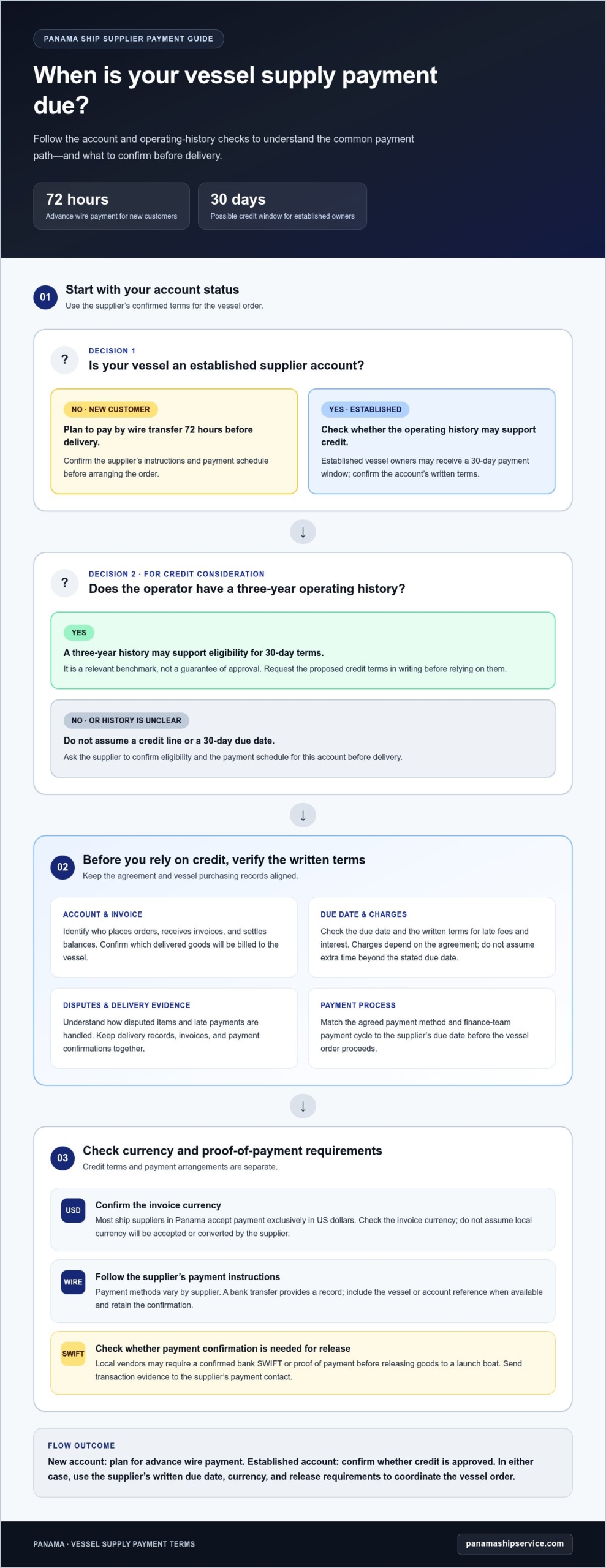
In Panama, established vessel owners may receive a 30-day payment window, while new customers generally pay by wire transfer 72 hours before delivery. Ship chandler credit terms are typically arranged through a credit line, with the vessel billed for goods delivered to its crew. Operators with a three-year history may obtain 30-day terms.
For a vessel on a tight port schedule, payment timing can affect whether a supply order stays on track. Understand the terms before ordering, especially if payment is required before delivery.
This guide explains common ship chandler credit terms in Panama, what operating history may support eligibility, and how new customers can prepare to pay. It also covers payment methods and currencies so you can plan the transaction and coordinate vessel supplies.
Key Takeaways
- Plan around the common distinction between credit for established customers and advance payment for new accounts.
- Use operating history and an established supplier relationship to understand what may support a credit application.
- Prepare for payment in US dollars and choose a method that fits the supplier’s payment requirements.
- Coordinate supply planning with vessel operations, and consider mechanical ship repairs when the vessel also needs technical work in Panama.
What are the payment terms typically expected by Panamanian ship suppliers?
In Panama, established vessel owners may receive a 30-day payment window, while new customers generally pay by wire transfer 72 hours before delivery. Clarify the payment schedule, credit eligibility, and written terms before arranging supplies.
-
Compare Terms for New and Established Customers
Start by identifying whether your vessel qualifies as an established account. Panamanian suppliers generally require new customers to pay by wire transfer 72 hours before delivery; established vessel owners may receive 30-day credit. Operators with a three-year history may obtain those credit terms.
Ask for the due date and confirm which delivered goods will appear on the invoice. Ship owners typically establish a credit line with the supplier and are billed for goods delivered to the crew. Keep account details and invoicing aligned with your vessel’s purchasing records.
-
Review Late Fees and Interest Charges
Read the payment clause before accepting credit. Late fees and interest charges depend on the written agreement, so identify the rate, when charges begin, and how overdue balances are calculated. Don’t assume that a 30-day payment window means extra time beyond the stated due date.
Ask how the supplier handles disputed invoices and late payments. Keep delivery records, invoices, and payment confirmations together. This makes it easier to reconcile the account and distinguish a billing issue from an overdue balance.
-
Negotiate Better Credit Terms
Build your request around the vessel’s operating history and a clear payment process. Operators with a three-year history may obtain 30-day terms. Present accurate billing details and explain how your team will review invoices and settle balances on schedule.
Discuss the credit period, payment method, and any cash or early-settlement discount as separate terms. Agree on discounts in writing rather than assuming they apply. Before accepting a credit line, review the terms for missing or disputed goods, delivery evidence, liability, late payment, and resolving billing disagreements.
Eligibility for credit among established operators
Prepare a clear account profile before requesting supplier credit. In Panama, an operating history of three years may support credit eligibility.
- Document your operating history. State how long the vessel owner or management company has operated, and keep the details consistent across purchasing and billing records. A three-year history is a relevant benchmark for operators seeking supplier credit in Panama, but it does not guarantee approval. Explain the relationship between the applicant and the vessel responsible for the account.
- Identify the account holder and payment contact. Specify which company will place orders, receive invoices, and settle balances. Include the vessel name and relevant operations and finance contacts in the account information. Consistent details link delivered goods to the correct account and reduce confusion during invoice review.
- Show how your team will manage invoices. Set a process to match delivery records with supplier invoices, direct questions to the right contact, and schedule payment. For example, assign someone to reconcile each order against its delivery record before submitting it for payment. A defined workflow shows how your organization plans to manage a credit line responsibly.
- Request the terms in writing before relying on credit for a vessel order. Confirm the account holder, invoicing process, due date, and how disputed items are handled. Compare the proposed terms with your finance team’s payment cycle and identify any mismatch before delivery. Clear expectations help your team plan purchases and maintain accurate records across vessel calls.
For Panama operations that combine purchasing with vessel work, ship supply support can sit alongside a coordinated service plan.
Payment methods and currencies
In Panama, most ship suppliers accept payment exclusively in US dollars. Payment processes and currencies vary between countries and ports, so follow each supplier’s stated instructions.
- Confirm the invoice currency before arranging payment. Panamanian suppliers generally use US dollars, so check that the invoice currency matches your payment account. If your company holds funds in another currency, allow for conversion through your bank. Don’t assume the supplier will accept local currency or convert funds for you.
- Use the payment method specified for the account. A bank transfer creates a record linking payment to the supplier’s invoice. Include the vessel or account reference in the transfer details when available, and retain the confirmation for your finance records. Payment instructions can vary between suppliers, even in the same port.
- Coordinate payment confirmation with delivery timing. In Panama, local vendors may require a confirmed bank SWIFT or proof of payment before releasing goods to a launch boat. Send the transfer evidence to the supplier’s payment contact and make sure it identifies the transaction. This connects payment processing with the vessel’s supply order.
- Keep credit arrangements separate from currency arrangements. A supplier credit line may reduce the need to exchange currency for purchases in unfamiliar ports, but the invoice still states the amount and currency owed. For a vessel calling at multiple ports, record each supplier’s billing currency, payment method, and account reference separately. This simplifies reconciliation and helps finance teams prepare the right transfer.
For each port call, keep payment details with the order documents. This gives vessel managers and finance staff a clear reference for matching invoices, transfers, and deliveries, without assuming one supplier’s process applies elsewhere.
Credit and currency arrangements are separate. A supplier credit line may reduce the need to exchange currency, but the invoice still states the amount and currency owed. Record each supplier’s billing currency and payment details separately, since processes can differ even within the same port.
Payment requirements for new customers
Prepare a credit application with your company identity, vessel details, authorized purchasing contact, and billing information. These details connect the applicant, order, delivery, and payment records.
- Set up the account file before placing an order. Include the legal business name, invoice address, vessel name, and person authorized to approve purchases. Add a finance contact to receive invoices and resolve account questions. Keep names and account references consistent across the application and order documents.
- Plan for payment before delivery. New customers in Panama generally pay by wire transfer 72 hours before delivery. Schedule the transfer so processing time does not collide with the vessel’s supply window. Use the supplier’s invoice reference and vessel details in the payment record to make the transaction easier to match.
- Send clear evidence of the transaction. In Panama, 90% of local vendors will not release goods to a launch boat until they receive a confirmed bank SWIFT or proof of payment. Forward the bank confirmation with the correct order reference, then retain a copy alongside the invoice and delivery record.
- Make each transaction traceable. For example, keep the supplier invoice, bank confirmation, and delivery record together in one account file. If the vessel receives several orders, separate records by order reference rather than combining payments without a clear breakdown. This gives purchasing and finance teams a useful audit trail.
- Request credit when your account information and payment process are ready. The application should clearly identify the responsible company, vessel, purchasing authority, and invoice recipient. Keep submitted forms and responses with the account records so future orders follow the same approved process.
Organize the vessel’s supply requirements and payment documents together, then coordinate ship supply needs around the planned delivery.
Panama Ship Service: Mechanical Ship Repairs
Panama Ship Service provides Mechanical Ship Repairs for vessels needing technical work alongside port operations. If maintenance needs go beyond supply planning, consider whether repairs, underwater hull services, a marine survey, or MARPOL disposal should be included in the operational plan. Coordinating these requirements helps vessel managers organize work during a Panama call.
Share the vessel’s repair or service requirements and relevant operational details when discussing next steps. A focused description helps clarify the work and how it fits the vessel’s schedule. For mechanical repairs, contact Panama Ship Service to discuss your vessel’s requirements.
Prepare Your Next Panama Call with Confidence
Include payment planning in the vessel’s wider port-call workflow. Assign responsibility for approvals, invoice review, and transaction records before the next order. A practical approach to ship chandler credit terms helps coordinate purchasing with other operational priorities, rather than treating payment as a separate task.
When a vessel also needs technical attention, Panama Ship Service offers Mechanical Ship Repairs, Underwater Hull Services, and MARPOL Disposal. Consider these services when planning work for a Panama call, alongside supply and payment arrangements. Organizing operational needs helps your team make decisions with a clearer view of the vessel’s requirements.
For payment details and support with your Panama operations, contact Panama Ship Service. Prepare your vessel and account information, and take the next step with confidence.
Frequently Asked Questions
What are standard credit terms offered by ship chandlers?
In Panama, standard ship chandler credit terms may give established vessel owners a 30-day payment window, while new customers generally pay before delivery. A credit account links delivered goods to the vessel’s billing account. Reconcile each invoice against the order and delivery record, and distinguish an agreed credit line from payment required before a specific delivery.
What credit limits do ship chandlers typically provide to vessel operators?
There is no single standard credit limit for vessel operators in Panama. The supplier sets the approved amount through the account agreement, so ask what the limit is and how it applies to outstanding invoices before ordering on credit. For example, a fleet manager should track unpaid invoices across vessels, not just the latest order, to see how much account capacity remains.
How do ship chandlers set credit terms for spot orders and port calls?
For spot orders, clarify how ship chandler credit terms apply to that port call. Payment arrangements depend on whether the buyer already has an account and when the goods are needed. Give the supplier the vessel name, order details, delivery timing, and invoice contact together. If delivery is scheduled during a brief port call, coordinate payment for that specific order.
How do ship chandler credit terms vary by country, port, or currency?
Payment processes and currencies can differ by country, port, and supplier. In Panama, new customers generally pay by wire transfer 72 hours before delivery, established operators with a three-year history may obtain 30-day credit, and most suppliers accept US dollars; confirm each supplier’s terms and currency separately.
What risks and liability terms are included in ship chandler credit agreements?
Agreements may cover liability, delivery evidence, missing or disputed goods, and how billing disagreements are resolved. Late fees and interest depend on the written agreement, so confirm when charges begin and how overdue balances are calculated.