
The lower-cost repair on paper isn’t always the lower-cost choice overall. The underwater repair vs. dry dock cost depends on the work required: accessible, well-defined repairs may be completed afloat, while work needing full access to the underwater hull, propeller, or rudder calls for dry docking. Compare the full scope and operational impact, not just the repair task.
It’s easy to focus on avoiding dock fees, but cleaning, inspection, and repair access all affect what each option can accomplish. This guide compares the cost drivers, cleaning results, inspection access, and repair scope of both approaches, helping you match the method to the vessel’s needs.
You’ll also see when afloat work can handle a defined job, when dry docking is the practical choice, and how combining tasks can help limit time in dock. Start by considering the hull’s condition and the access the repair requires.
Key Takeaways
- Match the repair method to the access the work requires: well-defined tasks may be possible afloat, while extensive underwater hull work often needs dry docking.
- Assess the full dry-dock budget, including supporting services and schedule impacts, rather than focusing on dock rental alone.
- Separate cleaning, inspection, coating, and structural repair needs to see what each approach can actually accomplish.
- Use the repair scope and operational schedule to decide whether afloat work, dry docking, or a combination is the practical fit.
Can hull repairs be completed during dockside repair?
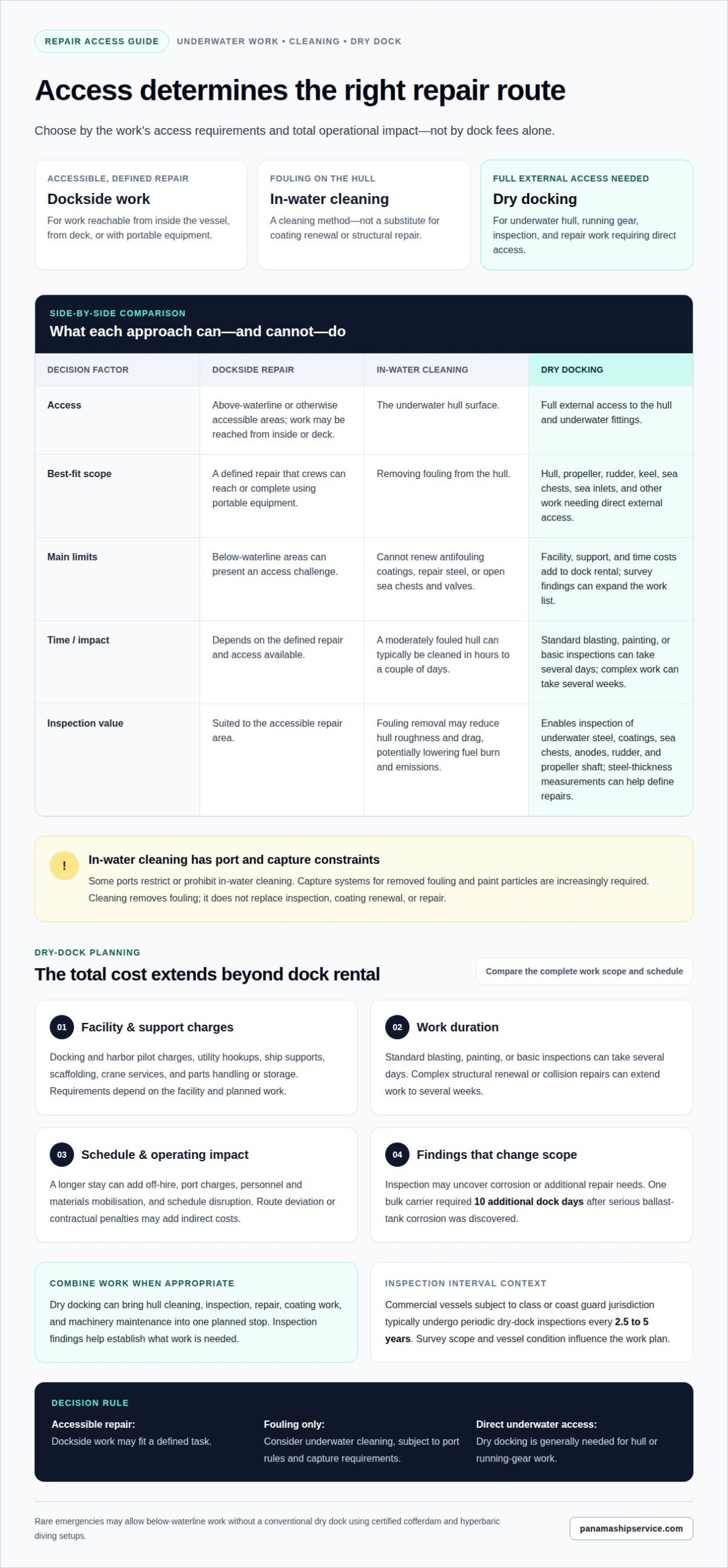
Some hull-related work can be completed while a vessel remains afloat, but access determines the scope. Dockside repair suits a defined job crews can reach from inside the vessel or from the deck, or complete with portable equipment. For example, a repair above the waterline may be possible without docking. Damage below the waterline presents a different access challenge.
In the United States, applicable requirements depend on the vessel’s flag, classification status, and survey scope. Some survey work may require dry docking when it needs access to the underwater hull.
Repairs to underwater hull areas such as the keel, sea chests, and sea inlets generally require taking the vessel out of the water. Tailshaft, stern tube, propeller, rudder, stabiliser, and bilge keel work also needs direct external access, usually provided by dry docking. A dry dock exposes the hull for inspection and steel-thickness measurements, helping define the repair scope. In rare emergencies, certified cofferdam and hyperbaric diving setups may allow below-waterline work without a conventional dry dock.
Cleaning is narrower in scope than repair. Underwater cleaning removes fouling, but it cannot renew antifouling coatings, repair steel, or open sea chests and valves. A moderately fouled hull can typically be cleaned underwater in hours to a couple of days. Removing biofouling can reduce hull roughness and drag, potentially lowering fuel burn and emissions. Some ports restrict or prohibit in-water cleaning, and capture systems for removed fouling and paint particles are increasingly required.
| Option | Access | Typical scope |
|---|---|---|
| Dockside repair | Above-waterline or accessible areas | Defined work using portable equipment |
| In-water cleaning | Hull surface underwater | Fouling removal only |
| Dry docking | Full external access | Hull, propeller, rudder, and underwater repairs |
Choose dockside work for accessible repairs, cleaning for fouling alone, and dry docking when the hull or running gear needs direct access.
Total dry-dock costs beyond dock rental
Dock rental is only one part of a dry-docking budget. A vessel may also incur docking and harbor pilot charges, utility hookups, ship supports, scaffolding, crane services, and parts handling or storage. Each cost depends on the facility and planned work. For example, coating work requires surface preparation, while structural repairs may need scaffolding and lifting equipment.
Time adds another cost. Standard blasting, painting, or basic inspections can take several days; complex structural renewal or collision repairs can extend work to several weeks. A longer stay can mean more off-hire, port charges, personnel and materials mobilisation, and schedule disruption. Route deviation or contractual penalties may add indirect costs. A survey that identifies corrosion or additional repair needs can also change the planned scope after arrival.
Compare the full operating impact, not just the dock’s daily charge. Wet dock use may be billed by the day, month, or year, while dry docking adds facility work and vessel support requirements. Waiting for an available dry dock can disrupt a planned port call or require a route change. Off-hire costs depend on the vessel’s lost earning capacity and the delay, so the same extension affects ships differently.
- List facility charges, equipment, utilities, and parts handling.
- Include mobilisation, port charges, and any route deviation.
- Allow for survey findings that expand the repair scope.
- Compare planned duration with possible schedule disruption.
A complete estimate depends on vessel size, repair scope, location, urgency, and expected time out of service. Project pricing depends on the case and is provided after a quote request. For survey-related planning, marine survey support can help clarify the work scope before docking arrangements are made.
Dry-dock cleaning, inspection, and repair scope
Dry docking gives the shipyard controlled access to the hull, enabling cleaning, inspection, and repair within one planned stop. Once the vessel is lifted, crews can inspect underwater steel, sea chests, anodes, the rudder, and propeller shaft. They can assess coating condition and identify corrosion or damage that was difficult to examine afloat. These findings help establish whether the work needs cleaning, coating renewal, steel repair, or a combination.
Scope affects duration. Standard blasting, painting, or basic inspections can take several days. Complex structural plate renewal, engine repowers, or collision damage repairs can extend work to several weeks. An inspection may also reveal defects that change the work list. For example, a bulk carrier required 10 additional dock days after serious ballast-tank corrosion was discovered. Build an approval process for extra work into the schedule and budget.
Dry docking also creates an opportunity to inspect machinery and service or overhaul engines, generators, and other mechanical systems. This can consolidate work that would otherwise require separate maintenance stops. Commercial vessels subject to class or coast guard jurisdiction typically undergo periodic dry-dock inspections every 2.5 to 5 years. The required survey scope and vessel condition influence which tasks belong in that period’s work plan.
- Clean: Remove fouling and prepare surfaces for inspection or coating work.
- Inspect: Examine hull steel, underwater fittings, and accessible machinery.
- Repair: Address corrosion, structural damage, or worn components.
- Renew: Apply coatings or replace steel where the inspection findings require it.
Dry docking is most valuable when the work needs broad external access, controlled surface preparation, or coordinated hull and machinery tasks. Afloat work may suit a narrower scope, but it cannot provide the same access to the whole vessel. Base the decision on inspection findings: define the defects first, then match each repair and renewal task to the conditions it requires.
How do underwater inspection, cleaning, and hull patching prices compare with dry dock services?
There is no single cost winner. Afloat inspection or cleaning avoids dry-dock facility charges, but covers a narrower scope. Dry docking brings additional facility and support costs, yet allows inspection and repair across the exposed hull. For a fair comparison, separate the task itself from off-hire, route deviation, port charges, and schedule effects.
Underwater inspection is useful when the question is specific, such as checking a suspected defect or documenting hull condition. Cleaning addresses fouling, not steel damage or coating renewal. A hull patch is different again: the repair method depends on the damage’s location and extent, access, and whether safe, controlled work is possible afloat. If the job needs broad access or dry conditions, dry docking may be necessary even if the initial task appears limited.
Compare options using the same scope:
- Inspection: Define the area and condition that need assessment.
- Cleaning: Identify fouling removal as the task, not structural repair.
- Hull patching: Establish damage extent, access requirements, and testing needs.
- Dry docking: Include facility costs, supporting services, and time out of service.
Afloat work isn’t always cheaper in direct costs. It can be more efficient overall when technically viable and when it avoids off-hire, route deviation, or extra port charges. Conversely, splitting a larger job into underwater inspection, temporary repair, and later dry-dock work can add coordination and repeat mobilisation. Vessel size, repair scope, location, and urgency all influence the comparison. Pricing depends on the case; a quote takes scope, access, and schedule into account.
For a hull condition that calls for underwater assessment or cleaning, request underwater hull support to define the work around the vessel’s operational needs.
Panama Ship Service: Underwater Hull Services
Panama Ship Service helps align underwater hull work with the vessel’s repair and operating requirements. Its Underwater Hull Services cover underwater inspection, cleaning, and hull maintenance, while Mechanical Ship Repairs address mechanical work. Marine Surveys can support the assessment of vessel condition and repair needs.
The right choice depends on access, the defect or fouling identified, and whether the work requires dry-dock conditions. Sharing the vessel’s location, observed issue, and operating schedule helps frame the next step around the actual scope, rather than treating every hull concern as a dry-dock job.
Contact Panama Ship Service to discuss your vessel’s underwater hull requirements.
Turn the repair decision into a workable plan
Before the next port call, turn the vessel’s condition into a defined repair scope. Separate essential work from tasks that can be scheduled later, then align the sequence with the vessel’s operating plan. The underwater repair vs. dry dock cost comparison is most useful when both options are assessed against the same work scope and operational priorities.
Panama Ship Service offers Underwater Hull Services and Mechanical Ship Repairs for vessel maintenance needs, along with MARPOL Disposals. Share the issue, required outcome, and vessel schedule to start a focused discussion about the next step. A clear scope keeps technical decisions connected to operational demands.
Contact Panama Ship Service to discuss your vessel’s requirements. A practical repair plan starts with the right scope and a clear next move.
Frequently Asked Questions
Which Dock Type Should You Choose?
Choose based on the repair’s access requirements and the vessel’s operating plan. A vessel needing coating renewal or a broad external hull examination generally requires dry docking. A defined task that can be safely completed afloat may suit dockside work. For example, if an inspection finds damage beyond the initially identified area, the repair scope and docking decision may need to change.
How Does Dry Docking a Vessel Work?
Dry docking moves a vessel from the water into a facility where the hull can be accessed externally. The ship is positioned and supported, then the water is removed from the dock or the vessel is lifted, depending on the facility. Crews carry out the planned inspection and repairs, followed by checks before the vessel returns to the water. Coordination between the ship’s team and yard helps keep tasks in sequence.
Maintenance Tasks: What Can Be Done Where?
Maintenance location depends on access, equipment, and working conditions. Tasks reachable from the deck or vessel interior may be completed afloat if the repair scope allows. Work involving the underside of the hull, external running gear, or coating application needs dry-dock access. Separate inspection, cleaning, and repair tasks in the work plan so a cleaning job isn’t mistaken for a structural repair.
What Is a Dry Dock and When Is It Necessary?
A dry dock is a facility that takes a vessel out of the water for maintenance, inspection, or repair. It becomes necessary when work requires external access to underwater surfaces or controlled dry conditions, such as extensive hull steel renewal. It may also be needed for class surveys that require underwater hull access. The decision follows the vessel’s survey requirements and the identified work scope.
What Is the Difference Between Drydock and Dockside Repair?
Drydock repair takes the vessel out of the water, exposing the hull and underwater components. Dockside repair is carried out while the vessel remains afloat, so the work is limited by access and the available conditions alongside. For example, a task reachable from a deck opening may be practical dockside, while a component requiring direct external access usually calls for dry docking.
How much does underwater ship hull repair cost compared with dry docking?
The underwater repair vs. dry dock cost comparison depends on repair scope, vessel size, location, and urgency. Afloat work can avoid dry-dock facility charges, but it isn’t automatically less expensive once operational impacts are included. Dry docking adds facility and support expenses while enabling work that may not be feasible afloat. Compare estimates using the same repair list, schedule assumptions, and required inspections.