
A dry dock survey starts well before a vessel enters the dock. A dry docking preparation survey organizes the inspection and repair scope, docking plan and loading details, so the vessel’s underwater areas can be examined safely and work can proceed in a clear sequence.
For ships operating through Panama, timing matters: planning connects the vessel’s condition and maintenance needs with its operational schedule. The survey allows close inspection of areas normally below the waterline, including the hull, propeller, rudder and sea chests. Findings can then guide repair priorities and the work planned for the dock.
This guide explains what the survey covers and how preparation fits into the wider project lifecycle. It also shows how docking loads, hull inspections and machinery work connect to planning, helping you approach the dock period with a defined scope and practical work sequence.
Key Takeaways
- Start the dry dock project early, aligning the maintenance scope, commercial schedule, documentation and logistics into a clear plan.
- Understand how a survey examines underwater areas, including sea connections, valves and propeller components, to identify work that may need to be scheduled.
- See why the docking plan and vessel loading condition matter when preparing for safe, controlled support in the dock.
- Learn how hull, rudder, propeller and stern-gear findings can guide repair priorities, with Panama Ship Service’s marine surveys and related technical services as a next step.
Dry dock project lifecycle and planning phases
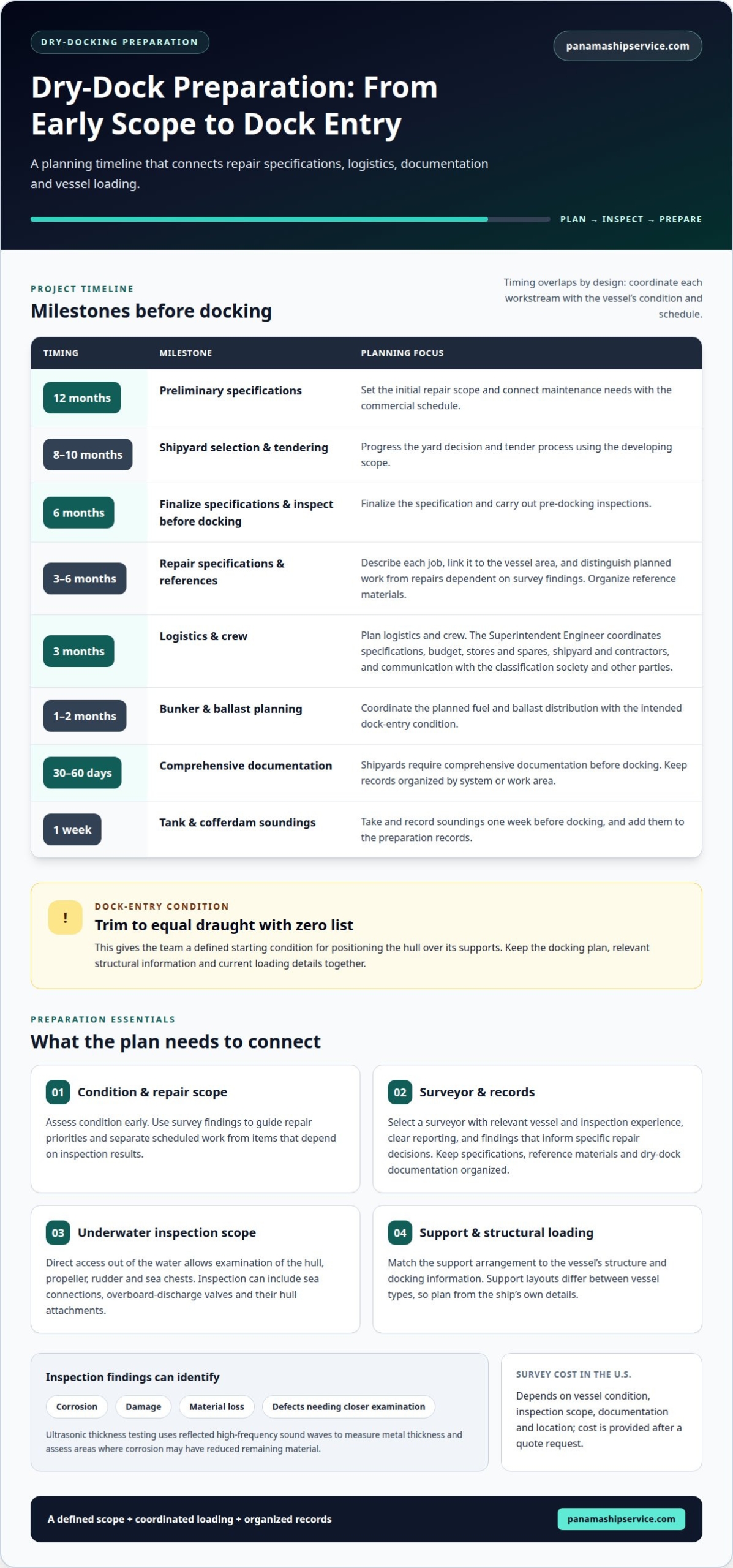
A dry docking preparation survey connects the vessel’s condition, repair scope and docking schedule. Planning progresses from early assessment to final documentation and onboard logistics.
Survey Preparation and Planning
Begin condition assessment and scope development well ahead of docking. This gives the team time to identify components for inspection, collect reference material and coordinate the commercial schedule with maintenance needs. A dry-dock surveyor should be selected for relevant vessel and inspection experience, clear reporting, and the ability to coordinate findings with the repair scope. These criteria help keep survey observations useful for planning.
Repair Specifications and Work Planning
Prepare repair specifications and reference materials three to six months before dry docking. Describe each job clearly, link it to the relevant vessel area, and distinguish planned work from repairs that depend on survey findings. This helps the team sequence hull and machinery tasks and organize materials. The Superintendent Engineer coordinates the specification, budget, stores and spare-parts orders, shipyard and contractors, and communication with the classification society and other parties.
Project Timeline and Cost
Develop the timeline in stages: preliminary specifications are scheduled 12 months before docking, shipyard selection and tendering 8-10 months before, and specification finalization with pre-docking inspections 6 months before. Plan logistics and crew 3 months before; shipyards require comprehensive documentation 30-60 days before docking. In the United States, survey cost depends on vessel condition, inspection scope, documentation and location, and is provided after a quote request.
Surveyor Selection and Required Records
Choose a surveyor with experience relevant to the vessel and inspection scope, whose findings can inform specific repair decisions. Survey records should include repair specifications, reference materials and comprehensive dry-dock documentation. Add tank and cofferdam soundings, taken and recorded one week before docking, to the preparation records. Organize documents by system or work area so findings can be linked to planned jobs throughout the project.
What is Dry Dock Survey ?
A dry-dock survey gives inspectors access to the vessel’s external underwater structure. Its findings help identify which hull, machinery and safety items need closer examination or repair.
Inspection of Hull and Underwater Areas
Once the vessel is out of the water, inspectors can examine the hull, propeller, rudder and sea chests directly. They look for corrosion, damage and material loss that may not be clear during an afloat inspection. Ultrasonic thickness testing uses reflected high-frequency sound waves to measure metal thickness, helping assess hull areas where corrosion may have reduced the remaining material.
Valves, Sea Connections, and Propeller
The inspection covers sea connections, overboard-discharge valves and their hull attachments. Defects in these interfaces can affect the boundary between the vessel and the sea. Inspectors also examine the propeller and related underwater components. Sea-chest valves and cocks need not be opened more than once during a special survey period unless the surveyor considers it necessary. Findings determine whether further examination is needed.
Survey Process and Inspection Requirements
Under the IMO MARPOL and SOLAS conventions, vessels require complete underwater-hull inspections twice within a five-year period, apart from annual hull and machinery surveys. A dry-dock inspection takes the vessel out of the water, providing direct access to submerged areas. If an in-water survey identifies damage that requires closer examination, dry docking may be necessary. The inspection scope and work sequence depend on the vessel’s condition and survey requirements.
Survey Scope and Common Deficiencies
A preparation survey organizes inspection findings and repair planning; a class renewal survey assesses the vessel against class requirements, while an underwater inspection examines submerged areas afloat. A Special Survey covers hull structure, machinery and all safety equipment. Typical concerns include corrosion, material loss, damaged underwater components and defects requiring more detailed inspection. Salt water, humidity and temperature can contribute to corrosion in metallic ship materials. For focused underwater hull inspection, organize findings by hull area and component.
Docking plans and structural loading
A docking plan coordinates the vessel’s position, loading condition and support arrangement before entry into the dry dock. Before docking, the ship should be trimmed to an equal draught with zero list. This provides a defined starting condition for positioning the hull over its supports. The plan connects that condition to the dock’s support layout and the work planned beneath the vessel.
Structural loading is central to preparation. The dock supports the vessel at planned contact points, so the arrangement must suit the ship’s structure and docking information. A tanker and a vessel with a different hull arrangement will not necessarily use identical support layouts. Keep the vessel’s docking plan, relevant structural information and current loading details together so everyone coordinating the operation works from the same basis.
Loading changes affect the plan. Complete bunker and ballast planning one to two months before dry docking, giving the team time to coordinate the vessel’s condition with the docking arrangements. Review the planned distribution of fuel and ballast alongside the intended dock-entry condition. Records from the previous dry dock can also inform planning by showing earlier repairs or areas that needed attention, without assuming the same findings will recur.
Once docking begins, track progress against the agreed sequence. Hull access, machinery work and other tasks may depend on the vessel’s supported position and nearby work. A daily meeting during dry-dock work reviews upcoming jobs and special requirements, helping teams coordinate changes. If inspection findings change the repair scope, record the affected work and communicate the change before it disrupts related tasks. Clear coordination keeps the docking plan aligned with work underway.
Hull, rudder, propeller, and stern gear work
Dry-dock access lets the inspection team assess the hull and underwater components directly. Findings help distinguish routine examination from repairs requiring a defined work scope. For oil-lubricated stern bearings, lubricating-oil analysis is carried out at intervals not exceeding six months. Reviewing the latest analysis alongside the planned inspection helps identify relevant stern-gear checks before shipyard work begins.
Propeller and tailshaft checks depend on the shaft arrangement. For shafts with keyed propellers, examine the tailshaft cone, key and keyway at every five-yearly period. This focuses attention on the connection between shaft and propeller. For controllable-pitch propellers mounted on solid flange couplings, the hydraulic-oil sample report must be based on a sample drawn no more than three months beforehand.
Rudder inspection depends on the survey findings and observed condition. The rudder should be lifted to examine its pintles if the surveyor considers this necessary. This directs attention to the rudder’s supporting arrangement rather than treating every vessel identically. Record the findings and link any required work to the repair specification, so the shipyard can coordinate the relevant components and work sequence.
Use the survey scope to coordinate hull, propeller and stern-gear tasks within the docking period. Oil-analysis timing, the shaft and propeller arrangement, and the need to examine rudder pintles all affect the inspection plan. Clear records distinguish work completed during the current period from checks due in a later survey cycle. This supports a focused marine survey and actionable repair planning.
For marine survey support related to hull and stern-gear findings, arrange a marine survey.
Ultrasonic thickness testing can assess metallic vessel components, including the hull, for material loss caused by corrosion. The course covers typical hull and machinery damage found during dry dockings.
Panama Ship Service: Marine Surveys
Panama Ship Service provides Marine Surveys to help vessel teams define inspection findings and dry-dock work scopes. Use its survey service to assess underwater hull condition or obtain clear findings to support repair planning.
When survey findings identify machinery work, Panama Ship Service also offers Mechanical Ship Repairs. Underwater Hull Services address underwater hull needs, while MARPOL Disposal supports disposal requirements. These services can help coordinate relevant technical needs around a vessel’s Panama operations.
Share the vessel’s survey requirements and the work areas needing attention to discuss the appropriate next step. Contact Panama Ship Service to discuss marine survey support for your dry-docking project.
Set the Next Docking Project in Motion
Use the survey findings to determine practical next steps: identify which work needs attention, what information should accompany it, and how it fits the vessel’s operating schedule. A clear handover from inspection to action keeps decisions focused as the docking project progresses.
For needs identified during a dry docking preparation survey, Panama Ship Service offers Mechanical Ship Repairs, Underwater Hull Services and MARPOL Disposal. These services support vessels whose findings involve machinery, underwater hull work or disposal requirements.
Bring the vessel’s survey scope and relevant findings into the discussion so the required support is clear. Contact Panama Ship Service to discuss your survey and take the next step with a defined project scope.
Frequently Asked Questions
What is a dry docking preparation survey and what does it cover?
A dry docking preparation survey is a planned assessment that turns a vessel’s condition and upcoming survey needs into a workable inspection and repair scope. Its output should clarify which findings need attention, which require further examination and which can be scheduled as planned maintenance. For example, a recorded hull concern can be linked to a specific location and proposed follow-up action.
When should a vessel’s dry dock preparation survey be performed?
Start planning well before the intended docking date, using the vessel’s survey schedule and maintenance condition to set the working date. Planning can begin as the vessel leaves its previous dry dock, giving the team time to track emerging defects during service. If new damage or machinery concerns arise, update the scope rather than waiting until the docking period is underway.
What are the steps in preparing a ship for a dry docking survey?
First, assemble the vessel’s survey status, maintenance records and known defect reports. Then define inspection areas and draft the repair scope, marking items that need further examination. Coordinate the scope with the docking plan, stores and spare-parts requirements, then issue the documentation to the relevant project parties. During the work, record findings and decisions against each item so the final report reflects the work completed.
What are the requirements for a dry dock survey under class and flag-state rules?
Applicable requirements depend on the vessel’s class survey status, flag-state certification and recorded survey due dates. Use those records to identify required inspection items and the authority or survey body involved. The project team should align the planned scope and supporting documents with those requirements, then record survey findings and completed actions in the vessel’s technical file.