
A crew change involves more than a flight and a berth. Effective crew sign-on sign-off procedures bring document checks, a clear handover, and coordinated airport-to-ship transfers together in the right order. Prepare travel and service records before departure, brief the incoming crew member on duties and vessel routines, then coordinate each transfer with the ship and port arrangements.
Travel plans can shift, documents need careful attention, and joining crew members must be ready to work safely aboard. A structured process keeps these moving parts clear. This guide explains how to gather and check documents, prepare a useful handover, and manage the journey from the airport to the vessel. It also covers the sign-off steps that help departing crew leave with records, belongings, and responsibilities properly addressed.
Key Takeaways
- Organize certificates and travel paperwork in a sequence that makes document checks easier before departure.
- Review passport and continuous discharge certificate condition and sea-service records before travel.
- Prepare a focused handover so the incoming crew member can understand duties, safety routines, and vessel operations.
- Coordinate airport pickup and ship transfer arrangements to keep each stage of joining clear and orderly.
Collecting certificates and travel documents
- Start with the joining crew member’s passport, seafarer employment agreement, required certificates, and travel documents. Match the documents to the person’s role, vessel, and route. Commercial ships, fishing vessels, and offshore operations can require different certificates and clearance records, so the sequence varies by assignment. Keep the relevant checklist with the crew-change file.
- Collect any visas or permits needed to disembark at the designated port, then check that travel details match. The ticket name should exactly match the passport name. Keep travel documents in hand baggage and carry photocopies. A difference in a ticket name, for example, can complicate airport processing, while checked baggage may be inaccessible during a transfer.
- Identify who pays for travel, medical examinations, and other sign-on or sign-off costs by reviewing the seafarer employment agreement, employer policy, and applicable law. For United States operations, required documents depend on the vessel, role, and route. Organize the credentials and clearances that apply to the assignment, rather than treating one document list as universal.
- For a port crew change, coordinate joining and departing crew documents with the vessel, port agent, and relevant authorities. Crew signing off need visas or permits for their designated port, and the vessel procedure may require ADM 04a and/or ADM 04b forms. Under July 2020 Kenya guidelines, Mombasa approval applications had to be lodged at the Kenya Maritime Authority at least seven days before a crew change.
- Prepare baggage and contingency records before travel. The guidance describes foreign-travel baggage as generally 40 kilos, with one bag generally capped at 23 kilos. Crew-change delays can result from port restrictions, visa issues, or travel disruptions; these can affect both the departure plan and the ship transfer. For Mombasa sign-offs under July 2020 Kenya guidelines, a confirmed flight out of Kenya was required within 48 hours of the ship’s arrival or departure.
Checking passports and continuous discharge certificates
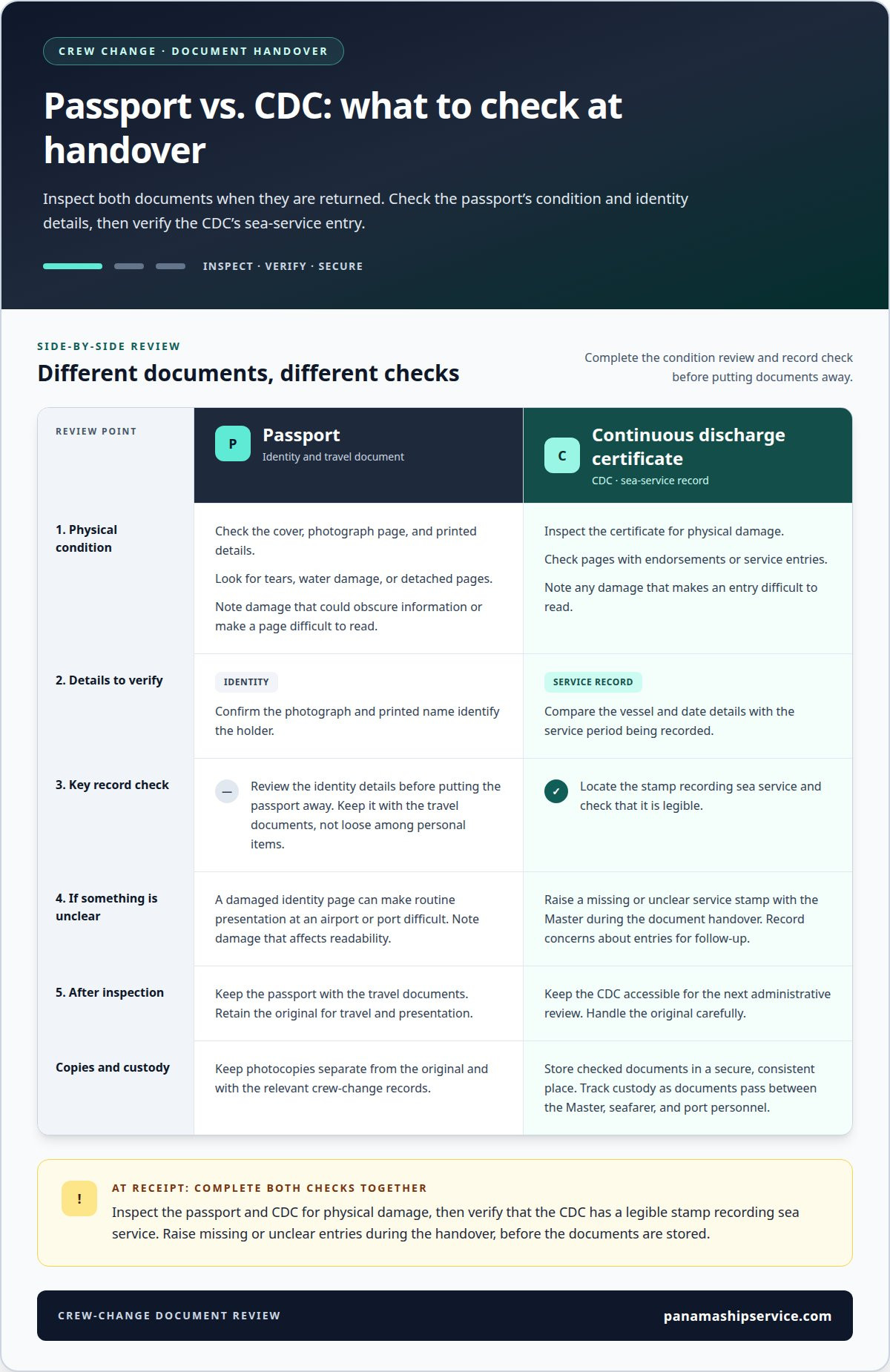
- When the Master returns the passport and continuous discharge certificate (CDC), inspect both for physical damage. Check the cover, photograph page, printed details, and any pages with endorsements or service entries. Note damage that could obscure information or make a page difficult to read.
- Review the passport’s identity details before putting it away. Confirm that the photograph and printed name identify the holder, then look for tears, water damage, or detached pages. Keep the passport with the travel documents, not loose among personal items. A damaged identity page can make routine document presentation difficult at an airport or port.
- Check the CDC for a stamp recording sea service. Locate the service entry and see whether the stamp is legible. A missing or unclear stamp can leave the record incomplete, so raise the issue with the Master during the document handover. Keep the CDC accessible for the next administrative review.
- Compare the CDC entries with the service period being recorded. Review the vessel and date details, and note any blank or unclear entry for follow-up. If a service stamp is present but difficult to read, for example, record the concern before travel. Handle the original carefully and keep photocopies separate.
- Store the checked documents in a secure, consistent place after inspection. Keep passport and CDC copies with the relevant crew-change records, while retaining the originals for travel and presentation. This makes the handover easier to track if documents move between the Master, the seafarer, and port personnel. Include document custody in crew-change planning so the handover remains orderly.
Examine both documents as they are handed over: check the passport and CDC for physical damage, then verify that the CDC has a stamp recording sea service. Completing these checks at receipt combines the condition review with the service-stamp check, rather than leaving either for later.
Briefing the incoming crew member
- Prepare handover notes before the crew change. List the incoming crew member’s duties, current vessel information, and relevant maintenance. Organize the notes by subject, such as routine tasks, equipment status, and work requiring follow-up. A clear record gives the reliever a practical starting point, rather than leaving them to rely on a hurried verbal summary.
- Set aside time for a direct briefing between the departing crew member and reliever. Explain the role’s daily routines, including tasks needing attention during the next watch or work period. Use the vessel’s procedures and current conditions as examples. Invite the incoming crew member to clarify instructions before the handover ends.
- Review ship procedures and safety protocols in a deliberate sequence. Identify the procedures relevant to the incoming person’s duties, then explain where instructions and records are kept aboard. Discuss how routine work connects with safety practices. Do not assume that experience on another vessel means the reliever knows this ship’s arrangements.
- Review relevant maintenance with the incoming crew member. Point out outstanding work, equipment concerns, and maintenance tasks recorded in the handover notes. Explain what is complete and what still needs attention. Distinguish, for example, a finished repair from an open task so the reliever understands its status.
- Ask the incoming crew member to summarize key duties and follow-up items in their own words. This can reveal unclear instructions while the departing crew member is still available. Confirm that the notes cover vessel information, operational routines, safety protocols, and relevant maintenance, rather than relying on memory alone.
- After joining, the Master should ensure the incoming crew member completes familiarization training as soon as practicable. Keep this distinct from the peer handover: the reliever learns duties and current work from the departing crew member, then completes vessel familiarization under the Master’s direction. Record any handover points requiring follow-up.
Sign-on airport and ship-transfer steps
- For sign-off, sequence approval, the onboard handover, disembarkation, and onward travel. Obtain written Crew Manager authorization before sign-off, except in a medical emergency. Arrange the required medical examination, settle wages and outstanding dues, return ship-issued equipment, collect personal belongings, and update crew records after departure.
- Before the joining crew member travels, align the flight arrival with the vessel’s location and transfer plan. Under July 2020 Kenya guidelines, a ship receiving joining crew had to be in Kenya or scheduled to arrive there before the crew arrived. This historical Mombasa requirement illustrates why vessel arrival timing matters.
- Assign a receiving agent and make the airport-to-ship handoff explicit. Under July 2020 Kenya guidelines, the ship’s agent receiving joining crew at the airport had to provide a fresh face mask and hand sanitizer. Record who meets the seafarer, where the transfer begins, and which vessel receives them.
- Plan a direct transfer between the ship and the point of arrival or departure. July 2020 Kenya guidelines called for direct crew transfers to minimize COVID-19 importation and spread. For Mombasa airport screening under those guidelines, the joining crew member’s temperature had to be below 37.5 degrees.
- Set a contingency for a missed connection or delayed vessel transfer. Under July 2020 Kenya guidelines, when direct transfer to the airport was not possible during a Port of Mombasa crew change, a seafarer could stay at an approved holding facility for a maximum of 48 hours. Keep transfer contacts and next steps with the itinerary.
- Close the arrival handoff with a clear confirmation that the crew member has reached the vessel. Keep the airport, transfer, and ship arrival stages in one operational timeline, so a change in flight or vessel timing can be communicated promptly. For vessel movements involving the Panama Canal, coordinate canal transit agency support.
Start off-signing early; coordinate documents and logistics with relevant authorities, port agents. Crew hand over ship procedures, safety protocols, operational routines. Guidance aligns with International Maritime Organization Circular Letter No. 4204/Add 14; providers observe 1.5 m distancing.
Panama Ship Service
Panama Ship Service supports vessel operations around a crew change with related maritime services. If a port call also requires technical or environmental work, coordinating those needs alongside crew arrangements can help keep vessel tasks organized.
Its services include Mechanical Ship Repairs, Underwater Hull Services, MARPOL Disposal, and Marine Surveys. A vessel may, for example, need a survey or repair during the same port call as a crew rotation. These services address separate operational requirements, so plan for both the crew handover and the vessel work.
Contact Panama Ship Service to discuss the vessel services relevant to your port call.
Plan the next port call with purpose
Well-managed crew sign-on and sign-off procedures are part of a wider vessel plan. Treat crew movement as one operational workstream and align its schedule with other port-call priorities. A shared plan helps responsible teams identify dependencies, communicate changes, and keep decisions clear when vessel timing shifts.
Use the next planning conversation to identify which vessel requirements can be addressed during the same call. Panama Ship Service offers Mechanical Ship Repairs, Underwater Hull Services, and MARPOL Disposal. These services meet separate operational needs, but considering them alongside crew movement can help you organize vessel priorities before arrival.
Set out the vessel’s requirements and preferred timing, then contact Panama Ship Service to discuss the relevant support. A clear plan gives your team a practical starting point for the next port call.
Frequently Asked Questions
What do crew sign-on and sign-off mean?
Crew sign-on means a seafarer joins a vessel for an assignment; sign-off means they leave. Together, crew sign-on sign-off procedures cover the personnel change and handover, not just airport arrival and departure. For example, when an officer’s contract ends, a relieving officer may join as the outgoing officer signs off.
What documents are required for crew sign-on and sign-off?
The required documents depend on the seafarer’s role, vessel, route, and port. A crew-change file may include a passport, continuous discharge certificate, role-related certificates, travel ticket, and any required visa or permit. Sign-off paperwork can include ADM 04a and/or ADM 04b forms. ADM 20 is the Certificate of Watchkeeping form for deck crew.
What are the steps in a standard crew sign-on procedure?
First, align the seafarer’s arrival with the vessel’s schedule and organize airport reception and transfer. Once aboard, the Master ensures familiarization training takes place as soon as practicable. Crew sign-on sign-off procedures also require a role-specific handover, so the joining seafarer understands open work and operational context before taking up duties.
What records must employers keep for crew sign-on and sign-off?
Maintain a crew-change file showing who joined or left, the relevant forms, travel coordination, and handover status. Records may also include performance assessments and handover notes. After crew members leave the vessel, update the Crew and Fleet Management system. Keeping these records together makes the personnel change easier to track without relying on recollection.