
Regular maintenance can help preserve a vessel’s condition and give insurers a clearer picture of how it is cared for, but it does not guarantee lower Hull and Machinery premiums. Managing ship maintenance costs effectively means looking beyond the repair quote: timing, work scope, inspection records, and the risk of avoidable downtime all matter.
It is understandable to focus on the immediate repair cost, especially when a vessel is on a tight schedule. But deferring necessary work can turn a defined maintenance task into a more disruptive problem, while a low quote may not cover the full scope required.
This guide explains how to plan maintenance and overhauls, use condition monitoring, and make routine inspections and repair documentation part of cost control. It also covers how to compare management quotes on more than price alone, and how maintenance records and vessel condition may factor into an insurer’s risk assessment.
Key Takeaways
- Set the repair scope and maintenance schedule early to support better planning and reduce the risk of disruptive, unplanned work.
- Use condition monitoring to spot developing machinery issues and prioritize maintenance before faults escalate.
- Keep inspection findings and repair records organized to track recurring issues and support maintenance decisions.
- Compare ship management quotes by scope, vessel needs, and performance indicators, not by fee alone.
1. Early maintenance and overhaul planning
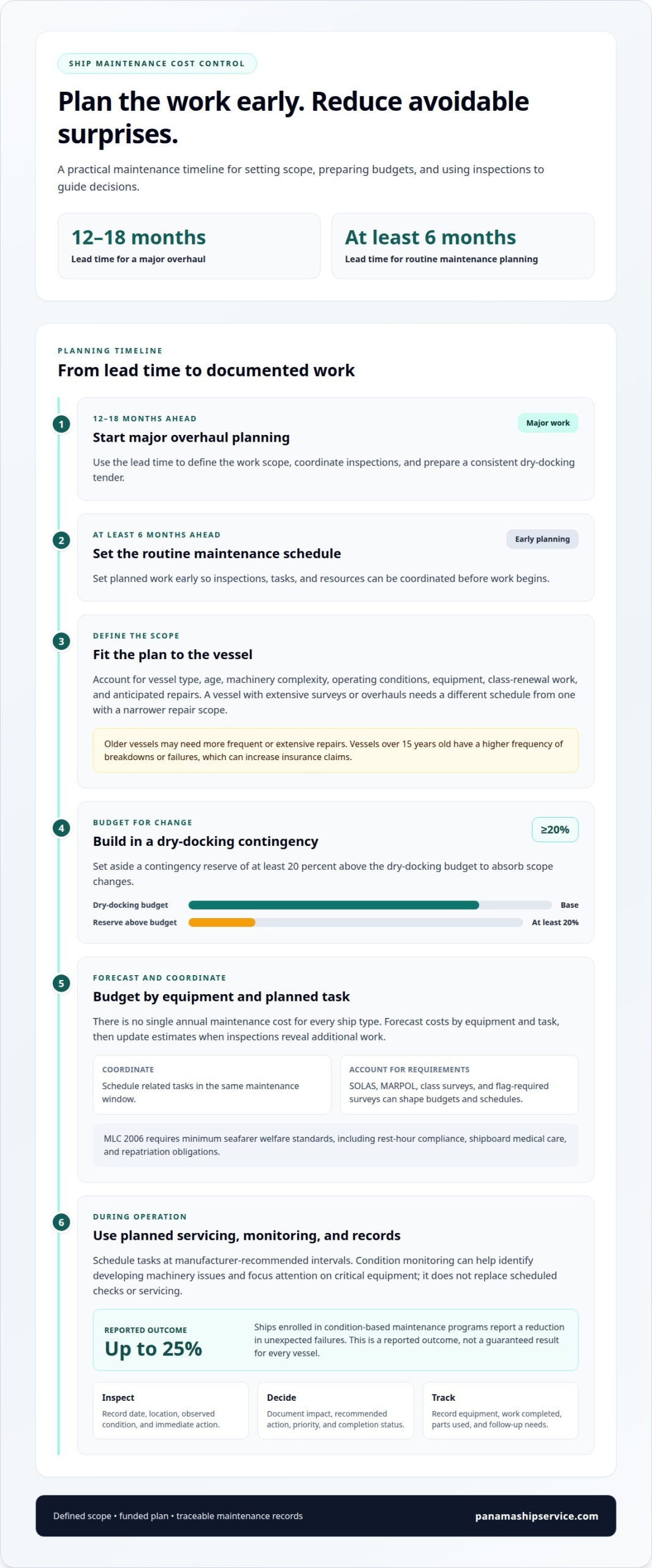
Start routine maintenance planning at least six months before work begins. For a major overhaul, begin 12 to 18 months ahead. This lead time helps define the work scope, coordinate inspections, and prepare a consistent dry-docking tender. Set aside a contingency reserve of at least 20 percent above the dry-docking budget to absorb scope changes.
Dry-docking schedules and costs vary with vessel type, age, machinery complexity, and class-renewal work. A vessel requiring extensive surveys or overhauls needs a different schedule from one with a narrower repair scope. Older vessels may need more frequent or extensive repairs, so their maintenance plans should reflect their condition and anticipated work.
There is no single annual maintenance cost that applies to every ship type. Vessel size, age, equipment, operating conditions, and repair scope all affect the budget. Larger vessels and complex systems generally require more maintenance resources. Forecast costs by equipment and planned task, then update estimates when inspections reveal additional work.
Regulatory and class requirements also shape budgets. SOLAS and MARPOL compliance can bring recurring equipment upgrades, tests, and statutory surveys; class surveys can be scheduled alongside flag-required surveys. According to the International Labour Organization, MLC 2006 requires minimum seafarer welfare standards, including rest-hour compliance, shipboard medical care, and repatriation obligations.
A planned maintenance system can reduce avoidable expense by scheduling tasks at the intervals recommended by equipment manufacturers. Record due dates, assign work, and coordinate related tasks within the same maintenance window. Lean methods can help eliminate unnecessary tasks and resource use without skipping required work.
Deferring repairs can allow defects to worsen, increasing repair scope and disrupting vessel schedules. Vessels over 15 years old have a higher frequency of breakdowns or failures, which can increase insurance claims. Early inspections and a funded work plan help operators address problems before they become larger operational issues.
2. Predictive and condition-based maintenance
Condition monitoring helps operators identify developing machinery issues before they escalate into failures. Rather than relying only on fixed service intervals, teams assess equipment condition and use the findings to prioritize work. Predictive maintenance goes further by tracking changes over time to estimate when intervention may be needed.
Start with critical equipment whose failure could disrupt vessel operations. Establish a baseline for its normal operating condition, then review monitoring data for meaningful changes. IoT sensors can monitor machinery health in real time as part of predictive maintenance. For example, a change in monitored machinery data can prompt an inspection and planned intervention before the issue becomes a breakdown.
Use a consistent workflow to turn a signal into a maintenance decision. Record the equipment and observation, compare the reading with its baseline, assess the operational impact, and assign a follow-up action. Link the finding to the vessel’s maintenance records so operators can see whether the condition persists after work. This also helps distinguish a one-off alert from a pattern that needs attention.
Condition-based maintenance does not mean waiting until equipment fails. Operators still need scheduled checks and manufacturer-recommended servicing; monitoring helps refine priorities between those tasks. Ships enrolled in condition-based maintenance programs report up to a 25% reduction in unexpected failures. Treat that figure as a reported outcome, not a guaranteed saving for every vessel.
Use monitoring data to focus inspections and maintenance resources where it indicates a developing concern. A sensor alert can prompt a closer assessment, while inspection findings provide context for deciding whether repair or continued observation is appropriate. Document the decision and its rationale. Over time, this record helps operators recognize recurring issues, plan work more precisely, and make better-informed maintenance decisions.
3. Routine inspections and repair documentation
Regular vessel inspections can identify defects before they worsen or become serious. Give each inspection a defined scope, such as machinery, hull condition, or safety equipment. Record the date, location, observed condition, and any immediate action. Clear records help maintenance teams distinguish a new defect from an issue already being monitored.
Inspection findings should lead to a documented decision. For each defect, record its operational impact, recommended action, priority, and completion status. If a component needs further assessment rather than immediate repair, note why and when it will be reviewed. This creates a traceable link between the inspection, the maintenance decision, and the work performed.
Repair documentation should identify the affected equipment, work completed, parts used, and any follow-up requirements. These details help reveal recurring faults and support more accurate planning. Because the nature and extent of repairs affect their cost, a precise work history can help teams determine whether repeat spending reflects normal upkeep or an unresolved underlying problem.
Consider the example of Operator A, whose vessel is 12 years old and has irregular inspections and deferred repairs. That pattern can leave developing defects undiscovered until they require more extensive work. Regularly scheduled maintenance can help avoid major repairs and reduce long-term costs by addressing findings before they expand into larger jobs.
Maintenance management software can help track and optimize ship repair schedules. Use it to assign inspection tasks, log findings, link work orders to equipment, and monitor repair completion. A simple workflow is to enter the finding, set its priority, assign the corrective task, and update the record once the work is complete. Consistent entries create a useful history across maintenance cycles.
Review inspection and repair records together during planning. Compare recurring defects, overdue tasks, and completed work to identify where schedules or priorities need adjustment. For example, repeated findings on one system may justify a closer inspection or a revised maintenance task. This evidence-based review directs attention and resources toward the vessel’s actual condition.
4. Comparing ship management quotes
A management quote is useful only when its scope matches the vessel’s needs. Compare what it includes for maintenance planning, inspection coordination, repair administration, reporting, and related responsibilities. Separate ongoing management work from repairs, parts, and other project costs. A lower headline fee may reflect a narrower scope, while a broader proposal may cover tasks the vessel would otherwise handle internally.
The crew can handle routine checks and straightforward upkeep when it has the right skills, tools, and time. Specialized repairs, complex diagnostics, or work requiring external facilities may be outsourced. The right division depends on equipment complexity, crew capability, vessel schedule, and the consequences of delaying the task.
Assess the operational record alongside the proposed scope. Shipowners comparing management providers are advised to review LTIF performance and Port State Control detention records for the preceding 36 months. Compare the same period for each candidate, then consider what those indicators reveal about safety performance and operational control. They complement, rather than replace, a detailed review of responsibilities.
Shipyard costs vary by location, so a management proposal should explain how work locations and coordination affect the overall plan. Regional yards may suit minor repairs, while extensive overhauls may require larger, better-equipped facilities. Compare the proposed approach with the vessel’s repair scope and schedule, not just the quoted management fee.
Before selecting a proposal, map each task to a responsible party and identify exclusions, approval steps, reporting frequency, and how changes are handled. This makes gaps visible before work begins and helps prevent unexpected associated costs. For a vessel requiring repair planning, discuss the repair scope as part of the comparison. Choose the option whose responsibilities, operational record, and work plan best fit the vessel.
Panama Ship Service
Panama Ship Service helps vessel operators address repair and maintenance needs with Mechanical Ship Repairs, Underwater Hull Services, Marine Surveys, and MARPOL Disposal. Turn to the company when inspection findings call for repair planning, underwater hull work is needed, or several operational requirements need attention around a Panama Canal transit.
These services support practical maintenance decisions: a marine survey can clarify the vessel’s condition, while repair work can address identified mechanical issues. Underwater Hull Services and MARPOL Disposal can also be coordinated with other vessel requirements. Aligning the work scope with the vessel’s schedule helps operators plan the next step clearly.
Contact Panama Ship Service to discuss your vessel’s maintenance or repair requirements.
Turn maintenance priorities into a clear next step
The next step is to connect your vessel’s maintenance priorities with the work needed to address them. Managing ship maintenance costs effectively means making decisions with a clear view of the vessel’s needs, planned repairs, and operating schedule. A defined scope keeps discussions focused and supports sound decisions about which work should proceed.
Panama Ship Service provides Mechanical Ship Repairs, Underwater Hull Services, and MARPOL Disposal. These services support vessel operators managing repair requirements and related operational needs. When contacting the company, outline the issue, relevant inspection findings, and scheduling considerations to help define the work scope.
Contact Panama Ship Service to discuss your vessel’s requirements and determine a practical next step. Clear priorities can help your team move forward with confidence.
Frequently Asked Questions
Can Regular Maintenance Lower Your Ship’s Hull & Machinery Insurance Costs?
Regular maintenance can give insurers evidence of how a vessel is managed, but it does not automatically reduce premiums. Insurers may consider the vessel’s condition, inspection findings, repair history, and maintenance clauses when assessing coverage. A condition survey may also identify issues that need attention before a policy is offered. Keep maintenance records complete and accurate to document the vessel’s risk profile clearly.
Ship Maintenance Cost: How can owners reduce it?
Owners can control expenditure by matching each maintenance task to the vessel’s condition and operating needs. Review repair history for repeat faults, then assess whether the underlying cause needs attention rather than repeatedly treating symptoms. Coordinate related work when equipment is already accessible, and manage spare-parts inventory according to actual requirements. To manage ship maintenance costs effectively, avoid unnecessary work without deferring repairs that protect safe, reliable operation.
How should ship operators budget for routine and unplanned maintenance?
Separate predictable maintenance from corrective work so operators can see which costs follow the planned schedule and which arise from defects. Build estimates around the vessel’s age, operating profile, equipment condition, and known repair history. Keep a reserve for unexpected work, then review it after inspections, repairs, or changes to operating plans. This makes budget adjustments traceable rather than relying on a single fixed estimate.
How can predictive maintenance and condition monitoring lower ship repair costs?
Condition data can help operators choose the right time and scope for intervention, rather than replacing a component solely because it has reached a routine service point. For example, if monitoring indicates a developing issue, the technical team can assess whether to coordinate the work with another planned maintenance task. Consistent records of alerts and resulting actions also help distinguish persistent equipment concerns from isolated readings.
How can operators compare ship repair yards and negotiate maintenance contracts?
Give each yard the same work description, equipment details, and expected deliverables so proposals can be compared consistently. Review location, schedule, included labor and materials, exclusions, and procedures for approving changes. Before agreeing, define inspection or testing requirements, completion records, and how additional work will be documented. Clear contract terms reduce ambiguity if the vessel’s condition changes after repairs begin.
What is the average annual maintenance cost for different types of ships?
There is no single average across ship types. Maintenance and repairs are around 10% of a vessel’s operating expenses, rising to 20-30% on old ships; larger vessels and those with complex systems typically cost more to maintain.