
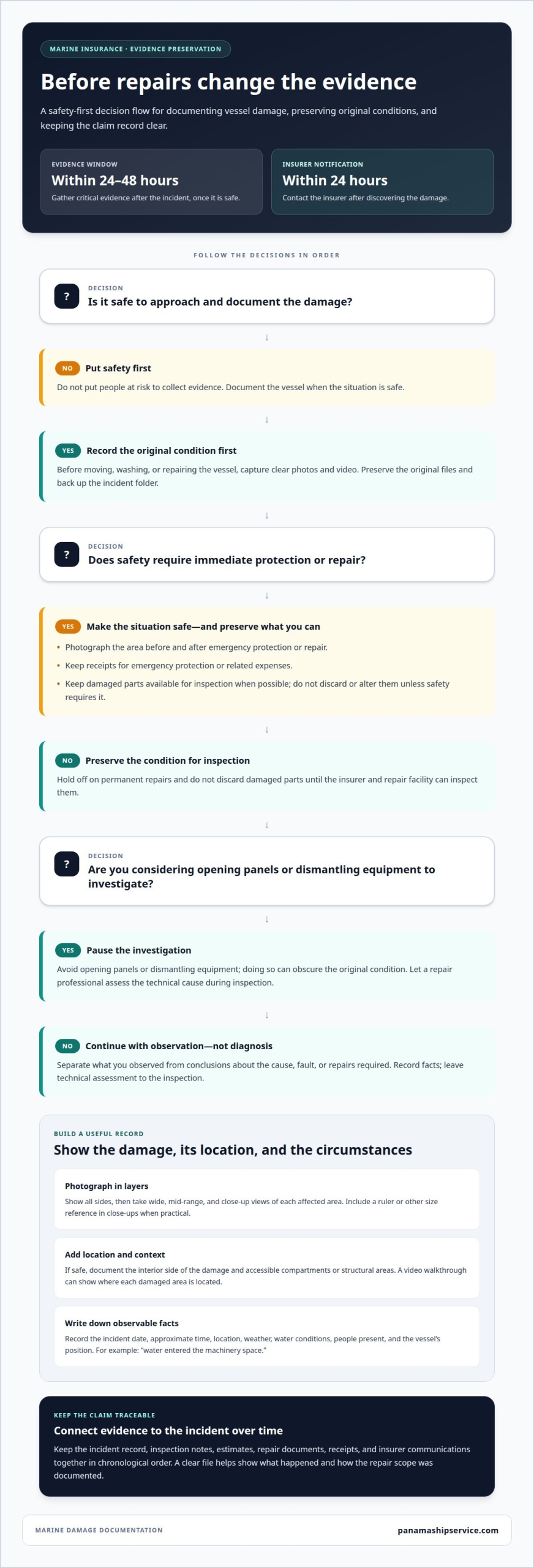
The first hours after damage matter. For a marine insurance incident, gather critical evidence within 24-48 hours and contact the insurer within 24 hours of discovering damage. Documenting ship repair for insurance starts with clear photos and video before moving, washing or repairing the vessel, once it’s safe. Avoid permanent repairs or discarding damaged parts until the insurer and repair facility can inspect them, unless safety requires immediate action.
Keeping a clear record can feel like a second job when a vessel also needs attention. A chronological claim file connects the incident, damage findings, inspection notes, estimates, and repair work, preserving evidence of what happened.
This article explains what to record, how to organize documents and insurer communications, and how to coordinate inspections and repair estimates. It also covers U.S. ship-repair contract clauses on inspection, invoicing, schedules, delays, and insurance requirements, distinguishing general claim documentation from obligations under a specific contract.
Key Takeaways
- Capture the damage from different angles and preserve the original condition before repair work changes the evidence.
- Keep claim records and insurer communications together in chronological order to make the incident easier to follow.
- Coordinate inspections and detailed repair estimates so the documented scope reflects both visible damage and related findings.
- Recognize that ship-repair contract requirements can cover inspection, work schedules, invoicing, delays and insurance.
Avoiding assumptions about damage causes and repair needs
Document ship damage with dated photos, video, written observations, and preserved parts before repairs alter the evidence. Gather critical evidence within 24-48 hours of a marine insurance incident, once the situation is safe.
Damage Causes and Equipment Failure
Separate observed facts from conclusions about the cause of damage or the repairs required. This distinction matters when equipment failure or severe damage has several possible explanations. Record what happened, what you observed, and the vessel’s position at the time. Avoid assigning fault or diagnosing a failed component in witness statements. A repair professional can assess the technical cause during an inspection, based on the recorded condition rather than assumptions.
Preserving Damaged Items and Evidence
Preserving evidence means keeping damaged parts and items available for inspection before permanent repairs begin. This gives the adjuster and repair facility a chance to examine their original condition. Don’t discard or alter damaged components before inspection unless safety requires immediate action. If emergency protection is necessary, photograph the area before and after, and keep the receipts. Avoid opening panels or dismantling equipment to investigate, as this can obscure the original condition.
Recording Interior and Exterior Damage
A complete damage record shows both the affected area and its location on the vessel. This context helps the adjuster understand the extent of damage across exterior and interior spaces. Photograph all sides, then take wide, mid-range, and close-up views of each affected area. Include a ruler or other size reference in close-ups when practical. If safe, document the interior side of the damage and accessible compartments or structural areas. A video walkthrough can also show where each damaged area is located.
Once it is safe, capture photos and video before moving, washing, or repairing the vessel. Preserve the original files and back up the incident folder so the evidence remains available throughout the claim.
Record the incident’s date, approximate time, location, weather, water conditions, and people present. Use factual statements such as “water entered the machinery space” rather than conclusions about the cause. These details help keep the incident account consistent during inspection and repair discussions.
Organizing claim records and insurer communications
Marine insurers may deny or reduce claims if records do not substantiate the damage, repair scope, or compliance with policy conditions. Missing incident reports, inconsistent statements, and absent receipts can leave significant gaps in the claim file.
Reviewing Claim Records Before Submission
Before submission, arrange claim materials chronologically in one digital folder. Include the policy details, claim number, incident report, insurer communications, witness contacts, receipts, and maintenance records. Review the sequence for missing documents and conflicting statements, then keep a copy of each submission. For customer property or third-party injury claims, add item descriptions, supporting receipts, and relevant witness details. For boat incidents involving injuries, missing persons, or damage exceeding USD 2,000, notify local authorities as well as the insurer.
Documents for Hull and Machinery Claims
A hull or machinery claim file should connect the incident record to the affected equipment, vessel condition, and proposed work. Include policy information, maintenance and service records, pre-incident documentation, an itemized damage inventory, repair estimates, and receipts for temporary protection or related expenses. Keep marina invoices, tow receipts, and relevant survey reports with the claim. Clear file names and dates help show which document supports each part of the claim.
Policy Compliance and Claim Resolution
Claim records can help show whether policy conditions were followed, including seaworthiness, proper cargo handling, and prompt notification. Keep insurer instructions and responses with the documents they relate to. For cargo-related claims, bills of lading, cargo manifests, condition surveys, shortage certificates, and damage reports can help establish the cargo’s condition and handling. Weather records, vessel logs, and stowage plans can also support the account of events during a voyage.
Before submitting the file, confirm that the inventory, estimates, receipts, and insurer correspondence are complete and organized. Keep the surveyor’s report alongside the related claim records so the sequence of events and supporting details are easy to follow.
Coordinating inspections and repair estimates with insurers
Coordinate the insurer’s inspection, technical assessment, and repair estimate around the same documented damage scope. Clear communication connects survey findings to proposed work and supporting records.
Coordinating Insurer Inspections
Coordinating an inspection means arranging access for the insurer’s surveyor and relevant repair representatives. Their attendance helps document the vessel’s condition before repairs change it. If damage affects class, have a Classification Society surveyor present at the initial survey. If repairs must begin immediately, the repair contractor’s manager should attend that survey. Share incident records and inspection findings with everyone involved to keep the assessment aligned.
Repair Estimates and Technical Assessments
A repair estimate translates technical findings into a defined scope of work. A marine surveyor or repair professional can assess damage and estimate repair or replacement costs. For hull damage, the estimate should itemize labor, materials, and time requirements. This detail lets the insurer compare proposed work with observed damage. Multiple estimates can also help validate the repair cost and show that reasonable solutions were considered.
Itemized Repair Inventories
An itemized inventory links each damaged item to its condition and proposed repair or replacement. List the item description, approximate purchase date, original cost, pre-damage condition, and estimated value. Add purchase receipts or appraisals when available. Without them, the surveyor may have less information to assess individual items. Keep the inventory consistent with the estimate so each listed repair or replacement corresponds to a documented finding.
Bring related expenses to the surveyor’s attention, including subcontractor accounts, replacement parts from the owner’s stock or suppliers, and applicable cleaning or painting work. These entries help explain the full repair scope. Keep supporting records with the estimate and identify the work related to each inspection finding. If the assessment changes the proposed scope, record why and update the inventory and estimate together. This creates a traceable basis for the insurer’s review.
Insurance requirements for ship construction and repair
Insurance documentation depends on the policy and, for contracted work, the applicable contract clauses. Keep claim evidence, survey findings, and repair records connected to the work performed.
Prior Approval and Surveyor Inspections
Prior approval and survey inspections establish the vessel’s condition and proposed repair scope before work changes the evidence. Whether insurer approval is required before repairs begin depends on the policy instructions. Arrange an inspection before repairs when feasible. Ship repair businesses should document the vessel’s condition before work starts because SRLL generally excludes pre-existing damage. Survey reports should record causation and the extent of damage, while annual and special surveys can provide evidence of seaworthiness.
Contractors should provide clear condition records, inspection findings, and detailed estimates. Itemizing labor, materials, and time requirements gives the insurer a defined basis for reviewing the proposed work.
Regulatory Records for Repair Claims
Regulatory and contract records establish which requirements apply to a particular repair. The U.S. Commerce Acquisition Regulations require clause 1352.271-79, Liability and Insurance, in all solicitations and contracts for ship repair. Clause 1352.271-90, Insurance Requirements, must be included in all solicitations and contracts for ship construction and ship repair.
For U.S. Coast Guard or other regulatory records, keep documents generated for the incident and repair with the claim file. The cited requirements do not specify a universal Coast Guard document set for every insurance claim. Keeping relevant survey evidence and contract records together clarifies the work, liability, and coverage under review.
Documenting Emergency Repairs
Emergency repair documentation should explain why immediate work was necessary and what changed. If safety requires action before an adjuster’s inspection, document the vessel’s condition before and after temporary protection or repairs, when safe. Preserve photographs, videos, parts where possible, and receipts. Notify the insurer and follow policy instructions while retaining evidence of the work and its connection to the incident.
For ship repair contracts, the U.S. Commerce Acquisition Regulations also address inspection and manner of work under clause 1352.271-70, invoicing under 1352.271-71, growth work under 1352.271-72, and schedules under 1352.271-73. Record emergency scope changes against the applicable contract documents. For repairs requiring a defined technical scope, [review mechanical ship repair options](panamashipservice.com).
Panama Ship Service: Mechanical Ship Repairs
Panama Ship Service provides Mechanical Ship Repairs for vessels needing corrective work after damage or equipment failure. Its Underwater Hull Services address underwater hull repair needs. Marine Surveys can also support assessment of vessel condition, connecting observed findings with the repair scope and claim records.
Bring incident details, inspection findings, and insurer requirements into repair discussions. A clear scope aligns the work with documented damage, while organized records make the repair process traceable. For vessels transiting the Panama Canal, coordinating technical needs through one operational hub can help manage repair planning alongside vessel schedules.
Contact Panama Ship Service to discuss your vessel’s repair requirements.
Move from claim records to a clear repair plan
Use the claim file as a working reference for decisions throughout the repair. Connecting documented damage to the repair scope helps keep operational planning and insurance records aligned as work progresses. Treat documenting ship repair for insurance as part of the repair process, not a task that ends when you submit the claim. Record changes to the agreed scope and keep supporting documents with the vessel’s repair file.
Panama Ship Service offers Mechanical Ship Repairs, Underwater Hull Services, and MARPOL Disposal. These services can support vessel needs beyond the immediate repair, while organized records keep each work item distinct. Select the service that matches the vessel’s requirements and the work identified in its repair plan.
Take the next step by discussing your vessel’s requirements with Panama Ship Service.
Frequently Asked Questions
How quickly should you gather documentation after a marine incident?
Begin gathering critical evidence within 24-48 hours of a marine insurance incident, once it’s safe. Contact the insurer within 24 hours of discovering damage. These are separate actions: early notification starts communication with the insurer, while collecting evidence preserves the vessel’s condition and incident details. If immediate safety measures are necessary, record the condition before and after those measures whenever safe to do so.
Should I throw away damaged items after taking photos?
Don’t discard damaged items simply because you’ve photographed them. Keep them available for inspection by the insurer and repair facility, since images may not show every detail of a failed component or damaged part. If safety requires an item to be removed, document its condition and keep remnants where possible. Record the vessel area it came from so its connection to the incident remains clear.
What records should be kept when documenting ship repairs for an insurance claim?
Keep a claim file linking the incident to the vessel’s condition, repair work, and related communications. Include the policy and claim number, incident report, insurer correspondence, survey reports, repair estimates, invoices, maintenance history, and receipts for related expenses. A tow receipt or marina invoice, for example, can support the timeline and actions taken. Preserve original photos and videos, and back up the folder.
What photos and videos should be taken before, during, and after ship repairs?
Before repairs, capture the vessel’s overall condition and clear views of each damaged area, including accessible interior spaces. During the work, document exposed damage and significant changes to the repair scope. Afterward, photograph the completed work and repaired area in context. A short video walkthrough can show how the damage relates to surrounding spaces. Keep original files so dates and the sequence of evidence remain available.
What information should a ship repair estimate and invoice include for insurance?
A hull repair estimate should itemize labor, materials, and time requirements, so the insurer can connect proposed work to the damage. An invoice should clearly correspond to the completed repair scope and identify the work and related charges. For U.S. ship repair contracts, the U.S. Commerce Acquisition Regulations require clause 1352.271-71, Method of Payment and Invoicing Instructions for Ship Repair, in solicitations and contracts.
What deadlines apply to notifying a marine insurer about ship damage and repairs?
Notify the insurer within 24 hours of discovering damage, and gather critical evidence within 24-48 hours after the incident, once safe. These timelines address initial notification and evidence collection; repair approval or other notice requirements depend on the applicable policy and contract instructions. Keep a dated record of insurer communications and repair updates, so the claim file shows when notice was given and what information followed.