
A lashing that looks secure may still be unsuitable for the cargo or voyage. A lashing and securing equipment survey assesses the condition and suitability of securing materials, as well as cargo position, lashing arrangement, angles, tension, and stowage. It identifies deficiencies while the cargo is accessible and can still be corrected before departure.
Heavy, oversized, and high-value cargo is exposed to forces from ship motion, wind, waves, and vibration. Equipment condition is only part of the assessment: the securing plan must also suit the cargo’s weight, dimensions, centre of gravity, and attachment points.
This guide explains what a safe survey examines, when equipment should be rejected, and how flat-rack structural limits can affect cargo acceptance. It also covers securing materials, dunnage, and attachment geometry, showing what shapes a professional assessment and what information supports it. The aim is to clarify which checks matter before cargo is released for transport.
Key Takeaways
- Understand how a survey assesses cargo position, securing arrangements, and alignment with the vessel’s Cargo Securing Manual and SOLAS VI/5.
- Learn which signs of damage, unsuitable condition, or inadequate documentation can make lashing equipment unacceptable for use.
- See why flat-rack selection depends on structural limits and load distribution, not just the unit’s nominal length or payload.
- Explore how securing material, dunnage, attachment points, and lashing angles influence the effectiveness of a cargo-securing plan.
What Is a Safe Lashing Survey?
A safe lashing survey checks whether cargo position, securing arrangements, and equipment are suitable for the planned transport. It covers loading into vessel holds or onto decks, including project cargo and steel products.
IMO, SOLAS, and Cargo Securing Manual Compliance
The survey considers the vessel’s approved Cargo Securing Manual and the relevant cargo-securing reference, SOLAS VI/5. It assesses whether the proposed lashing arrangement fits the cargo, stowage plan, and intended voyage. During loading, the surveyor examines cargo position, centre of gravity, lashing angles, and applied tension. Any deficiency that could affect safe stowage calls for corrective action before departure.
A professional survey follows the cargo from its specifications through to its loaded condition. The surveyor assesses weight, dimensions, and centre of gravity, then checks the equipment and arrangement against expected handling and voyage forces. For cargo stacked in a hold or on deck, the review considers the stack’s weight and height in relation to the stowage plan and the vessel’s applicable limits.
Marine surveys account for vessel motion, waves, wind, and vibration during a sea passage. Truck and rail surveys instead assess securing against the movements and handling associated with road or rail transport. In each case, the cargo, route, and transport mode shape the securing plan.
Cargo-Specific Lashing Requirements
Project cargo, steel products, and machinery need securing arrangements suited to their individual weight, dimensions, centre of gravity, and securing points. For example, a long steel product requires attention to its position and the distribution of restraints; machinery may require assessment of how its weight acts through its supports. No single lashing pattern suits every cargo unit.
A qualified cargo surveyor should have the technical competence to assess cargo specifications, lashing equipment, and the applicable Cargo Securing Manual. The surveyor records observations and identifies deficiencies for correction before the vessel sails or the cargo leaves the terminal or yard.
In the United States, survey cost depends on cargo type, scope, loading location, and timing, with pricing provided after a quote request. These factors determine the inspection needed for the cargo and its securing arrangement.
Inspection and rejection of lashing equipment
An inspection checks whether each securing component is suitable for its assigned load and position. A lashing and securing equipment survey also documents deficiencies, allowing corrective action before the vessel departs.
Inspection Evidence and Documentation
The surveyor examines chains, tensioners, turnbuckles, wire ropes, hooks, and straps for condition, strength, certification, and technical suitability. The IMO CSS Code and CTU Code are references for lashing inspections. The report can include an equipment list, photographs, observations, and final approval. Clear evidence links each finding to the component and its location in the loaded arrangement.
When a component fails inspection, the report documents the non-conformity with photographs and comments. This gives the cargo team a clear basis for corrective action before departure, rather than a general note that the equipment needs attention.
Inspection and Maintenance Intervals
Inspection timing should reflect equipment use, condition, and the cargo operation. The surveyor assesses equipment before it is used for a load, then documents its condition during the relevant operation. Components exposed to handling or changing loads need attention when those changes could affect their suitability.
Maintenance records help show whether a component remains fit for the planned securing arrangement. The survey report should distinguish equipment that passes inspection from equipment requiring maintenance or rejection. This prevents an unsuitable item from being treated as ready simply because it was used before.
Final Inspection and Adjustments
Once the cargo is loaded, the surveyor checks the completed arrangement, including the number, position, and tension of lashings. The review also considers cargo movement, centre of gravity, and whether each component is correctly engaged. A change in cargo position can alter tension or load distribution, so the final check must reflect the actual stow.
Any deficiency is documented for correction before the vessel sails or cargo leaves the terminal or yard. The surveyor then examines the adjusted arrangement and records the outcome. For cargo operations that need a broader vessel assessment, a marine survey can document other relevant observations alongside lashing findings.
Flat-rack equipment limits and condition checks
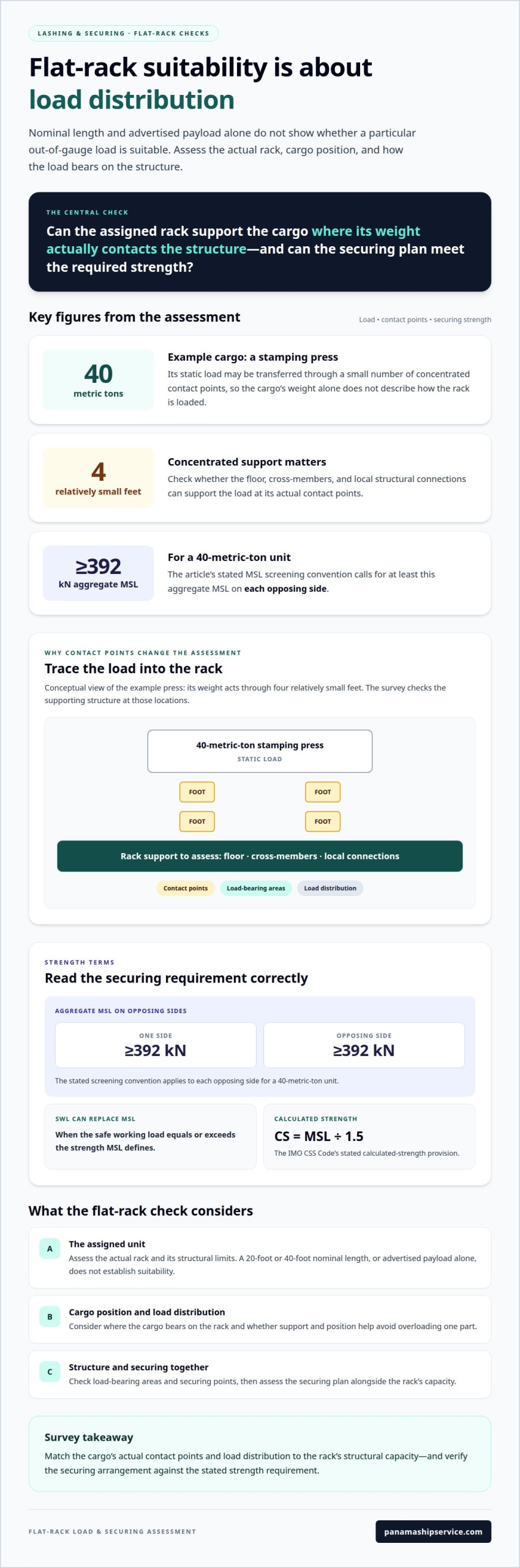
Flat-rack suitability depends on the assigned unit’s structural limits, cargo position, and load distribution. A unit may be 20-foot or 40-foot, but nominal length and advertised payload alone don’t establish whether it can carry a particular out-of-gauge load. The survey considers the actual rack and how the cargo bears on it.
Load concentration matters. A 40-metric-ton stamping press, for example, can transfer its static load through four relatively small feet. The survey therefore assesses whether the floor, cross-members, and local structural connections can support the load at those contact points. Adequate support and a suitable position help avoid overloading one part of the rack.
The securing plan is assessed alongside the rack’s capacity. For a 40-metric-ton unit, the stated MSL screening convention calls for at least 392 kN of aggregate MSL on each opposing side. A safe working load may replace MSL when it equals or exceeds the strength MSL defines. The IMO CSS Code’s calculated-strength provision gives CS as MSL divided by 1.5.
Condition checks cover the flat rack’s load-bearing areas and securing points, along with the chains and other restraint components. The surveyor relates the equipment arrangement to the cargo’s weight and position, then considers how handling could affect the secured load. If the rack’s structure or proposed arrangement cannot support the cargo, corrective action is needed before loading proceeds.
Photographs and written observations make the assessment useful during cargo operations. A clear record identifies the assigned flat rack, cargo position, load concentration, and any issue affecting structural capacity or securing. For marine transport, this evidence helps the relevant parties understand why a unit is suitable or what must change before loading.
Securing materials and attachment geometry
Material choice matters because each restraint transfers forces along a particular path. Chains, wires, ropes, straps, and brackets can secure cargo, but their strength and arrangement must suit the unit and its attachment points. A survey assesses the cargo securing plan as a complete system, not simply a count of individual restraints.
Geometry affects how effectively each lashing resists movement. The surveyor assesses the angle, direction, and attachment position of each restraint, then considers how these factors interact with the cargo’s weight and expected transport forces. A steep or poorly aligned lashing may not restrain movement in the direction required. Turnbuckles and tensioners must also suit the selected lashing and maintain the intended tension.
Material strength is assessed using the applicable working figures. The stated MSL for web lashing is 50 per cent of breaking strength; for reusable wire rope, it is 30 per cent. A rule-of-thumb method calls for the total MSL of securing devices on each side to equal the cargo item’s weight. These screening figures don’t replace assessment of the actual cargo, lashing geometry, and securing plan.
Dunnage and blocking help distribute forces between cargo and supporting surfaces. Timber’s stated securing strength is 0.3 kN/cm² normal to the grain, so orientation matters when timber transfers load. The survey considers the contact area, grain direction, and placement in relation to the cargo and its restraint points. A poor fit can leave gaps or concentrate pressure where the arrangement needs support.
The inspection records the material types, number, angles, arrangement, dunnage, and blocking. This gives the cargo team a practical basis for correcting the plan before transport. For operational support with cargo movements, arrange cargo handling.
Panama Ship Service: Marine Surveys
Panama Ship Service provides Marine Surveys for shipping operations that require professional assessment of cargo condition, equipment, or vessel requirements. Use this service when project cargo, flat racks, or securing arrangements need survey attention during a vessel’s call at the Panama Canal.
A survey supports operational decisions by documenting relevant observations and identifying deficiencies that need attention. This can help cargo interests and vessel teams resolve issues before departure, while the load remains accessible. The assessment should reflect the actual cargo, securing arrangement, and operation, rather than assume one approach suits every shipment.
For cargo or vessel survey requirements connected with an upcoming operation, contact Panama Ship Service.
Plan the survey around your next cargo operation
Arrange the survey while the cargo and securing arrangement are still accessible. Share the cargo details, planned loading sequence, transport requirements, and any known equipment concerns. This provides a practical starting point for defining the survey scope and aligning the inspection with the operation.
A lashing and securing equipment survey is one part of preparing a vessel for cargo operations. Panama Ship Service also offers Mechanical Ship Repairs, Underwater Hull Services, and MARPOL Disposal. Coordinating relevant vessel requirements can help keep operational planning focused around the port call.
Discuss your survey requirements and the cargo operation ahead with Contact Panama Ship Service. A clear next step can make planning more straightforward.
Frequently Asked Questions
Can damaged lashing gear be repaired?
Some damaged gear can be repaired, but it should not remain in service until its suitability is established. A bent hook, damaged chain link, or faulty tensioner can compromise the entire securing arrangement. Remove the item from use, have it assessed by a competent repairer, and inspect it again after repair. If its strength or safe operation cannot be demonstrated, replacement is the safer decision.
How Does a Marine Surveyor Inspect Twistlocks During a Lashing and Securing Equipment Survey?
A marine surveyor examines twistlocks for visible damage, corrosion, deformation, missing parts, and clear identification. The surveyor also assesses whether each lock operates and engages correctly with the container corner fittings. During a lashing and securing equipment survey, the findings should identify the affected twistlock and its location. Set aside any lock that cannot be shown to engage or operate properly until corrective action is taken.
What is MSL and how does it differ from SWL?
MSL means maximum securing load, while SWL means safe working load. They are related strength measures, but the terms are not automatically interchangeable. An SWL may replace MSL when it equals or exceeds the strength defined by MSL. For example, when assessing a restraint’s documentation, the surveyor considers whether its stated rating supports the planned securing arrangement rather than treating different labels as equivalent.
What is direct lashing?
Direct lashing connects cargo to securing points so the restraint helps oppose cargo movement. The lashing carries tension between the cargo attachment and the deck or container securing point. Its direction and angle affect how it acts against movement. For example, a lashing aligned to resist sideways movement may not provide the same restraint in another direction.
What is frictional lashing?
Frictional lashing presses cargo against its supporting surface so friction helps resist sliding. The restraint’s pretension and the contact between the cargo and surface both affect the arrangement. For example, a slippery interface can reduce available friction even when lashings appear tight. A survey considers the cargo support, contact surfaces, and lashing arrangement together, not tension alone.
What is lashing capacity?
Lashing capacity is the rated securing force assigned to a lashing device for cargo restraint. It helps determine whether the selected device suits its intended role in the securing plan. Consider the rating alongside the device’s condition, attachment points, and arrangement. A component’s capacity alone does not establish that the complete lashing system is suitable for a particular cargo unit.