
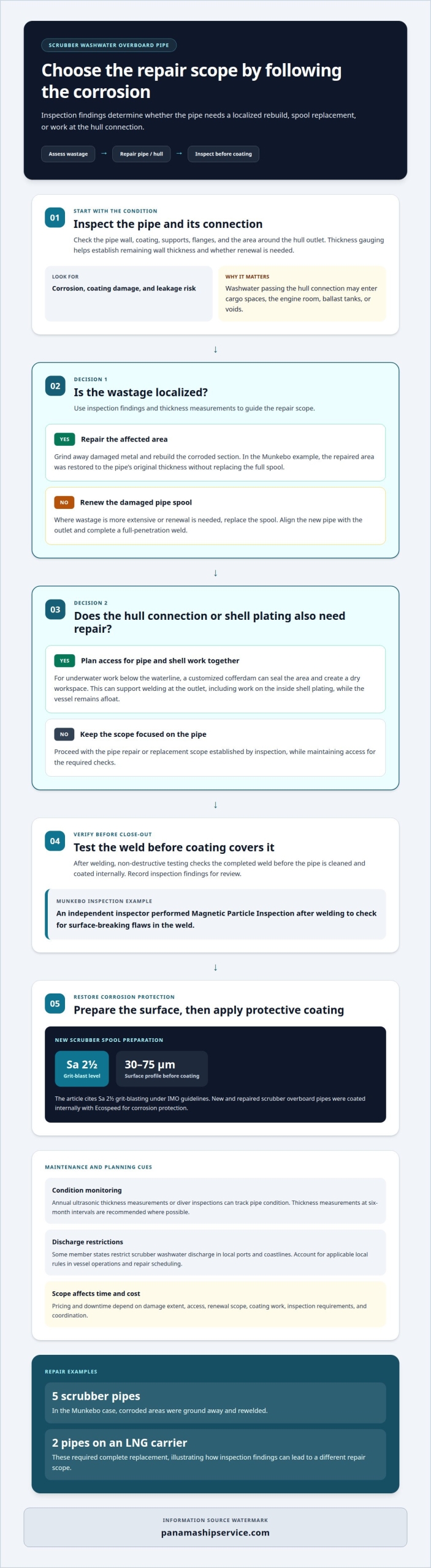
The repair method depends on how far corrosion has progressed, not just what is visible from outside. A scrubber washwater overboard discharge pipe repair may involve grinding out and rebuilding a localized corroded area, or replacing a damaged pipe spool when wastage is more extensive. The work can also include repairs at the hull connection, protective epoxy coating, final inspection, and coordination with class.
That distinction matters because corrosion can affect both the discharge pipe and its connection to the ship’s hull, creating a risk of water ingress. A sound repair plan addresses the damaged area and the checks needed before the work is complete.
The examples below show how repair teams have handled corrosion damage, external pipe and hull repairs, epoxy application, and inspection. They also explain how repair scope and class coordination fit together, so you can understand what to expect when a scrubber discharge pipe needs attention.
Key Takeaways
- Learn how corrosion at the discharge pipe and hull connection can create a water-ingress risk, and which signs guide repair planning.
- See how repair teams address damage with localized pipe work or spool replacement, including repairs that require access at the hull.
- Understand how grinding, epoxy coating and non-destructive inspection fit into the repair and close-out process.
- See how class coordination supports repair completion, and when Mechanical Ship Repairs can help with a damaged scrubber discharge pipe.
Corrosion risks to discharge pipes and hull plates
Acidic scrubber washwater can attack overboard piping, especially at uncoated or damaged sections where mild-steel pipework joins hull plating. Corrosion thins the pipe wall and can cause leakage. If washwater passes the hull connection, it may enter cargo spaces, the engine room, ballast tanks, or voids. Early assessment is important because the repair scope depends on whether wastage is localized or extends through the pipe or shell connection.
Inspection focuses on the pipe wall, coating condition, supports, flanges, and the area around the hull outlet. Where wastage appears, thickness gauging helps establish the remaining wall thickness and whether renewal is needed. A scrubber washwater overboard discharge pipe repair may involve rebuilding a localized area or replacing the spool. The replacement pipe and its protective coating must suit exposure to corrosive washwater; coating damage can leave the metal vulnerable again.
Munkebo case: Five scrubber pipes had corroded areas. The repair team ground away the damaged metal and rewelded those areas. Two pipes on an LNG carrier required complete replacement. The different outcomes show why inspection findings guide the choice between localized repair and renewal.
Discharge restrictions: The International Maritime Organization notes that some member states restrict scrubber washwater discharge in local ports and coastlines. These restrictions can affect discharge planning during repair, so vessel operations and the repair schedule must account for the rules that apply at the location.
Cost and downtime: Repair pricing depends on the extent of damage, access, renewal scope, coating work, and inspection requirements. Pricing is provided after a quote request. Downtime also depends on the repair method, access conditions, and coordination needed to complete and inspect the work.
Safety and environmental risks: Leakage can cause water ingress into vessel spaces, while repair work near the outlet requires control of washwater and repair debris. A defined work scope and inspection help address these risks before the vessel returns the pipe to service.
Damage to overboard piping and hull plating
Scrubber systems route washwater through overboard piping and a hull penetration. Damage at either point can require work on the pipe and shell plating, not just a surface patch. Before welding begins, the repair team establishes the affected area and access method. The scope depends on where the pipe has failed and whether the hull connection also needs repair.
For underwater work, a customized cofferdam can seal the area below the waterline and create a dry working environment. This access arrangement supports welding at the outlet while the vessel remains afloat. It is especially relevant when the repair requires work on the inside shell plating, where an ordinary external approach cannot complete the connection.
Munkebo case: Damaged scrubber overboard pipe locations required welding on the inside shell plating. The repair team designed and built custom cofferdams for those locations. This provided welders with a dry workspace at the hull connection, allowing the pipe and shell work to proceed together.
For a replacement, the team aligns the new pipe spool with the outlet and completes a full-penetration weld. This joint connects the replacement pipe through its full thickness, rather than relying on a surface weld alone. Alignment and hull fit matter: a poorly positioned spool can complicate the joint and subsequent inspection.
Testing follows welding. In the described repair sequence, the completed weld undergoes non-destructive testing before the pipe is cleaned and coated internally. This order lets inspectors assess the weld before coating covers the pipe surface. The repair process includes a documented inspection step, followed by corrosion protection for the renewed pipework.
Where shell access, spool alignment and testing must be coordinated, repair coordination helps keep the work sequence clear.
External pipe grinding, epoxy application and final inspection
Before underwater repair begins, a diver’s visual inspection can document the overboard pipe, hull outlet, and nearby coating. This preliminary view helps locate visible damage and plan access. For ongoing maintenance, annual ultrasonic thickness measurements or diver inspections can track the pipe’s condition. Thickness measurements at six-month intervals are recommended where possible.
The repair sequence follows the inspection findings: expose and prepare damaged metal, repair or replace the affected pipe, then inspect the completed work and restore the protective coating. The exact scope depends on the damage and access. This sequence provides inspection points before coating conceals the repaired surface.
Munkebo case: A scrubber pipe had a corroded area that could be repaired without replacing the full spool. The repair team ground away the wastage and rebuilt the area to the pipe’s original thickness. This restored the affected section while retaining the existing pipe.
Surface preparation affects coating adhesion. New scrubber spool pipes are grit-blasted to Sa 2½ under the cited IMO guidelines, with a surface profile of 30-75 µm before coating. After preparation, the repaired or replacement pipe receives protective coating. The inside of new and repaired scrubber overboard pipes was coated with Ecospeed for corrosion protection.
Inspection verifies the repair before close-out. In the Munkebo case, an independent inspector performed Magnetic Particle Inspection after welding. This non-destructive test checks for surface-breaking flaws in the weld. The repair sequence then allows cleaning and coating, with inspection findings recorded for review.
External coating work and underwater inspection address different surfaces. A diver’s preliminary view identifies external conditions; thickness measurements track metal loss, while Magnetic Particle Inspection examines completed welds. Together, these checks give the repair team a basis for monitoring pipe condition and assessing the finished work.
Class approval and repair coordination
Class involvement should be considered when the repair scope is planned, not only after welding. A scrubber spool pipe with wall-thickness reduction of 20% or more generates a Condition of Class. Repair planning therefore needs clear inspection findings, the proposed scope and records of completed work. Class review and acceptance depend on the vessel’s requirements and the evidence available.
ClassNK has received several reports of scrubber washwater pipe issues. This context makes documented condition assessment useful: thickness readings identify wastage, while inspection results show whether the work involves local renewal or a replacement spool. The repair team can coordinate the scope and inspection stages with the vessel’s class representative.
Sister-vessel case: An LNG carrier had scrubber overboard pipes inspected and repaired in Munkebo, Denmark. Its sister vessel returned to the yard about one month later. Inspection found four pipes did not require full replacement. This illustrates why each vessel needs its own condition assessment before repair materials and work are finalized.
Coordination also covers work sequencing. The team aligns hull access, welding, non-destructive testing, cleaning, and coating so inspection can take place before surfaces are covered. For exhaust gas cleaning systems, repair records can organize the measured damage, selected repair method, and inspection outcome. This gives class and vessel representatives a consistent basis for reviewing completion.
Sea connections and overboard discharge valves, including their attachment to shell plating, are inspected during periodical docking surveys. Existing scrubber installations should also have their design and installation reviewed at the next scheduled drydocking. These checks can identify repair needs before they disrupt the marine schedule. Overboard piping and material selection are usually within the shipyard’s delivery scope, so responsibilities should be coordinated across the repair plan.
For an alternative repair scope or an upcoming survey, coordinate scrubber pipe repair planning around the vessel’s inspection findings and class requirements.
Panama Ship Service: Mechanical Ship Repairs
Panama Ship Service provides Mechanical Ship Repairs for vessels requiring work on scrubber discharge pipework or related mechanical damage. When corrosion reaches the hull outlet, its Underwater Hull Services can support the repair. Marine Surveys can support condition assessment, while the scope depends on inspection findings, pipe condition, and access.
A clear repair brief should identify the affected area, relevant inspection records, hull access needs, and planned vessel schedule. This helps align mechanical work with inspection and repair sequencing, including class coordination.
Contact Panama Ship Service to discuss your vessel’s scrubber pipe repair requirements.
Plan the next repair window with confidence
The next step is to turn inspection findings into a repair scope that fits the vessel’s operating schedule. A clear record of pipe condition, access requirements, and needed follow-up gives the repair team a practical starting point. This preparation helps align scrubber washwater overboard discharge pipe repair with related hull work and vessel planning.
Panama Ship Service offers Mechanical Ship Repairs and Underwater Hull Services for repair needs involving pipework and hull access. Its MARPOL Disposals service can also support disposal requirements connected with vessel operations. The right scope depends on the work identified for the vessel, so begin by outlining the damage and service requirements that need attention.
Contact Panama Ship Service about repairs to discuss the next step for your vessel.
Frequently Asked Questions
What regulations govern scrubber washwater overboard discharge pipe repairs on ships?
IMO exhaust gas cleaning guidelines address washwater discharge, while repair work also involves the vessel’s class and flag requirements. Under the 2021 Guidelines, washwater pH must be at least 6.5 at a distance of 4 m from the overboard discharge. Local restrictions can affect discharge planning too, so the applicable port or coastal rules matter alongside the repair scope.
Can a vessel discharge scrubber washwater while the overboard pipe is being repaired?
Do not assume discharge through a pipe that is isolated or under repair can continue. The vessel’s operating procedures and restrictions at its location affect whether scrubber operation can continue through another suitable arrangement. Some IMO Member States restrict washwater discharge in local ports and coastlines, so the repair plan needs to account for the vessel’s location and the condition of the affected line.
What are the class and flag-state requirements for scrubber overboard pipe repair?
Class and flag-state requirements depend on the vessel and repair scope. A scrubber spool pipe with wall-thickness reduction of 20% or more generates a Condition of Class. Repair coordination should include measured condition, the proposed work and records of inspection and completion. The vessel’s class process and applicable flag requirements guide review and close-out, rather than a single procedure applying to every ship.
How do professionals diagnose leaks, corrosion, or blockage in a scrubber washwater discharge pipe?
Professionals combine external observations with pipe-condition assessment. A diver can inspect the underwater outlet for visible leakage or coating damage, while ultrasonic thickness readings help identify wall loss. If blockage is suspected, the team assesses the pipe’s internal condition and flow during an appropriate inspection. Comparing these findings helps distinguish restricted flow from corrosion, a leaking joint, or damage near the hull connection.
What materials and welding procedures are suitable for scrubber washwater discharge piping?
Material selection must account for corrosive washwater, the hull connection, and the protective coating system. The repair team uses the pipe specification and repair scope to determine suitable replacement material and welding arrangements. At a hull penetration, alignment and a compatible connection are central to the joint. Completed welds can be examined with non-destructive testing before cleaning and coating finish the repair.
Does repairing the scrubber discharge pipe require dry docking or can it be done afloat?
Some repairs can be completed afloat using a cofferdam to create a dry work area. A pipe-in-pipe repair is best suited to overboard pipes greater than 300 mm and can be installed while the vessel is afloat and in operation. Other damage may require more extensive access or hull work, making the repair scope and docking schedule important planning factors.