
Protecting a repair budget starts before work begins, not after the invoice arrives. Effective ship repair cost control strategies begin with a clear condition assessment and maintenance history, then align the repair scope with parts availability, warranty coverage, sourcing, and quality checks.
Planned maintenance can help prevent smaller faults from developing into more extensive repairs, while records of recurring issues help teams focus spending where it matters. Cost control should not mean cutting corners: unsuitable parts or incomplete repairs can lead to repeat work and further disruption.
This article explains how professional assessments shape a practical repair plan, how inventory and warranty reviews can prevent unnecessary orders, and how procurement and quality controls support sound budgeting. It also covers what to consider when planning repair work and how decisions affect scope, timing, and the vessel’s longer-term maintenance needs.
Key Takeaways
- Use equipment condition and repair records to prioritize work and spot recurring faults before they expand the scope.
- Review onboard spare parts for condition and warranty status before placing orders, prioritizing components critical to operations.
- Assess sourcing options by total procurement impact, including delivery method, location, and opportunities to consolidate purchasing.
- Prioritize suitable, reliable parts and quality controls to reduce the risk of repeat failures and avoidable rework.
1. Equipment condition assessments and maintenance history
Condition assessment is one of the practical ship repair cost control strategies that helps determine whether to repair or replace equipment. Repair can retain serviceable components, while replacement may make sense when damage is extensive or recurring faults create operational risk. The decision depends on inspection findings, repair scope, equipment condition, and the consequences of failure.
A repair estimate connects assessment findings with labor, materials, parts, and expected downtime. Other key cost drivers include equipment complexity and the extent of damage. Reviewing maintenance records helps identify recurring faults, rather than treating each defect as an isolated issue.
Preventive maintenance covers planned inspections and routine servicing. Corrective maintenance addresses faults after detection, while predictive maintenance uses condition data, such as vibration or oil analysis, to identify developing problems. Regular inspections can reveal deterioration early. A turbocharger overhaul at 48,000 running hours is one example of an interval used to guide maintenance planning.
Ships usually undergo major dry docking every 2.5 to 5 years, but condition and scope shape the actual plan. Combining compatible upgrades with scheduled maintenance may avoid duplicated setup or access work. Since new technology can add expense, the provider weighs each upgrade against its operational value and timing.
In the United States, applicable regulations, taxes, and port requirements may affect repair scope and timing. Their relevance depends on the vessel, work, and location, so include them in project planning. Ship repair cost control strategies also depend on clear scope management: document agreed work, record new findings, and assess schedule and budget effects before authorizing changes.
To manage labor and schedules, sequence tasks, coordinate work crews, and align parts delivery with the repair plan. Planned maintenance and condition monitoring help prioritize work before faults escalate. These ship repair cost control strategies turn inspection and operating records into a focused repair plan.
2. Spare parts inventory and warranty checks
An onboard inventory review can prevent duplicate orders and identify parts available for planned work. Record each component’s location, condition, identification details, and warranty status. A spare part that is damaged, obsolete, or unsuitable for the specific engine may not meet the repair need, even if it appears available on paper.
Prioritize inventory according to equipment criticality. A component that could disable propulsion or another essential system deserves a different replenishment priority from a noncritical item. This directs purchasing attention to parts most likely to affect safe, reliable operation and can help avoid costly workarounds when an original part cannot arrive in time.
Warranty checks belong before new orders. Some original equipment manufacturers offer spare-parts warranties of 12-18 months. Coverage depends on the applicable terms, so record the purchase date, part identification, and supporting documentation. For engine work, verify whether the part itself remains covered and whether the proposed repair relates to the original issue. A valid warranty may change which costs fall to the vessel operator.
Inventory management balances readiness with excess stock. Holding every possible component ties up resources and can leave parts unused or deteriorating; holding too little can delay work while replacements are sourced. Use issue and repair records to identify frequently needed items, then align stock levels with equipment criticality and expected maintenance. Parts availability affects scheduling, and avoidable delays may disrupt operations and contribute to higher fuel costs.
Repair contracts should define the agreed scope, responsibilities, warranty terms, and how additional work is handled. A change order records newly discovered work, its cost and schedule impact, and approval before the scope expands. Clear documentation helps both parties distinguish included work from added work. For coordinated mechanical ship repair planning, align the parts review with the repair scope before work begins.
Maritime shipping companies can use just-in-time inventory to improve inventory management. Consider this approach alongside equipment criticality and expected maintenance when reviewing replenishment needs. Issue and repair records can help identify which parts warrant attention, keeping inventory decisions connected to repair scope and the vessel’s operational requirements.
3. Procurement and global sourcing
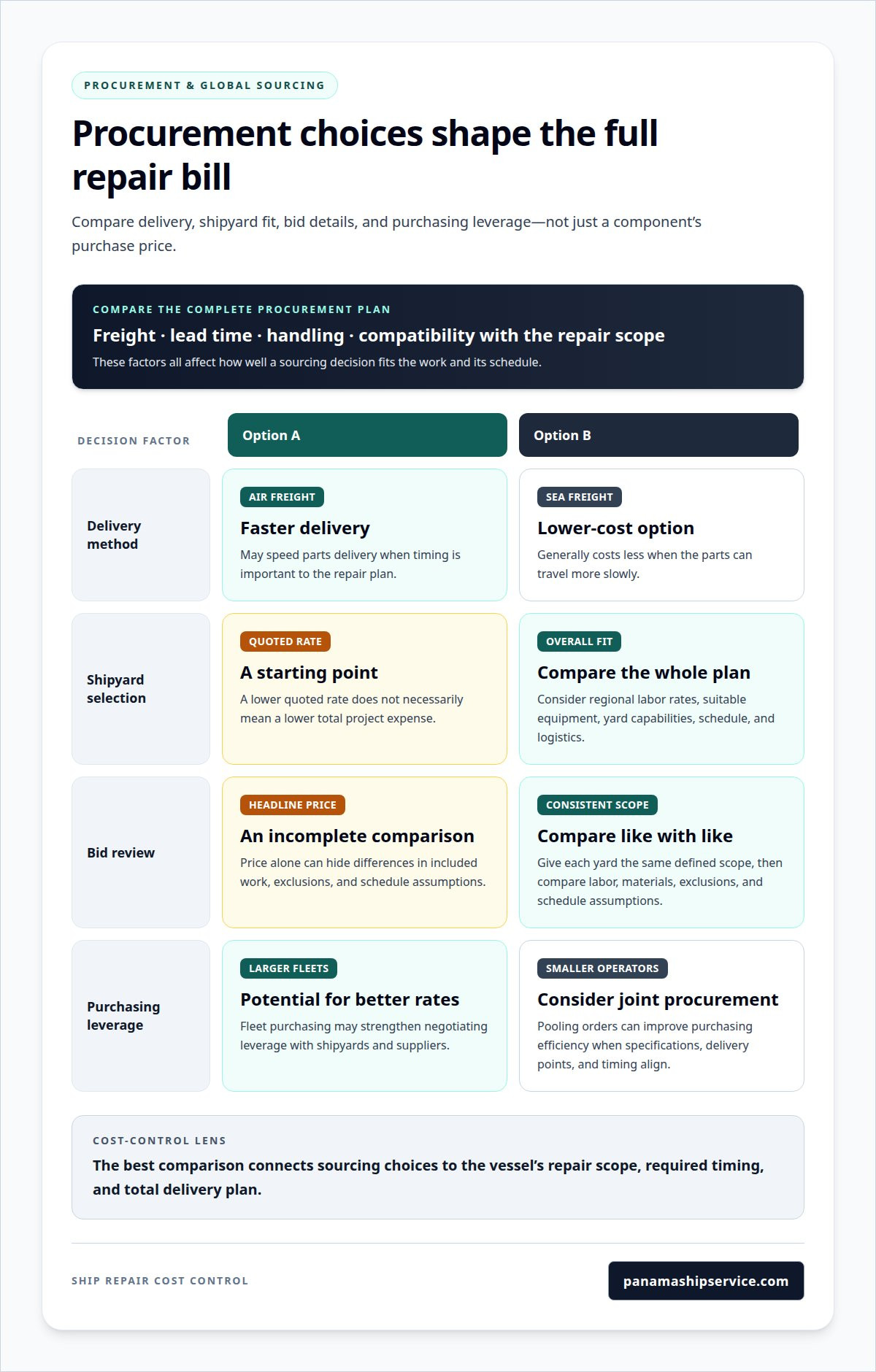
Procurement is one of the ship repair cost control strategies that affects more than a component’s purchase price. Compare the complete delivery plan, including freight, lead time, handling, and compatibility with the repair scope. For example, air freight may speed delivery, while sea freight is generally the lower-cost option when parts can travel more slowly.
Shipyard location also influences overall project cost. Labor rates and access to suitable equipment vary by region, so a lower quoted rate may not mean a lower total expense. Compare each yard’s capabilities, proposed schedule, included work, and logistics with the vessel’s needs.
Competitive bidding works best when every shipyard receives the same defined scope. Organize inspection findings and work requirements into a consistent request, then compare bids for labor, materials, exclusions, and schedule assumptions. This helps shipowners assess how well the scope fits, rather than focusing on the headline price alone.
Fleet size can strengthen purchasing leverage. Larger fleets may negotiate better rates with shipyards and suppliers, while smaller operators can explore joint procurement. Pooling orders can improve purchasing efficiency when specifications, delivery points, and timing align across vessels. These are practical ship repair cost control strategies, particularly when repeated needs can be sourced together.
Strategic sourcing also means reviewing suppliers and procurement practices before urgent work begins. E-procurement systems can centralize requests, approvals, and order records, giving teams a clearer view of purchasing activity. Strategic partnerships may support bulk purchasing, while consistent part specifications can simplify repeat orders across similar equipment.
For a useful comparison, separate urgent components from items that can follow a longer delivery route. Match each part’s arrival date to the repair schedule, then assess freight options and supplier terms together. Effective ship repair cost control strategies balance suitability, availability, delivery, and project scope instead of optimizing one purchase in isolation.
4. Quality spare parts and repeat-failure prevention
Materials, spare parts, and consumables can account for substantial repair costs, especially when components are specialized. Reliable parts can reduce repeat failures, while a cheaper substitute may create additional work if it does not suit the equipment. For an engine repair, matching the replacement component to the required specification is essential.
Before installation, inspect each part’s condition, identification, and compatibility with the equipment. Compare the delivered component with the approved repair scope and record any mismatch before work proceeds. This simple hold point helps prevent unsuitable parts from entering an assembly or delaying completion after disassembly.
Part quality alone does not explain every repeat failure. Examine the failed component and surrounding equipment to determine whether the cause relates to wear, damage, installation, or another system issue. For example, replacing a failed component without addressing a related fault may leave the original failure pattern in place.
After installation, inspections should confirm that the work matches the repair scope and that connected components are correctly reassembled. The provider should document the part used, work performed, and inspection findings in the repair record. Those details give the vessel’s maintenance team a clear reference if the same equipment develops a fault later.
Monitoring equipment after repair can help identify changes before they develop into another breakdown. Compare operating observations with the vessel’s maintenance records and investigate unusual signs promptly. A repeat fault should trigger a review of the component, repair method, and operating conditions, rather than an automatic replacement. This directs follow-up work toward the cause, not just the visible symptom.
For professional repair work that includes parts inspection and quality checks, arrange mechanical ship repair support.
Cost reduction approaches include improving maintenance productivity, preventive maintenance, eliminating repeat failures, and reviewing maintenance contracts and rates. Before ordering, check spare parts already in inventory for their condition and warranty status. Rank plant assets by criticality and prioritize orders for the most critical equipment. Workarounds when original spare parts are unavailable on time have led to expensive repairs during operations.
Maintenance costs include labor, equipment capital expenditure, integration costs, and condition-monitoring data quality. Transporting engine cylinder heads between decks can take an hour, a task that may be assigned to crew rather than higher-cost qualified marine engineers.
Panama Ship Service: Mechanical Ship Repairs
Panama Ship Service provides Mechanical Ship Repairs for vessels requiring professional repair work. Turn to the service when inspection findings, equipment faults, or planned maintenance call for a defined repair scope. Clear information about the vessel’s condition and required work provides a practical starting point for planning.
When hull condition is part of the repair picture, Underwater Hull Services and Marine Surveys address related inspection needs. MARPOL Disposal is also available when waste disposal is required alongside vessel operations. These services can help coordinate relevant needs around a vessel’s work in Panama.
For mechanical repairs, share the vessel’s maintenance records, assessment findings, and known parts requirements. Contact Panama Ship Service to discuss the repair work your vessel needs.
Make the Next Repair Decision Count
A stronger maintenance budget is built through consistent decisions, not a single round of cost cutting. Put ship repair cost control strategies into the vessel’s ongoing planning cycle, so repair priorities inform future budgets and operational decisions. That creates a clearer basis for assigning resources while keeping reliability in view.
For your next repair, define the operational need and the outcome the work must support. Panama Ship Service provides Mechanical Ship Repairs, with Underwater Hull Services and MARPOL Disposal for related vessel needs. Share your repair requirements with the team to discuss a practical next step.
Contact Panama Ship Service today to discuss your vessel’s repair needs. A focused plan can help you move ahead with greater clarity and confidence.
Frequently Asked Questions
What are typical ship repair costs by vessel type and repair scope?
Ship repair costs depend on vessel size and complexity, equipment condition, required labor and parts, and the extent of the work. A limited component repair differs substantially from a major overhaul involving specialized systems or extensive downtime. Panama Ship Service provides a quote on request, shaped by the vessel, repair scope, materials, and work requirements. Share the relevant repair details to support a project-specific estimate.
What U.S. regulations, taxes, and port requirements affect ship repair costs?
Applicable regulations, taxes, and port requirements can affect repair scope and timing. Their relevance depends on the vessel, work, and location, so include them in project planning.