
Low fresh-water output doesn’t automatically mean the plates need acid descaling. Professional fresh water generator plate cleaning and acid descaling starts with verifying the output problem and identifying evaporator scale; for one marine descaler, the stated concentration is 10 to 20%, and it shouldn’t be used above 40°C. The correct process depends on the descaler and the generator’s condition.
It’s reasonable to want effective cleaning without avoidable downtime or risk to the plates. This guide explains how professionals assess low output, identify scale, and clean in place (CIP) using an inhibited acid descaler. It also covers the information that helps plan the work and when a mechanical ship repair specialist can support the vessel.
Key Takeaways
- Use a timed collection test to distinguish a genuine production shortfall from an unreliable output reading.
- Assess evaporator deposits before choosing a cleaning method; scale composition helps determine whether acid descaling is appropriate.
- Match the inhibited acid and CIP process to the plate unit, controlling the cleaning conditions throughout the procedure.
- Use the inspection findings to plan the next maintenance step and reduce the risk of unnecessary cleaning or equipment damage.
How professionals perform cleaning-in-place descaling
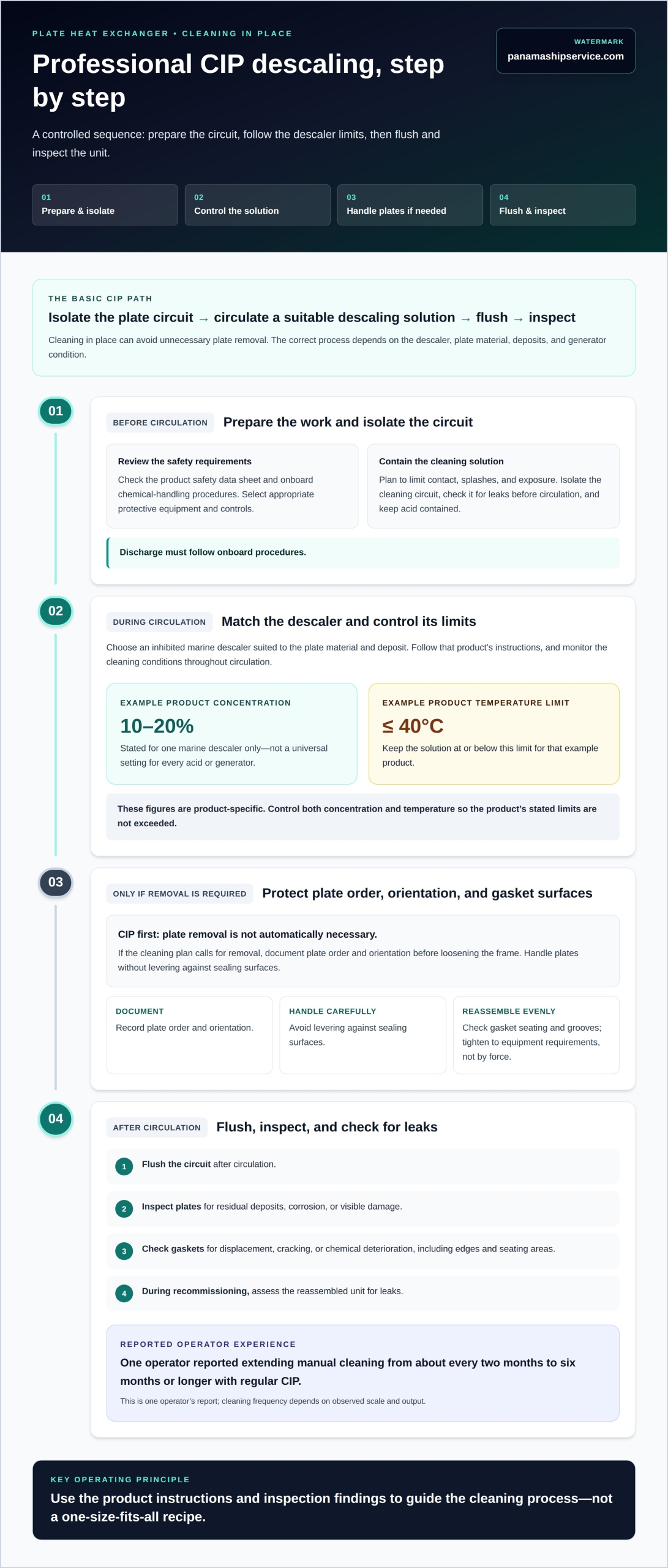
A plate heat exchanger transfers heat between seawater and other circuits through alternating channels, while vacuum enables evaporation at low temperatures. For CIP, professionals isolate the plate circuit, circulate a suitable descaling solution, then flush and inspect the equipment.
-
PPE and Acid Cleaning Precautions During Professional Service
Before circulating acid, professionals review the product’s safety data sheet and the vessel’s chemical-handling procedures. They select appropriate protective equipment and controls, and plan the work to limit contact, splashes, and exposure. They isolate the cleaning circuit and check it for leaks before circulation. Acid must remain contained, and any discharge must follow onboard procedures.
-
Acid Concentration and Temperature for Professional Descaling
Choose the inhibited marine descaler for the plate material and deposit, then follow its product instructions. One marine descaler is used at a concentration of 10 to 20%; that range isn’t a universal setting for every acid or generator. Keep the solution at or below 40°C for that example product. Professionals control concentration and temperature during circulation to avoid exceeding its stated limits.
-
Professional Plate Removal and Reinstallation Without Gasket Damage
Use CIP when the plate pack can be cleaned in place; removal is not automatically necessary. If the cleaning plan requires removal, professionals document plate order and orientation before loosening the frame. They handle plates without levering against sealing surfaces, then inspect gasket seating and grooves before reassembly. The pack is tightened evenly to the equipment’s requirements, not forced closed.
-
Professional Plate and Gasket Inspection After Cleaning
After circulation, professionals flush the circuit and inspect the plates for residual deposits, corrosion, or visible damage. They check gasket edges and seating areas for displacement, cracking, or chemical deterioration, then assess the reassembled unit for leaks during recommissioning. Cleaning frequency depends on observed scale and output. One operator reported extending manual cleaning from about every two months to six months or longer with regular CIP.
How professionals confirm low output with a timed collection test
Professionals measure the collected distillate over a recorded interval and compare it with the generator’s rated capacity. They also log operating conditions, since temperature, vacuum, and extraction affect production.
- Stabilize and record operating conditions. Before timing collection, professionals confirm the generator is operating steadily and note relevant readings. A typical vacuum fresh water generator operates at 85-95% vacuum and evaporates at 40-60°C. Readings outside the unit’s normal operating pattern can affect production, so the collection result needs this context.
- Collect distillate through a known interval. Direct product water into a clean, measurable collection vessel, keeping the test arrangement consistent. Record the start and stop times and the collected volume. Professionals use the same collection method when repeating the test, so changes reflect production rather than a different measurement setup.
- Compare measured output with rated capacity. Check the result against the generator’s capacity rating and its specified test conditions. For example, the JWP-26-C rated capacity is specified at a cooling-water temperature of 32°C. A reading taken under different cooling-water conditions may not be directly comparable to that rating.
- Review extraction and readings before blaming scale. Check brine level, vacuum, feed conditions, and the distillate path alongside the timed volume. Brine visible more than 20 mm up the sight glass indicates poor extraction. That finding can help explain low output, so professionals distinguish extraction problems from evaporator deposits before selecting a cleaning response.
- Use repeat results to guide the next inspection. If consistent timed tests still show low production under comparable operating conditions, professionals investigate the evaporator and related equipment. Record the readings and conditions for maintenance planning. If the vessel also needs a broader condition review, a marine survey can address that separate requirement.
How professionals assess evaporator scale composition and perform an acid fizz test
Professionals use the appearance of deposits and a controlled acid reaction to guide cleaning choices. A fizz test offers a clue, but it is not a complete chemical analysis.
- Locate and document representative deposits. Identify scale on evaporator plates and record where it appears, its color, and its texture. Compare deposits from different plate areas rather than treating every patch as identical. A chalky layer on one plate and a darker deposit elsewhere may indicate different accumulation patterns, so location and appearance belong in the inspection record.
- Assess the deposit before selecting a treatment. Look for hard, adherent scale that could restrict heat transfer or obstruct plate channels. Note whether deposits appear uniform or concentrated around particular flow paths. Visual inspection helps describe the fouling, but appearance alone cannot establish its chemical composition or prove that an acid treatment is suitable.
- Test a controlled sample for effervescence. Professionals isolate a small piece of deposit and apply an appropriate acid reagent under controlled conditions. Observe whether bubbles form, how quickly the reaction begins, and whether it continues. Carbonate minerals can release gas when they react with acid, so visible fizz supports the possibility of carbonate scale.
- Interpret the reaction as one indicator. Scale from an evaporator run with untreated seawater was found to be about 91% calcium carbonate. That finding illustrates why carbonate deposits may be common, but it does not establish the composition of deposits in another generator. Little or no fizz also doesn’t rule out mixed scale or other fouling.
- Use the result alongside the plate inspection. Record the test observation with the deposit location and visible condition. Treat fizz as supporting evidence, not a measurement of scale percentage or a stand-alone cleaning prescription. If deposits vary across the plate pack, assess those areas separately before selecting a descaling approach. This helps avoid assuming one sample represents every channel.
Professional use of inhibited sulphamic and citric acid
Hydrochloric acid and other strong acids can corrode generator metals, damage gaskets, and create hazardous exposure. Professionals choose an inhibited descaler compatible with the plate materials and follow the product instructions.
- Match the acid to the deposit and equipment. Professionals consider inspection findings, plate materials, gasket condition, and the chemical’s stated use. Inhibited sulphamic or citric acid may be selected when the product instructions support that application. The acid name alone doesn’t establish suitability; formulation and equipment compatibility guide the decision.
- Use the descaler as directed. Follow the selected product’s stated dilution, temperature limits, circulation method, and handling precautions. Don’t transfer a concentration or temperature from one marine descaler to another. For example, the 10 to 20% concentration and 40°C maximum described for one product apply to that product, not automatically to sulphamic or citric formulations.
- Protect the plate pack during circulation. Professionals isolate the fresh water generator circuit and confirm the cleaning arrangement suits the unit. They circulate the inhibited solution through the intended passages, monitor the process, and stop if leakage or an unexpected reaction appears. Avoid uncontrolled exposure, prolonged contact, or mixing chemicals outside the product instructions.
- Flush and assess before returning to service. After descaling, professionals flush the circuit according to the chemical instructions and inspect for remaining deposits. They assess plates and gaskets for visible attack or displacement, then check the reassembled unit for leakage. Residual acid or missed deposits can undermine the cleaning outcome, so the post-cleaning check matters.
- Escalate equipment damage separately. If inspection reveals damaged components beyond cleaning, address the repair need rather than increasing acid strength. For vessel mechanical issues identified during maintenance, discuss mechanical ship repairs as a separate next step.
Panama Ship Service
Panama Ship Service can support vessel maintenance when generator inspection reveals wider condition concerns. If plate findings point to a mechanical issue beyond cleaning, its Mechanical Ship Repairs can address the repair work. Marine Surveys can provide a broader assessment of vessel condition. These services complement descaling but do not replace technical assessment of deposits, acid compatibility, or plate condition.
Share the inspection findings and the operational issue that prompted the review. This context helps identify relevant vessel support instead of treating every output problem as a cleaning task. Contact Panama Ship Service to discuss your vessel’s needs.
Plan the Next Maintenance Decision
Use the generator’s inspection findings to plan its next maintenance. Keep output records and notes on plate condition with the vessel’s service history, so future decisions are based on observations rather than assumptions. A measured approach to fresh water generator plate cleaning and acid descaling can also help distinguish generator work from wider vessel support needs.
If inspection identifies work beyond the plate pack, Panama Ship Service offers Mechanical Ship Repairs, Underwater Hull Services, and MARPOL Disposal. These services address separate operational needs and can be considered as part of the vessel’s maintenance planning.
Contact Panama Ship Service for support and discuss the next step for your vessel. Clear findings make the conversation more focused and help keep maintenance planning practical.
Frequently Asked Questions
How do professionals clean fresh water generator evaporator plates step by step?
Professionals assess the generator and deposits before selecting a cleaning method. For fresh water generator plate cleaning and acid descaling, they determine whether CIP can reach the fouled passages or whether the plate pack needs further inspection. They then follow the selected chemical’s instructions, flush the circuit, and assess the equipment before it returns to operation. The sequence depends on the generator’s design and condition.
Which chemicals do professionals use to acid descale fresh water generator plates?
Professionals may choose inhibited sulphamic or citric acid formulations designed for marine descaling. Fresh water generator plate cleaning and acid descaling require a product suited to the scale, plate material, and gasket compatibility. Follow the product instructions for use. Hydrochloric acid can cause corrosion and gasket damage, so a strong acid is not automatically appropriate just because it reacts with deposits.
How long does professional acid cleaning of fresh water generator plates take?
The duration depends on deposit buildup, access to the plate circuit, and the selected descaler’s instructions. Professionals also allow for circulation, flushing, and post-cleaning inspection. A generator with difficult access or persistent deposits may need a different work plan from one suited to straightforward CIP. These factors, together with the vessel’s operational requirements, shape the maintenance schedule.
How do professionals safely circulate and neutralize acid descaling solution?
Professionals isolate the cleaning circuit and use a circulation setup suited to the generator and descaler. They monitor for leaks or unexpected reactions, then flush the equipment according to the chemical instructions. Neutralization and disposal follow the product procedure and applicable onboard handling processes. They do not mix chemicals or improvise treatment, because the correct procedure depends on the solution used.