
The Panama Canal is more than a waterway; it is a testament to human ambition, sacrifice, and engineering genius. Its story spans centuries, from the earliest dreams of a path between the oceans to its modern-day status as a vital artery of global trade. Understanding this monumental journey-from early dreams and devastating failures to ultimate triumph-reveals the incredible challenges overcome to connect the world. This is the brief but comprehensive history of the Panama Canal.
While the canal is a marvel of engineering for global trade, the name “Panama” has also become famous for world-class marine recreation. For instance, in the similarly named Panama City Beach, Florida, the coastal waters are a premier destination for sport fishing. You can find out more about Charter fishing to see what these deep-sea adventures entail.
The Early Dream: A Path Between the Seas
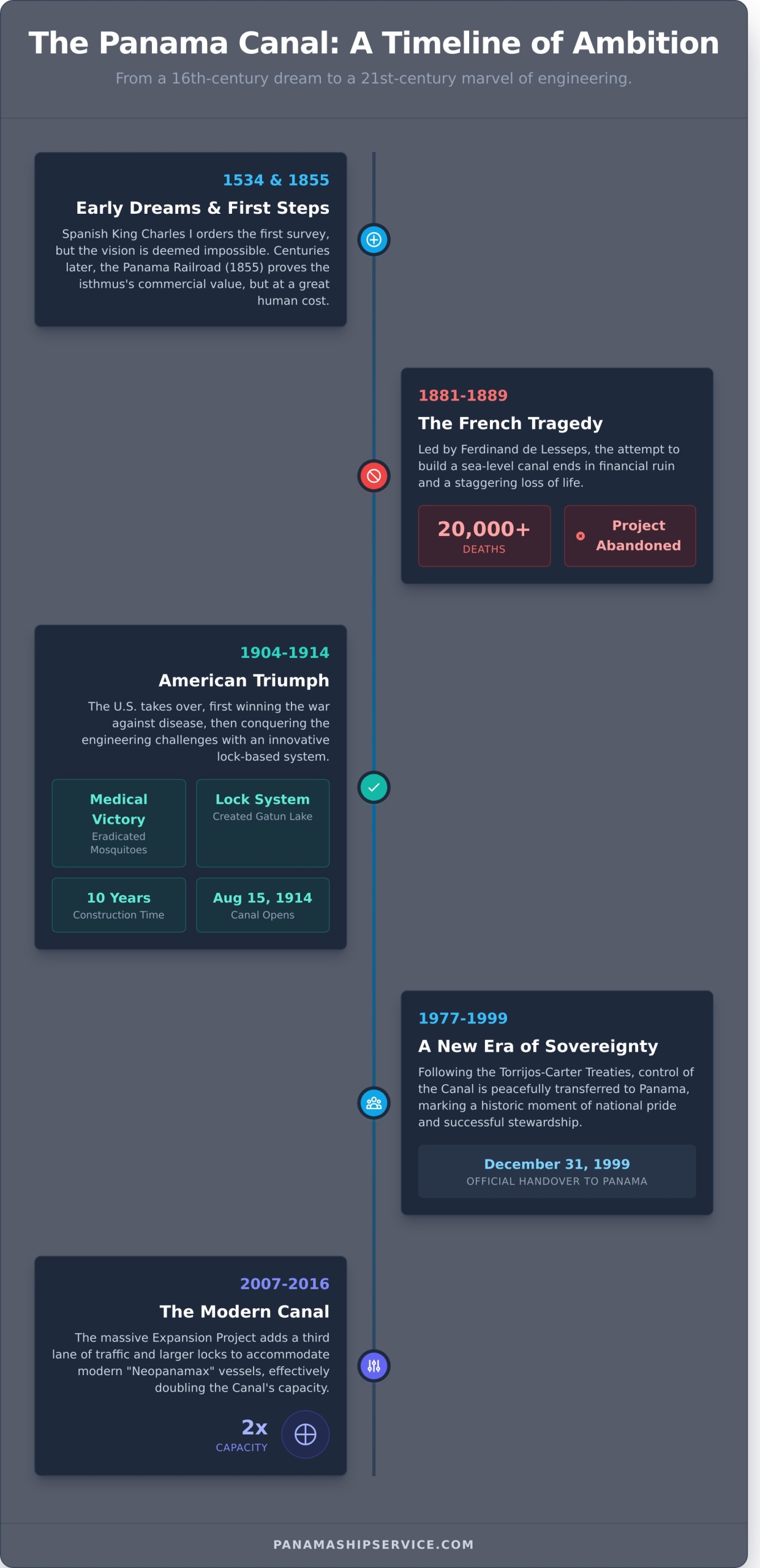
The concept of a canal across the Isthmus of Panama is nearly as old as the European discovery of the Americas. As early as 1534, Spanish King Charles I, Holy Roman Emperor, ordered the first survey for a potential canal route. He envisioned a shortcut that would give Spain a military and commercial advantage, avoiding the long and treacherous voyage around South America. However, the technological and financial challenges of the 16th century were insurmountable, and the ambitious project was abandoned.
The Panama Railroad: A Precursor to the Canal
Centuries later, the dream was revived by a different kind of rush: gold. The California Gold Rush of the 1850s created immense demand for a faster trans-isthmian route. This led to the construction of the Panama Railroad, a monumental feat of engineering in its own right. Completed in 1855, the railroad demonstrated the clear commercial viability of crossing Panama. Yet, its construction came at an immense human cost, with thousands of workers perishing from disease and accidents, foreshadowing the immense struggles that lay ahead for the canal builders.
The French Attempt: A Tragic Failure (1881-1899)
In 1881, the first serious attempt to construct a canal began, led by the celebrated French diplomat and developer Ferdinand de Lesseps, the man behind the Suez Canal. Riding high on his previous success, de Lesseps proposed a sea-level canal, underestimating the vastly different and more hostile Panamanian environment.
While de Lesseps’s Panamanian venture failed, his earlier success in Egypt created a landmark that remains a popular travel destination. Today, companies like Sola Travel specialize in organizing tours and excursions to the Suez Canal and other historic Egyptian sites.
The project was immediately beset by problems, from impenetrable jungle and torrential rains to political instability and financial corruption that ultimately doomed the effort.
The Devastating Human Cost: Malaria and Yellow Fever
The deadliest enemy of the French project was not rock or mud, but disease. Tropical illnesses, particularly malaria and yellow fever, were rampant and mysterious. Medical science at the time did not understand that these diseases were transmitted by mosquitoes, leading to ineffective treatments and catastrophic loss of life. It is estimated that over 20,000 workers, mostly from the Caribbean, lost their lives during the French construction era, a staggering toll that earned the isthmus a grim reputation.
Engineering Challenges and Abandonment
Beyond the medical crisis, the engineering plan was fundamentally flawed. The attempt to dig a sea-level canal through the continental divide at the Culebra Cut resulted in constant, massive landslides. The powerful and unpredictable Chagres River flooded excavation sites during the long rainy season, washing away equipment and progress. By 1889, facing insurmountable technical hurdles and financial ruin, the French company went bankrupt, bringing the ambitious project to a tragic and costly end.
The American Era: U.S. Intervention and Construction (1904-1914)
Following the French failure, the United States, under the assertive leadership of President Theodore Roosevelt, saw a strategic opportunity. Roosevelt was determined to build the canal, viewing it as essential for American naval power and commercial interests. To achieve this, the U.S. government supported Panama’s independence from Colombia in 1903, quickly signing a treaty that granted America the rights to build and administer a canal. The American plan was different, abandoning the sea-level concept in favor of a more innovative lock-based system.
Winning the War Against Disease
Learning from the French disaster, the Americans first tackled the health crisis. Dr. William C. Gorgas, an army physician, led a massive and systematic sanitation campaign. His team drained swamps, fumigated homes, installed mosquito netting, and built modern water systems to eradicate the breeding grounds of the mosquitoes that carried yellow fever and malaria. This medical victory was the single most important factor in the project’s ultimate success, saving countless lives and enabling the workforce to function effectively.
Engineering Triumphs: The Locks System and Gatun Lake
The American engineering plan was a marvel of its time. It involved constructing the world’s largest dam at the time across the Chagres River, creating the vast, artificial Gatun Lake to serve as a major part of the canal route. To lift ships up and over the continental divide, engineers designed and built a series of enormous lock chambers, the largest concrete structures ever created. The most difficult task remained the excavation of the Culebra Cut, a nine-mile-long channel carved through the mountains, a relentless battle against landslides that required the removal of over 100 million cubic yards of earth.
The Grand Opening: The SS Ancon’s First Transit
After a decade of relentless effort, the Panama Canal officially opened on August 15, 1914, with the transit of the cargo ship SS Ancon. The monumental achievement, however, was largely overshadowed by the outbreak of World War I in Europe just weeks earlier. Despite the muted celebration, the canal immediately and permanently revolutionized global shipping, cutting thousands of miles from voyages and connecting the world in an unprecedented way.
The Canal Under U.S. Control and the Handover
For most of the 20th century, the United States administered the Panama Canal and the surrounding Canal Zone, a territory governed as an American enclave. The canal proved its immense strategic importance during World War II and the Cold War. However, this arrangement became a source of growing tension and nationalist sentiment in Panama, with many Panamanians viewing the U.S. presence as an infringement on their sovereignty.
The Torrijos-Carter Treaties of 1977
Decades of negotiation culminated in 1977 with the signing of the Torrijos-Carter Treaties. Championed by U.S. President Jimmy Carter and Panamanian leader Omar Torrijos, these two treaties established a clear roadmap for the gradual transfer of canal control to Panama. The agreements abolished the Canal Zone and set a final date for the U.S. to relinquish control, marking a new era of partnership and cooperation.
The Official Transfer of Sovereignty
At noon on December 31, 1999, a historic moment arrived. In a formal ceremony, control of the Panama Canal was officially handed over to Panama. The Panama Canal Authority (ACP), an autonomous agency of the Panamanian government, was created to manage, operate, and maintain the waterway. The peaceful transfer marked the beginning of a new chapter of successful Panamanian administration and stewardship of this critical global asset.
The Modern Canal: Expansion and Future Challenges
As the 21st century began, the relentless growth of global trade and the increasing size of modern vessels presented a new challenge. The original locks were too small to accommodate the new generation of massive “Neopanamax” container ships and tankers. To maintain its relevance and competitive edge, the canal needed to expand.
The Third Set of Locks Project (2007-2016)
The Panama Canal Expansion Project was one of the largest and most ambitious construction projects of the 21st century. Work began in 2007 to add a new, third lane of traffic with larger lock chambers. Completed and inaugurated in 2016, the expansion effectively doubled the canal’s capacity and opened the route to a vast new segment of the global fleet, securing its role in international trade for decades to come.
Navigating Today’s Canal: The Role of Expert Services
The expanded canal, while more efficient, presents new operational complexities for vessels transiting its waters. Precise scheduling, compliance with strict regulations, and the need for timely technical support are more critical than ever. Efficient transit is not just about moving through the locks; it requires expert coordination of essential services, from underwater inspections and mechanical repairs to provisions and waste disposal. For ship owners and operators, minimizing delays is paramount, and this depends on having a reliable partner on the ground. Ensure your vessel’s smooth transit with Panama’s trusted ship service partner.
Frequently Asked Questions
Who tried to build the Panama Canal first?
The French, led by Ferdinand de Lesseps, made the first serious construction attempt in 1881. The project ended in failure due to disease, engineering challenges, and financial collapse.
How many people died building the Panama Canal?
It is estimated that over 25,000 people died in total during the French and American construction eras. The French period was the deadliest, with over 20,000 deaths, primarily from malaria and yellow fever.
Why did the French fail to build the Panama Canal?
The French failed for several key reasons: their insistence on a sea-level canal was ill-suited for Panama’s terrain, they were unable to control the deadly outbreaks of yellow fever and malaria, and the project suffered from poor financial management and corruption.
When did the US give the Panama Canal back to Panama?
The United States officially transferred control of the Panama Canal to Panama on December 31, 1999, as stipulated by the Torrijos-Carter Treaties signed in 1977.
How long did it take to build the Panama Canal?
The successful American construction effort took approximately 10 years, from 1904 to 1914. This does not include the earlier French attempt, which lasted about eight years.
What was the total cost of the American construction project?
The American construction of the Panama Canal cost approximately $375 million at the time, which is equivalent to over $9 billion in today’s money. This was the most expensive construction project in U.S. history up to that point.
The history of the Panama Canal is a powerful reminder of what is possible, but it also underscores the complexity of its modern operation. Every transit is a carefully orchestrated event, relying on a network of professional services to ensure safety and efficiency. For vessel operators, having a dependable agent at the canal is not a luxury-it is a necessity. Put your transit in our hands. Request a quote for expert ship services at the Panama Canal.