
The time your vessel spends waiting for a Panama Canal slot isn’t just lost revenue; it’s the most cost-effective maintenance window in your schedule. Industry data confirms that afloat steel renewal in Panama can reduce repair costs by 40 to 60 percent compared to conventional drydocking. When you’re facing high daily charter rates and a tight transit window, the last thing you need is a deviation to a shipyard for unexpected corrosion or structural damage found during transit preparation.
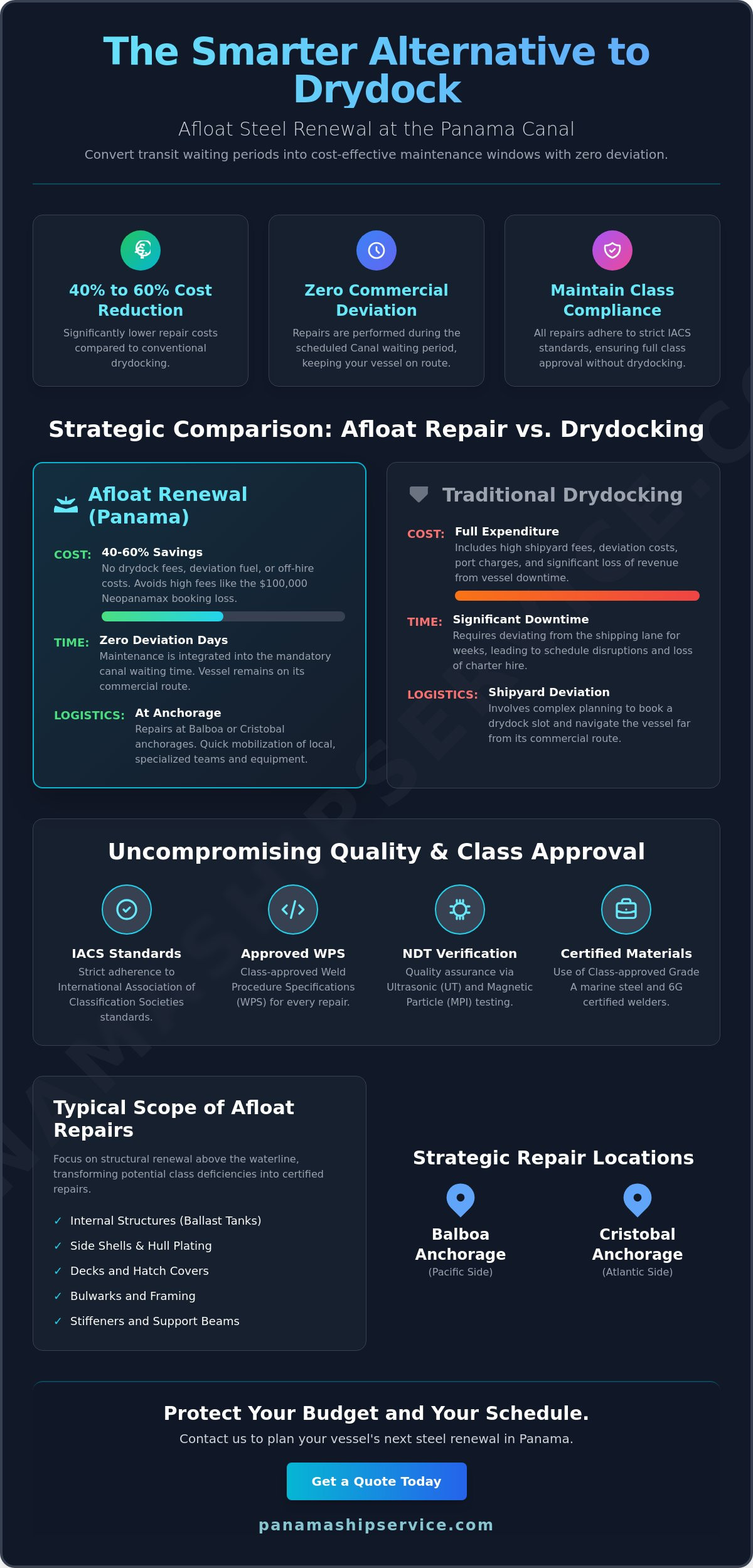
You know that every hour at anchor feels like a drain on your budget, especially when standard Neopanamax booking fees have reached $100,000 as of May 2026. This article shows you exactly how to execute critical structural repairs at canal anchorages to maintain class compliance without the expense of a drydock. We’ll examine the coordination between class surveyors and repair teams to ensure your vessel completes its steel renewal during the waiting period with zero deviation from your planned route.
Key Takeaways
- Convert transit waiting periods into productive maintenance windows by performing repairs without deviating from your commercial route.
- Discover the specific technical scope of afloat steel renewal panama, focusing on internal structures and side shells above the waterline.
- Maintain class compliance by adhering to IACS standards and utilizing approved Weld Procedure Specifications for all in-water structural work.
- Compare the total cost of ownership between afloat repairs and drydocking to see how you can protect your vessel’s operational budget.
- Identify the logistical differences between Balboa and Cristobal anchorages to streamline your repair schedule and equipment mobilization.
Understanding Afloat Steel Renewal in the Panama Canal Zone
Afloat steel renewal panama refers to the structural replacement of steel plates, stiffeners, and framing while a vessel remains at anchor or alongside a pier. This method bypasses the need for a drydock facility by focusing on areas such as internal tanks, decks, and side shells located above the waterline. By addressing localized corrosion or impact damage during a scheduled transit wait, operators prevent minor issues from escalating into major class deficiencies that could halt a voyage. It’s a strategic intervention that transforms unavoidable idle time into a period of high-value maintenance.
This proactive approach falls under the broader category of Ships husbandry, which encompasses the essential maintenance and repair tasks required to keep a vessel operational and compliant. In the high-pressure environment of the Panama Canal, where transit slots are expensive and tightly scheduled, performing these repairs afloat is a matter of fiscal responsibility. It eliminates the overhead of shipyard mobilization and keeps the vessel in the commercial lane. You don’t have to sacrifice your schedule to maintain your vessel’s structural integrity.
The Critical Role of Structural Integrity for Canal Transit
The Panama Canal Authority (ACP) maintains rigorous safety standards, recently updated in the OP Notice to Shipping No. N‑01‑2026. Any visible structural damage or significant wastage can trigger an inspection that delays your transit. Common problem areas include ballast tanks, hatch covers, and bulwarks. Identifying these “unforeseen” steel issues early allows for a repair plan that fits within the canal waiting period. Repairing these components afloat ensures the vessel meets the structural requirements for a safe transit without losing its position in the queue. It’s about being proactive rather than reactive when the ACP inspectors board.
Why Panama is the Ideal Location for Afloat Repairs
Panama serves as a strategic crossroads with a high concentration of specialized labor and class-certified materials. The proximity to major shipping lanes means repair teams can mobilize quickly to either the Balboa or Cristobal anchorages. There is a natural synergy between steel work and mechanical ship repairs in Panama. This allows owners to bundle multiple service requirements into a single stop. The availability of heavy-duty barges and specialized welding equipment ensures that even large-scale afloat steel renewal panama projects are handled with precision and speed. The logistics are already in place; you just need to activate the service.
Technical Standards and Class Approval for In-Water Repairs
Executing afloat steel renewal panama requires more than just skilled labor; it demands strict adherence to International Association of Classification Societies (IACS) standards. Class societies like ABS, Lloyd’s Register, and DNV don’t compromise on structural integrity just because a vessel isn’t in drydock. Every repair begins with a Class-approved Weld Procedure Specification (WPS). This document dictates the exact parameters for the repair, from the type of electrodes used to the specific welding sequence. Following these protocols ensures that the structural integrity of your vessel remains at the same level as a shipyard-based repair.
Quality assurance is verified through Non-Destructive Testing (NDT). Technicians use Ultrasonic Testing (UT) and Magnetic Particle Inspection (MPI) to ensure full penetration and the absence of surface defects. In the Panama Canal Zone, coordination with local class surveyors is a daily operational reality. Having a repair team that understands how to present work for final survey is the difference between a certified repair and a costly rework. If you need a professional assessment before starting work, our marine surveys in Panama provide the necessary technical baseline.
Certified Welding Procedures and Material Sourcing
High-quality repairs rely on certified Grade A marine steel. While global steel prices have fluctuated, with US hot-rolled coil reaching $1,002 per ton in early May 2026, sourcing the correct material remains non-negotiable for class approval. Welders must hold 6G certifications to handle the complex overhead and vertical positions common in ballast tanks or side shells. In Panama’s tropical climate, managing humidity is a critical technical challenge. Repair teams must implement controlled pre-heating cycles to ensure the steel remains dry and at the correct temperature to prevent hydrogen-induced cracking in the weld metal.
Safety Protocols for Hot Work at Anchor
Safety is the primary priority for any afloat project. Before a single torch is lit, a certified chemist must issue a Gas-Free certificate for any enclosed space entry. This is a mandatory requirement for tank renewals. During the afloat steel renewal panama process, a dedicated fire watch is stationed to monitor the surrounding environment and adjacent compartments. These protocols ensure that localized hot work doesn’t compromise the safety of the crew or the vessel’s cargo. For operators looking to streamline these complex logistics, coordinating with a local Canal transit agency helps manage both the technical and administrative requirements of the repair.
Afloat Steel Renewal vs. Drydocking: A Strategic Comparison
Technical managers often face a difficult choice when structural deficiencies are identified: schedule an immediate drydock or attempt an afloat repair. Analyzing the total cost of ownership (TCO) reveals that afloat steel renewal panama is the superior financial choice for most localized structural issues. Conventional drydocking carries massive overhead costs, including tug assistance, pilotage into the yard, and daily docking fees. By contrast, afloat repairs eliminate these expenses entirely. Research indicates that performing repairs in-water can reduce overall costs by 40 to 60 percent compared to a traditional shipyard stay. This saving isn’t just about the labor; it’s about the elimination of the logistical “dead time” associated with yard mobilization.
Logistical complexity also favors the afloat approach. In a shipyard scenario, you move the vessel to the repair team, which often requires significant deviation from commercial routes. With afloat renewal, the repair team, equipment, and certified steel plates come to your vessel while it sits at a Panama Canal anchorage. This allows you to maintain your position in the transit queue. There are, however, technical limits to this method. If the structural damage is extensive, located deep below the waterline, or involves the vessel’s keel, a drydock remains unavoidable. For internal tank work, deck plating, or side shell repairs above the waterline, the afloat method is the industry standard for efficiency.
Time-Saving Advantages for Busy Ship Operators
The primary advantage of afloat steel renewal panama is the elimination of off-hire time. Shipyards in the Caribbean or Pacific are often booked months in advance, forcing operators to wait for a slot while a minor deficiency worsens. Performing repairs while at anchor in Balboa or Cristobal allows for work to proceed during bunkering or cargo operations. Industry case studies show that localized steel renewal performed afloat saves an average of 10 to 15 days of off-hire time. In an era where Neopanamax booking fees can reach $200,000 for last-minute slots, you can’t afford to lose your transit window for a repair that could have been handled at anchor.
Cost-Benefit Analysis for Technical Managers
Daily anchorage fees in Panama are a fraction of the cost of shipyard docking fees. Utilizing local, Panama-based teams also reduces mobilization costs significantly. You aren’t paying to fly in specialized technicians; the expertise is already on the ground. Another hidden benefit is the avoidance of “scope creep.” Shipyard stays frequently result in unexpected “while we’re here” repairs that inflate the final invoice. Afloat repairs stay focused on the specific class-mandated renewal, allowing for tighter budget control. This focused approach ensures that your technical budget is spent on necessary structural integrity rather than shipyard overhead.
Logistics of Steel Renewal at Panama Anchorages
Executing a successful repair project in the Panama Canal Zone requires precise logistical coordination between the vessel, the repair team, and the Panama Canal Authority (ACP). Unlike a shipyard where infrastructure is fixed, afloat steel renewal panama relies on mobile workshops delivered via barge to your vessel’s location. This flexibility allows repairs to proceed without interrupting the vessel’s transit schedule, but it demands a deep understanding of the local maritime environment. From managing heavy equipment mobilization to navigating the seasonal weather patterns, the logistics determine the project’s timeline and success.
Weather is a primary factor for any hot work in Panama. The rainy season, which typically runs from May through December, presents unique challenges for welding operations. Specialized repair teams use heavy-duty tenting and localized enclosures to keep the work area dry. They also employ specialized heating equipment to manage the steel temperature, ensuring that the high humidity doesn’t compromise the weld’s integrity. These technical adjustments allow for consistent progress even during heavy tropical downpours.
Navigating Balboa and Cristobal Repair Zones
The choice of anchorage depends on your vessel’s route and the specific logistics of the project. Balboa, located on the Pacific side, is the logical choice for Northbound vessels. Its proximity to major port facilities makes it ideal for rapid equipment mobilization. Cristobal, on the Atlantic side, serves Southbound vessels and offers a different set of logistical advantages for Atlantic-side supply chains. Before work begins, the repair team must coordinate with the ACP to obtain the necessary permits for hot work at anchor. This administrative step is critical; without the correct ACP authorization, repairs can be halted, leading to the very delays you’re trying to avoid.
Mobilization and Equipment Logistics
Mobile repair barges act as the nerve center for afloat projects. These vessels carry everything from the certified steel plates to the industrial-grade welding machines and compressors. For afloat steel renewal panama, the barge must provide a continuous 24/7 supply of power and compressed air to the vessel’s repair site. This self-sufficiency ensures that the vessel’s own power systems remain dedicated to operational needs. Often, these structural repairs are performed in tandem with underwater hull services to maximize the maintenance window. This integrated approach allows technical managers to address both internal structural issues and external hull fouling in a single stop. To ensure your vessel remains compliant and on schedule, contact Panama Ship Service to coordinate your structural repairs.
Panama Ship Service: Your Partner for Efficient Steel Fabrication
Panama Ship Service operates as a comprehensive partner for technical managers who cannot afford the downtime associated with shipyard repairs. Our “One-Stop-Shop” model allows for the seamless execution of complex structural work while a vessel remains in the commercial lane. We specialize in high-volume steel fabrication and emergency repairs, providing a seasoned veteran’s perspective on every project. Because the Panama Canal operates around the clock, our teams maintain an operational rhythm that matches the urgency of your schedule. This ensures that repairs are completed during the inevitable waiting period at anchor, protecting your position in the transit queue.
Our track record with major global shipping lines and leading class societies is built on a foundation of reliability and technical proficiency. We understand the high-stakes nature of the maritime industry, where a single day of off-hire time can cost tens of thousands of dollars. By positioning ourselves as a localized and functional authority in this strategic hub, we allow owners to delegate technical complexity to us. This results in a simplified operational experience and measurable cost savings.
Our Fabrication and Welding Capabilities
Technical precision is the foundation of our steel services. We mobilize teams of certified welders and technicians who are equipped with state-of-the-art tools for precision cutting and fitting. Every afloat steel renewal panama project we undertake adheres to strict environmental standards. We maintain a rigorous commitment to environmental safety during all repair activities, ensuring that your vessel remains compliant with both international class societies and local regulations. Our equipment is specifically designed for the challenges of the maritime environment, allowing for high-quality results even in the humid conditions of the canal zone.
Consolidating Services to Minimize Canal Delays
Efficiency in the Panama Canal Zone is often a matter of logistical consolidation. Choosing a partner that handles multiple facets of ships husbandry reduces the administrative burden on your crew and shore-based staff. For instance, you can combine structural repairs with MARPOL disposal panama to clear waste streams while the steel work progresses. Our dedicated project managers handle the complex coordination with class surveyors, ensuring that every afloat steel renewal panama project is inspected and certified before your transit slot arrives.
The goal is always to finalize repairs within the planned transit window. We transform potential delays into productive maintenance stops, ensuring your vessel leaves Panama in better condition than it arrived. You don’t have to manage multiple vendors or navigate local regulations alone. Delegation of these tasks to our experienced team allows you to focus on your primary cargo operations while we secure the structural integrity of your fleet.
Secure Your Vessel’s Structural Integrity at Anchor
Maintaining structural integrity shouldn’t require a detour to a distant shipyard. By choosing afloat repairs, you leverage the canal’s waiting period to address corrosion or damage without losing your transit slot. This approach ensures your vessel remains in class while significantly reducing the total cost of ownership. You can avoid the high overhead of drydocking and keep your vessel in the commercial lane where it belongs. It’s the most effective way to protect your schedule and your operational budget during a high-stakes transit.
Panama Ship Service provides the technical expertise and logistical reach to handle these critical repairs at both Balboa and Cristobal anchorages. Our IACS certified welders and 24/7 emergency response team are ready to mobilize immediately to keep your fleet operational. Afloat steel renewal panama is the most efficient way to manage your technical budget while maintaining a strict voyage schedule. We handle the complex coordination with class surveyors so you can focus on cargo operations without unnecessary administrative burdens.
Request a fast-response quote for afloat steel renewal in Panama and secure your vessel’s structural performance today. Our team is ready to assist you with a professional and reliable solution.
Frequently Asked Questions
Is afloat steel renewal in Panama approved by major class societies?
Yes, afloat steel renewal panama is fully recognized by major classification societies like ABS, DNV, and Lloyd’s Register. The process requires a Class-approved Weld Procedure Specification (WPS) and a final inspection by a surveyor to confirm the repair meets international safety standards. By adhering to IACS protocols, these repairs maintain the vessel’s certification status without the need for a drydock stay.
What is the maximum thickness of steel that can be renewed afloat?
There is no fixed maximum thickness for afloat repairs, as capability depends on the structural location and Class society approval. Most projects involve standard marine grade steel plates ranging from 10mm to 25mm for decks and side shells. The repair team evaluates each project’s technical requirements to ensure that welding procedures and equipment are perfectly matched to the plate specifications.
Can steel renewal be performed while the vessel is loading or discharging cargo?
Steel renewal can often proceed during cargo operations provided all safety protocols for hot work are strictly followed. This requires precise coordination between the repair team and the vessel’s officers to maintain safe distances from venting systems or flammable materials. Performing these tasks alongside cargo handling is a primary strategy for ship operators to eliminate off-hire time and maximize efficiency.
How long does a typical afloat steel renewal project take in Panama?
A typical project is often scheduled to coincide with the vessel’s canal waiting period, which usually spans three to five days. Smaller localized renewals can be completed within 48 hours, while more extensive internal structural work might require additional time. The exact duration depends on the total tonnage of steel being replaced and the complexity of the internal access required for the repair team.
What documents are required by the ACP for repairs at anchor?
The Panama Canal Authority (ACP) requires a formal notification of repair and a valid hot work permit for any welding conducted at anchor. Operators must also provide a safety plan and, in specific cases, a chemist’s certificate for tank entries. These regulations, updated in the OP Notice to Shipping No. N‑01‑2026, ensure that maintenance activities don’t interfere with canal traffic or safety.
Does Panama Ship Service provide gas-free certificates for tank repairs?
Panama Ship Service coordinates the necessary safety inspections, though gas-free certificates must be issued by an authorized chemist according to local regulations. We manage the logistics of getting these certified professionals on board to perform atmospheric testing. This ensures that all tanks are safe for entry and hot work before our specialized repair teams begin the afloat steel renewal panama process.
Can you perform afloat steel renewal at both Balboa and Cristobal anchorages?
Yes, we provide full repair services at both the Balboa (Pacific) and Cristobal (Atlantic) anchorages. Our mobile repair barges and launch services are strategically positioned to mobilize to either side of the canal quickly. This flexibility allows technical managers to schedule repairs based on the vessel’s specific direction of transit and its commercial cargo requirements.
How do you ensure welding quality in the high humidity of Panama?
Welding quality in tropical humidity is maintained through controlled pre-heating and the use of specialized, moisture-resistant electrodes. Technicians use industrial-grade tenting and enclosures to protect the weld site from tropical rain and salt spray. These measures, combined with Non-Destructive Testing (NDT) such as ultrasonic inspections, ensure that the final weld meets the rigorous standards required for class certification.