
A smooth transit through the Panama Canal is a matter of precision, but a single MARPOL compliance issue can bring your schedule to a grinding halt. The threat of massive, unexpected fines from Panamanian authorities is a serious operational risk, and the resulting vessel detentions can cause catastrophic delays. For ship owners and charterers, the key to success is avoiding MARPOL fines in Panama, yet uncertainty over local enforcement priorities and the difficulty in finding reliable partners for waste disposal often create a difficult and frustrating environment. This is a high-stakes challenge where you cannot afford any missteps.
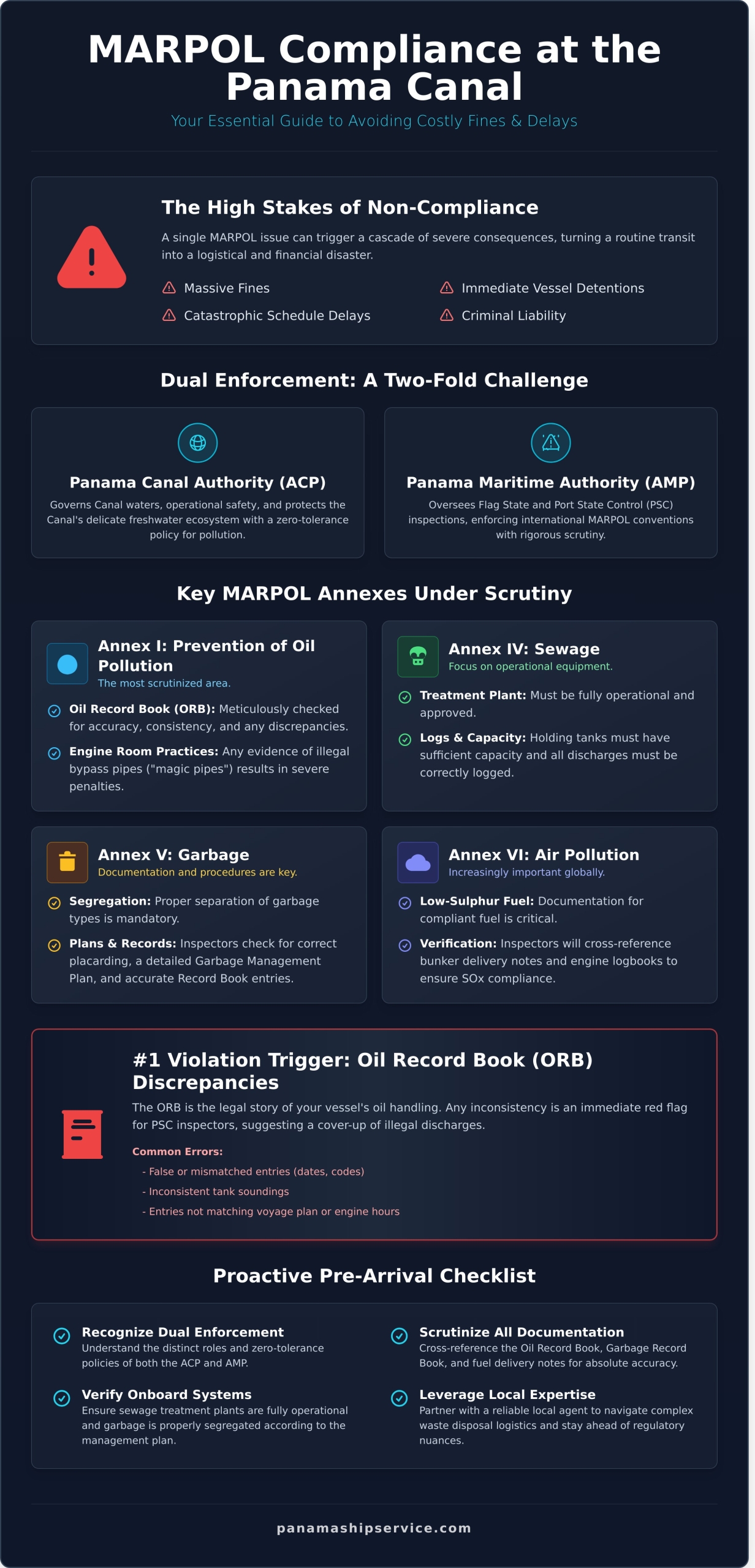
This practical guide is your expert solution. We cut through the complexity to provide a clear, step-by-step plan for guaranteed MARPOL compliance. You will learn the most common violations to watch for, understand exactly how to prepare your documentation and onboard procedures, and gain the confidence needed for a seamless inspection process. Implement these proven strategies to prevent costly penalties and ensure your vessel moves through the Canal efficiently and without delay, transforming uncertainty into operational confidence.
Key Takeaways
- Recognize that both the ACP and AMP enforce strict MARPOL regulations, subjecting vessels to heightened scrutiny and zero tolerance for non-compliance at the Panama Canal.
- Identify the most frequent and easily overlooked non-compliance issues-from documentation errors to waste management-that consistently trigger costly penalties in Panamanian waters.
- Implement a proactive pre-arrival checklist to ensure all documentation and onboard systems are in order, a critical step for avoiding MARPOL fines in panama.
- Leverage local expertise to navigate complex waste disposal logistics and regulatory requirements, ensuring a smooth, efficient, and delay-free transit.
The High Stakes: MARPOL Enforcement at the Panama Canal
Transiting the Panama Canal is a critical operational milestone, but it is also a moment of intense regulatory scrutiny. Compliance with the International Convention for the Prevention of Pollution from Ships (MARPOL) is not merely a suggestion here-it is a strict requirement enforced by two powerful entities: the Panama Canal Authority (ACP) and the Panama Maritime Authority (AMP). While the ACP governs the Canal’s waters and operational safety, the AMP oversees flag state and port state control inspections. A misstep with either can turn a routine transit into a costly logistical nightmare. For ship owners and operators, understanding this dual enforcement landscape is the first critical step in avoiding MARPOL fines in panama.
The consequences of non-compliance extend far beyond monetary penalties. A MARPOL violation can lead to immediate vessel detention, disrupting tight schedules and leading to significant demurrage costs. In severe cases, responsible crew members and even company executives can face criminal liability. Furthermore, the reputational damage from an environmental violation can impact future charter opportunities and insurance premiums. In this high-stakes environment, even a minor clerical error in a logbook or a poorly maintained piece of equipment can trigger a full-scale inspection, proving that effective preparation is essential for avoiding MARPOL fines in panama and safeguarding your operations.
Why Panama is a Compliance Hotspot
The Canal’s status as a global maritime chokepoint guarantees a high volume of traffic, which naturally leads to a greater number of inspections. Its proximity to the United States means that US Coast Guard enforcement standards heavily influence local inspection protocols, creating a zero-tolerance culture for violations. Most importantly, the ACP is the vigilant guardian of the Canal’s delicate freshwater ecosystem, making pollution prevention its absolute top priority.
Key MARPOL Annexes Under Scrutiny in Panama
While all MARPOL regulations are in force, inspectors in Panama place particular emphasis on annexes with a direct and visible environmental impact. Our expert teams see consistent focus on the following:
- Annex I (Oil): Inspectors meticulously review the Oil Record Book (ORB) for accuracy and consistency. Any discrepancies or signs of improper engine room practices, such as illegal bypass pipes (“magic pipes”), will result in severe penalties.
- Annex IV (Sewage): Vessels must have a fully operational and approved sewage treatment plant or a holding tank with sufficient capacity. All discharge procedures must be correctly logged and adhere to Canal regulations.
- Annex V (Garbage): Proper segregation of garbage is mandatory. Inspectors will check for correct placarding, a detailed Garbage Management Plan, and accurate entries in the Garbage Record Book.
- Annex VI (Air Pollution): With global emissions standards tightening, documentation for low-sulphur fuel is critical. Inspectors will verify bunker delivery notes and engine logbooks to ensure compliance with SOx emission limits.
Common Violations That Trigger Fines in Panamanian Waters
In the high-traffic waters of the Panama Canal, Port State Control (PSC) inspections are rigorous and frequent. For Masters and Chief Engineers, understanding the most common MARPOL violations is the first and most critical step in avoiding MARPOL fines in Panama. These issues are rarely complex; they are typically the result of procedural oversights, poor record-keeping, or inadequate crew training.
This is your guide to what Panamanian authorities watch for, ensuring your vessel is prepared for inspection and avoids costly delays.
Oil Record Book (ORB) Discrepancies
The Oil Record Book is the single most scrutinized document during a MARPOL inspection. It serves as the legal record of your vessel’s oil and sludge handling. Discrepancies are the number one cause of PSC detentions worldwide because they immediately suggest a cover-up of illegal discharges. PSC inspectors cross-reference the ORB with everything from engine running hours to tank soundings. Key errors include:
- False Entries: Mismatched dates, incorrect codes for discharge operations, or entries that do not align with the vessel’s voyage plan.
- Inconsistent Soundings: Recorded sludge or bilge water tank levels that do not match the inspector’s physical measurements.
- ‘Magic Pipe’ Evidence: Any sign of a non-standard bypass pipe or hose in the engine room, even if disconnected, will trigger an in-depth investigation.
Improper Garbage Management (Annex V)
Compliance with Annex V of the main international convention for pollution prevention is not optional, and PSC inspectors check it carefully. Violations often stem from a lack of onboard discipline and outdated procedures. Common failures include incorrect segregation of plastics from food waste, an outdated or non-existent Garbage Management Plan, and an incomplete Garbage Record Book. Inspectors will also verify that proper placards are displayed and that the crew is trained on correct disposal procedures.
Sewage and Oily Water Separator (OWS) Issues
Your vessel’s pollution prevention equipment must be fully operational and maintained to the highest standard. PSC inspectors will verify not just the equipment’s condition but also the crew’s ability to operate it correctly. A failure here demonstrates a direct risk to the marine environment and undermines all efforts in avoiding MARPOL fines in Panama. Watch out for:
- Bypassed Alarms: Tampering with the OWS 15 ppm alarm or oil content meter is a severe violation.
- Non-Functional Systems: Inoperable sewage treatment plants or OWS systems that cannot be demonstrated to work will lead to detention.
- Missing Records & Competency: A lack of maintenance logs, missing spare parts for critical equipment, or a crew unable to explain the system’s operation indicates systemic neglect.
Pre-Arrival Checklist: A Proactive Approach to Compliance
Successful transit through the Panama Canal is not a matter of luck; it is the result of meticulous preparation. Your vessel’s first line of defense against costly penalties is a robust pre-arrival verification process. Implementing this checklist is the most effective operational strategy for avoiding MARPOL fines in Panama, ensuring a smooth and efficient passage.
Documentation and Record Review
Inspectors from the Panama Canal Authority (ACP) scrutinize vessel records with an expert eye. Any inconsistency is a major red flag. Before arrival, your senior officers must conduct a thorough audit of all MARPOL-related paperwork.
- Audit Record Books: Scrutinize the Oil Record Book (ORB) Parts I & II and the Garbage Record Book. Ensure all entries are accurate, chronological, and consistent with tank soundings, sludge disposal receipts, and incinerator logs.
- Verify Certificates: Confirm all MARPOL certificates are valid, onboard, and readily accessible. This includes the International Oil Pollution Prevention (IOPP), International Sewage Pollution Prevention (ISPP), and International Air Pollution Prevention (IAPP) certificates.
- Update Emergency Plans: Ensure the Shipboard Oil Pollution Emergency Plan (SOPEP) or SMPEP is updated and specific to the vessel. The plan must be fully compliant with the standards outlined in the official Panama Canal Regulations, which define MARPOL 73/78 applicability for the waterway.
Onboard Equipment and Systems Check
Functioning equipment is non-negotiable. A last-minute failure can lead to significant delays and fines. A pre-arrival function test of all critical systems is an essential risk-mitigation step.
- Test the OWS: Run the Oily Water Separator (OWS) and test its 15 ppm alarm and automatic stopping device. Log the test in the ORB and ensure the system is clean and properly maintained.
- Inspect Sewage Treatment Plant: Verify the proper operation of the sewage treatment plant and any comminuting systems to ensure effluent standards are consistently met.
- Confirm Placards: Walk the vessel to confirm all required MARPOL Annex V placards are correctly displayed in prominent locations-including the galley, deck areas, and engine room-in the working language of the crew.
Crew Briefing and Training
Your crew is the most critical element in maintaining compliance. Well-trained personnel who understand the high-stakes environment of the Canal are fundamental to a successful transit.
- Conduct Pre-Arrival Meeting: Hold a mandatory briefing focused on MARPOL procedures specific to Panama’s waters, including restrictions on discharges within the Canal Zone.
- Drill Emergency Response: Drill the crew on their specific responsibilities under the SOPEP. Ensure every relevant crew member knows the procedure for reporting a spill and initiating containment.
- Reinforce Zero-Tolerance Policy: Clearly communicate the company’s absolute zero-tolerance policy for illegal discharges, emphasizing the severe personal and corporate consequences of non-compliance.
A proactive audit can identify blind spots in your preparation. For complete peace of mind and an expert, third-party assessment, our qualified team is ready to assist. Need an expert review? Our surveyors can perform a pre-arrival audit.
Managing Waste Disposal: Your Critical Link to Compliance in Panama
In the high-stakes environment of the Panama Canal, proper waste disposal is not a recommendation; it is a non-negotiable requirement for maintaining a clean operational record. Mismanagement of sludge, slops, or garbage is one of the fastest ways to incur penalties, operational delays, and scrutiny from Port State Control (PSC). Successfully avoiding MARPOL fines in Panama hinges directly on how you manage your vessel’s waste streams from start to finish.
Arranging disposal at the Canal presents unique logistical challenges. Tight transit schedules and limited anchorage times demand an efficient, well-coordinated service. Any delay or error by a disposal provider can have a cascading effect, jeopardizing your vessel’s schedule and budget. This is where the distinction between a low-cost, uncertified operator and a professional partner becomes critically clear.
The Process for Sludge, Slops, and Garbage Removal
Executing a compliant disposal requires precision. For sludge and slops, barge services must be scheduled well in advance, coordinated with your agent to align with your vessel’s itinerary. For garbage, strict segregation is enforced. Waste must be separated into categories (e.g., plastics, food waste, operational waste) and secured in specific, color-coded bags. Upon completion, the most critical step is receiving official receipts and a certificate of disposal from the provider, as this documentation is your proof of compliance for PSC inspectors.
Selecting a Certified MARPOL Service Provider
Your choice of disposal partner is a direct reflection of your commitment to compliance. The risks of using uncertified, ‘cheap’ providers are immense, ranging from fraudulent paperwork to illegal dumping, which can lead to severe legal and financial repercussions. A professional partner provides not just a service, but a verifiable paper trail and complete peace of mind.
When selecting a provider, look for:
- AMP Certification: Ensure they are fully licensed and approved by the Panama Maritime Authority (AMP).
- Proven Track Record: Look for an established company with extensive experience at the Canal.
- Clear Communication: Your partner must provide constant updates and transparent documentation.
A reliable expert ensures every step is documented correctly, giving you the evidence needed to satisfy any inspection. This proactive approach is fundamental to avoiding MARPOL fines in Panama and protecting your operations. Don’t leave your compliance to chance. Ensure compliance. Schedule your MARPOL disposal with Panama Ship Service.
Panama Ship Service: Your Trusted Partner for a Smooth Transit
Navigating the complex regulatory landscape of the Panama Canal requires more than just adherence to international standards; it demands specialized local expertise. Misinterpreting a local directive or failing to meet the precise expectations of Panamanian authorities can lead to significant delays and costly penalties. At Panama Ship Service, we provide the expert guidance and on-the-ground support necessary for avoiding MARPOL fines in Panama. We are not just a vendor; we are your strategic partner, dedicated to ensuring your vessel’s transit is compliant, efficient, and trouble-free.
Deep Local Knowledge of ACP and AMP Procedures
Our team possesses an in-depth, practical understanding of the procedures set forth by the Panama Canal Authority (ACP) and the Panama Maritime Authority (AMP). This is not theoretical knowledge-it is built on years of daily interaction and successful operations. We know what local inspectors look for and how to prepare your vessel and crew for a smooth inspection process.
- Proactive Coordination: We maintain strong professional relationships with port authorities, allowing for efficient scheduling and clear communication.
- Regulatory Insight: Our experts stay constantly updated on the latest regulatory amendments and enforcement trends affecting Canal transit.
- Inspection Preparedness: We ensure your documentation and onboard procedures align perfectly with local expectations, minimizing the risk of non-compliance.
A One-Stop-Shop for All Your Compliance Needs
True compliance extends beyond waste disposal. A successful transit depends on the overall condition and readiness of your vessel. Panama Ship Service offers a comprehensive suite of solutions designed to address every potential need. By consolidating your services with a single, trusted provider, you reduce administrative burdens and eliminate the risk of miscommunication between multiple vendors.
- Integrated Services: Beyond MARPOL disposal, we provide critical services including bunker surveys, technical repairs, and essential supplies.
- Streamlined Operations: One point of contact means simplified logistics, invoicing, and reporting for your team.
- Holistic Support: Our primary objective is to ensure your vessel is fully prepared for a seamless and efficient passage, from arrival to departure.
Put your transit in our hands. Choosing Panama Ship Service means choosing peace of mind. We mitigate your operational risk, save your crew valuable time, and protect your bottom line by ensuring every detail is managed with expert precision. For ship owners and charterers focused on avoiding MARPOL fines in Panama and guaranteeing a smooth operation, we are the definitive solution. Contact us today to learn how our expert team can support your next transit.
Secure Your Smooth Transit: Partner with Panama’s MARPOL Experts
Navigating the Panama Canal demands meticulous attention to MARPOL regulations. The financial and operational risks of non-compliance are significant, making proactive preparation-from rigorous pre-arrival checks to flawless waste disposal management-absolutely critical. A comprehensive, expert-led strategy is the most effective approach for avoiding MARPOL fines in panama and protecting your vessel’s schedule and budget.
Don’t leave compliance to chance. For over 20 years, Panama Ship Service has been the trusted partner for leading ship owners and managers at the Canal. As a fully certified provider by the Panama Maritime Authority (AMP), we deliver the expert solutions required for a seamless passage. We are the experts so you don’t have to be.
Contact us today to schedule your MARPOL services and ensure a fine-free transit. Put your vessel in capable hands and navigate Panamanian waters with confidence.
Frequently Asked Questions About MARPOL Compliance in Panama
What are the most common reasons for a Port State Control (PSC) detention in Panama?
PSC detentions in Panama frequently stem from MARPOL-related deficiencies. The most common issues involve discrepancies in the Oil Record Book (ORB), inoperable or bypassed Oily Water Separators (OWS), and improper garbage management, including incorrect segregation and record-keeping. Defective fire-fighting and life-saving appliances are also major reasons for detention. Ensuring all equipment is functional and records are meticulously maintained is critical for a smooth inspection and avoiding costly delays at the Panama Canal.
Can we discharge treated sewage within Panama Canal waters?
No. The discharge of any treated or untreated sewage is strictly prohibited within Panama Canal waters, including anchorages and terminal ports. The Panama Canal Authority (ACP) enforces a zero-discharge policy, which is more stringent than the standard MARPOL Annex IV regulations. All sewage holding tanks must be sealed or secured before entering Canal waters to prevent accidental discharge. Vessels must have sufficient holding capacity or arrange for disposal services well in advance of transit.
What kind of MARPOL records do Panamanian inspectors focus on the most?
Panamanian inspectors place significant emphasis on the Oil Record Book (ORB Part I & II) and the Garbage Record Book. They meticulously cross-reference entries with tank soundings, engine room logs, and the physical state of pollution prevention equipment. Any inconsistencies, such as missing entries, unrealistic sludge production figures, or discrepancies between recorded and actual garbage quantities, are immediate red flags. Accurate and transparent record-keeping is a cornerstone of avoiding MARPOL fines in panama.
How far in advance should we schedule sludge or garbage disposal services?
To ensure timely and efficient service, we recommend scheduling sludge or garbage disposal at least 48 to 72 hours prior to your vessel’s arrival at a Panamanian port or anchorage. For large quantities or specialized waste disposal requirements, providing even more advance notice is advisable. This allows for proper coordination of barges, trucks, and necessary documentation, preventing potential delays to your vessel’s transit schedule and ensuring full MARPOL compliance before inspection.
What happens if a MARPOL violation is found during an inspection in Panama?
If a MARPOL violation is discovered, the Panama Maritime Authority (AMP) will likely issue a deficiency and may detain the vessel until the issue is rectified. This is followed by significant monetary fines, which can escalate based on the severity of the violation. In serious cases, such as deliberate illegal discharge, criminal proceedings may be initiated against the vessel’s owners and crew. Prompt and effective corrective action is critical to minimizing both the financial impact and operational downtime.
Are the MARPOL regulations enforced differently on the Atlantic vs. Pacific side of the Canal?
The core MARPOL regulations and Panama Canal Authority (ACP) rules are enforced with equal stringency on both the Atlantic and Pacific sides. While inspection teams may vary, the standards and protocols for Port State Control remain uniform. Vessels should expect the same high level of scrutiny at Balboa and Cristobal. The key to avoiding MARPOL fines in panama is maintaining consistent compliance throughout your entire passage, regardless of which side you enter or anchor on.